


 |
TTP521S - Transport Policy And Planning - 1st Opp - Nov 2025 |
|
|
1 Page 1 |
▲back to top |
nAmlBIA unlVERSITY
OF SCIEnCE RnD TECHnOLOGY
FACULTY OF COMMERCE, HUMAN SCIENCBAND EDUCATION
DEPARTMENT OF MARKETING, LOGISTICS AND SPORTS MANAGEMENT
QUALIFICATION: BACHELOR OF TRANSPORT MANAGEMENT
QUALIFICATION CODE: 07BTRA LEVEL: 5
COURSE CODE: TTP521 S
COURSE NAME: TRANSPORT POLICY AND
PLANNING
SESSION: NOVEMBER 2025
DURATION: 3 HOURS
PAPER: THEORY
MARKS: 100
FIRST OPPORTUNITY EXAMINATION QUESTION PAPER
EXAMINER(S) Dr Helvi Petrus
Mr. Oscar Kaveru
Mr Zenzo Moye
MODERATOR:
Prof Smart Dumba
INSTRUCTIONS
1. Answer all questions.
2. Read all the questions carefully before answering.
3. Number the answers clearly.
4. Give special attention to the manuscript instructions.
THIS QUESTION PAPER CONSISTS OF 6 PAGES (Including this front page)
Page 1 of6
|
|
2 Page 2 |
▲back to top |
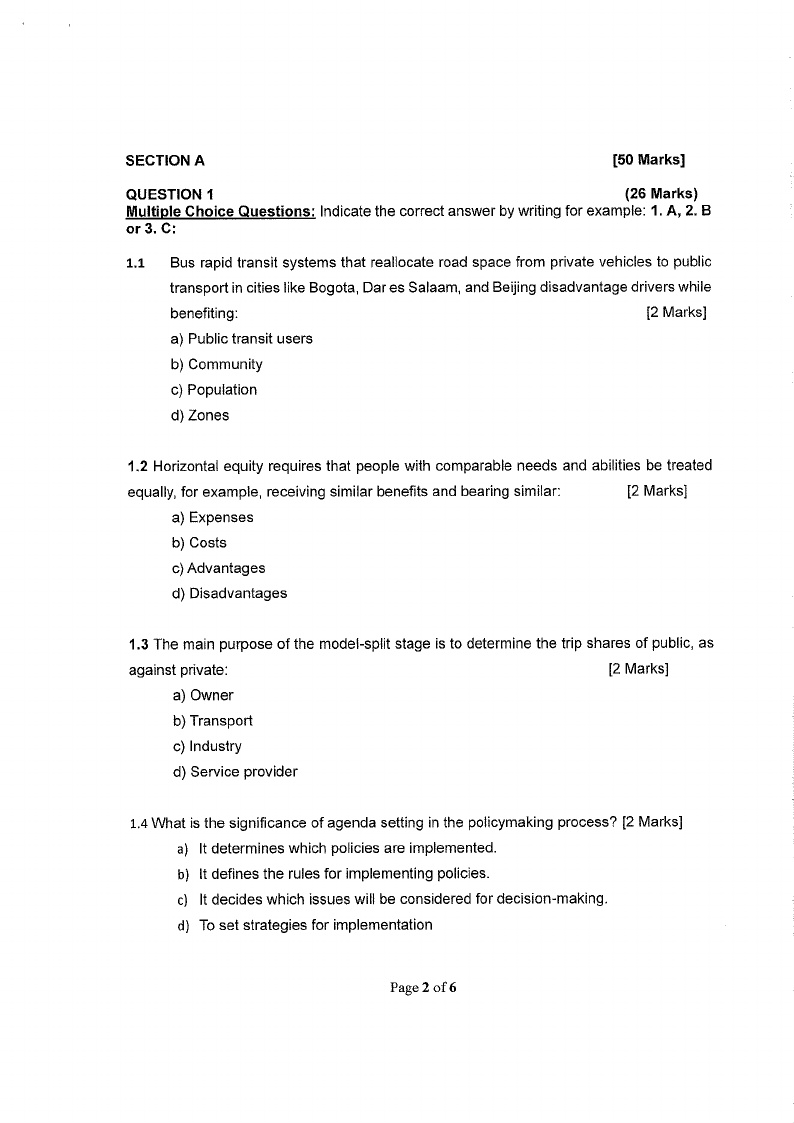
SECTION A
[50 Marks]
QUESTION 1
(26 Marks)
Multiple Choice Questions: Indicate the correct answer by writing for example: 1. A, 2. B
or 3. C:
1.1 Bus rapid transit systems that reallocate road space from private vehicles to public
transport in cities like Bogota, Dar es Salaam, and Beijing disadvantage drivers while
benefiting:
[2 Marks]
a) Public transit users
b) Community
c) Population
d) Zones
1.2 Horizontal equity requires that people with comparable needs and abilities be treated
equally, for example, receiving similar benefits and bearing similar:
[2 Marks]
a) Expenses
b) Costs
c) Advantages
d) Disadvantages
1.3 The main purpose of the model-split stage is to determine the trip shares of public, as
against private:
[2 Marks]
a) Owner
b) Transport
c) Industry
d) Service provider
1.4 What is the significance of agenda setting in the policymaking process? [2 Marks]
a) It determines which policies are implemented.
b) It defines the rules for implementing policies.
c) It decides which issues will be considered for decision-making.
d) To set strategies for implementation
Page 2 of6
|
|
3 Page 3 |
▲back to top |
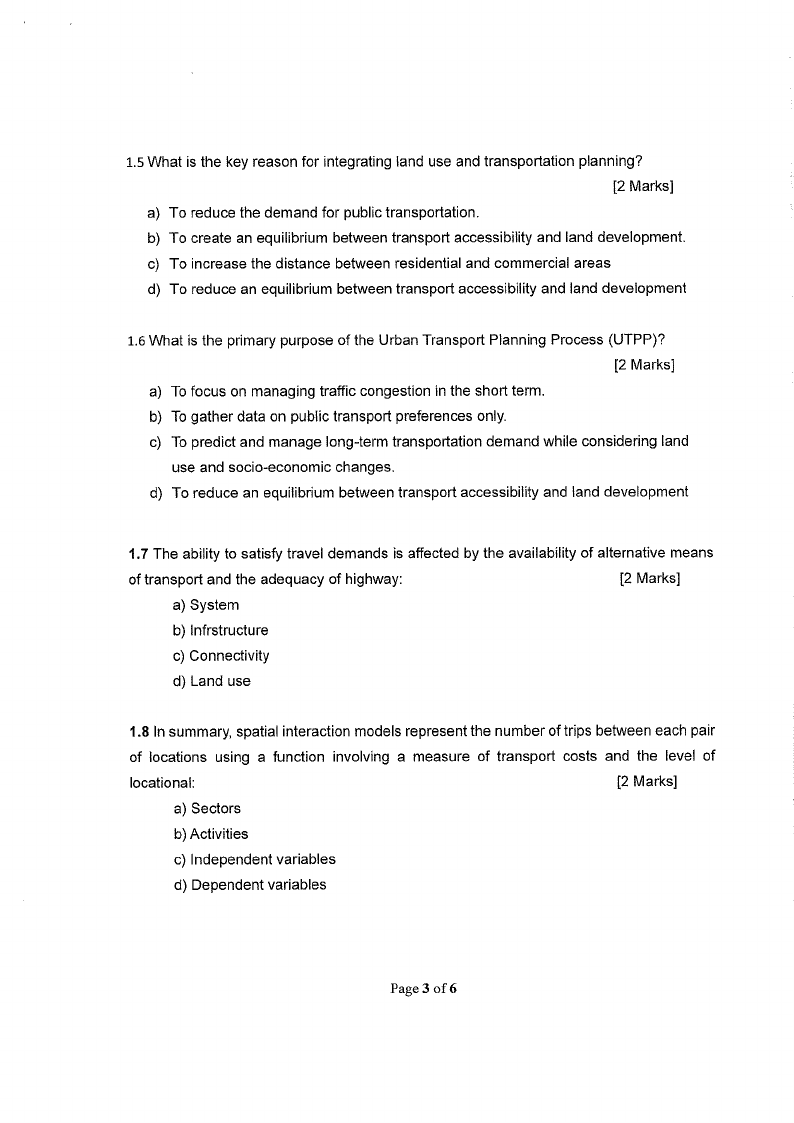
1.5 What is the key reason for integrating land use and transportation planning?
[2 Marks]
a) To reduce the demand for public transportation.
b) To create an equilibrium between transport accessibility and land development.
c) To increase the distance between residential and commercial areas
d) To reduce an equilibrium between transport accessibility and land development
1.6 What is the primary purpose of the Urban Transport Planning Process (UTPP)?
[2 Marks]
a) To focus on managing traffic congestion in the short term.
b) To gather data on public transport preferences only.
c) To predict and manage long-term transportation demand while considering land
use and socio-economic changes.
d) To reduce an equilibrium between transport accessibility and land development
1.7 The ability to satisfy travel demands is affected by the availability of alternative means
of transport and the adequacy of highway:
[2 Marks]
a) System
b) lnfrstructure
c) Connectivity
d) Land use
1.8 In summary, spatial interaction models represent the number of trips between each pair
of locations using a function involving a measure of transport costs and the level of
locational:
[2 Marks]
a) Sectors
b) Activities
c) Independent variables
d) Dependent variables
Page 3 of6
|
|
4 Page 4 |
▲back to top |
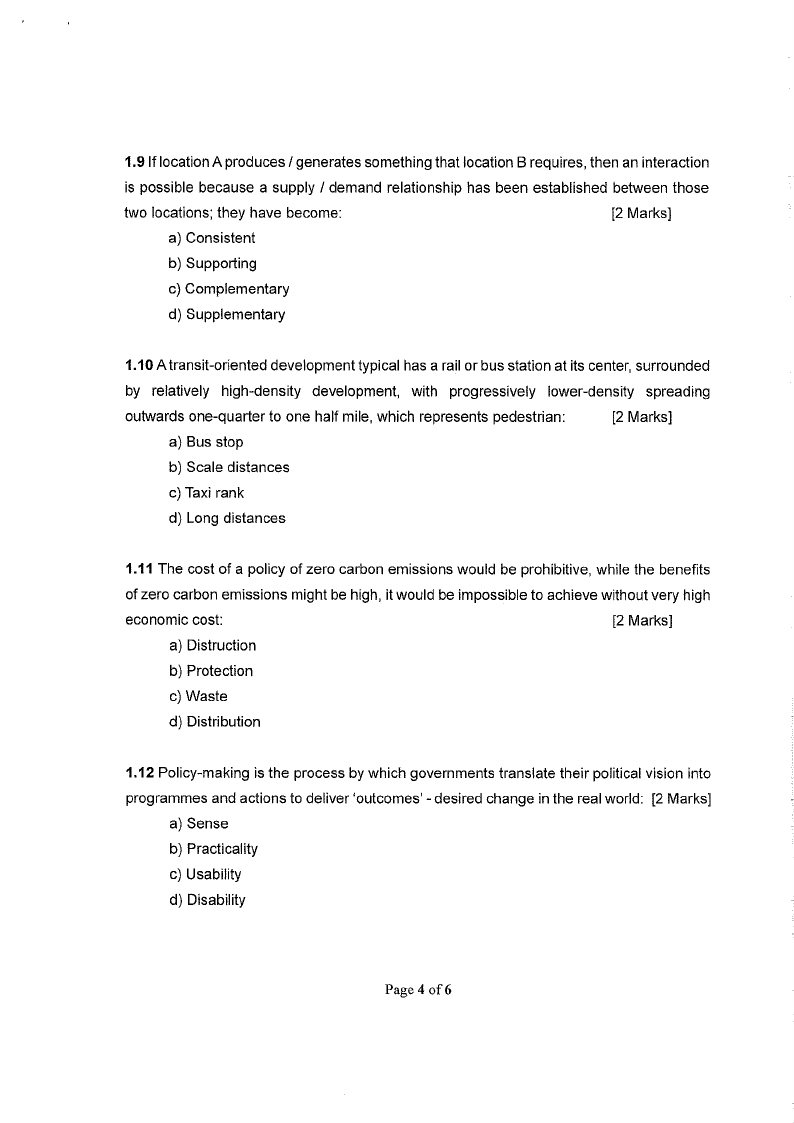
1.9 If location A produces/ generates something that location B requires, then an interaction
is possible because a supply / demand relationship has been established between those
two locations; they have become:
[2 Marks]
a) Consistent
b) Supporting
c) Complementary
d) Supplementary
1.10 A transit-oriented development typical has a rail or bus station at its center, surrounded
by relatively high-density development, with progressively lower-density spreading
outwards one-quarter to one half mile, which represents pedestrian:
[2 Marks]
a) Bus stop
b) Scale distances
c) Taxi rank
d) Long distances
1.11 The cost of a policy of zero carbon emissions would be prohibitive, while the benefits
of zero carbon emissions might be high, it would be impossible to achieve without very high
economic cost:
[2 Marks]
a) Distruction
b) Protection
c) Waste
d) Distribution
1.12 Policy-making is the process by which governments translate their political vision into
programmes and actions to deliver 'outcomes' - desired change in the real world: [2 Marks]
a) Sense
b) Practicality
c) Usability
d) Disability
Page 4 of6
|
|
5 Page 5 |
▲back to top |
1.13 Thus, in 1964, Curitiba prepared a new plan, the Preliminary Urban Development
Plan, which evolved over the next 2 years to become the "Curitiba Master Plan," and
which has guided city development for the last:
[2 Marks]
a) 30 years
b) 35 years
c) 25 years
d) 33 Years
QUESTION 2
[24 Marks)
The following Statements are true or false. Write true (T) if the answer is correct or
false (F) if the answer is incorrect.
2.1 There is a higher propensity to travel in households with private vehicle than those
without.
[2 Marks]
2.2 Since travel is a function of human activity, it was found out that most trips are rarely
generated from home.
[2 Marks]
2.3 Cordon surveys-external, use direct interviews or pre-paid postcards at designated
survey points.
[2 Marks]
2.4 Trips generated by residential zones are treated inseparately from non-home end of a
trip.
[2 Marks]
2.5 Generally, for a more representative sample size interview; low density residential
areas can have a larger sample than a densely populated center.
[2 Marks]
2.6 Cordon surveys-external, is disadvantageous in that they reduce travel delay and
requires few enumerators.
[2 Marks]
2.7 Trip generation analysis should be done concurrently with trip purpose. [2 Marks]
2.8 A residential zone is rarely complementary to an employment zone because the first is
supplying workers while the second is supplying jobs.
[2 Marks]
2.9 The Lowry research model was an approach taken to investigate an urban form as
represented by a land-use model.
[2 Marks]
2.10 To support sustainable urban development, transportation planning must shift away
from a car-oriented mobility planning paradigm and toward an accessibility-based paradigm
that integrates land-use and transportation policies.
[2 Marks]
Page 5 of6
|
|
6 Page 6 |
▲back to top |
'I
2.11 Mobility and accessibility are rarely the two fundamental benefits transportation is
meant to achieve.
[2 Marks]
2.12 Although there are many land uses, some less significant are left as they do not have
notable effects.
[2 Marks]
SECTION B
QUESTION 3
(25 Marks)
Discuss the various typologies of policy. In your answer, explain the distinctions between
the following pairs of policy types (use relevant examples to illustrate the differences where
possible)?
3.1 Substantive vs Administrative Policy
[5 Marks]
3.2 Vertical vs Horizontal Policy
[5 Marks]
3.3 Reactive vs Proactive Policy
[5 Marks]
3.4 Current vs Future Policy
[5 Marks]
3.5 Formal vs Informal Policy
[5 Marks]
QUESTION 4
(25 Marks)
Discuss the key stages of the transport policy formulation wheel/cycle. Explain how each
stage contributes to developing and implementing effective transport policies?
TOTAL MARKS 100
THE END
Page 6 of6