


 |
TTP521S - Transport Policy And Planning - 2nd Opp - Nov 2025 |
|
|
1 Page 1 |
▲back to top |
nAmlBIA unlVERSITY
OF SCIEnCE Ano TECHnOLOGY
FACULTY OF COMMERCE, HUMAN SCIENCE AND EDUCATION
DEPARTMENT OF MARKETING, LOGISTICS AND SPORT MANAGEMENT
QUALIFICATION: BACHELOR OF TRANSPORT MANAGEMENT
QUALiFiCATION CODE: 07BTRA LEVEL: 5
COURSE CODE: TTP521S
COURSE NAME: TRANSPORT POLICY AND
PLANNING
SESSION: NOVEMBER 2025
DURATION: 3 HOURS
PAPER: THEORY
MARKS: 100
SECOND OPPORTUNITY EXAMINATION QUESTION PAPER
EXAMINER(S) Dr. Helvi Petrus
Mr. Oscar Kaveru
Mr. Zenzo Moyo
MODERATOR: Prof Smart Dumba
INSTRUCTIONS
1. Answer All questions.
2. Read all the questions carefully before answering.
3. Number the answers clearly.
4. Give specific attention to the manuscript instructions
THIS QUESTION PAPER CONSISTS OF 7 PAGES (Including this front page)
|
|
2 Page 2 |
▲back to top |
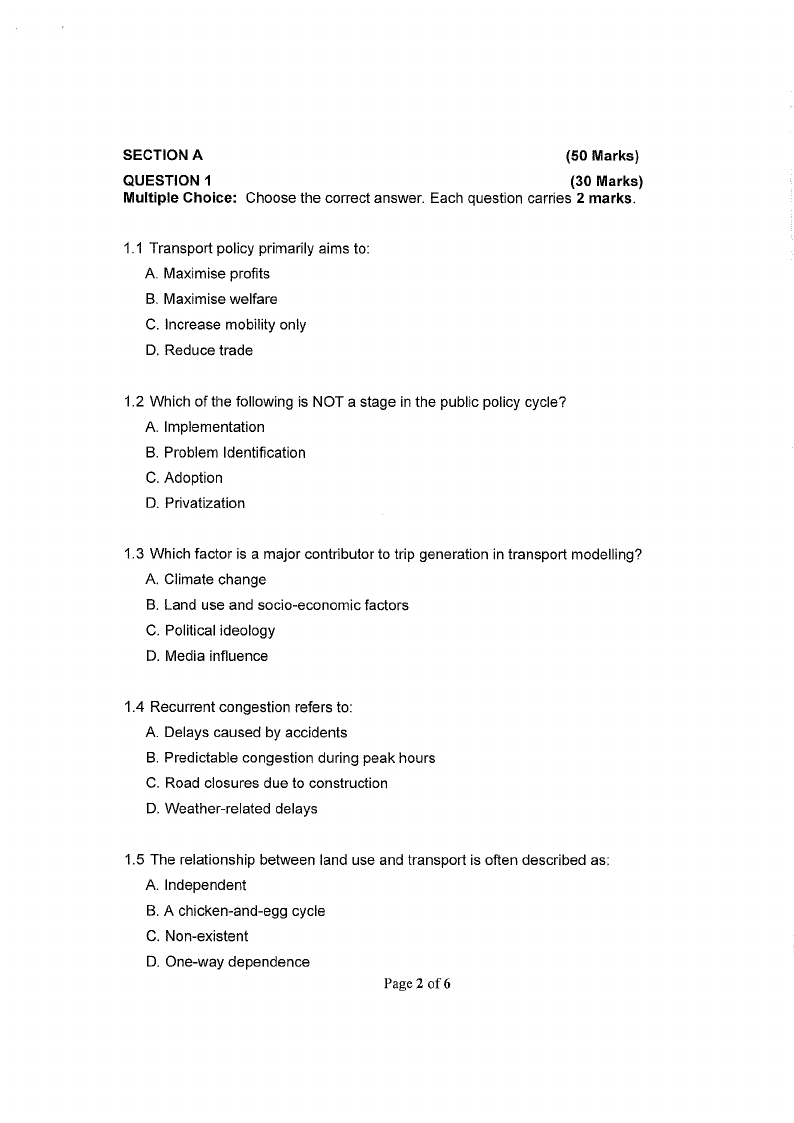
SECTION A
(50 Marks)
QUESTION 1
(30 Marks)
Multiple Choice: Choose the correct answer. Each question carries 2 marks.
1.1 Transport policy primarily aims to:
A. Maximise profits
B. Maximise welfare
C. Increase mobility only
D. Reduce trade
1.2 Which of the following is NOT a stage in the public policy cycle?
A. Implementation
B. Problem Identification
C. Adoption
D. Privatization
1.3 Which factor is a major contributor to trip generation in transport modelling?
A. Climate change
B. Land use and socio-economic factors
C. Political ideology
D. Media influence
1.4 Recurrent congestion refers to:
A. Delays caused by accidents
B. Predictable congestion during peak hours
C. Road closures due to construction
D. Weather-related delays
1.5 The relationship between land use and transport is often described as:
A. Independent
B. A chicken-and-egg cycle
C. Non-existent
D. One-way dependence
Page 2 of6
|
|
3 Page 3 |
▲back to top |
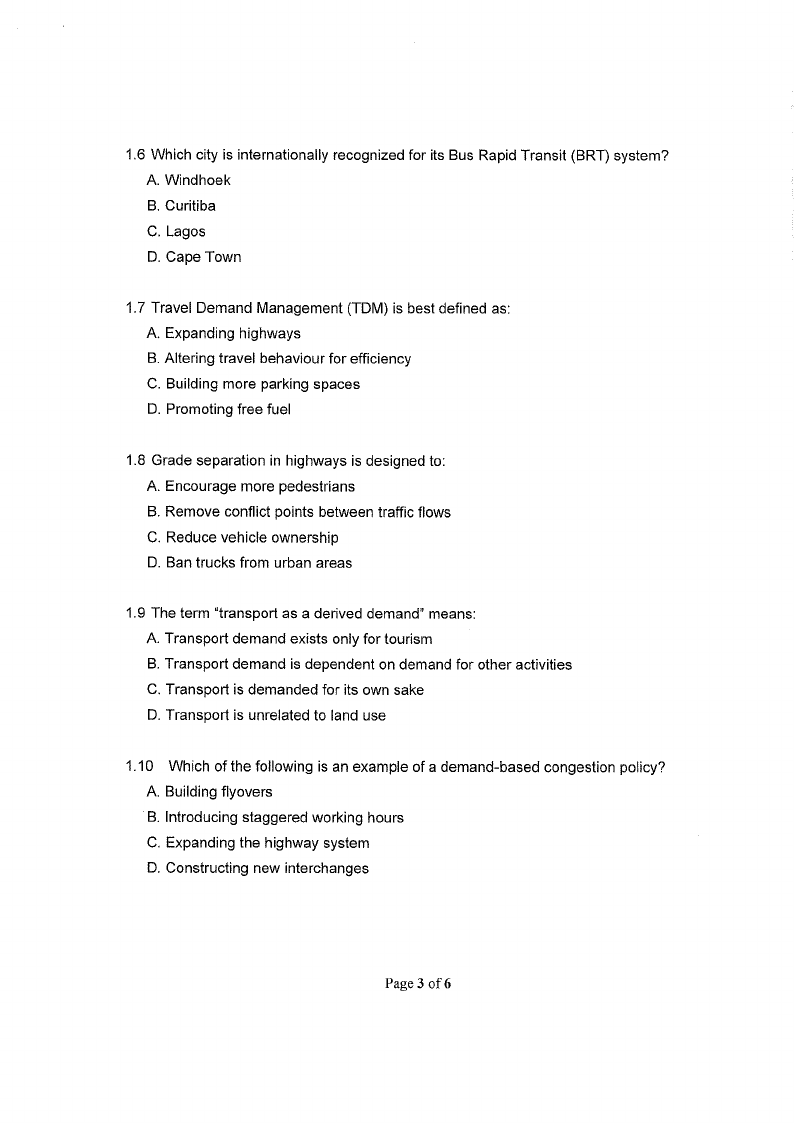
1.6 Which city is internationally recognized for its Bus Rapid Transit (BRT) system?
A. Windhoek
B. Curitiba
C. Lagos
D. Cape Town
1.7 Travel Demand Management (TOM) is best defined as:
A. Expanding highways
B. Altering travel behaviour for efficiency
C. Building more parking spaces
D. Promoting free fuel
1.8 Grade separation in highways is designed to:
A. Encourage more pedestrians
B. Remove conflict points between traffic flows
C. Reduce vehicle ownership
D. Ban trucks from urban areas
1.9 The term "transport as a derived demand" means:
A. Transport demand exists only for tourism
B. Transport demand is dependent on demand for other activities
C. Transport is demanded for its own sake
D. Transport is unrelated to land use
1.10 Which of the following is an example of a demand-based congestion policy?
A. Building flyovers
B. Introducing staggered working hours
C. Expanding the highway system
D. Constructing new interchanges
Page 3 of6
|
|
4 Page 4 |
▲back to top |
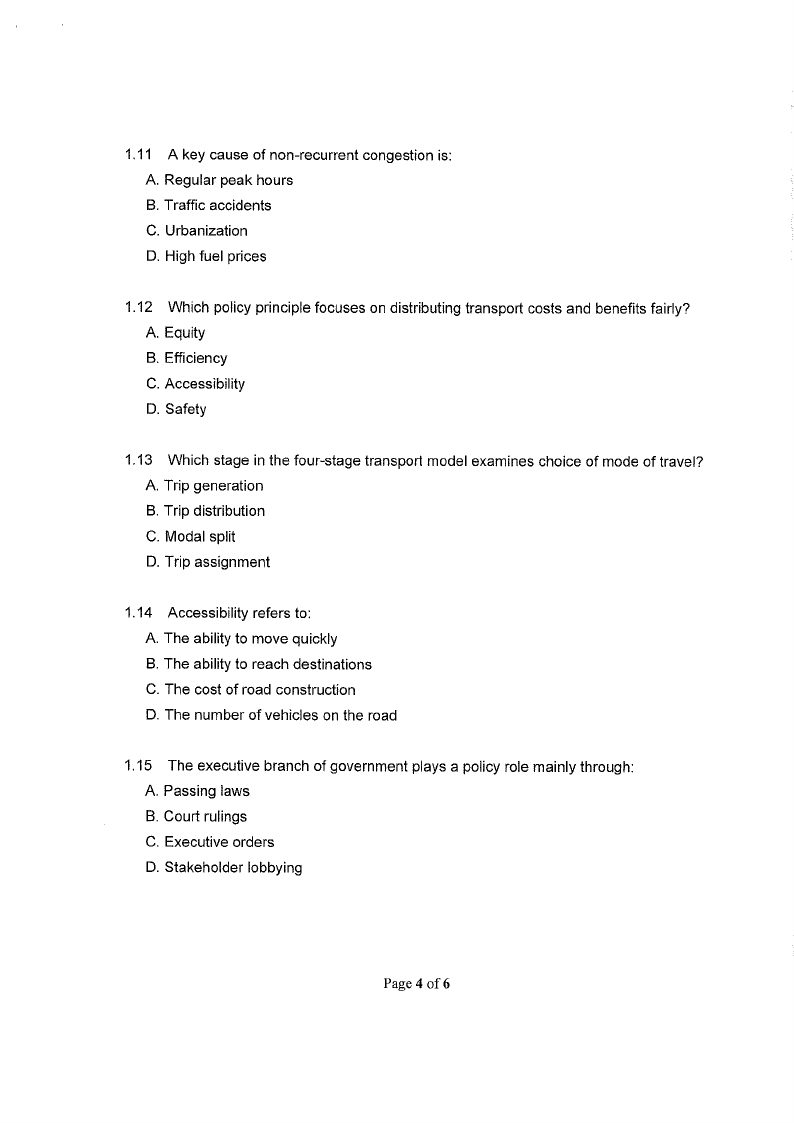
1. 11 A key cause of non-recurrent congestion is:
A. Regular peak hours
B. Traffic accidents
C. Urbanization
D. High fuel prices
1. 12 Which policy principle focuses on distributing transport costs and benefits fairly?
A. Equity
B. Efficiency
C. Accessibility
D. Safety
1. 13 Which stage in the four-stage transport model examines choice of mode of travel?
A. Trip generation
B. Trip distribution
C. Modal split
D. Trip assignment
1. 14 Accessibility refers to:
A. The ability to move quickly
B. The ability to reach destinations
C. The cost of road construction
D. The number of vehicles on the road
1. 15 The executive branch of government plays a policy role mainly through:
A. Passing laws
B. Court rulings
C. Executive orders
D. Stakeholder lobbying
Page 4 of6
|
|
5 Page 5 |
▲back to top |
QUESTION 2
(20 Marks)
True or False: Indicate whether the statement is true or false for example: 2.1 False or
2.2 False Each carry 2 mark.
2.1 Transport planning and transport policy are interchangeable terms. [2 Marks]
2.2Trip distribution in modelling examines where people travel to.
[2 Marks]
2.3 Urban sprawl decreases dependence on private cars.
[2 Marks]
2.4 Travel Demand Management includes staggered working hours.
[2 Marks]
2.5 Policy adoption is the final stage in the policy cycle.
[2 Marks]
2.5.1 Land use zoning can allocate land for residential, industrial, and recreational
purposes.
[2 Marks]
2.6Grade separation eliminates traffic conflicts at intersections.
[2 Marks]
2.7 Accessibility refers to the ability to reach destinations, not just movement. [2 Marks]
2.8 Non-recurrent congestion arises from predictable daily traffic peaks. [2 Marks]
2.9 Household income influences trip generation.
[2 Marks]
SECTION B
(50 Marks)
Question 3: Senario based on Congestion in Windhoek
(26 Marks)
Windhoek is one of the fastest-growing cities in southern Africa. Daily congestion during
morning and evening peak hours is worsening, especially on routes linking Katutura,
Khomasdal, and informal settlements to the central business district. Contributing factors
include urban sprawl, increased car ownership, poor public transport coverage, and limited
infrastructure expansion. The congestion has ripple effects on productivity, environmental
quality, and commuter well-being.
3.1 Identify and discuss the main causes of congestion in Windhoek.
(10 marks)
3.2 Explain any two 2 of congestion consequences on economic, social, and
environmental.
(4 marks)
3.3 Suggest TWO policy-based and TWO planning-based solutions that could realistically
address the problem.
(8 marks)
Page 5 of6
|
|
6 Page 6 |
▲back to top |
3.4 Explain the benefits of compact city development in reducing congestion. (4 marks)
Question 4: Senario based on Policy Formulation
(24 Marks)
The Namibian government is drafting a new transport policy to address congestion, safety,
and sustainability. Key actors include the Ministry of Works and Transport, city councils,
the private sector, and residents. The process requires balancing national development
goals with local needs, while ensuring wide citizen participation.
4.1 Outline any five (5) the main stages in the public policy cycle.
(15 marks)
4.2 Explain the roles of any three (3) stakeholders in shaping transport policy. (9 marks)
THE END
TOTAL MARKS 100
Page 6 of6