


 |
RTP610S - REFLECTIVE TEACHING AND PRACTICE - 2ND OPP - JULY 2025 |
|
|
1 Page 1 |
▲back to top |
nAm I BIA un IVERSITY
OF SCIEnCE Ano TECHnOLOGY
FACULTYOF COMMERCE, HUMAN SCIENCEAND EDUCATION
DEPARTMENTOF TECHNICALAND VOCATIONAL EDUCATIONAND TRAINING
QUALIFICATION: DIPLOMA IN TECHNICAL AND VOCATIONAL EDUCATION AND TRAINING:
TRAINER
QUALIFICATION CODE: 0GDTVT
COURSE CODE: RTP610S
SESSION: JULY 2025
LEVEL: 6
COURSE NAME: REFLECTIVETEACHINGAND
PRACTICE
PAPER: 2
DURATION: 3 HOURS
MARKS: 100
SECOND OPPORTUNITY EXAMINATION QUESTION PAPER
EXAMINER(S) DR OKSANA KACHEPA
MODERATOR: DR MICHAEL TJIVIKUA
INSTRUCTIONS
1. Answer ALL the questions.
2. Read all the questions carefully before answering.
3. Number the answers clearly
THIS QUESTION PAPER CONSISTS OF _6_ PAGES (Including this front page)
|
|
2 Page 2 |
▲back to top |
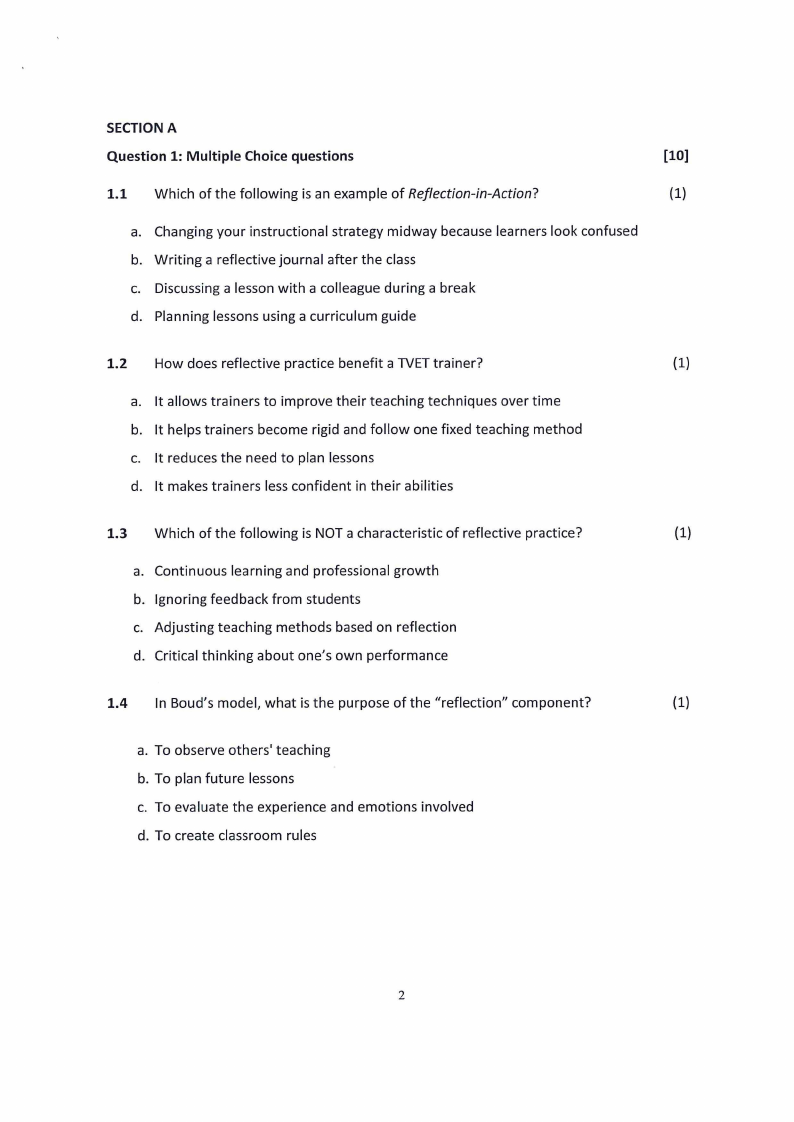
SECTION A
Question 1: Multiple Choice questions
[10]
1.1 Which of the following is an example of Reflection-in-Action?
{1)
a. Changing your instructional strategy midway because learners look confused
b. Writing a reflective journal after the class
c. Discussing a lesson with a colleague during a break
d. Planning lessons using a curriculum guide
1.2 How does reflective practice benefit a TVETtrainer?
(1)
a. It allows trainers to improve their teaching techniques over time
b. It helps trainers become rigid and follow one fixed teaching method
c. It reduces the need to plan lessons
d. It makes trainers less confident in their abilities
1.3 Which of the following is NOT a characteristic of reflective practice?
{1)
a. Continuous learning and professional growth
b. Ignoring feedback from students
c. Adjusting teaching methods based on reflection
d. Critical thinking about one's own performance
1.4 In Boud's model, what is the purpose of the "reflection" component?
(1)
a. To observe others' teaching
b. To plan future lessons
c. To evaluate the experience and emotions involved
d. To create classroom rules
2
|
|
3 Page 3 |
▲back to top |
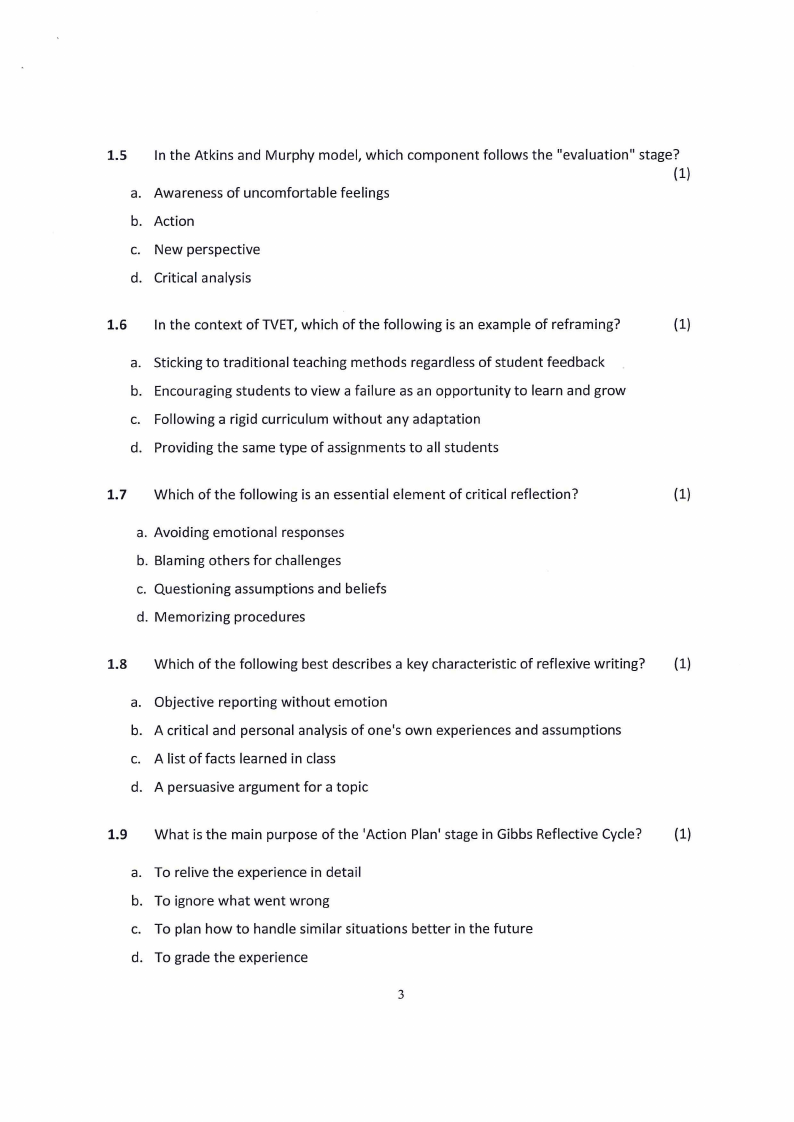
1.5 In the Atkins and Murphy model, which component follows the "evaluation" stage?
(1)
a. Awareness of uncomfortable feelings
b. Action
c. New perspective
d. Critical analysis
1.6 In the context of TVET,which of the following is an example of reframing?
(1)
a. Sticking to traditional teaching methods regardless of student feedback
b. Encouraging students to view a failure as an opportunity to learn and grow
c. Following a rigid curriculum without any adaptation
d. Providing the same type of assignments to all students
1.7 Which of the following is an essential element of critical reflection?
(1)
a. Avoiding emotional responses
b. Blaming others for challenges
c. Questioning assumptions and beliefs
d. Memorizing procedures
1.8 Which of the following best describes a key characteristic of reflexive writing?
(1)
a. Objective reporting without emotion
b. A critical and personal analysis of one's own experiences and assumptions
c. A list of facts learned in class
d. A persuasive argument for a topic
1.9 What is the main purpose of the 'Action Plan' stage in Gibbs Reflective Cycle? (1)
a. To relive the experience in detail
b. To ignore what went wrong
c. To plan how to handle similar situations better in the future
d. To grade the experience
3
|
|
4 Page 4 |
▲back to top |
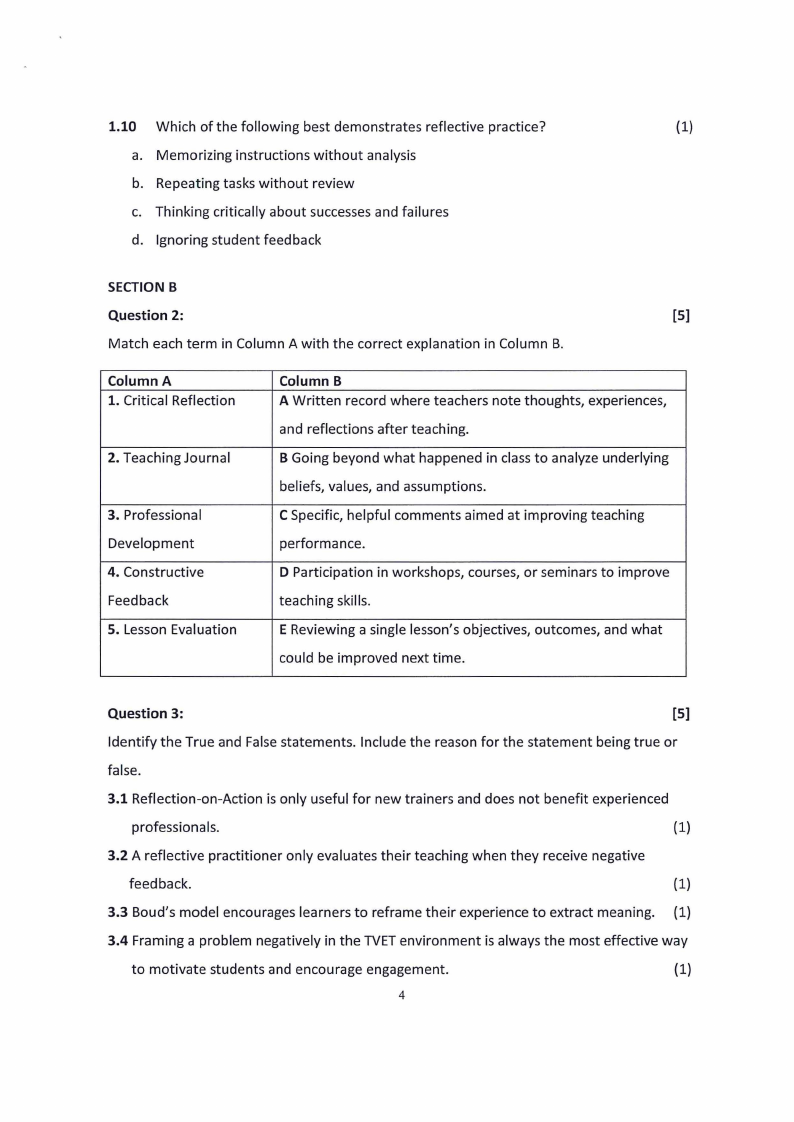
1.10 Which of the following best demonstrates reflective practice?
(1)
a. Memorizing instructions without analysis
b. Repeating tasks without review
c. Thinking critically about successesand failures
d. Ignoring student feedback
SECTION B
Question 2:
[5]
Match each term in Column A with the correct explanation in Column B.
Column A
1. Critical Reflection
2. Teaching Journal
3. Professional
Development
4. Constructive
Feedback
5. Lesson Evaluation
Column B
A Written record where teachers note thoughts, experiences,
and reflections after teaching.
B Going beyond what happened in class to analyze underlying
beliefs, values, and assumptions.
C Specific, helpful comments aimed at improving teaching
performance.
D Participation in workshops, courses, or seminars to improve
teaching skills.
E Reviewing a single lesson's objectives, outcomes, and what
could be improved next time.
Question 3:
[5]
Identify the True and False statements. Include the reason for the statement being true or
false.
3.1 Reflection-on-Action is only useful for new trainers and does not benefit experienced
professionals.
(1)
3.2 A reflective practitioner only evaluates their teaching when they receive negative
feedback.
(1)
3.3 Baud's model encourages learners to reframe their experience to extract meaning. (1)
3.4 Framing a problem negatively in the TVETenvironment is always the most effective way
to motivate students and encourage engagement.
(1)
4
|
|
5 Page 5 |
▲back to top |
3.5 Critical reflection encourages professionals to challenge their own assumptions and
improve their practice.
(1)
SECTION C
Question 4
[20]
4.1 Define Reflection-on-Action and explain its significance in professional teaching practice.
Provide an explanation of any two (2) relevant points.
(6)
4.2 Describe three (3) key steps involved in conducting effective Reflection-on-Action after a
lesson.
(6)
4.3 Discuss four (4) benefits of Reflection-on-Action for TVETtrainers.
(8)
Question 5
[18]
5.1 State and describe two (2) strategies a TVET trainer can use for reflective practice.
(6)
5.2 Identify two (2) challenges trainers may face when applying reflective practice and
suggest solutions.
(6)
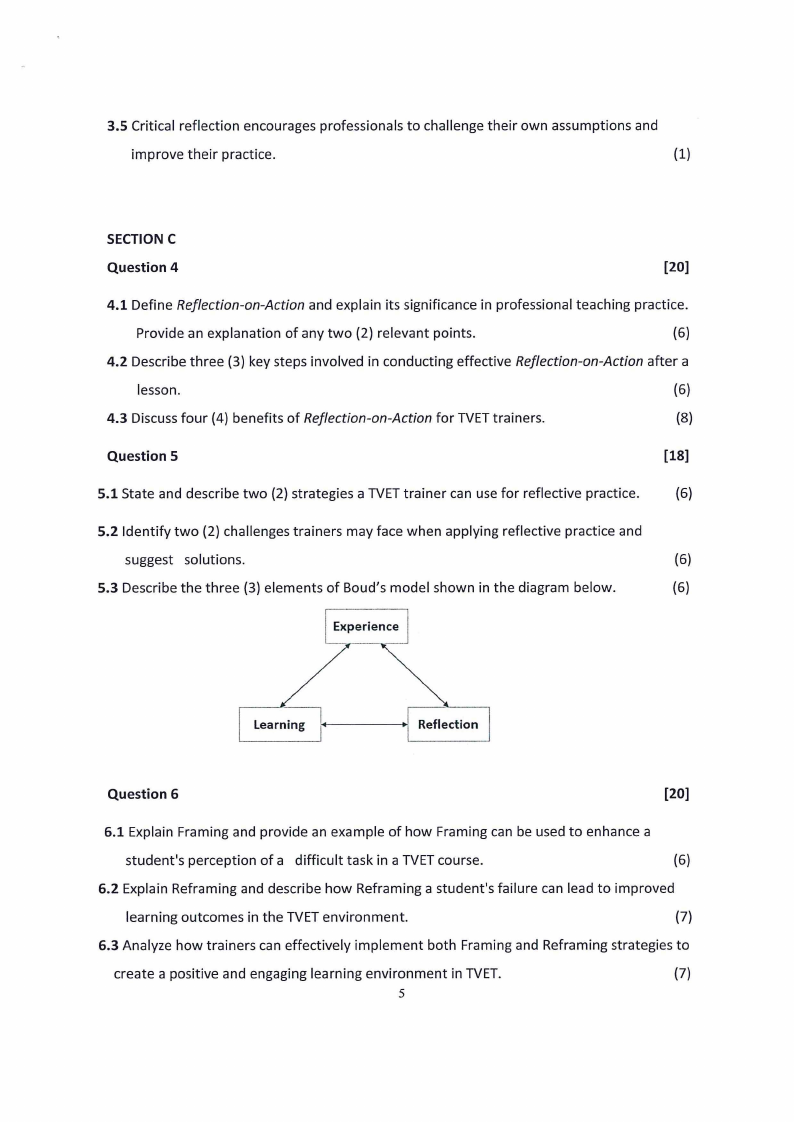
5.3 Describe the three (3) elements of Baud's model shown in the diagram below.
(6)
Experience
-----+1/ Learning 1+1
Reflection
Question 6
[20]
6.1 Explain Framing and provide an example of how Framing can be used to enhance a
student's perception of a difficult task in a TVET course.
(6)
6.2 Explain Reframing and describe how Reframing a student's failure can lead to improved
learning outcomes in the TVET environment.
(7)
6.3 Analyze how trainers can effectively implement both Framing and Reframing strategies to
create a positive and engaging learning environment in TVET.
(7)
5
|
|
6 Page 6 |
▲back to top |

Question 7
[22]
7.1 Define critical reflection and explain how critical reflection can enhance a TVETtrainer's
assessment practices. Provide an explanation of any four (4) relevant points.
(10)
7.2 Provide a practical example of how a TVET trainer might use each stage of Gibbs'
Reflective cycle after conducting a poor-performing student assessment.
(12)
END OF PAPER
[100 MARKS]
6