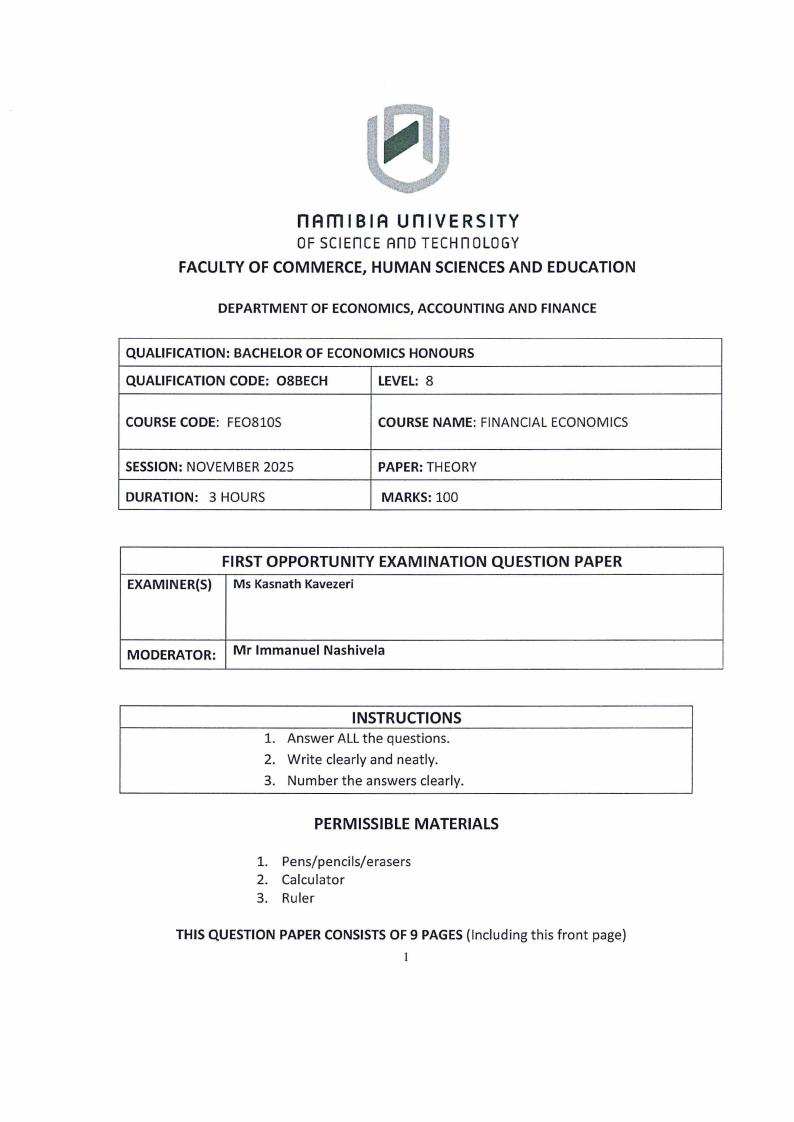
FEO810S-FINANCIAL ECONOMICS-1ST OPP- NOV 2025


FEO810S-FINANCIAL ECONOMICS-1ST OPP- NOV 2025


1 Page 1

▲back to top


nAmlBIA unlVERSITY
OF SCI En CE Ano TECH n OLOGY
FACULTY OF COMMERCE1 HUMAN SCIENCES AND EDUCATION
DEPARTMENT OF ECONOMICS, ACCOUNTING AND FINANCE
QUALIFICATION: BACHELOR OF ECONOMICS HONOURS
QUALIFICATION CODE: O8BECH
LEVEL: 8
COURSE CODE : FEO810S
COURSE NAME: FINANCIAL ECONOMICS
SESSION: NOVEMBER 2025
DURATION: 3 HOURS
PAPER: THEORY
MARKS: 100
FIRST OPPORTUNITY EXAMINATION QUESTION PAPER
EXAMINER(S} Ms Kasnath Kavezeri
MODERATOR: Mr Immanuel Nashivela
INSTRUCTIONS
1. Answer ALL the questions.
2. Write clearly and neatly.
3. Number the answers clearly.
PERMISSIBLE MATERIALS
1. Pens/pencils/erasers
2. Calculator
3. Ruler
THIS QUESTION PAPER CONSISTS OF 9 PAGES (Including this front page)

2 Page 2

▲back to top


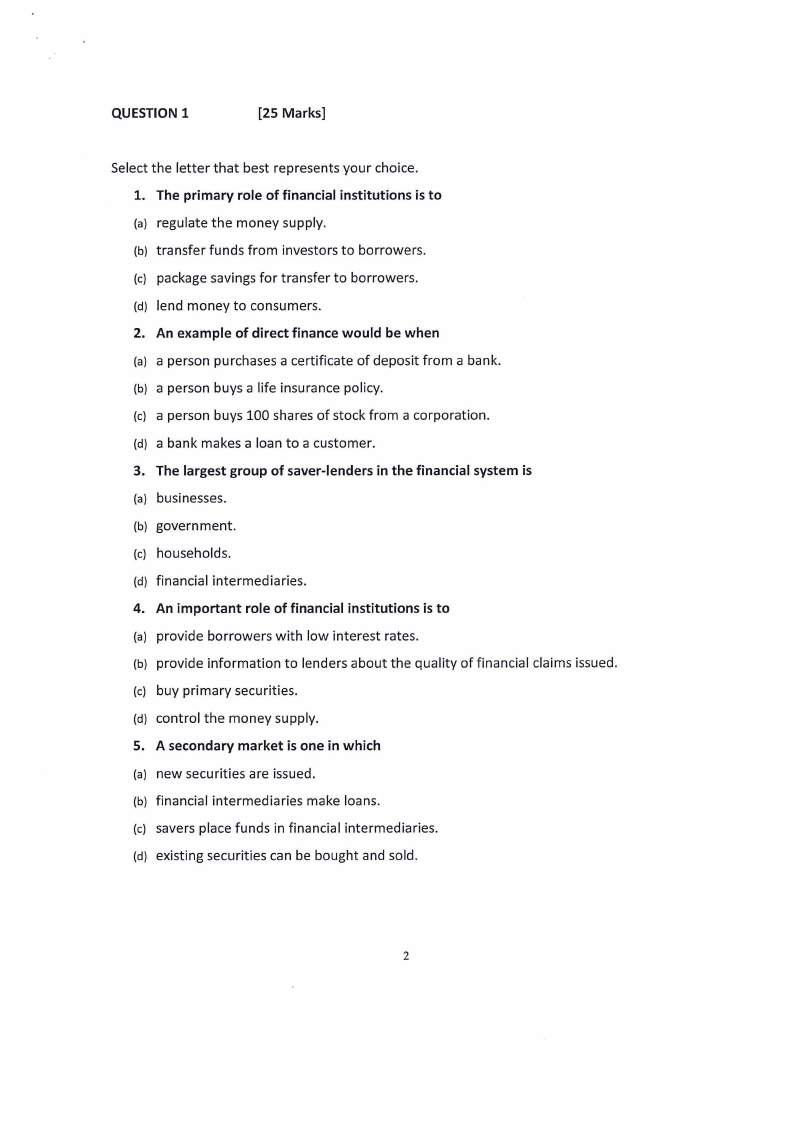
QUESTION 1
[25 Marks]
Select the letter that best represents your choice.
1. The primary role of financial institutions is to
(a) regulate the money supply.
(b) transfer funds from investors to borrowers.
(c) package savings for transfer to borrowers.
(d) lend money to consumers.
2. An example of direct finance would be when
(a) a person purchases a certificate of deposit from a bank.
(bl a person buys a life insurance policy.
(c) a person buys 100 shares of stock from a corporation.
(d) a bank makes a loan to a customer.
3. The largest group of saver-lenders in the financial system is
(a) businesses.
(b) government.
(c) households.
(d) financial intermediaries.
4. An important role of financial institutions is to
(a) provide borrowers with low interest rates.
(bl provide information to lenders about the quality of financial claims issued.
(c) buy primary securities.
(d) control the money supply.
5. A secondary market is one in which
(a) new securities are issued.
(b) financial intermediaries make loans.
(c) savers place funds in financial intermediaries.
(d) existing securities can be bought and sold .
2

3 Page 3

▲back to top


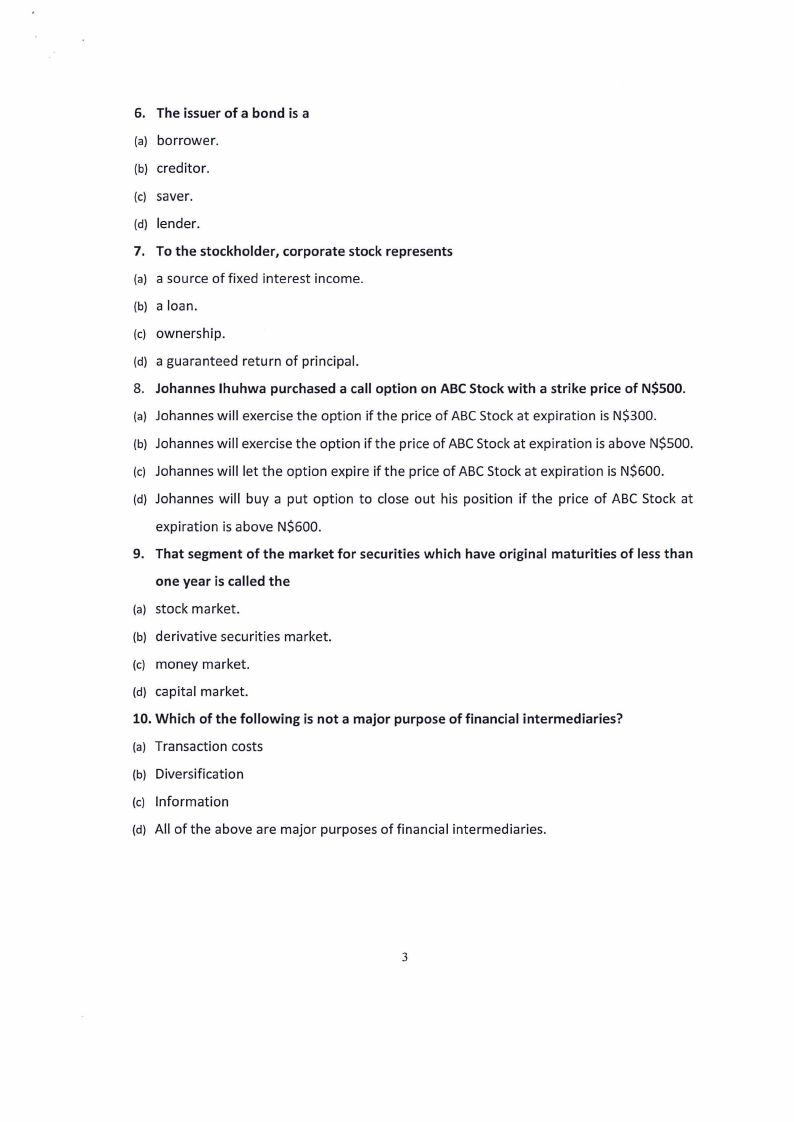
6. The issuer of a bond is a
(a) borrower.
(bl creditor.
(c) saver.
(d) lender.
7. To the stockholder, corporate stock represents
(a) a source of fixed interest income.
(b) a loan .
(c) ownership.
(d) a guaranteed return of principal.
8. Johannes lhuhwa purchased a call option on ABC Stock with a strike price of N$500.
(a) Johannes will exercise the option if the price of ABC Stock at expiration is N$300.
(b) Johannes will exercise the option if the price of ABC Stock at expiration is above N$500.
(c) Johannes will let the option expire if the price of ABC Stock at expiration is N$600.
(d) Johannes will buy a put option to close out his position if the price of ABC Stock at
expiration is above N$600.
9. That segment of the market for securities which have original maturities of less than
one year is called the
(a) stock market.
(b) derivative securities market.
(c) money market.
(d) capital market.
10. Which of the following is not a major purpose of financial intermediaries?
(a) Transaction costs
(b) Diversification
(c) Information
(d) All of the above are major purposes of financial intermediaries.
3

4 Page 4

▲back to top


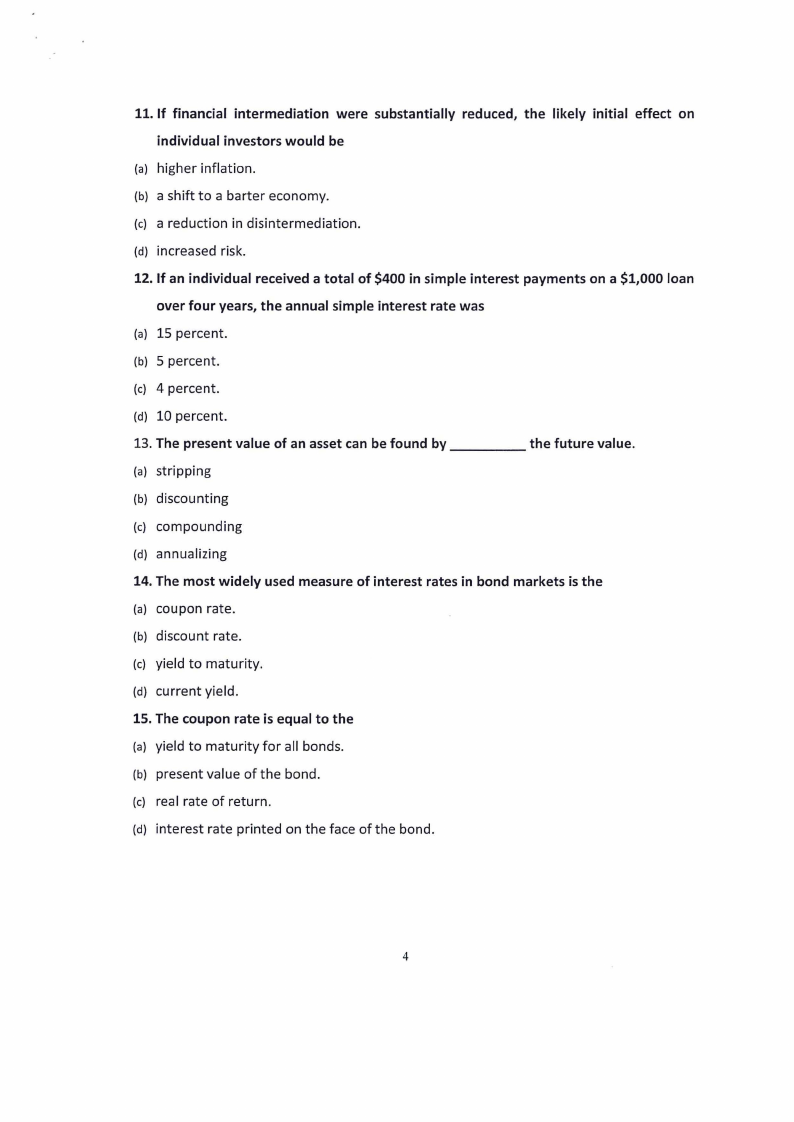
11. If financial intermediation were substantially reduced, the likely initial effect on
individual investors would be
(a) higher inflation.
(b) a shift to a barter economy.
(c) a reduction in disintermediation.
(d) increased risk.
12. If an individual received a total of $400 in simple interest payments on a $1,000 loan
over four years, the annual simple interest rate was
(a) 15 percent.
(bl 5 percent.
(c) 4 percent.
(d) 10 percent.
13. The present value of an asset can be found by _____ the future value.
(a) stripping
(b) discounting
(c) compounding
(d) annualizing
14. The most widely used measure of interest rates in bond markets is the
(a) coupon rate.
(b) discount rate.
(c) yield to maturity.
(d) current yield.
15. The coupon rate is equal to the
(a) yield to maturity for all bonds.
(b) present value of the bond.
(c) real rate of return.
(d) interest rate printed on the face of the bond.
4

5 Page 5

▲back to top


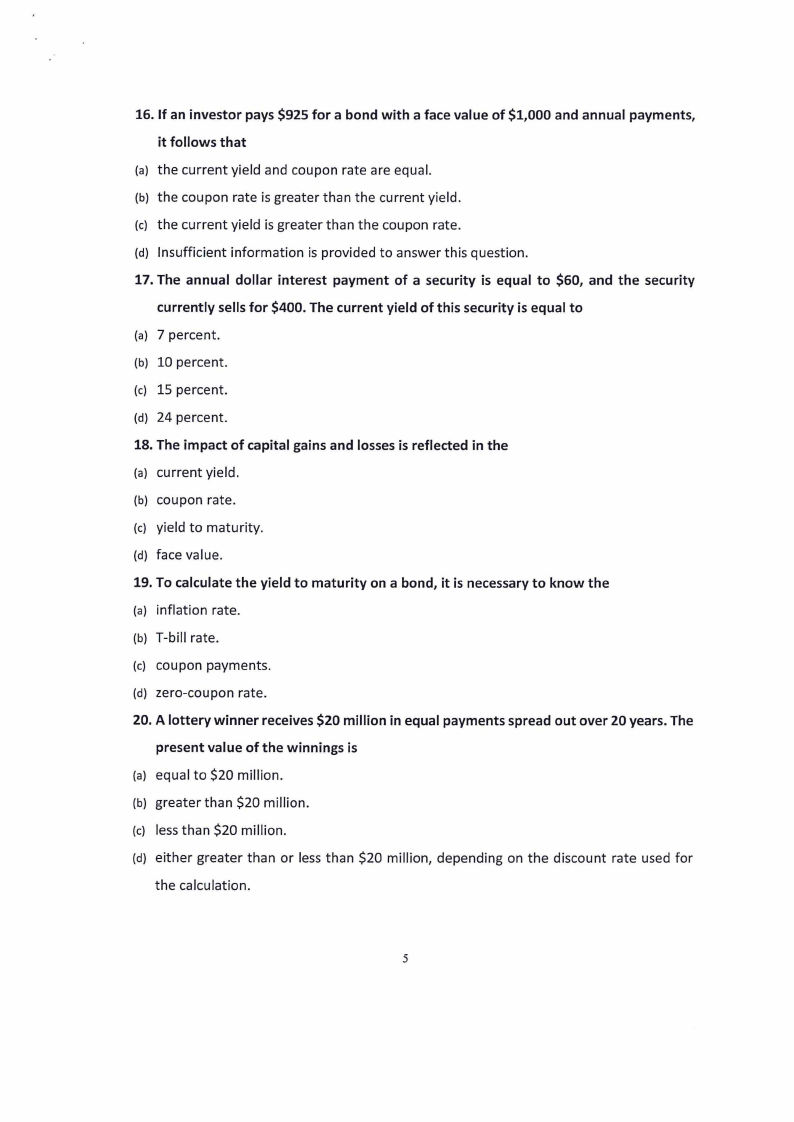
16. If an investor pays $925 for a bond with a face value of $1,000 and annual payments,
it follows that
(a) the current yield and coupon rate are equal.
(b) the coupon rate is greater than the current yield.
(c) the current yield is greater than the coupon rate .
(d) Insufficient information is provided to answer this question.
17. The annual dollar interest payment of a security is equal to $60, and the security
currently sells for $400. The current yield of this security is equal to
(a) 7 percent.
(b) 10 percent.
(c) 15 percent.
(d) 24 percent.
18. The impact of capital gains and losses is reflected in the
(a) current yield.
(b) coupon rate.
(c) yield to maturity.
(d) face value.
19. To calculate the yield to maturity on a bond, it is necessary to know the
(a) inflation rate.
(b) T-bill rate.
(c) coupon payments.
(d) zero-coupon rate.
20. A lottery winner receives $20 million in equal payments spread out over 20 years. The
present value of the winnings is
(a) equal to $20 million.
(b) greater than $20 million.
(c) less than $20 million.
(d) either greater than or less than $20 million, depending on the discount rate used for
the calculation.
5

6 Page 6

▲back to top


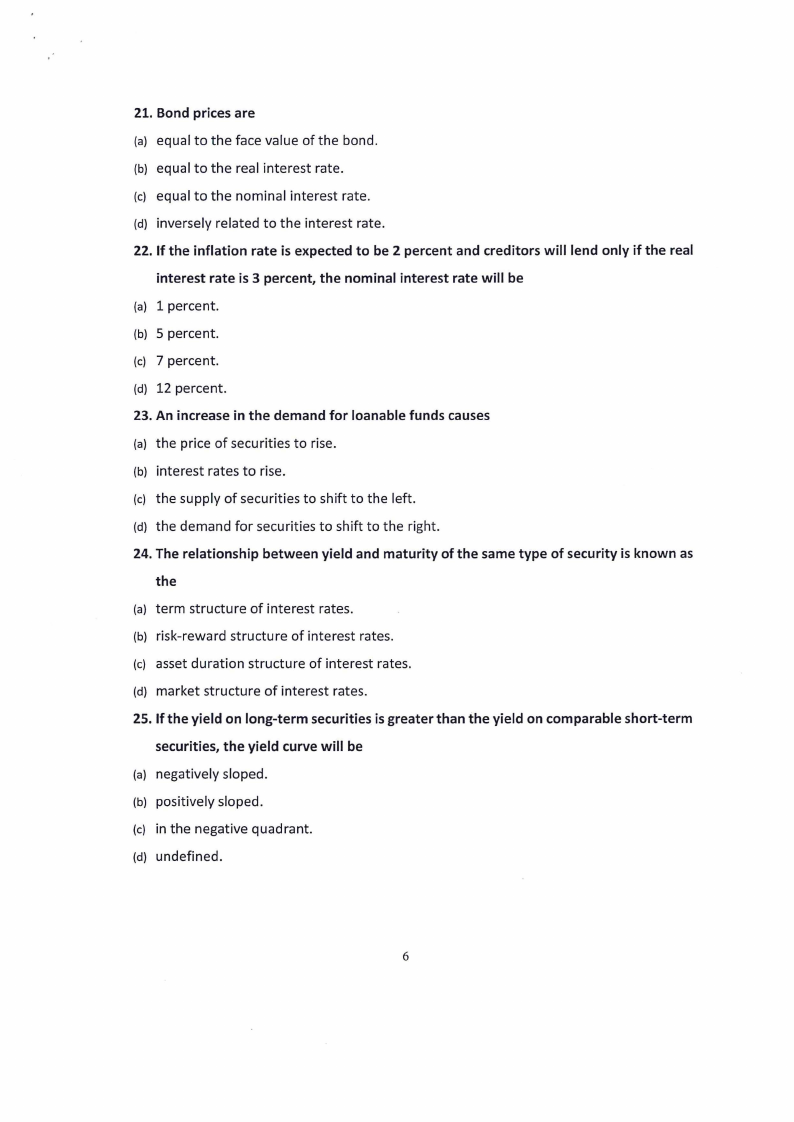
21. Bond prices are
(a) equal to the face value of the bond.
(b) equal to the real interest rate.
(c) equal to the nominal interest rate.
(d) inversely related to the interest rate.
22. If the inflation rate is expected to be 2 percent and creditors will lend only if the real
interest rate is 3 percent, the nominal interest rate will be
(a) 1 percent.
(b) 5 percent.
(c) 7 percent.
(d) 12 percent.
23. An increase in the demand for loanable funds causes
(a) the price of securities to rise.
(b) interest rates to rise.
(c) the supply of securities to shift to the left.
(d) the demand for securities to shift to the right.
24. The relationship between yield and maturity of the same type of security is known as
the
(a) term structure of interest rates.
(bl risk-reward structure of interest rates.
(c) asset duration structure of interest rates.
(d) market structure of interest rates.
25. If the yield on long-term securities is greater than the yield on comparable short-term
securities, the yield curve will be
(a) negatively sloped .
(bl positively sloped.
(cl in the negative quadrant.
(d) undefined.
6

7 Page 7

▲back to top


QUESTION 2
[25 Marks]
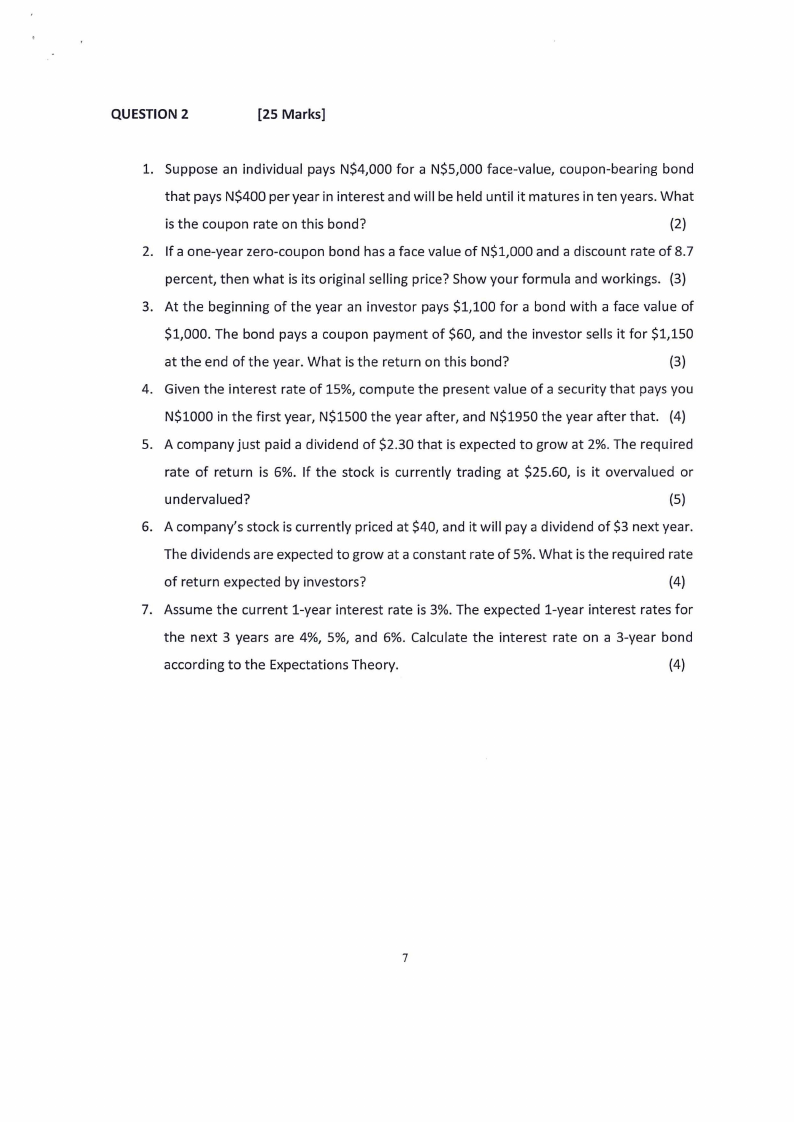
1. Suppose an individual pays N$4,000 for a N$5,000 face-value, coupon-bearing bond
that pays N$400 per year in interest and will be held until it matures in ten years. What
is the coupon rate on this bond?
(2)
2. If a one-year zero-coupon bond has a face value of N$1,000 and a discount rate of 8.7
percent, then what is its original selling price? Show your formula and workings. (3)
3. At the beginning of the year an investor pays $1,100 for a bond with a face value of
$1,000. The bond pays a coupon payment of $60, and the investor sells it for $1,150
at the end of the year. What is the return on this bond?
(3)
4. Given the interest rate of 15%, compute the present value of a security that pays you
N$1000 in the first year, N$1500 the year after, and N$1950 the year after that. (4)
5. A company just paid a dividend of $2.30 that is expected to grow at 2%. The required
rate of return is 6%. If the stock is currently trading at $25.60, is it overvalued or
undervalued?
(5)
6. A company's stock is currently priced at $40, and it will pay a dividend of $3 next year.
The dividends are expected to grow at a constant rate of 5%. What is the required rate
of return expected by investors?
(4)
7. Assume the current 1-year interest rate is 3%. The expected 1-year interest rates for
the next 3 years are 4%, 5%, and 6%. Calculate the interest rate on a 3-year bond
according to the Expectations Theory.
(4)
7

8 Page 8

▲back to top


QUESTION 3
[25 Marks]
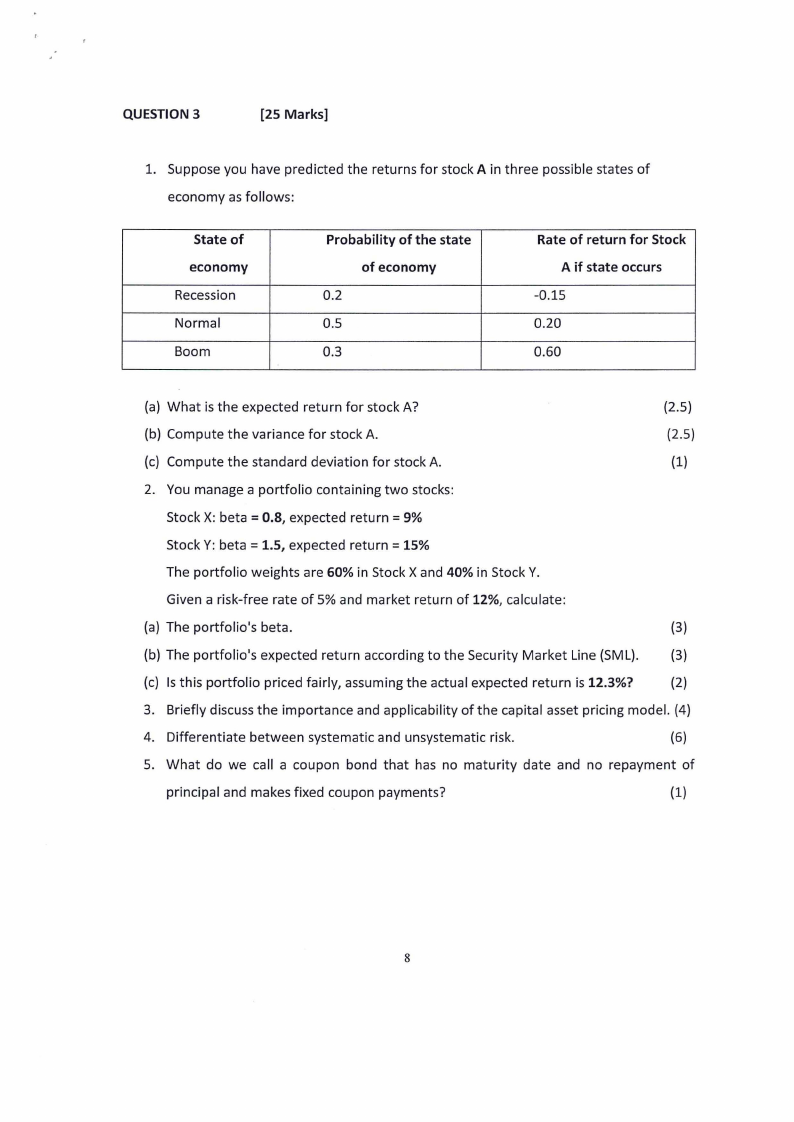
1. Suppose you have predicted the returns for stock A in three possible states of
economy as follows:
State of
economy
Recession
Normal
Boom
Probability of the state
of economy
0.2
0.5
0.3
Rate of return for Stock
A if state occurs
-0.15
0.20
0.60
(a) What is the expected return for stock A?
(2 .5)
(b) Compute the variance for stock A.
(2.5)
(c) Compute the standard deviation for stock A.
(1)
2. You manage a portfolio containing two stocks :
Stock X: beta= 0.8, expected return= 9%
Stock Y: beta= 1.5, expected return= 15%
The portfolio weights are 60% in Stock X and 40% in Stock Y.
Given a risk-free rate of 5% and market return of 12%, calculate:
(a) The portfolio's beta.
(3)
(b) The portfolio's expected return according to the Security Market Line (SML). (3)
(c) Is this portfolio priced fairly, assum ing the actual expected return is 12.3%?
(2)
3. Briefly discuss the importance and applicability of the capital asset pricing model. (4)
4. Differentiate between systematic and unsystematic risk.
(6)
5. What do we call a coupon bond that has no maturity date and no repayment of
principal and makes fixed coupon payments?
(1)
8

9 Page 9

▲back to top


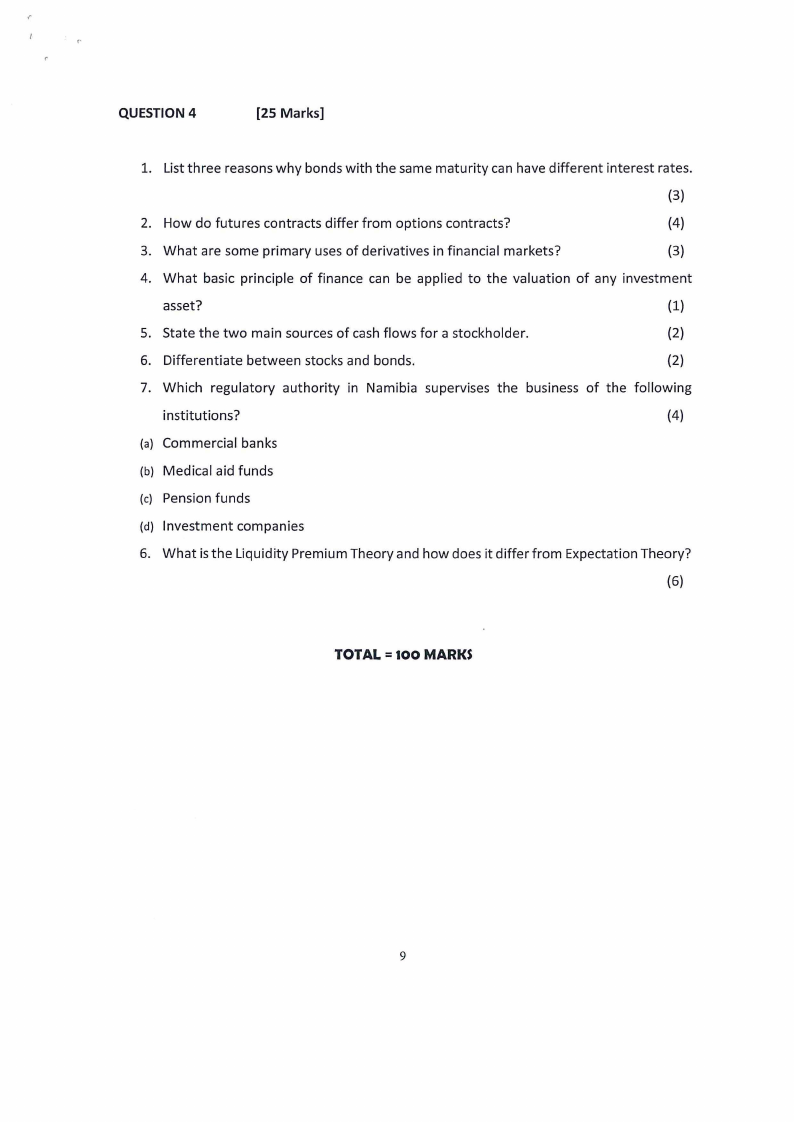
QUESTION 4
[25 Marks]
1. List three reasons why bonds with the same maturity can have different interest rates.
(3)
2. How do futures contracts differ from options contracts?
(4)
3. What are some primary uses of derivatives in financial markets?
(3)
4. What basic principle of finance can be applied to the valuation of any investment
asset?
(1)
5. State the two main sources of cash flows for a stockholder.
(2)
6. Differentiate between stocks and bonds.
(2)
7. Which regulatory authority in Namibia supervises the business of the following
institutions?
(4)
(a) Commercial banks
(b) Medical aid funds
(c) Pension funds
(d) Investment companies
6. What is the Liquidity Premium Theory and how does it differ from Expectation Theory?
(6)
TOTAL = 100 MARKS
9