


 |
WWR711S-WATER AND WETLAND RESOURCES MANAGEMENT-2ND OPP-JULY 2025 |
|
|
1 Page 1 |
▲back to top |
nAm I 8 I A un IVE RSITY
OF SCIEnCE Ano TECHnOLOGY
FACULTY OF HEALTH, NATURAL RESOURCES AND APPLIED SCIENCES
DEPARTMENT OF NATURAL RESOURCE SCIENCES
QUALIFICATION: BACHELOR of NATURAL RESOURCE MANAGEMENT (NRM)
QUALIFICATION CODE: 07BNRS
LEVEL: 7
COURSE CODE: WWR711S
COURSE NAME: WATER AND WETLAND
RESOURCESMANAGEMENT
SESSION: JULY 2025
DURATION: 2.5 HOURS
PAPER: THEORY
MARKS: 120
SECOND OPPORTUNITY EXAMINATION QUESTION PAPER
EXAMINER(S) Mrs. C NTESA
MODERATOR: Mrs. N NASHIPILI
INSTRUCTIONS
1. Answer ALL the questions.
2. Read all the questions carefully before answering.
3. Number the answers clearly
4. Make sure your name and surname, question number and
the date appear on the answer script.
5. Please ensure that your writing is legible, neat and
presentable.
THIS QUESTION PAPER CONSISTS OF 4 PAGES (Including this front page)
|
|
2 Page 2 |
▲back to top |
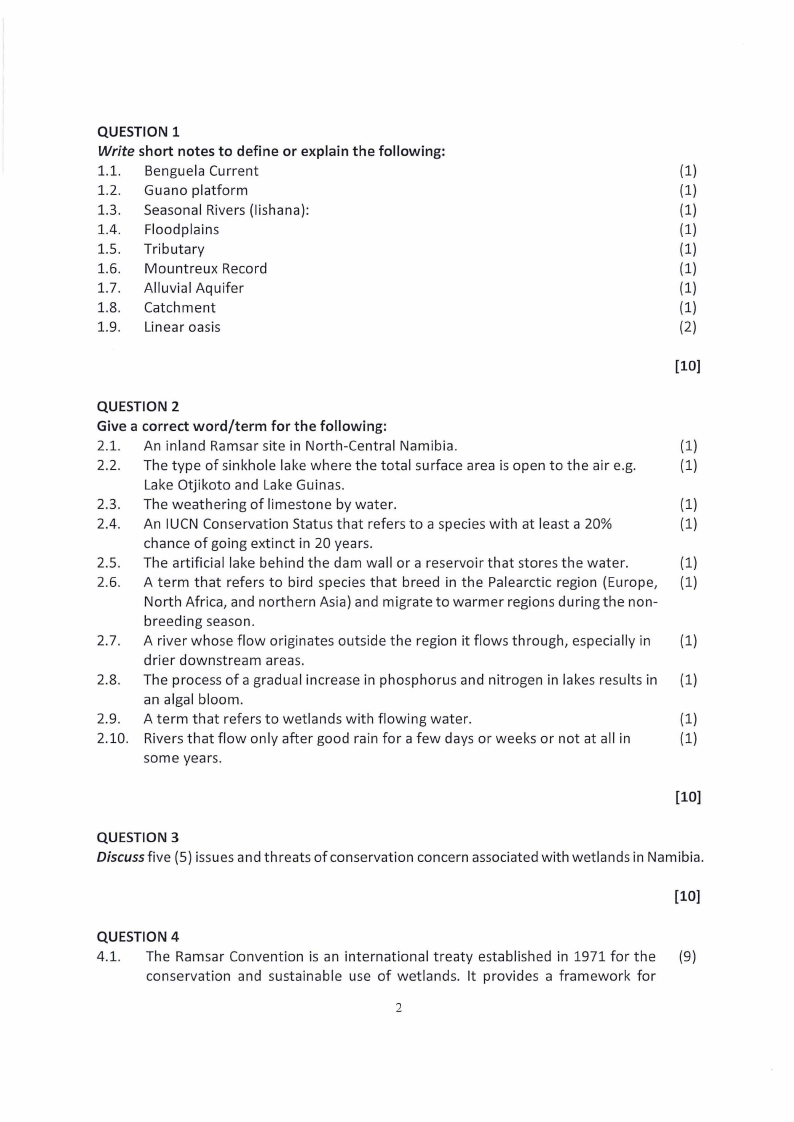
QUESTION 1
Write short notes to define or explain the following:
1.1. Benguela Current
(1)
1.2. Guano platform
(1)
1.3. Seasonal Rivers (lishana):
(1)
1.4. Floodplains
(1)
1.5. Tributary
(1)
1.6. Mountreux Record
(1)
1.7. Alluvial Aquifer
(1)
1.8. Catchment
(1)
1.9. Linear oasis
(2)
[10]
QUESTION 2
Give a correct word/term for the following:
2.1. An inland Ramsar site in North-Central Namibia.
(1)
2.2. The type of sinkhole lake where the total surface area is open to the air e.g.
(1)
Lake Otjikoto and Lake Guinas.
2.3. The weathering of limestone by water.
(1)
2.4. An IUCN Conservation Status that refers to a species with at least a 20%
(1)
chance of going extinct in 20 years.
2.5. The artificial lake behind the dam wall or a reservoir that stores the water.
(1)
2.6. A term that refers to bird species that breed in the Palearctic region (Europe, (1)
North Africa, and northern Asia) and migrate to warmer regions during the non-
breeding season.
2.7. A river whose flow originates outside the region it flows through, especially in (1)
drier downstream areas.
2.8. The process of a gradual increase in phosphorus and nitrogen in lakes results in (1)
an algal bloom.
2.9. A term that refers to wetlands with flowing water.
(1)
2.10. Rivers that flow only after good rain for a few days or weeks or not at all in
(1)
some years.
[10]
QUESTION 3
Discussfive (5) issues and threats of conservation concern associated with wetlands in Namibia.
[10]
QUESTION 4
4.1. The Ramsar Convention is an international treaty established in 1971 for the (9)
conservation and sustainable use of wetlands. It provides a framework for
2
|
|
3 Page 3 |
▲back to top |
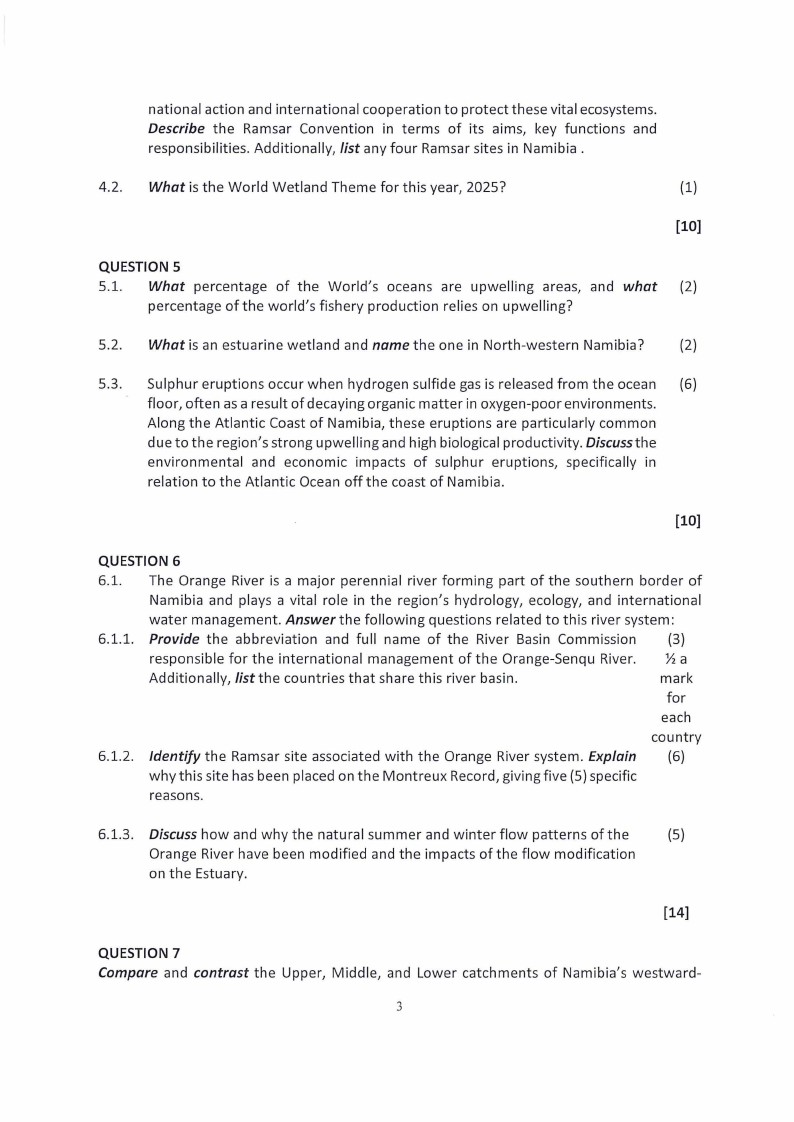
national action and international cooperation to protect these vital ecosystems.
Describe the Ramsar Convention in terms of its aims, key functions and
responsibilities. Additionally, list any four Ramsar sites in Namibia .
4.2. What is the World Wetland Theme for this year, 2025?
(1)
[10]
QUESTION 5
5.1. What percentage of the World's oceans are upwelling areas, and what (2)
percentage of the world's fishery production relies on upwelling?
5.2. What is an estuarine wetland and name the one in North-western Namibia?
(2)
5.3. Sulphur eruptions occur when hydrogen sulfide gas is released from the ocean (6)
floor, often as a result of decaying organic matter in oxygen-poor environments.
Along the Atlantic Coast of Namibia, these eruptions are particularly common
due to the region's strong upwelling and high biological productivity. Discuss the
environmental and economic impacts of sulphur eruptions, specifically in
relation to the Atlantic Ocean off the coast of Namibia.
[10]
QUESTION 6
6.1. The Orange River is a major perennial river forming part of the southern border of
Namibia and plays a vital role in the region's hydrology, ecology, and international
water management. Answer the following questions related to this river system:
6.1.1. Provide the abbreviation and full name of the River Basin Commission (3)
responsible for the international management of the Orange-Senqu River. ½a
Additionally, list the countries that share this river basin.
mark
for
each
country
6.1.2. Identify the Ramsar site associated with the Orange River system. Explain (6)
why this site has been placed on the Montreux Record, giving five (5) specific
reasons.
6.1.3. Discuss how and why the natural summer and winter flow patterns of the
(5)
Orange River have been modified and the impacts of the flow modification
on the Estuary.
[14]
QUESTION 7
Compare and contrast the Upper, Middle, and Lower catchments of Namibia's westward-
3
|
|
4 Page 4 |
▲back to top |
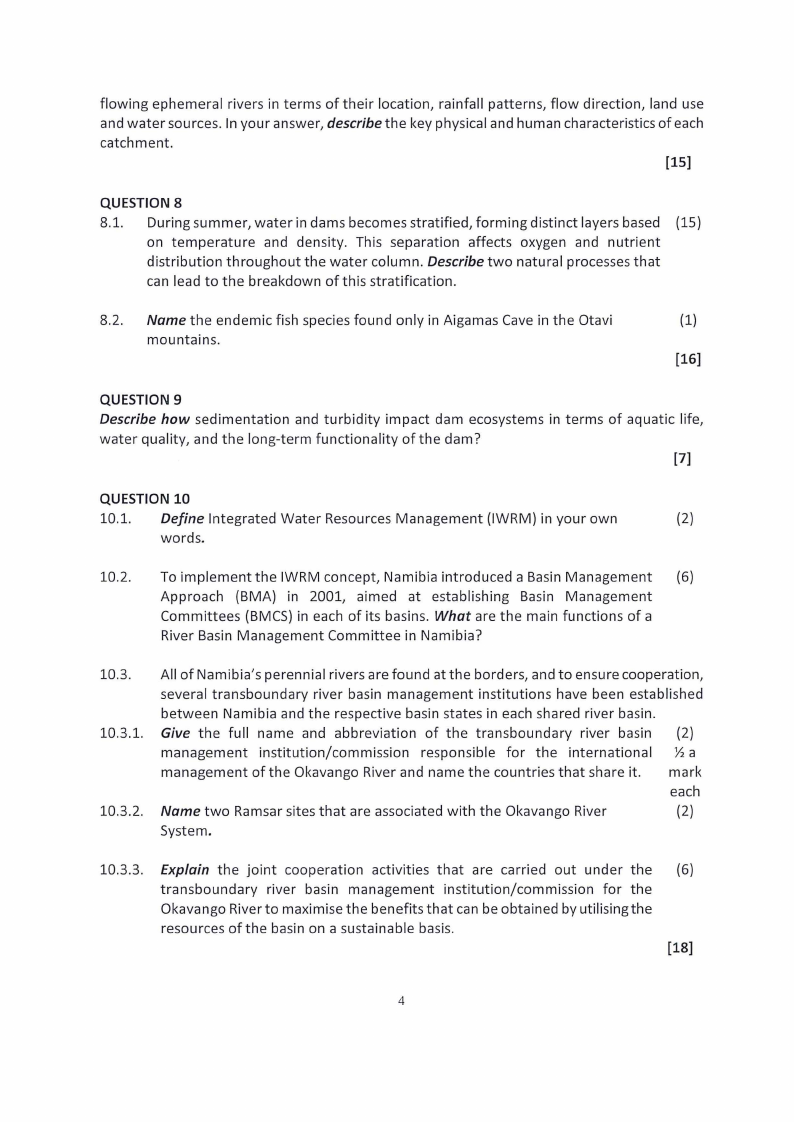
flowing ephemeral rivers in terms of their location, rainfall patterns, flow direction, land use
and water sources. In your answer, describe the key physical and human characteristics of each
catchment.
[15]
QUESTION 8
8.1. During summer, water in dams becomes stratified, forming distinct layers based (15)
on temperature and density. This separation affects oxygen and nutrient
distribution throughout the water column. Describe two natural processes that
can lead to the breakdown of this stratification.
8.2. Name the endemic fish species found only in Aigamas Cave in the Otavi
(1)
mountains.
[16]
QUESTION 9
Describe how sedimentation and turbidity impact dam ecosystems in terms of aquatic life,
water quality, and the long-term functionality of the dam?
[7]
QUESTION 10
10.1. Define Integrated Water Resources Management (IWRM) in your own
(2)
words.
10.2.
To implement the IWRM concept, Namibia introduced a Basin Management (6)
Approach (BMA) in 2001, aimed at establishing Basin Management
Committees (BMCS) in each of its basins. What are the main functions of a
River Basin Management Committee in Namibia?
10.3.
10.3.1.
10.3.2.
All of Namibia's perennial rivers are found at the borders, and to ensure cooperation,
several transboundary river basin management institutions have been established
between Namibia and the respective basin states in each shared river basin.
Give the full name and abbreviation of the transboundary river basin (2)
management institution/commission responsible for the international ½ a
management of the Okavango River and name the countries that share it. mark
each
Name two Ramsar sites that are associated with the Okavango River
(2)
System.
10.3.3. Explain the joint cooperation activities that are carried out under the (6)
transboundary river basin management institution/commission for the
Okavango Riverto maximise the benefits that can be obtained by utilising the
resources of the basin on a sustainable basis.
[18]
4