


 |
OSB611S - ORGANISATIONAL BEHAVIOR - 1ST OPP - JUNE 2025 |
|
|
1 Page 1 |
▲back to top |
nAmlBIA unlVERSITY
OFSClEnCEAno TECHnOLOGY
FACULTY OF COMMERCE, HUMAN SCIENCE AND EDUCATION
DEPARTMENT OF GOVERNANCE AND MANAGEMENT SCIENCES
QUALIFICATION: BACHELOR OF HUMAN RESOURCESMANAGEMENT
QUALIFICATION CODE: 07BHRM
LEVEL: 6
COURSE CODE: OSB611S
COURSE NAME: ORGANISATIONAL BEHAVIOUR
SESSION: JUNE 2025
DURATION: 3 HOURS
PAPER: THEORY
MARKS: 100
EXAMINER(S)
FIRST OPPORTUNITY EXAMINATION PAPER
Mr. Ehrenfried Tjivii Ndjoonduezu
MODERATOR:
Ms. M Sezuni
INSTRUCTIONS
1. The paper consists of Sections A, Band C. Answer ALL the questions.
2. Write clearly,and neatly.
3. Number the answers clearly.
PERMIS
SIBLE MATERIALS
1. Examination paper.
2. Examination script.
THIS QUESTION PAPER CONSISTS OF 7 PAGES {Including this front page)
1
|
|
2 Page 2 |
▲back to top |
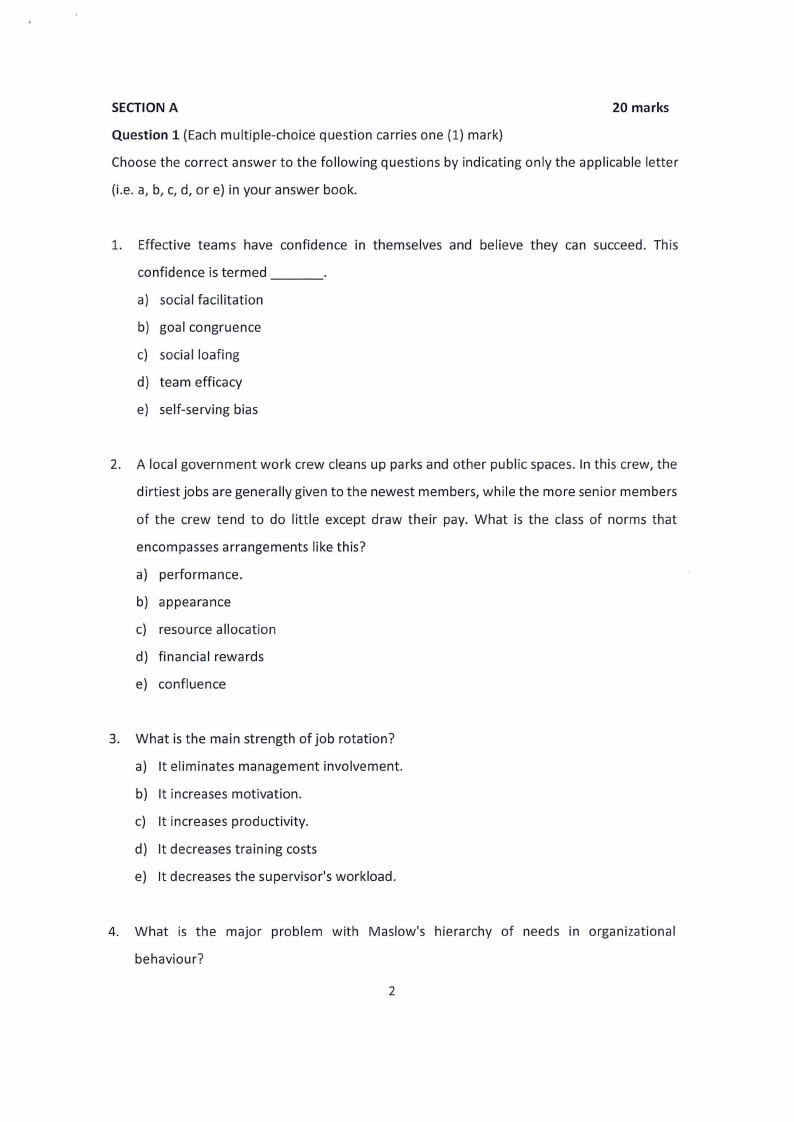
SECTION A
20 marks
Question 1 (Each multiple-choice question carries one (1) mark)
Choose the correct answer to the following questions by indicating only the applicable letter
(i.e. a, b, c, d, ore) in your answer book.
l. Effective teams have confidence in themselves and believe they can succeed. This
confidence is termed __ _
a) social facilitation
b) goal congruence
c) social loafing
d) team efficacy
e) self-serving bias
2. A local government work crew cleans up parks and other public spaces. In this crew, the
dirtiest jobs are generally given to the newest members, while the more senior members
of the crew tend to do little except draw their pay. What is the class of norms that
encompasses arrangements like this?
a) performance.
b) appearance
c) resource allocation
d) financial rewards
e) confluence
3. What is the main strength of job rotation?
a) It eliminates management involvement.
b) It increases motivation.
c) It increases productivity.
d) It decreases training costs
e) It decreases the supervisor's workload.
4. What is the major problem with Maslow's hierarchy of needs in organizational
behaviour?
2
|
|
3 Page 3 |
▲back to top |
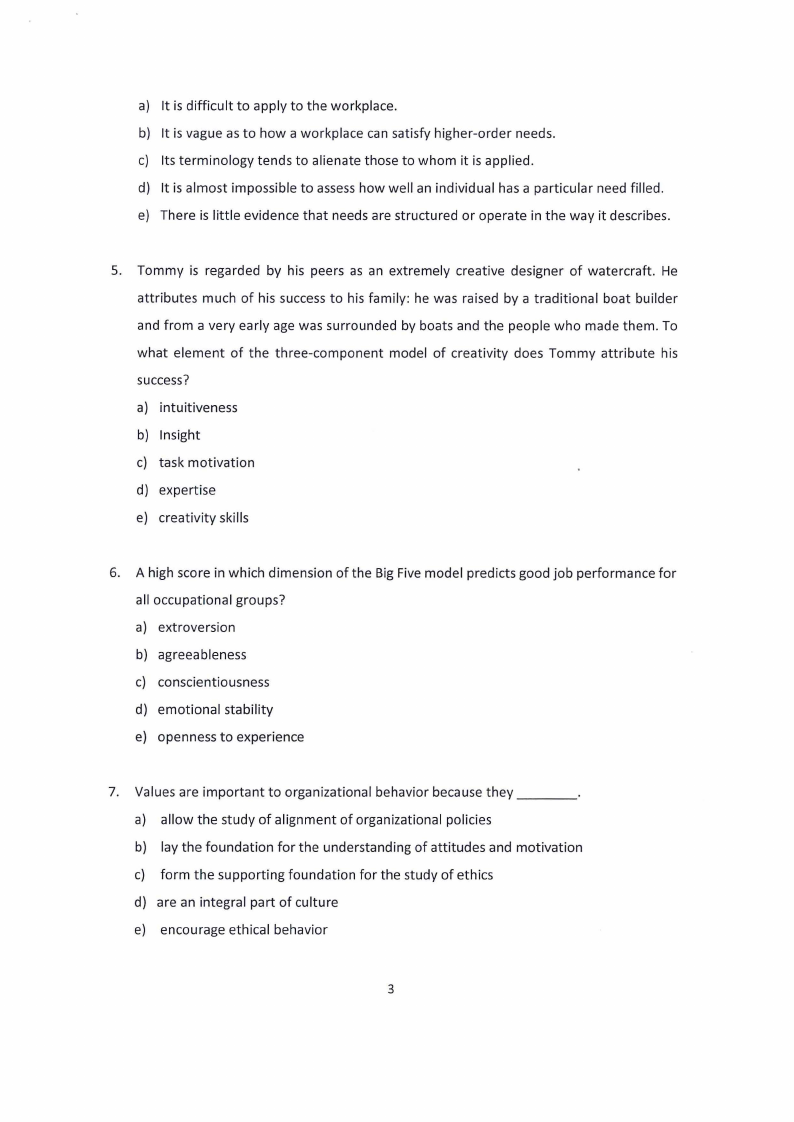
a) It is difficult to apply to the workplace.
b) It is vague as to how a workplace can satisfy higher-order needs.
c) Its terminology tends to alienate those to whom it is applied.
d) It is almost impossible to assess how well an individual has a particular need filled.
e) There is little evidence that needs are structured or operate in the way it describes.
5. Tommy is regarded by his peers as an extremely creative designer of watercraft. He
attributes much of his success to his family: he was raised by a traditional boat builder
and from a very early age was surrounded by boats and the people who made them. To
what element of the three-component model of creativity does Tommy attribute his
success?
a) intuitiveness
b) Insight
c) task motivation
d) expertise
e) creativity skills
6. A high score in which dimension of the Big Five model predicts good job performance for
all occupational groups?
a) extroversion
b) agreeableness
c) conscientiousness
d) emotional stability
e) openness to experience
7. Values are important to organizational behavior because they ___ _
a) allow the study of alignment of organizational policies
b) lay the foundation for the understanding of attitudes and motivation
c) form the supporting foundation for the study of ethics
d) are an integral part of culture
e) encourage ethical behavior
3
|
|
4 Page 4 |
▲back to top |
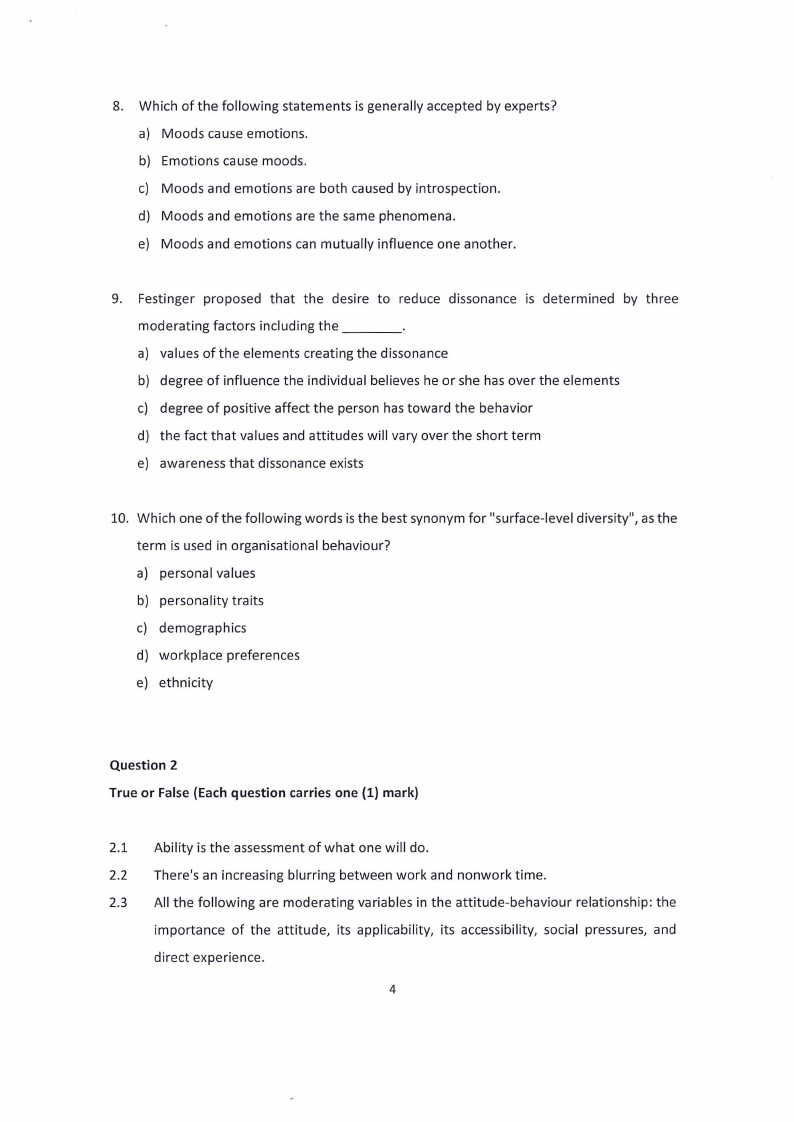
8. Which of the following statements is generally accepted by experts?
a) Moods cause emotions.
b) Emotions cause moods.
c) Moods and emotions are both caused by introspection.
d) Moods and emotions are the same phenomena.
e) Moods and emotions can mutually influence one another.
9. Festinger proposed that the desire to reduce dissonance is determined by three
moderating factors including the ___ _
a) values of the elements creating the dissonance
b) degree of influence the individual believes he or she has over the elements
c) degree of positive affect the person has toward the behavior
d) the fact that values and attitudes will vary over the short term
e) awareness that dissonance exists
10. Which one of the following words is the best synonym for "surface-level diversity", as the
term is used in organisational behaviour?
a) personal values
b) personality traits
c) demographics
d) workplace preferences
e) ethnicity
Question 2
True or False (Each question carries one (1) mark)
2.1 Ability is the assessment of what one will do.
2.2 There's an increasing blurring between work and nonwork time.
2.3 All the following are moderating variables in the attitude-behaviour relationship: the
importance of the attitude, its applicability, its accessibility, social pressures, and
direct experience.
4
|
|
5 Page 5 |
▲back to top |
2.4 Moods are feelings that tend to be less intense than emotions.
2.5 Giving an attribution external causation means you assume that the individual is
responsible for his or her own behaviour.
2.6 Myers-Briggs Type Indicator is a 100-question personality test that types four
characteristics into sixteen personality types.
2.7 Research shows that in equity theory, men prefer same-sex comparisons, but women
do not.
2.8 Flexible spending plans allow employees to set aside up to the dollar amount offered
in the plan to pay for services.
2.9 From management's perspective, the greatest appeal of skill-based pay plans is
decreased payroll costs.
2.10 Turnover rates are higher for self-managed work teams than for employees working
in traditional work structures.
SECTION B
(12)
Question 3
Case Incident 2
What Does Diversity Training Teach?
Some researchers have provided evidence that diversity training programs may not be
delivering the expected outcomes. The authors interpret this evidence as a sign that
corporate efforts to improve diversity are more effective when the focus is on concrete
measurable goals with accountability. It may be that entrenched attitudes related to race,
ethnicity, and gender are just too hard to change in short-term classroom settings.
Others argue that diversity training isn't really designed to increase the number of women
and minorities in top management positions but rather to improve relationships among
workers.
Reviews of the historical development of diversity programs demonstrate some significant
changes in the ways diversity trainers conceptualize their role. Early diversity training efforts
focused primarily on legal compliance and the regulatory framework. This may have created
an attitude that diversity was a problem to be solved and avoided, when possible, rather than
an opportunity. Demographic diversity was also the only focus of these programs, meaning
other forms of workforce diversity, like differences in abilities or attitudes, were ignored.
5
|
|
6 Page 6 |
▲back to top |
Some features led to unintended consequences. Some diversity programs encouraged
participants to describe stereotypical language regarding different groups to expose the
content of people's assumptions. Unfortunately, follow-up discussions with participants
showed the discussions may have reinforced the very stereotypes the programs were
supposed to undermine. These practices also could be very embarrassing for participants.
Because the training focused primarily on portraying historically underrepresented minorities
and women in White male-dominated environments, White males (who make up a significant
portion of the workforce) felt excluded and stigmatized.
Contemporary diversity management programs have changed their focus considerably in
response to these concerns. Diversity training sessions are now designed to minimize public
shame or embarrassment. Legal compliance is still a major part of diversity training, but the
business case for effective diversity management is a much more central component of
training sessions.
Questions
3.1 Do you think representation in top management is a fair indicator of the effects of
diversity training programs? Why or why not?
(6)
3.2 What significant obstacles must be overcome to make diversity programs effective?
(6)
6
|
|
7 Page 7 |
▲back to top |
SECTION C
Question 4
(68 marks)
4.1 Explain why teams have become so popular.
(8)
4.2 Describe the Big Five personality dimension of conscientiousness and explain how it
can predict behavior at work.
(12)
4.3 Describe what is meant by the terms "person-job fit" and "person-organization fit."
(8)
4.4 Discuss some of the errors in perceptual judgment made by interviewers in job
interviews.
(10)
4.5 Explain how a worker's emotional state can affect customer service and customers.
(12)
4.6 Most of the research in OB has been concerned with three attitudes: job satisfaction,
job involvement, and organizational commitment. Explain the difference between
these attitudes.
(9)
4.7 What inferences can be made from analysing two employees who share many deep-
level diversity factors?
(9)
7
I