


 |
PMV611S - PRINCIPLES AND METHODS OF VALUATION - 1ST OPP - JUNE 2025 |
|
|
1 Page 1 |
▲back to top |

nAm I BIA unIVE RSITY
OFSCIEnCEAnD TECHnOLOGY
FACULTYOF ENGINEERINGAND THEBUILTENVIRONMENT
DEPARTMENTOF LANDAND SPATIALSCIENCES
QUALIFICATION(S):BACHELOROF PROPERTYSTUDIES
DIPLOMA IN PROPERTYSTUDIES
QUALIFICATION(SC) ODE:
08BOPS, 06DIPS
NQF LEVEL: 6
COURSECODE: PMV611S
COURSENAME: PRINCIPLESAND METHODS
OF VALUATION
EXAMSSESSIONJ: UNE 2025
PAPER:
THEORY
DURATION: 3 HOURS
MARKS:
100
EXAMINER
FIRSTOPPORTUNITYEXAMINATION QUESTIONPAPER
Mr. AMIN ISSA
MODERATOR: Mr. SAMUEL ATO K. HAYFORD
INSTRUCTIONS
1. Read the entire question paper before answering the Questions.
2. Please write clearly and legibly!
3. Please STARTEACHQUESTIONON A FRESHPAGE.
4. The question paper contains a total of 3 questions.
5. You must answer ALLQUESTIONS.
6. Make sure your Student Number is on the EXAMINATION BOOK(S).
PERMISSIBLEMATERIALS
1. Non-programmable Scientific Calculator
THIS QUESTIONPAPERCONSISTSOF 8 PAGES(Including this front page)
|
|
2 Page 2 |
▲back to top |
Principles and Methods of Valuation
PMV611S
Question1
1.1 For each of the following statements indicate whether it is true or false. Eachcorrect answer carries
one (1) mark.
i) The Cost method of valuation focuses on the physical attributes of a property, estimating its
value based on the cost to replace or replicate It, minus depreciation. It considers historical and
material worth.
ii)
In the Cost Method, value is calculated by summing land value and the depreciated cost of
improvements while in the Income Method value is calculated by dividing Net Operating Income
by the cap rate.
iii) The value of a property is directly related to its ability to generate income. Investors and
appraisers assume that the primary driver of property value is the net operating income (NOi) it
produces. This is one of the main assumptions of the Sales Comparison method of valuation.
iv) Ideally, the sales comparison approach assumesthat market conditions remain relatively stable
over the period during which the comparables were sold. Significant changes in market
conditions can undermine the reliability of this method.
v) In the sales comparison approach, the principle of substitution asserts that a knowledgeable
buyer will pay more for a property than the cost of acquiring a similar property with comparable
utility.
vi) A 10% vacancy rate reduces both gross income and operating expenses in NOi calculations.
vii) Valuing a hotel using the profits method requires deducting staff salaries from gross earnings.
viii) Net Operating Income (NOi) excludes mortgage payments and capital expenditure becauseNOi
focuses on operational performance, not financing.
ix) If a comparable has a swimming pool and the subject property does not, the Valuer deducts the
First Opportunity Question Paper
Page2 of8
June 2025
|
|
3 Page 3 |
▲back to top |
Principles and Methods of Valuation
value of the pool subject from the sale price.
PMV611S
x) The Hospitality comparable method of Valuation is best suited for the valuation of hotels, lodges
and cinemas.
xi) A comparable erven of size 1,200 sq.m plot was recently sold for N$2.4 million. A subject erven
of size 1,000 sq.m would thus sell for an adjusted value of N$2 million.
xii) Capitalisation rates are inversely related to property values; lower rates indicate higher values
and vice versa.
xiii) Replacement cost and reproduction cost are interchangeable terms in the cost method.
xiv) If a N$2.0 million comparable sold 6 months ago in a market rising at 2% monthly, the current
adjusted value is N$ 2.24 million.
xv) A penthouse with panoramic ocean views in Walvis Bay may sell for N$ 3.5 million versus N$ 2.8
million for an identical unit without views, despite identical size in square metres.
xvi) Leaseholds are valued lower than freeholds due to tenure limitations.
xvii) Volatile property markets increase reliability as comparables become outdated quickly.
xviii) If the total value using the income approach is N$1,000,000 and the Land value (using market
data) is N$200,000 then the building value is N$1,200,000.
xix) The residual method of valuation is used to find the value of special purpose properties and the
land on which they are built.
xx) The age of a property based on the amount of wear and tear it has sustained is referred to as
the effective age.
First Opportunity Question Paper
Page3 of 8
June 2025
|
|
4 Page 4 |
▲back to top |
Principles and Methods of Valuation
PMV611S
1.2 Read each question carefully. Among the alternative answers, choose the letter that correspond to
the best/correct answer. Eachcorrect answer carries two (2) marks.
1.2.1 A building has a replacement cost of N$1.5 million and depreciation of N$300,000. The land value is
N$400,000. What is the total property value?
A. N$1.6 million
B. N$1.7 million
C. N$1.8 million
D. N$1.9 million
1.2.2 An office building generates N$120,000 in NOi annually. If the cap rate is 8%, what is the property
value?
A. N$1.2 million
B. N$1.5 million
C. N$1.8 million
D. N$1.0 million
1.2.3 The residual method is used to value land by subtracting development costs and profit from the
total development value. What is the formula for land value?
A. Land Value = Total Development Value - (Development Costs+ Profit)
B. Land Value= Total Development Value+ (Development Costs+ Profit)
C. Land Value= Total Development Value/ (Development Costs+ Profit)
D. Land Value= Total Development Value x (Development Costs+ Profit)
1.2.4 Which type of property is best suited for valuation using the profits method?
A. Residential homes
B. Income-generating commercial properties
C. Specialized businesseslike hotels or pubs
D. Vacant land
First Opportunity Question Paper
Page4 of 8
June 2025
|
|
5 Page 5 |
▲back to top |
Principles and Methods of Valuation
PMV611S
1.2.5 Which of the following best describes the Cost Method of valuation?
A. Estimating the value of a property by calculating the cost to replace or reproduce the building,
minus depreciation.
B. Valuing a property based on the recent sale prices of comparable properties In the area.
C. Determining the value of a property based on its potential Income-generating capacity.
D. Using the current market trends to establish the property's value.
1.2.6 Adjustments In the sales comparison method are typically made for differences in:
A. Only size and age
B. Size, age, condition, and location
C. Only location and condition
D. Only size and condition
1.2.7 A property has a replacement cost of N$2 million and depreciation of N$400,000. The land value is
N$600,000. What is the total property value?
A. N$2.2 million
B. N$2.4 million
C. N$2.6 million
D. N$2.8 million
1.2.8 A petrol station is most appropriately valued using which of the following methods?
A. Cost method
B. Income (profits) method
C. Sales comparison (market) method
D. All of the above, but typically the income (profits) method is most appropriate
1.2.9 If the total development value of a project Is N$5 million, development costs are N$3 million, and
the developer's profit is N$500,000, what is the land value?
A. N$1.6 million
B. N$1.5 million
C. N$1.0 million
D. N$1.0 million
First Opportunity Question Paper
Page 5 of 8
June 2025
|
|
6 Page 6 |
▲back to top |

Principles and Methods of Valuation
PMV611S
1.2.10 A property valuer is undertaking the valuation of the Central Police Station at the corner of Bahnhof
Street and Independence Avenue in the Windhoek Central Business District (CBD) in April 2023.
Which property type should he/she consider in establishing the rate of land per square meter?
A. The land rates for similar police stations only
B. The rate being applied on commercial/business properties in the CBD
C. It is not possible because of the uniqueness of the police station
D. All of the above
(40)
Question 2
2.1 In real estate, there are two main types of obsolescence namely, functional and economic
obsolescence. From the list below Identify which of them is functional or economic obsolescence.
(5)
i) Outdated building design
ii) Closure of a major employer in a small town
iii) Reduced vehicular traffic due to main road diversion
iv) An office building with rigid design layout
v) Strong smell from a nearby abattoir in a residential neighbourhood
2.2 The Discounted Cash Flow (DCF)analysis provides a comprehensive view of how future cash flows
contribute to the current value of the property, accounting for the time value of money and risk.
A commercial property with projected annual cash flows over a five-year period is to be valued and
a discount rate of 10% is used to calculate the present value of these future cash flows. Prepare a
DCF table showing calculations to arrive at the value of the property.
Assumptions:
• Initial Investment: N$0 (assuming we are calculating the value of an existing property).
• Annual Cash Flows: N$100,000 for each of the years 1,2,3,4, and N$120,000 in year 5
(reflecting potential growth).
• Discount Rate: 10% (reflecting risk and time value of money).
• Terminal Value: For simplicity, assume a terminal value equal to the final year's cash flow
divided by the discount rate (perpetuity method).
(15)
First Opportunity Question Paper
Page 6 of 8
June 2025
|
|
7 Page 7 |
▲back to top |
Principles and Methods of Valuation
PMV611S
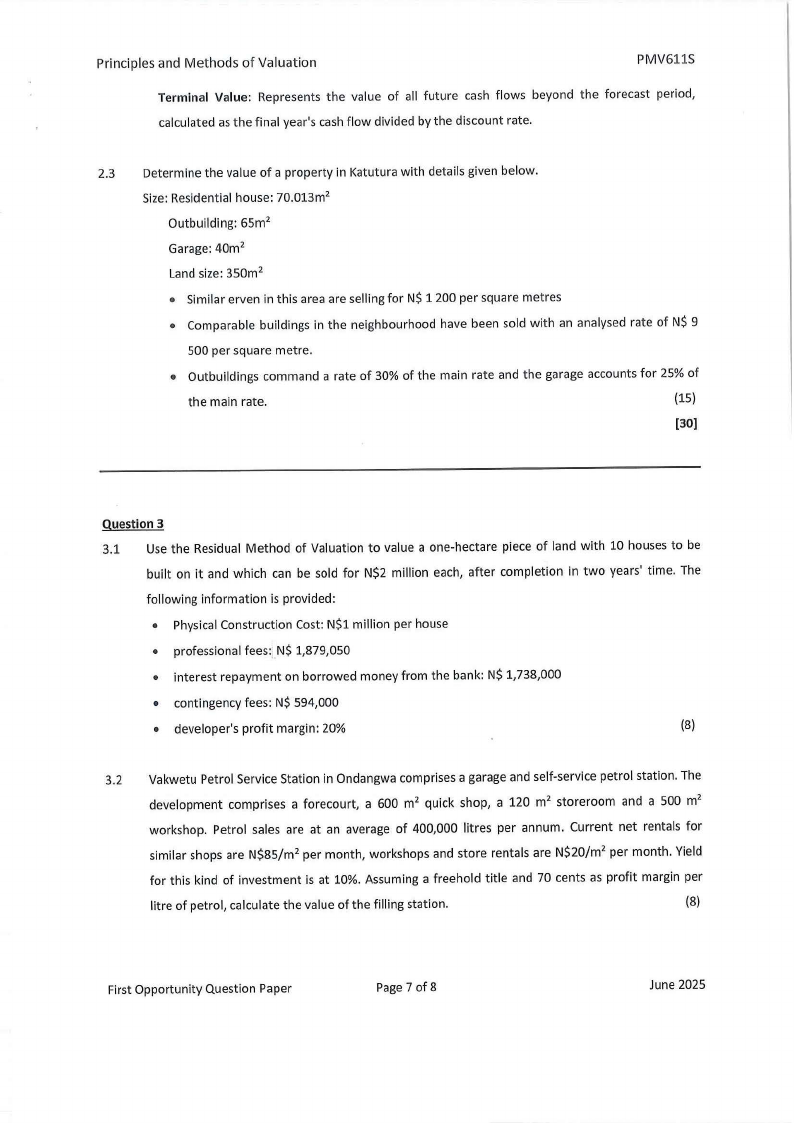
Terminal Value: Represents the value of all future cash flows beyond the forecast period,
calculated as the final year's cash flow divided by the discount rate.
2.3 Determine the value of a property in Katutura with details given below.
Size: Residential house: 70.013m2
Outbuilding: 65m2
Garage: 40m 2
Land size: 350m2
• Similar erven in this area are selling for N$ 1 200 per square metres
• Comparable buildings in the neighbourhood have been sold with an analysed rate of N$ 9
500 per square metre.
• Outbuildings command a rate of 30% of the main rate and the garage accounts for 25% of
the main rate.
(15)
[30)
Question 3
3.1 Use the Residual Method of Valuation to value a one-hectare piece of land with 10 houses to be
built on it and which can be sold for N$2 million each, after completion in two years' time. The
following information is provided:
• Physical Construction Cost: N$1 million per house
• professional fees: N$ 1,879,050
• interest repayment on borrowed money from the bank: N$ 1,738,000
• contingency fees: N$ 594,000
• developer's profit margin: 20%
(8)
3.2 Vakwetu Petrol Service Station in Ondangwa comprises a garage and self-service petrol station. The
development comprises a forecourt, a 600 m2 quick shop, a 120 m2 storeroom and a 500 m2
workshop. Petrol sales are at an average of 400,000 litres per annum. Current net rentals for
similar shops are N$85/m 2 per month, workshops and store rentals are N$20/m 2 per month. Yield
for this kind of investment is at 10%. Assuming a freehold title and 70 cents as profit margin per
litre of petrol, calculate the value of the filling station.
(8)
First Opportunity Question Paper
Page7 of 8
June 2025
|
|
8 Page 8 |
▲back to top |

Principles and Methods of Valuation
PMV611S
3.3 The estimated gross earnings of Zena Hotel is N$1,000,000 per annum. The cost of goods sold
(purchase) amount to N$450,000 and working expenses amount to N$150,000. If tenant
remuneration for working in the business is 45% of the Net Income and interest on capital is 8%,
calculate the rental value.
(8)
3.4 Using the variable yield of the Term and Reversion method, estimate the value of a freehold
interest in a shop premises in a secondary location let at a net rent of N$80,000 per annum on a
lease having 4 years remaining. The current market rental is estimated to be N$150,000. The yields
for the term and reversion are 7% and 8% respectively.
(6)
[30]
First Opportunity Question Paper
Page 8 of 8
June 2025