PLU411S - PRINCIPLES OF LANGUAGE USE PM DI - 1ST OPP - JUNE 2025


PLU411S - PRINCIPLES OF LANGUAGE USE PM DI - 1ST OPP - JUNE 2025


1 Page 1

▲back to top


nAmlBIA
unlVERSITY
OF SCIEnCE Ano TECHnOLOGY
FACULTYOF COMMERCE, HUMAN SCIENCEAND EDUCATION
DEPARTMENTOF COMMUNICATION AND LANGUAGES
QUALIFICATION:VARIOUS
QUALIFICATIONCODE: VARIOUS
COURSECODE: PLU411S
LEVEL: 4
COURSENAME: PRINCIPLESOF LANGUAGE USE
SESSION:
JUNE/JULY 2025
PAPER:
THEORY .f01\\DI_
DURATION: 3 HOURS
MARKS:
100
EXAMINER(S)
SECONDOPPORTUNITYEXAMINATION QUESTION PAPER
Dr R. Nekongo
Dr E. lthindi
Ms N. Haimbodi
Ms N. Ashimbuli
Ms K. Tameja
Ms J. Ndamanhomhata
Ms V. Verbeeck
Ms R. Ndengu
Mr R. Muyunda
MODERATOR: Mr C. Gwasira
INSTRUCTIONS
1. Answer ALL the questions.
2. Write clearly and neatly.
3. Number the answers clearly.
THIS QUESTIONPAPERCONSISTSOF _9_ PAGES(Including this front page}
1

2 Page 2

▲back to top


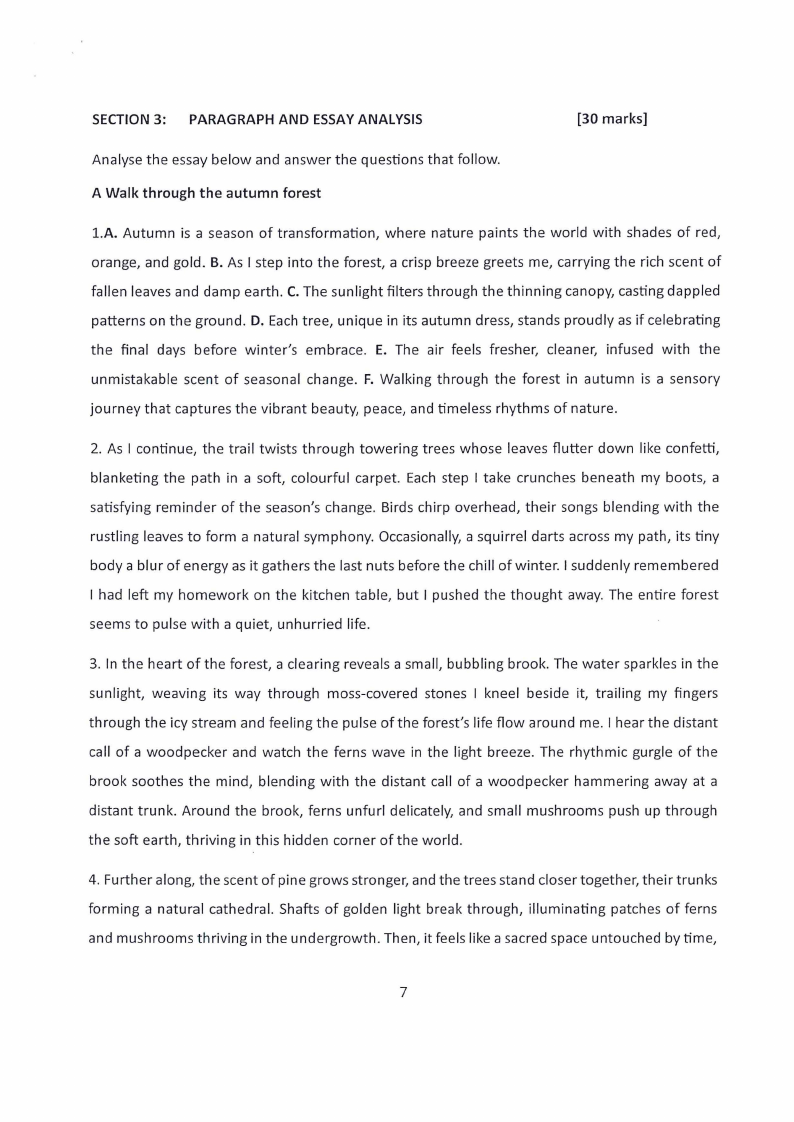
SECTION 1: READING COMPREHENSION
[30 marks]
Read the text below and answer the questions that follow, based on the text. Check the
instructions for each question carefully.
Challenges faced by first-year university students and how to overcome them
1. Transitioning from high school to university is an exciting yet daunting experience for many
students. First-year students face a range of challenges, from adapting to a new environment to
managing their academic workload. One of the biggest difficulties they encounter is adjusting to
the independent learning style required at university. Without proper guidance, many students
struggle to stay on top of their studies, resulting in stress and anxiety.
2. One of the most common challenges first-year students face is finding their way around
campus. Many universities are vast, with multiple buildings and lecture halls. This can make it
difficult for new students to locate their classes, especially during the first few weeks. To
overcome this, students should familiarize themselves with the campus map, ask for directions
from senior students or staff, and arrive early for classes until they gain confidence in navigating
the university grounds.
3. Another major issue is reading and understanding timetables. Unlike high school, where
schedules are fixed, university timetables often include different classes, lecturers, and venues
that change throughout the week. Misinterpreting the timetable can lead to missing important
lectures or arriving at the wrong location. To avoid this, students should carefully study their
timetable, highlight key information, and use digital tools such as calendar apps to set reminders
for classes and deadlines.
4. Excelling at university requires effective time management and self-discipline. Many students
struggle to balance academic responsibilities with social activities. To succeed, they must develop
a structured study plan, prioritize assignments, and avoid procrastination. Utilizing university
resources, such as study groups and academic workshops, can also be beneficial. Additionally,
seeking support from mentors or lecturers when facing difficulties can help students stay on
track. It is crucial to cultivate resilience and a tenacious attitude towards challenges to achieve
academic success.
5. Despite the challenges, being a first-year student has several advantages. It is a period of
exploration and growth, where students gain independence and new experiences. They have
access to diverse academic resources, clubs, and extracurricular activities that enrich their
university life. Furthermore, first-year students have the opportunity to build networks and
friendships that can support them throughout their academic journey. Engaging in university life
fosters personal development and enhances problem-solving skills, which are valuable in future
careers.
2

3 Page 3

▲back to top


6. To address these challenges, universities should provide orientation programs that help
students integrate smoothly into campus life. Institutions should also offer workshops on time
management and academic skills to equip students with the necessary tools for success.
Additionally, establishing mentorship programs where senior students guide first-year students
can be highly beneficial. Creating an environment where students feel supported and encouraged
will contribute to a positive university experience.
7. In conclusion, first-year university students face numerous challenges, including difficulty
finding classes, understanding timetables, managing their time, and dealing with peer pressure.
However, with proper planning, guidance, and the use of available resources, they can overcome
these obstacles and excel in their studies. Universities must also play a role in ensuring students
receive the support they need. By adopting effective strategies, students can make the most of
their university experience and build a strong foundation for their academic and professional
future.
Adapted from https://chatgtp.com
1.1 What is the passage about?
(2)
1.2. What is the number one challenge faced by first-year students?
(1)
1.3. What is the main idea expressed in paragraph 2?
(2)
1. 4. What can students do to find their way around campus easily?
(3)
1.5. What does the highlighted word they in paragraph 1 refer to?
(1)
1.6 How can students avoid missing lectures and confusing their venues?
(3)
1.7 What are the three advantages of being a first-year student as expressed in paragraph 5? (6)
1.8. According to the passage, how can institutions or universities address the challenges that
first-year students face?
(4)
1.9 Vocabulary-based question. Match the definitions given in Column B with the selected 5
words in Column A, as they are used in the passage. Please note that there are two odd choices.
E.g. 1.9.1 B
(5)
Column A: Words
1.9.1 tenacious
1.9.2 procrastination
1.9.3 extracurricular
1.9.4 resilience
(paragraph 4)
(paragraph 4)
(paragraph 5 )
(paragraph 4)
Column B: Definitions
A. The ability to recover
difficulties.
quickly
from
3

4 Page 4

▲back to top


1.9.5 navigating
(paragraph 2 )
B. To find one's way around a place.
C. Holding on firmly to a goal despite
challenges.
D. Delaying tasks unnecessarily.
E. Activities outside the regular academic
curriculum.
F.The act of exploring an unfamiliar area.
G. The use of persuasion or intimidation to
make someone do something.
10. Decide whether the following statements are True or False.
(3)
10.1. Unlike in high school, university timetables follow a strict and unchanging structure, making
it easier for students to plan their schedules.
10.2. Although first-year students encounter challenges, they do not have opportunities to
develop social and academic networks that support them.
10.3. Universities can contribute to student success by implementing support systems such as
orientation programs, time management workshops, and mentorship initiatives.
SECTION2: GRAMMARAND LANGUAGEUSAGE
[30 marks]
Read the following text carefully again, taken from Section A, and answer the questions that
follow.
1. Transitioning from high school to university is an exciting yet daunting experience for many
students. First-year students face a range of challenges, from adapting to a new environment to
managing their academic workload. One of the biggest difficulties they encounter is adjusting to
the independent learning style required at university. Without proper guidance, many students
struggle to stay on top of their studies, resulting in stress and anxiety.
2. One of the most common challenges first-year students face is finding their way around
campus. Many universities are vast, with multiple buildings and lecture halls. This can make it
difficult for new students to locate their classes, especially during the first few weeks. To
overcome this, students should familiarize themselves with the campus map, ask for directions
4

5 Page 5

▲back to top


from senior students or staff, and arrive early for classes until they gain confidence in navigating
the university grounds.
3. Another major issue is reading and understanding timetables. Unlike high school, where
schedules are fixed, university timetables often include different classes, lecturers, and venues
that change throughout the week. Misinterpreting the timetable can lead to missing important
lectures or arriving at the wrong location. To avoid this, students should carefully study their
timetable, highlight key information, and use digital tools such as calendar apps to set reminders
for classes and deadlines.
4. Excelling at university requires effective time management and self-discipline. Many students
struggle to balance academic responsibilities with social activities. To succeed, they must develop
a structured study plan, prioritize assignments, and avoid procrastination. Utilizing university
resources, such as study groups and academic workshops, can also be beneficial. Additionally,
seeking support from mentors or lecturers when facing difficulties can help students stay on
track. It is crucial to cultivate resilience and a tenacious attitude towards challenges to achieve
academic success.
2.1 Identify the part of speech of each balded word in Paragraph 2 of the text above, as per the
function of the word in the sentence.
(7)
2.1.1 of
2.1.2 challenges
2.1.3 their
2.1.4 universities
2.1.5 and
2.1.6 new
2.1.7 especially
2.2. Articles form parts of speech in English. Construct a sentence in which you use all the words
that constitute the articles and underline them. Each article must only be used once.
(3)
2.3 What verb tense is the sentence below?
(1)
Sentence: Excelling at university requires effective time management and self-discipline.
2.4 Change the sentence in Question 2.3 above into the following tenses:
2.4.1 Future tense simple
(2)
2.4.2 Past perfect tense simple
(2)
5

6 Page 6

▲back to top


2.5 Write the sentence written in bold in Paragraph 4 in the following forms:
Sentence: It is crucial to cultivate resilience and a tenacious attitude towards challenges to
achieve academic success.
2.5.1 Question form
(2)
2.5.2 Negative form
(2)
2.6 Firstly, identify and write down the subject and the verb in the sentences below. Then, indicate
whether the subject and the verb agree or disagree.
2.6.1 Another major issue is reading and understanding timetables.
a. The subject .....
b. The verb ...
(2)
c. Agree or Disagree?
(1)
2.6.2 Many students struggle to balance academic responsibilities with social activities.
a. The subject: ....
b. The verb: ...
(2)
c. Agree or Disagree? ....
(1)
2.7 You were taught four different types of sentences in this course. Decide what type the
following sentences are. E.g., Compound, simple, etc.
(5)
2.7.1 Without proper guidance, many students struggle to stay on top of their studies, resulting
in stress and anxiety.
2.7.2 One of the most common challenges first-year students face is finding their way around
campus.
2.7.3 Because it was raining, we stayed indoors, and we played board games all afternoon.
2.7.4 Misinterpreting the timetable can lead to missing important lectures or arriving at the
wrong location.
2.7.5. I finished my assignment, but I forgot to submit it online.
6

7 Page 7

▲back to top


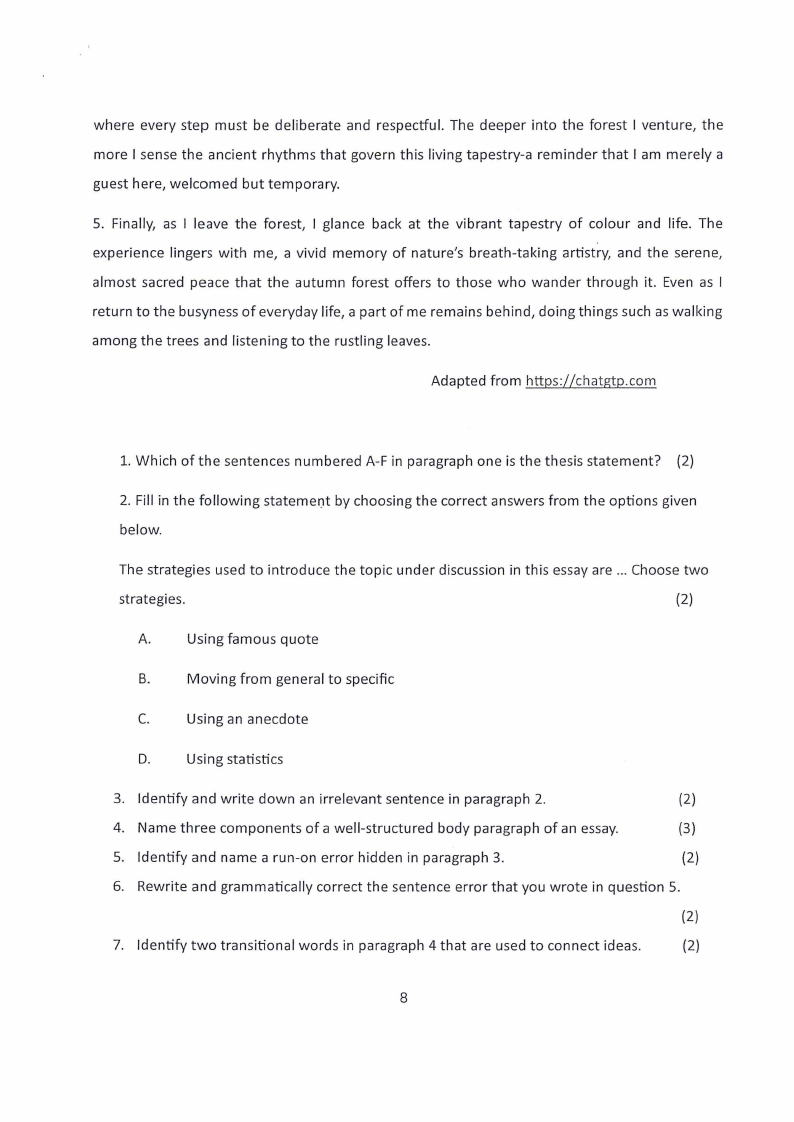
SECTION 3: PARAGRAPH AND ESSAYANALYSIS
[30 marks]
Analyse the essay below and answer the questions that follow.
A Walk through the autumn forest
1.A. Autumn is a season of transformation, where nature paints the world with shades of red,
orange, and gold. B. As I step into the forest, a crisp breeze greets me, carrying the rich scent of
fallen leaves and damp earth. C. The sunlight filters through the thinning canopy, casting dappled
patterns on the ground. D. Each tree, unique in its autumn dress, stands proudly as if celebrating
the final days before winter's embrace. E. The air feels fresher, cleaner, infused with the
unmistakable scent of seasonal change. F. Walking through the forest in autumn is a sensory
journey that captures the vibrant beauty, peace, and timeless rhythms of nature.
2. As I continue, the trail twists through towering trees whose leaves flutter down like confetti,
blanketing the path in a soft, colourful carpet. Each step I take crunches beneath my boots, a
satisfying reminder of the season's change. Birds chirp overhead, their songs blending with the
rustling leaves to form a natural symphony. Occasionally, a squirrel darts across my path, its tiny
body a blur of energy as it gathers the last nuts before the chill of winter. I suddenly remembered
I had left my homework on the kitchen table, but I pushed the thought away. The entire forest
seems to pulse with a quiet, unhurried life.
3. In the heart of the forest, a clearing reveals a small, bubbling brook. The water sparkles in the
sunlight, weaving its way through moss-covered stones I kneel beside it, trailing my fingers
through the icy stream and feeling the pulse of the forest's life flow around me. I hear the distant
call of a woodpecker and watch the ferns wave in the light breeze. The rhythmic gurgle of the
brook soothes the mind, blending with the distant call of a woodpecker hammering away at a
distant trunk. Around the brook, ferns unfurl delicately, and small mushrooms push up through
the soft earth, thriving in this hidden corner of the world.
4. Further along, the scent of pine grows stronger, and the trees stand closer together, their trunks
forming a natural cathedral. Shafts of golden light break through, illuminating patches of ferns
and mushrooms thriving in the undergrowth. Then, it feels like a sacred space untouched by time,
7

8 Page 8

▲back to top


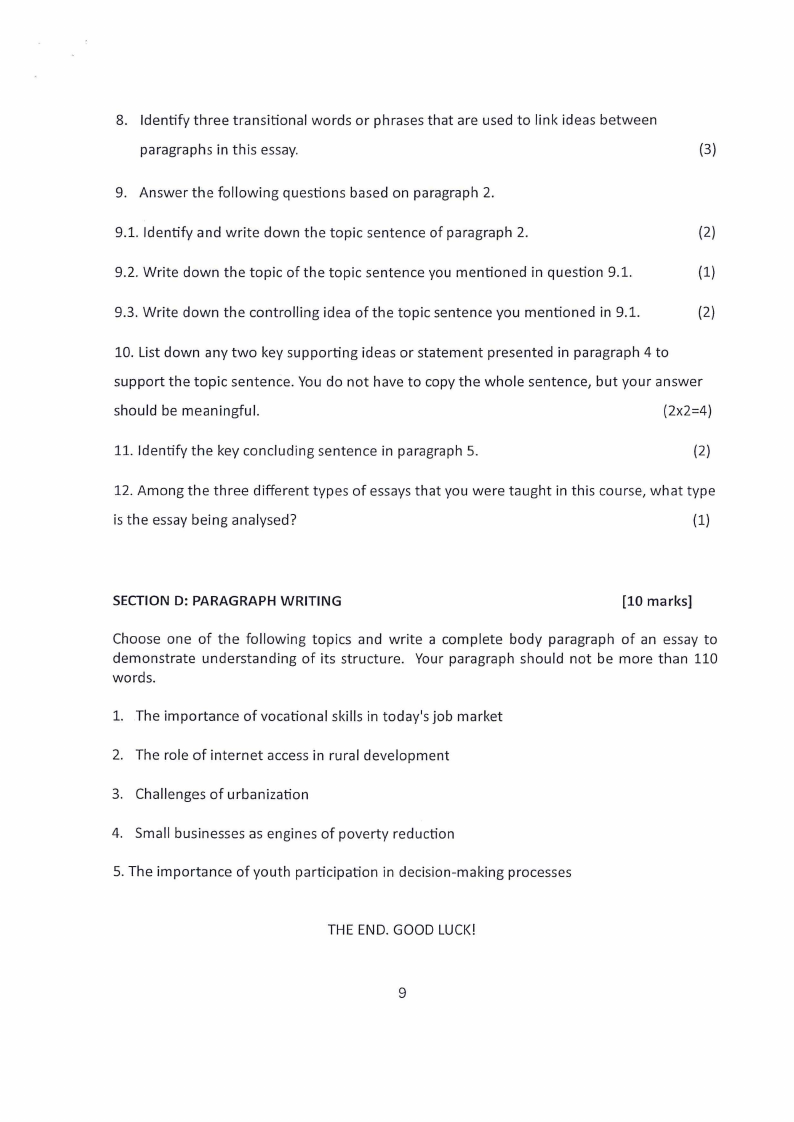
where every step must be deliberate and respectful. The deeper into the forest I venture, the
more I sense the ancient rhythms that govern this living tapestry-a reminder that I am merely a
guest here, welcomed but temporary.
5. Finally, as I leave the forest, I glance back at the vibrant tapestry of colour and life. The
experience lingers with me, a vivid memory of nature's breath-taking artistry, and the serene,
almost sacred peace that the autumn forest offers to those who wander through it. Even as I
return to the busyness of everyday life, a part of me remains behind, doing things such as walking
among the trees and listening to the rustling leaves.
Adapted from https://chatgtp.com
1. Which of the sentences numbered A-Fin paragraph one is the thesis statement? (2)
2. Fill in the following statemer:it by choosing the correct answers from the options given
below.
The strategies used to introduce the topic under discussion in this essay are ... Choose two
strategies.
(2)
A.
Using famous quote
B.
Moving from general to specific
C.
Using an anecdote
D.
Using statistics
3. Identify and write down an irrelevant sentence in paragraph 2.
(2)
4. Name three components of a well-structured body paragraph of an essay.
(3)
5. Identify and name a run-on error hidden in paragraph 3.
(2)
6. Rewrite and grammatically correct the sentence error that you wrote in question 5.
(2)
7. Identify two transitional words in paragraph 4 that are used to connect ideas.
(2)
8

9 Page 9

▲back to top


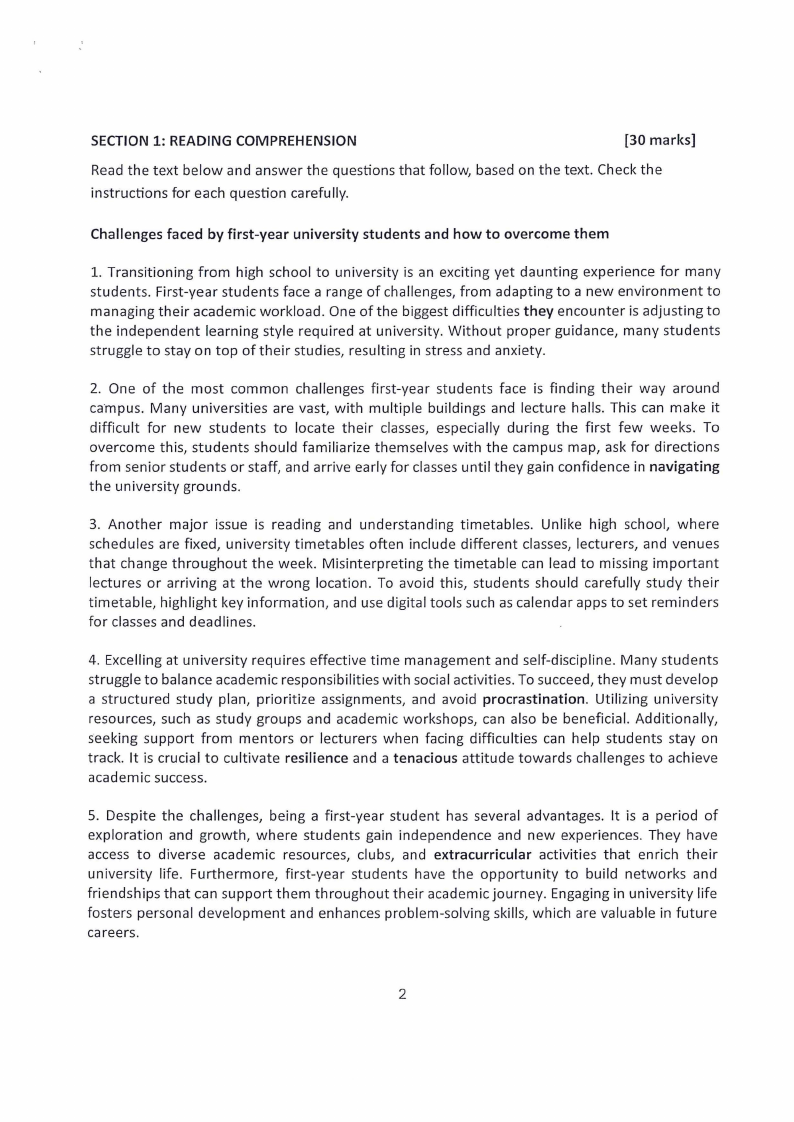
8. Identify three transitional words or phrases that are used to link ideas between
paragraphs in this essay.
(3)
9. Answer the following questions based on paragraph 2.
9.1. Identify and write down the topic sentence of paragraph 2.
(2)
9.2. Write down the topic of the topic sentence you mentioned in question 9.1.
(1)
9.3. Write down the controlling idea of the topic sentence you mentioned in 9.1.
(2)
10. List down any two key supporting ideas or statement presented in paragraph 4 to
support the topic sentence. You do not have to copy the whole sentence, but your answer
should be meaningful.
(2x2=4)
11. Identify the key concluding sentence in paragraph 5.
(2)
12. Among the three different types of essays that you were taught in this course, what type
is the essay being analysed?
(1)
SECTION D: PARAGRAPH WRITING
[10 marks]
Choose one of the following topics and write a complete body paragraph of an essay to
demonstrate understanding of its structure. Your paragraph should not be more than 110
words.
1. The importance of vocational skills in today's job market
2. The role of internet access in rural development
3. Challenges of urbanization
4. Small businesses as engines of poverty reduction
5. The importance of youth participation in decision-making processes
THE END. GOOD LUCK!
9