


 |
GRE811S-CORPORATE GOVERNANCE RISK MANAGEMENT AND ETHICS- 1ST OPP- JUNE 2025 |
|
|
1 Page 1 |
▲back to top |
nAmlBIA UnlVERSITY
OF SCIEnCE Ano TECHn OLOGY
FACULTY OF COMMERCE, HUMAN SCIENCESAND EDUCATION
DEPARTMENT OF ECONOMICS, ACCOUNTING & FINANCE
QUALIFICATION : BACHELOR OF ACCOUNTING {HONOURS)
QUALIFICATION CODE: 08BOAH
COURSE CODE: GRE 811S
LEVEL: 8
COURSE NAME: CORPORATE GOVERNANCE,
RISK MANAGEMENT AND ETHICS
DATE: JUNE 2025
DURATION: 3 HOURS
PAPER: THEORY AND APPLICATION
MARKS: 100
EXAMINER:
MODERATOR:
FIRST OPPORTUNITY EXAMINATION
Dumisani R. Muzira
Marko Tandota
INSTRUCTIONS
• This question paper is made up of FOUR (4) questions.
• Start each question on a new page.
• Answer All the questions and in blue or black ink.
• You are advised to pay due attention to expression and presentation. Failure to do so
will cost you marks.
• Start each question on a new page in your answer booklet
PERMISSIBLE MATERIALS
Non-programmable calculator/financial calculator
THIS QUESTION PAPER CONSISTS OF 5 PAGES {Including this front page)
pg.1
|
|
2 Page 2 |
▲back to top |
Question 1
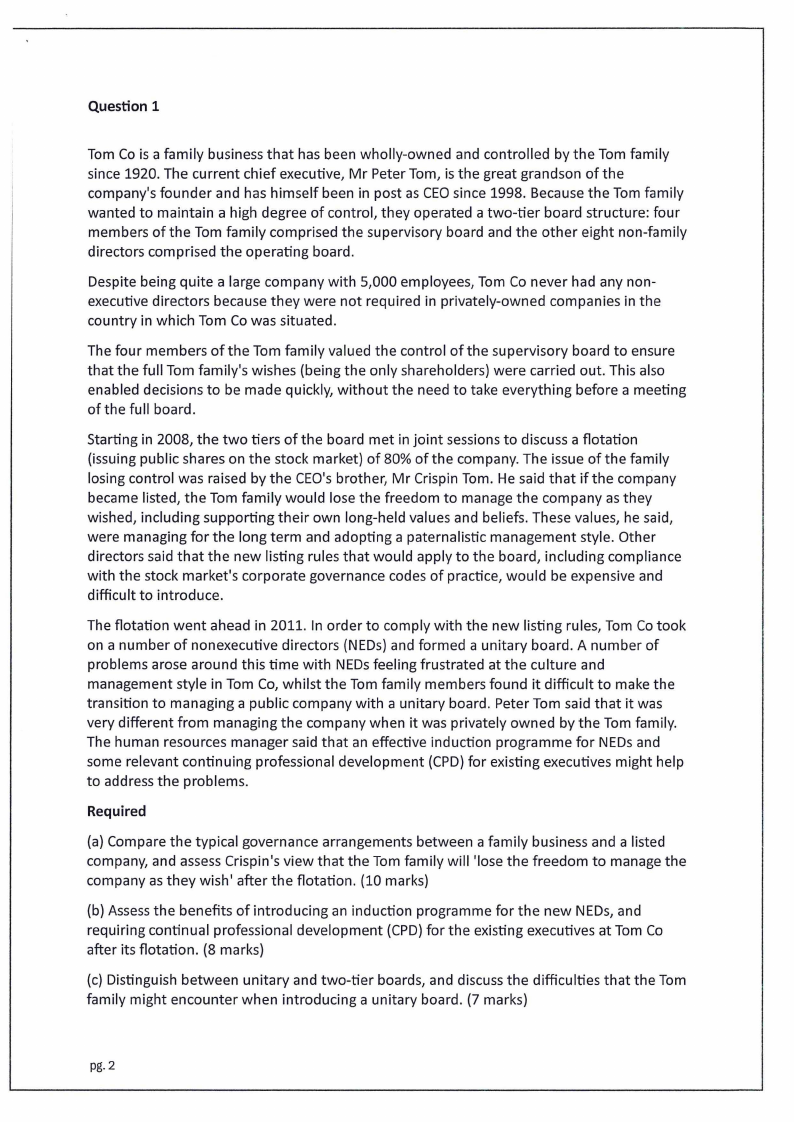
Tom Co is a family business that has been wholly-owned and controlled by the Tom family
since 1920. The current chief executive, Mr Peter Tom, is the great grandson of the
company's founder and has himself been in post as CEOsince 1998. Because the Tom family
wanted to maintain a high degree of control, they operated a two-tier board structure: four
members of the Tom family comprised the supervisory board and the other eight non-family
directors comprised the operating board.
Despite being quite a large company with 5,000 employees, Tom Co never had any non-
executive directors because they were not required in privately-owned companies in the
country in which Tom Co was situated.
The four members of the Tom family valued the control ofthe supervisory board to ensure
that the full Tom family's wishes (being the only shareholders) were carried out. This also
enabled decisions to be made quickly, without the need to take everything before a meeting
of the full board.
Starting in 2008, the two tiers of the board met in joint sessions to discuss a flotation
(issuing public shares on the stock market) of 80% of the company. The issue of the family
losing control was raised by the CEO'sbrother, Mr Crispin Tom. He said that if the company
became listed, the Tom family would lose the freedom to manage the company as they
wished, including supporting their own long-held values and beliefs. These values, he said,
were managing for the long term and adopting a paternalistic management style. Other
directors said that the new listing rules that would apply to the board, including compliance
with the stock market's corporate governance codes of practice, would be expensive and
difficult to introduce.
The flotation went ahead in 2011. In order to comply with the new listing rules, Tom Co took
on a number of nonexecutive directors (NEDs) and formed a unitary board. A number of
problems arose around this time with NEDsfeeling frustrated at the culture and
management style in Tom Co, whilst the Tom family members found it difficult to make the
transition to managing a public company with a unitary board. Peter Tom said that it was
very different from managing the company when it was privately owned by the Tom family.
The human resources manager said that an effective induction programme for NEDs and
some relevant continuing professional development (CPD)for existing executives might help
to address the problems.
Required
(a) Compare the typical governance arrangements between a family business and a listed
company, and assess Crispin's view that the Tom family will 'lose the freedom to manage the
company as they wish' after the flotation. (10 marks)
(b) Assessthe benefits of introducing an induction programme for the new NEDs,and
requiring continual professional development (CPD)for the existing executives at Tom Co
after its flotation. (8 marks)
(c) Distinguish between unitary and two-tier boards, and discuss the difficulties that the Tom
family might encounter when introducing a unitary board. (7 marks)
pg.2
|
|
3 Page 3 |
▲back to top |
Question 2
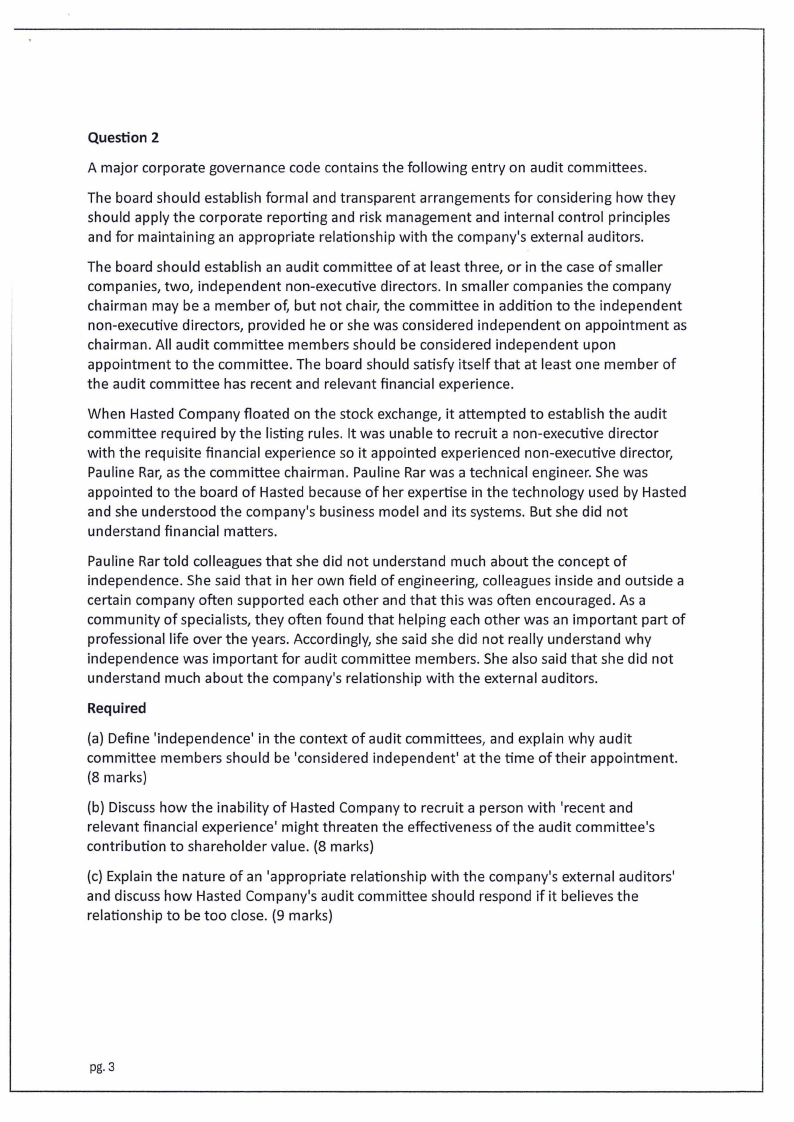
A major corporate governance code contains the following entry on audit committees.
The board should establish formal and transparent arrangements for considering how they
should apply the corporate reporting and risk management and internal control principles
and for maintaining an appropriate relationship with the company's external auditors.
The board should establish an audit committee of at least three, or in the case of smaller
companies, two, independent non-executive directors. In smaller companies the company
chairman may be a member of, but not chair, the committee in addition to the independent
non-executive directors, provided he or she was considered independent on appointment as
chairman. All audit committee members should be considered independent upon
appointment to the committee. The board should satisfy itself that at least one member of
the audit committee has recent and relevant financial experience.
When Hasted Company floated on the stock exchange, it attempted to establish the audit
committee required by the listing rules. It was unable to recruit a non-executive director
with the requisite financial experience so it appointed experienced non-executive director,
Pauline Rar, as the committee chairman. Pauline Rar was a technical engineer. She was
appointed to the board of Hasted because of her expertise in the technology used by Hasted
and she understood the company's business model and its systems. But she did not
understand financial matters.
Pauline Rar told colleagues that she did not understand much about the concept of
independence. She said that in her own field of engineering, colleagues inside and outside a
certain company often supported each other and that this was often encouraged. As a
community of specialists, they often found that helping each other was an important part of
professional life over the years. Accordingly, she said she did not really understand why
independence was important for audit committee members. She also said that she did not
understand much about the company's relationship with the external auditors.
Required
(a) Define 'independence' in the context of audit committees, and explain why audit
committee members should be 'considered independent' at the time of their appointment.
(8 marks)
(b) Discuss how the inability of Hasted Company to recruit a person with 'recent and
relevant financial experience' might threaten the effectiveness of the audit committee's
contribution to shareholder value. (8 marks)
(c) Explain the nature of an 'appropriate relationship with the company's external auditors'
and discuss how Hasted Company's audit committee should respond if it believes the
relationship to be too close. (9 marks)
pg.3
|
|
4 Page 4 |
▲back to top |
Question 3
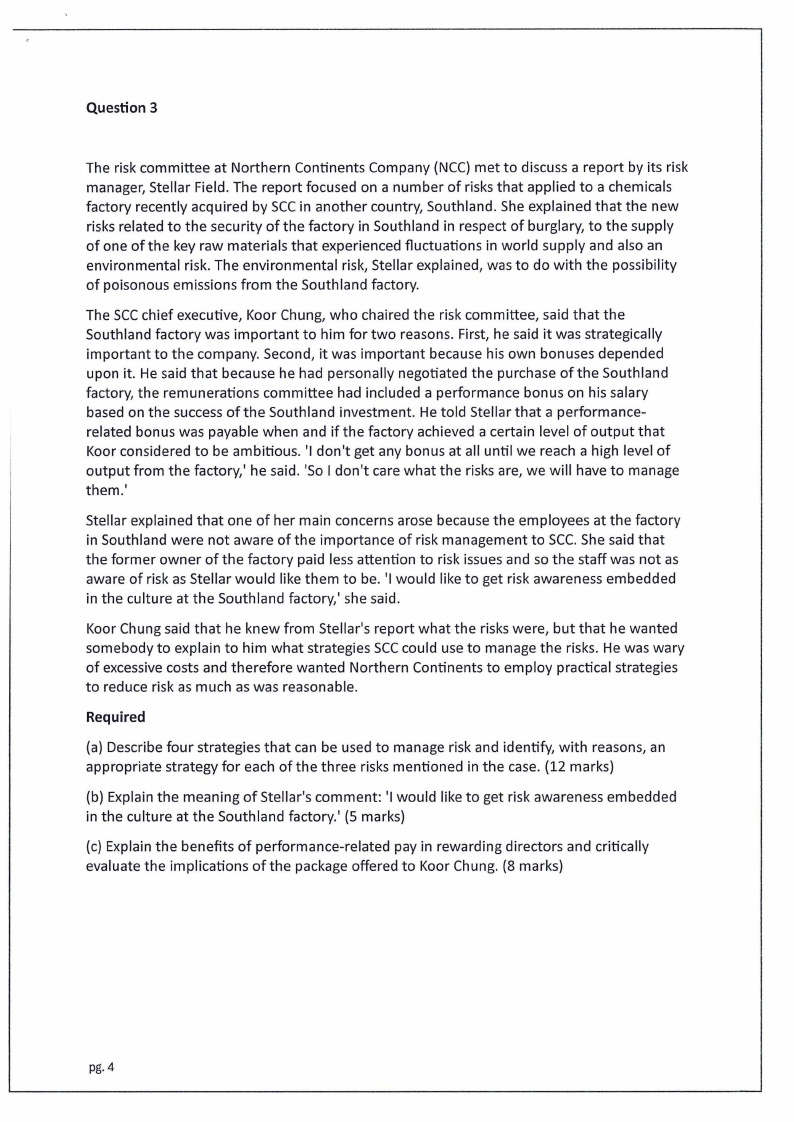
The risk committee at Northern Continents Company (NCC)met to discuss a report by its risk
manager, Stellar Field. The report focused on a number of risks that applied to a chemicals
factory recently acquired by SCCin another country, Southland. She explained that the new
risks related to the security of the factory in Southland in respect of burglary, to the supply
of one of the key raw materials that experienced fluctuations in world supply and also an
environmental risk. The environmental risk, Stellar explained, was to do with the possibility
of poisonous emissions from the Southland factory.
The SCCchief executive, Koor Chung, who chaired the risk committee, said that the
Southland factory was important to him for two reasons. First, he said it was strategically
important to the company. Second, it was important because his own bonuses depended
upon it. He said that because he had personally negotiated the purchase of the Southland
factory, the remunerations committee had included a performance bonus on his salary
based on the success of the Southland investment. He told Stellar that a performance-
related bonus was payable when and if the factory achieved a certain level of output that
Koor considered to be ambitious. 'I don't get any bonus at all until we reach a high level of
output from the factory,' he said. 'So I don't care what the risks are, we will have to manage
them.'
Stellar explained that one of her main concerns arose because the employees at the factory
in Southland were not aware of the importance of risk management to SCC.She said that
the former owner of the factory paid less attention to risk issues and so the staff was not as
aware of risk as Stellar would like them to be. 'I would like to get risk awareness embedded
in the culture at the Southland factory,' she said.
Koor Chung said that he knew from Stella r's report whatthe risks were, but that he wanted
somebody to explain to him what strategies SCCcould use to manage the risks. He was wary
of excessive costs and therefore wanted Northern Continents to employ practical strategies
to reduce risk as much as was reasonable.
Required
(a) Describe four strategies that can be used to manage risk and identify, with reasons, an
appropriate strategy for each of the three risks mentioned in the case. (12 marks)
(b) Explain the meaning of Stellar's comment: 'I would like to get risk awareness embedded
in the culture at the Southland factory.' (5 marks)
(c) Explain the benefits of performance-related pay in rewarding directors and critically
evaluate the implications of the package offered to Koor Chung. (8 marks)
pg.4
|
|
5 Page 5 |
▲back to top |
Question 4
Pee pie is a publicly quoted company. Its products are based on raw materials grown in
tropical countries and processed either in these countries or in the eventual sales markets.
Processing is undertaken partly by Pee pie and partly by sub-contractors. The products are
branded and sold worldwide, but mainly in the United Kingdom and North America. They
are sold to consumers through a very large number of outlets.
Pee's chief executive has always regarded annual reporting as ideally never exceeding legal
requirements. However, the non-executive directors have for some time expressed concern
that the company has not developed any systems of environmental or social reporting to
shareholders, although many comparable companies already publish such information as
part of their Annual Report. A government minister has now stated that legislation will be
considered if all companies do not make progress on reporting on social and environmental
policies. One non-executive director has raised the possibility of going further and preparing
a report-~ased on t_heprinciples of integrated reporting.
Required
(a) Identify the main issues that could be covered in the environmental and social report. {8
marks)
(b) Analyse the impact of business p·cirtnersand other stakeholders on the content of the
environmental and·sodal report. (5 marks)
(c) Identify the information that the board requires to review the company's progress on
environmental and social issues. (6 marks)
(d) Explore how an integrated report on Pee's activities could provide wider insights than an
environmental and social report. (6 marks)
pg.5