


 |
PRS521S - Principles And Practices Of Sports Management - 2nd Opp - Nov 2025 |
|
|
1 Page 1 |
▲back to top |
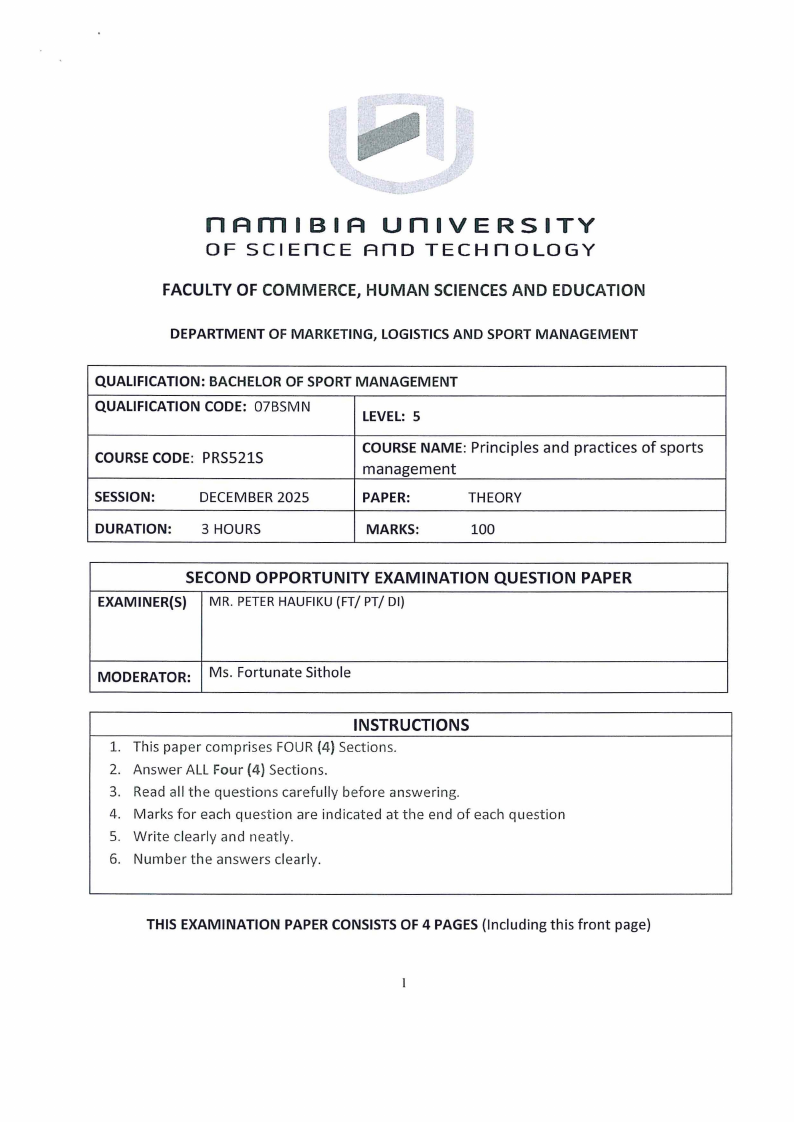
n Am I B I A u n IVE Rs I TY
OF SCI En CE Ano TECH n □ LOGY
FACULTY OF COMMERCE, HUMAN SCIENCES AND EDUCATION
DEPARTMENT OF MARKETING, LOGISTICS AND SPORT MANAGEMENT
QUALIFICATION: BACHELOR OF SPORT MANAGEMENT
QUALIFICATION CODE: 07BSMN
LEVEL: 5
COURSE CODE: PRS521S
SESSION:
DECEMBER 2025
COURSE NAME: Principles and practices of sports
management
PAPER:
THEORY
DURATION: 3 HOURS
MARKS:
100
SECOND OPPORTUNITY EXAMINATION QUESTION PAPER
EXAMINER(S) MR. PETER HAUFIKU (FT/ PT/ DI)
MODERATOR: Ms. Fortunate Sithole
INSTRUCTIONS
1. This paper comprises FOUR (4) Sections.
2. Answer ALL Four (4) Sections.
3. Read all the questions carefully before answering.
4. Marks for each question are indicated at the end of each question
5. Write clearly and neatly.
6. Number the answers clearly.
THIS EXAMINATION PAPER CONSISTS OF 4 PAGES {Including this front page)
|
|
2 Page 2 |
▲back to top |
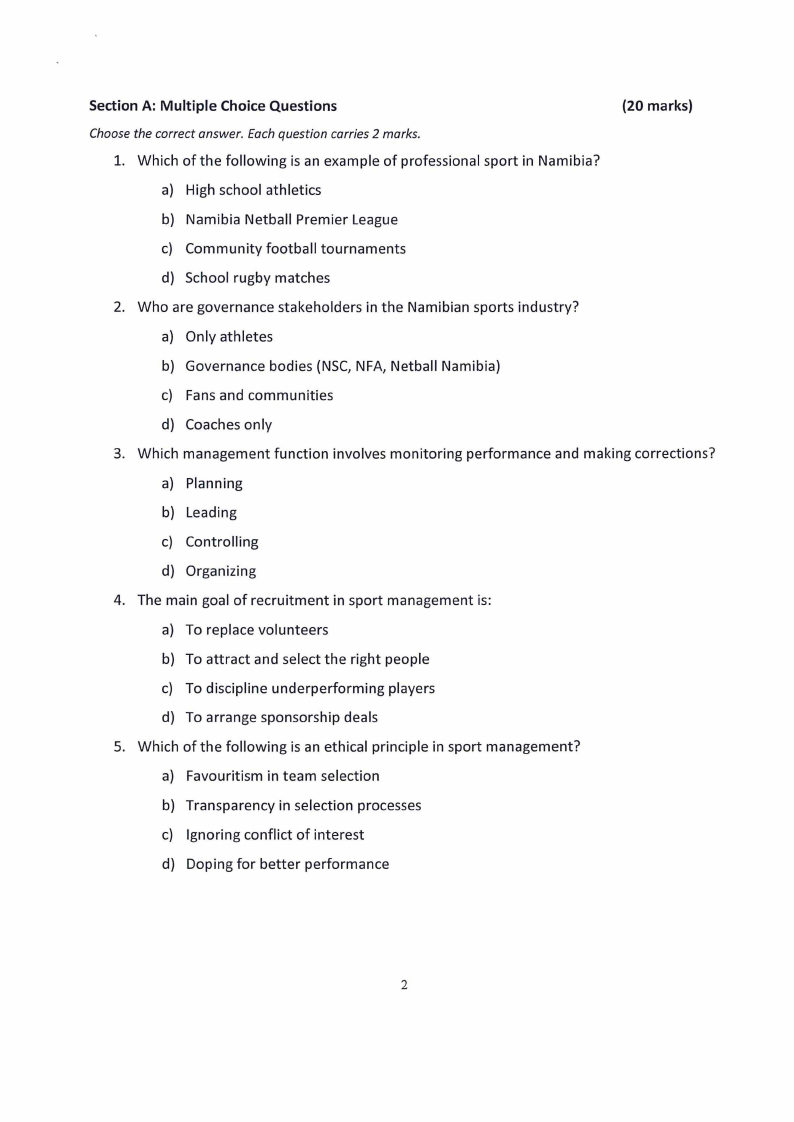
Section A: Multiple Choice Questions
(20 marks)
Choose the correct answer. Each question carries 2 marks.
1. Which of the following is an example of professional sport in Namibia?
a) High school athletics
b) Namibia Netball Premier League
c) Community football tournaments
d) School rugby matches
2. Who are governance stakeholders in the Namibian sports industry?
a) Only athletes
b) Governance bodies (NSC, NFA, Netball Namibia)
c) Fans and communities
d) Coaches only
3. Which management function involves monitoring performance and making corrections?
a) Planning
b) Leading
c) Controlling
d) Organizing
4. The main goal of recruitment in sport management is:
a) To replace volunteers
b) To attract and select the right people
c) To discipline underperforming players
d) To arrange sponsorship deals
5. Wh ich of the following is an ethical principle in sport management?
a) Favouritism in team selection
b) Transparency in selection processes
c) Ignoring conflict of interest
d) Doping for better performance
2
|
|
3 Page 3 |
▲back to top |
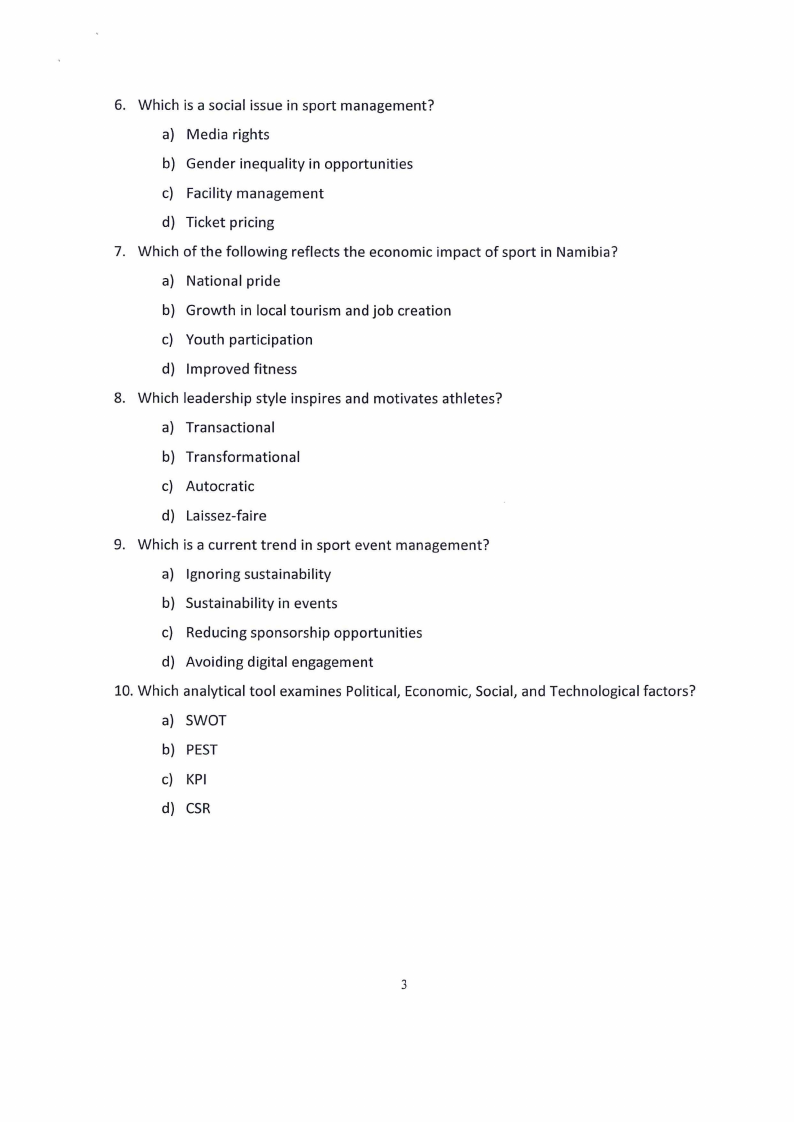
6. Which is a social issue in sport management?
a) Media rights
b) Gender inequality in opportunities
c) Facility management
d) Ticket pricing
7. Which of the following reflects the economic impact of sport in Namibia?
a) National pride
b) Growth in local tourism and job creation
c) Youth participation
d) Improved fitness
8. Which leadership style inspires and motivates athletes?
a) Transactional
b) Transformational
c) Autocratic
d) Laissez-faire
9. Which is a current trend in sport event management?
a) Ignoring sustainability
b) Sustainability in events
c) Reducing sponsorship opportunities
d) Avoiding digital engagement
10. Which analytical tool examines Political, Economic, Social, and Technological factors?
a) SWOT
b) PEST
c) KPI
d) CSR
3
|
|
4 Page 4 |
▲back to top |
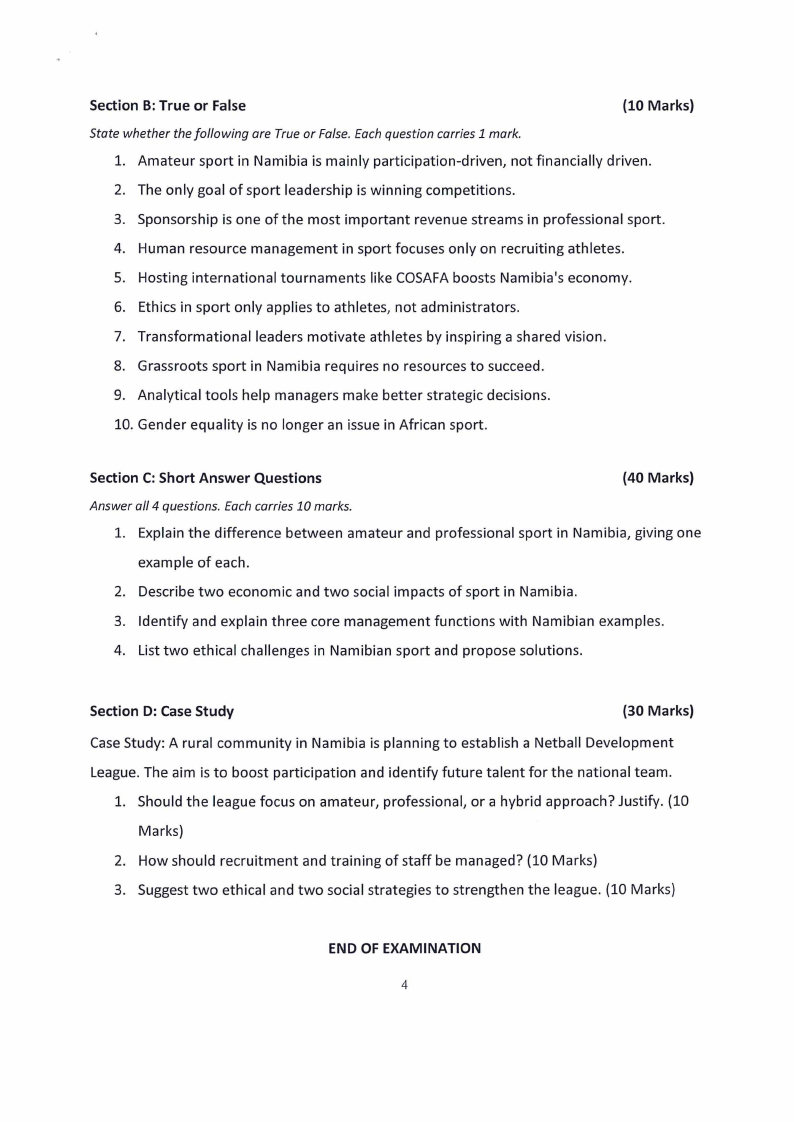
Section B: True or False
(10 Marks)
State whether the following are True or False. Each question carries 1 mark.
1. Amateur sport in Namibia is mainly participation-driven, not financially driven .
2. The only goal of sport leadership is winning competitions .
3. Sponsorship is one of the most important revenue streams in professional sport.
4. Human resource management in sport focuses only on recruiting athletes.
5. Hosting international tournaments like COSAFA boosts Namibia's economy.
6. Ethics in sport only applies to athletes, not administrators.
7. Transformational leaders motivate athletes by inspiring a shared vision.
8. Grassroots sport in Namibia requires no resources to succeed.
9. Analytical tools help managers make better strategic decisions.
10. Gender equality is no longer an issue in African sport.
Section C: Short Answer Questions
(40 Marks)
Answer all 4 questions. Each carries 10 marks.
1. Explain the difference between amateur and professional sport in Namibia, giving one
example of each.
2. Describe two economic and two social impacts of sport in Namibia .
3. Identify and explain three core management functions with Namibian examples.
4. List two ethical challenges in Namibian sport and propose solutions.
Section D: Case Study
(30 Marks)
Case Study: A rural community in Namibia is planning to establish a Netball Development
League. The aim is to boost participation and identify future talent for the national team .
1. Should the league focus on amateur, professional, or a hybrid approach? Justify. {10
Marks)
2. How should recruitment and training of staff be managed? {10 Marks)
3. Suggest two ethical and two social strategies to strengthen the league. (10 Marks)
END OF EXAMINATION
4