


 |
ASP720S - APPLIED SPATIAL PLANNING - 1ST OPP - JUNE 2025 |
|
|
1 Page 1 |
▲back to top |
nAm I BIA UnlVERSITY
OF SCIEnCE Ano TECHn OLOGY
FACULTY OF ENGINEERING AND THE BUILT ENVIRONMENT
DEPARTMENT OF ARCHITECTURE, PLANNING AND CONSTRUCTION
QUALIFICATION: BACHELOROF REGIONALAND RURALDEVELOPMENT
QUALIFICATION CODE: 07BRAR
LEVEL: 7
COURSE CODE: ASP720S
COURSE NAME: APPLIEDSPATIALPLANNING
DATE: JUNE 2025
PAPER: THEORY
DURATION: 3 HOURS
MARKS: 100
EXAMINER{S)
MODERATOR
FIRST OPPORTUNITY EXAMINATION QUESTION PAPER
Dr. Laudika J Kandjinga
Ms. Rosena Mubiana
INSTRUCTIONS
1. Read the entire question paper before answering the questions.
2. Read each question carefully and address all parts of the questions.
3. Answer ALLthe questions.
4. Answers may be written in any order but must be legibly numbered.
5. Please write clearly and legibly.
6. Ensure your Student Number is on the EXAMINATION BOOK(s).
Permissible Items: Pencil, eraser, and ruler
THIS QUESTION PAPER CONSISTS OF 3 PAGES
(Including this front page)
|
|
2 Page 2 |
▲back to top |
Applied Spatial Planning
ASP720S
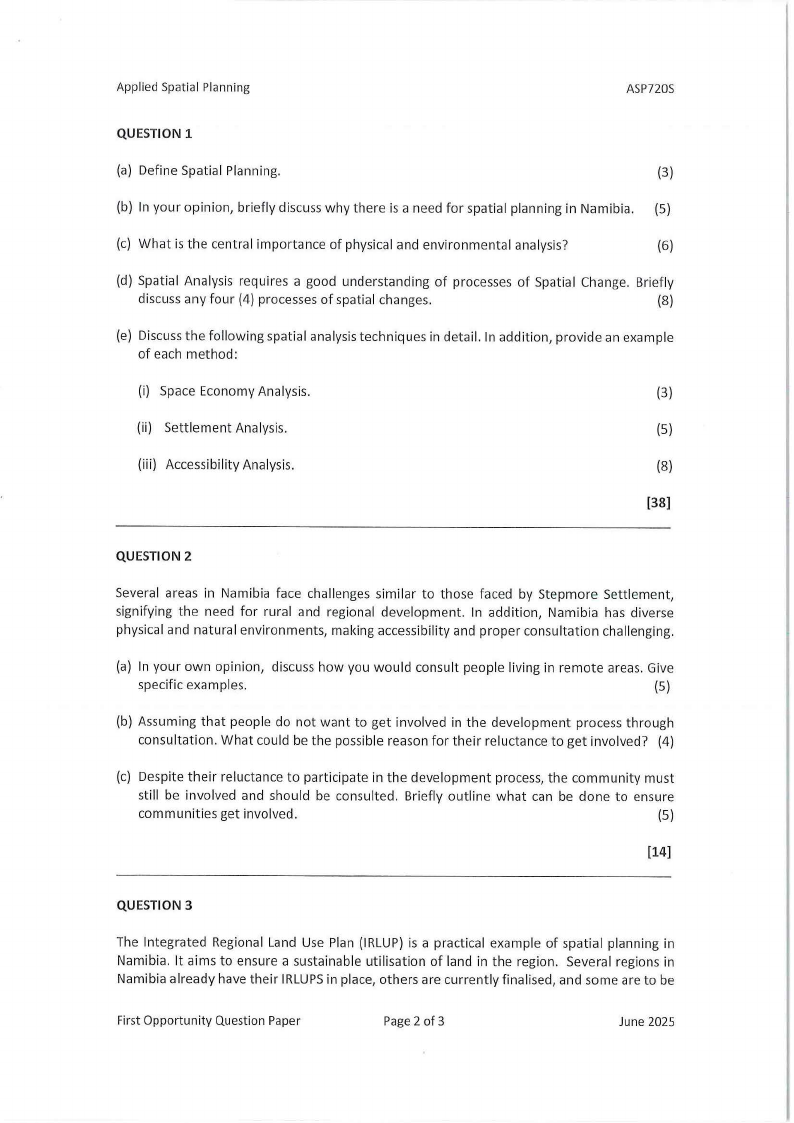
QUESTION 1
(a) Define Spatial Planning.
(3)
(b) In your opinion, briefly discuss why there is a need for spatial planning in Namibia. (5)
(c) What is the central importance of physical and environmental analysis?
(6)
(d) Spatial Analysis requires a good understanding of processes of Spatial Change. Briefly
discuss any four (4) processes of spatial changes.
(8)
(e) Discussthe following spatial analysis techniques in detail. In addition, provide an example
of each method:
(i) Space Economy Analysis.
(3)
(ii) Settlement Analysis.
(5)
(iii) Accessibility Analysis.
(8)
[38]
QUESTION 2
Several areas in Namibia face challenges similar to those faced by Stepmore Settlement,
signifying the need for rural and regional development. In addition, Namibia has diverse
physical and natural environments, making accessibility and proper consultation challenging.
(a) In your own opinion, discuss how you would consult people living in remote areas. Give
specific examples.
(5)
(b) Assuming that people do not want to get involved in the development process through
consultation. What could be the possible reason for their reluctance to get involved? (4)
(c) Despite their reluctance to participate in the development process, the community must
still be involved and should be consulted. Briefly outline what can be done to ensure
communities get involved.
(5)
[14]
QUESTION 3
The Integrated Regional Land Use Plan (IRLUP) is a practical example of spatial planning in
Namibia. It aims to ensure a sustainable utilisation of land in the region. Several regions in
Namibia already have their IRLUPSin place, others are currently finalised, and some are to be
First Opportunity Question Paper
Page 2 of 3
June 2025
|
|
3 Page 3 |
▲back to top |
Applied Spatial Planning
ASP720S
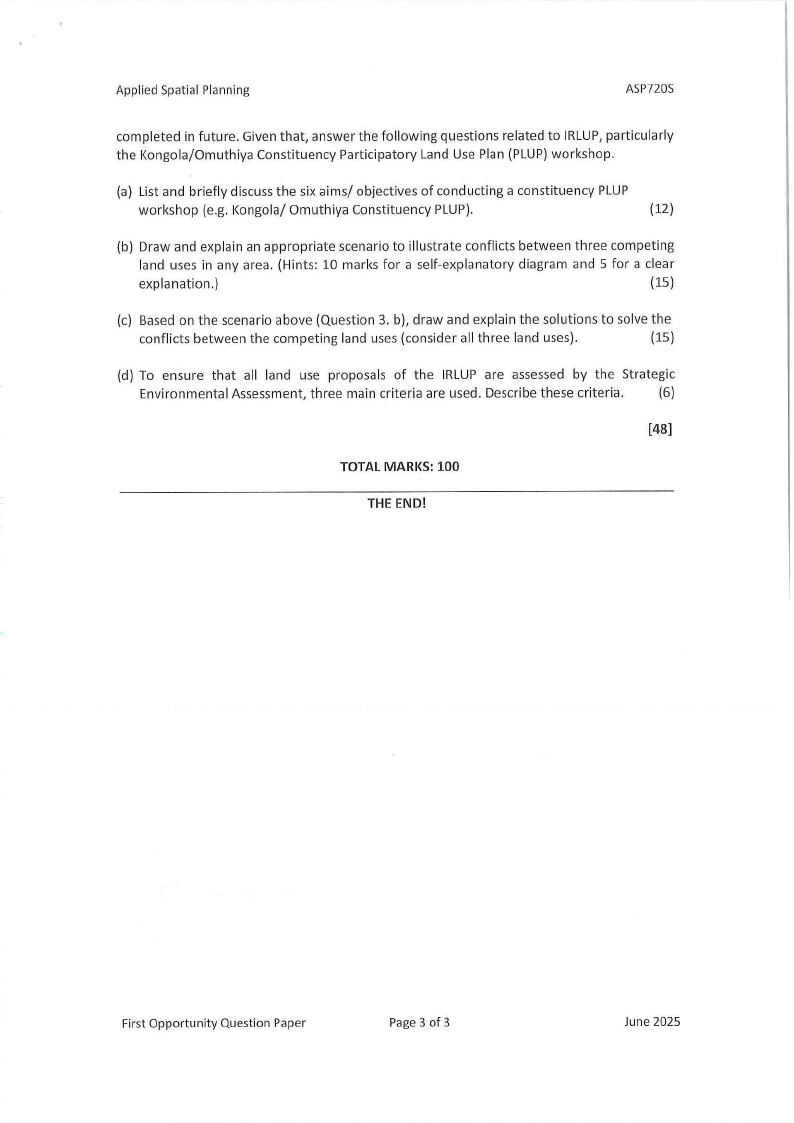
completed in future. Given that, answer the following questions related to IRLUP,particularly
the Kongola/Omuthiya Constituency Participatory Land Use Plan (PLUP)workshop.
(a) List and briefly discuss the six aims/ objectives of conducting a constituency PLUP
workshop (e.g. Kongola/ Omuthiya Constituency PLUP).
(12)
(b) Draw and explain an appropriate scenario to illustrate conflicts between three competing
land uses in any area. (Hints: 10 marks for a self-explanatory diagram and 5 for a clear
explanation.)
(15)
(c) Based on the scenario above (Question 3. b), draw and explain the solutions to solve the
conflicts between the competing land uses (consider all three land uses).
(15)
(d) To ensure that all land use proposals of the IRLUP are assessed by the Strategic
Environmental Assessment, three main criteria are used. Describe these criteria.
(6)
[48]
TOTAL MARKS: 100
THE END!
First Opportunity Question Paper
Page 3 of 3
June 2025