


 |
FSM621S - Forwarding and Shipping Management - 1st Opp - Nov 2025 |
|
|
1 Page 1 |
▲back to top |
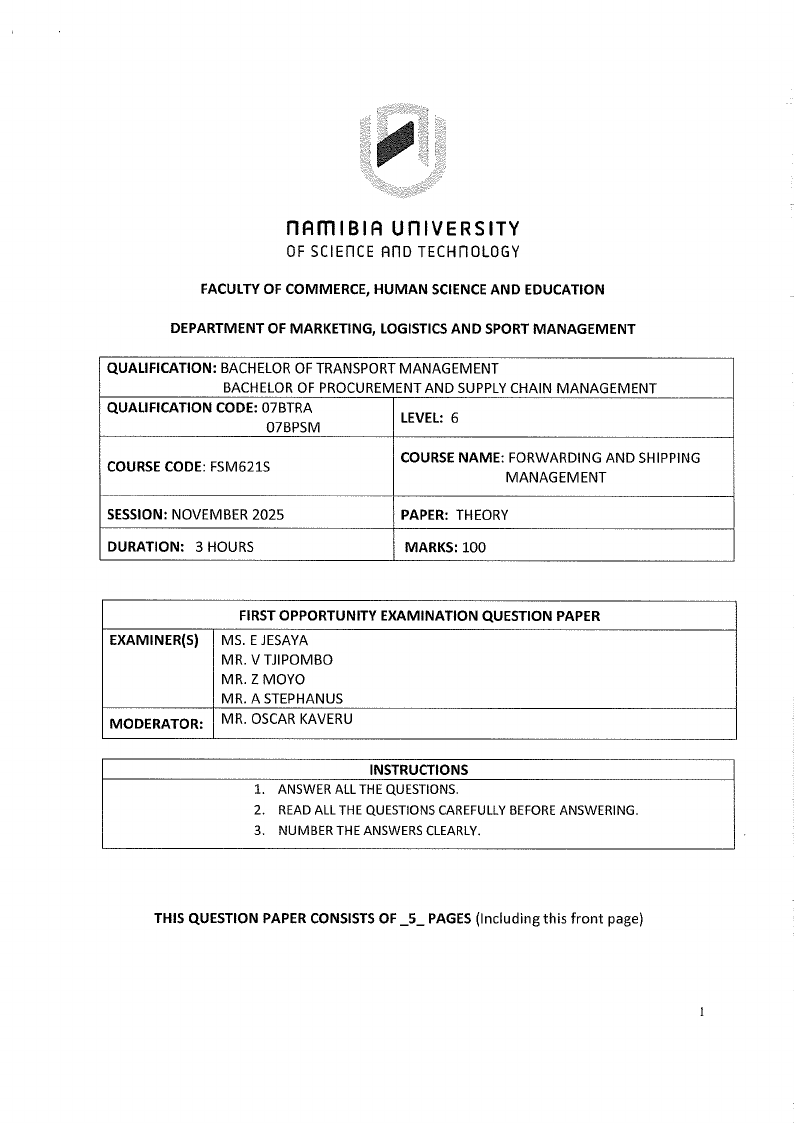
nAmlBIA UnlVERSITY
OF SCIEnCE Ano TECHnOLOGY
FACULTY OF COMMERCE, HUMAN SCIENCE AND EDUCATION
DEPARTMENT OF MARKETING, LOGISTICS AND SPORT MANAGEMENT
QUALIFICATION: BACHELOR OF TRANSPORT MANAGEMENT
BACHELOR OF PROCUREMENT AND SUPPLY CHAIN MANAGEMENT
QUALIFICATION CODE: 07BTRA
07BPSM
LEVEL: 6
COURSE CODE: FSM621S
COURSE NAME: FORWARDING AND SHIPPING
MANAGEMENT
SESSION: NOVEMBER 2025
DURATION: 3 HOURS
PAPER: THEORY
MARKS: 100
EXAMINER(S)
MODERATOR:
FIRST OPPORTUNITY EXAMINATION QUESTION PAPER
MS. E JESAYA
MR. V TJIPOMBO
MR. ZMOYO
MR. A STEPHANUS
MR. OSCAR KAVERU
INSTRUCTIONS
1. ANSWER ALL THE QUESTIONS.
2. REA0 ALL THE QUESTIONS CAREFULLY BEFORE ANSWERING.
3. NUMBER THE ANSWERS CLEARLY.
THIS QUESTION PAPER CONSISTS OF _S_ PAGES (Including this front page)
|
|
2 Page 2 |
▲back to top |

SECTION A: SHORT ANSWER QUESTIONS
QUESTION 1: MULTIPLE CHOICE
40 MARKS
20 MARKS
There are ten multiple-choice questions with several possible choices; choose the best
possible answer, e.g., 1.1 A.
2x10 = 20 MARKS
1.1. _ _ _ _ _ _ _ is when customs determine at what price identical or similar goods are sold
within 90 days of importation into the importing country and determines an entry value based
upon normal mark-ups in the distribution channel.
a) Deductive method
b) Comparative method
c) Computed or reconstructed value method
d) Method of last resort
1.2. The components of freight transportation systems are:
a) Nodes
b) Infrastructures
c) Networks
d) Flows
e) All of the above
1.3.Some of the bottle necks being experienced by ports operations are:
a) Financial constraints
b) Insufficient infrastructure capacity
c) Increasing container throughput
d) All of the above
1.4. _ _ _ _ _is a large standard size metal box into which cargo is packed for shipment aboard
specially configured transport modes.
a) Carton
b) Pallet
c) Container
d) All of the above
1.5.Customs duty is collected on the value of the goods imported in a country, and it is called?
a) Ad volorem
b) ASYCUDA
c) SADS00
d) None of the above
1.6. _ _ _ _ _ _ used from transportation of people with limited cargo capacity.
a) Passenger airlines
b) Cargo only carriers
c) Charter air carriers
d) Expressed consignment air carriers
2
|
|
3 Page 3 |
▲back to top |
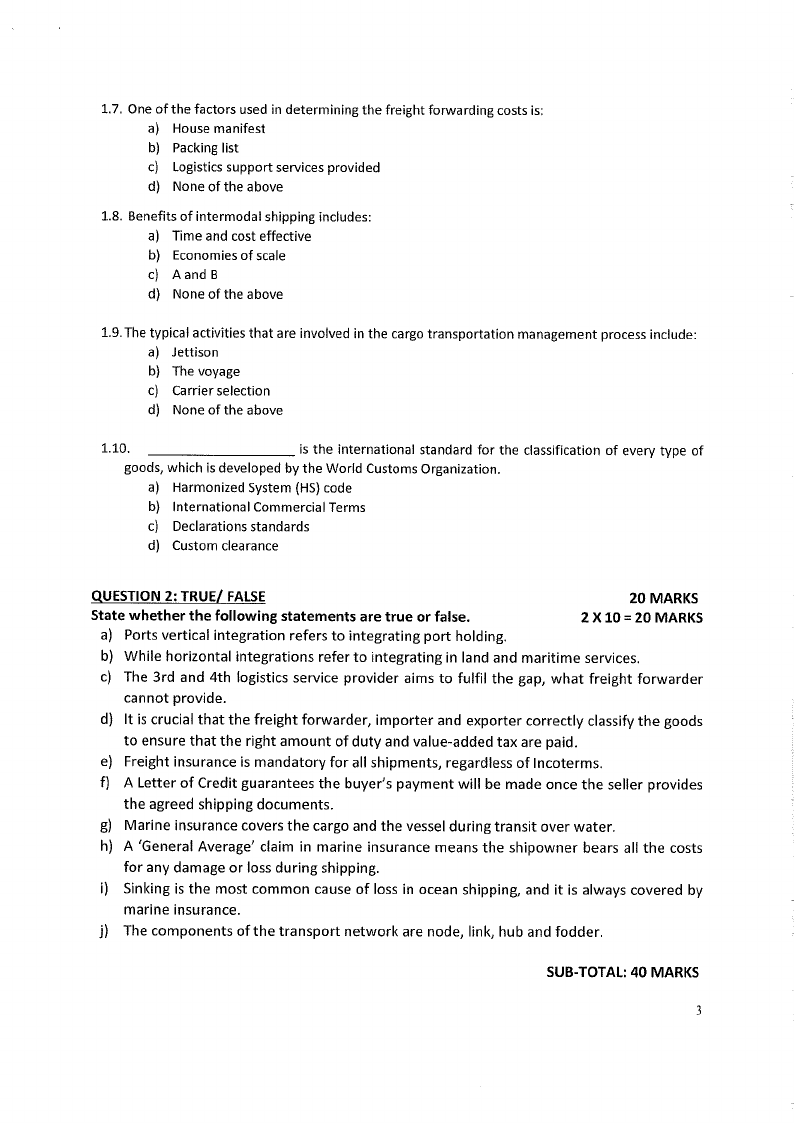
1.7. One of the factors used in determining the freight forwarding costs is:
a) House manifest
b) Packing list
c) Logistics support services provided
d) None of the above
1.8. Benefits of intermodal shipping includes:
a) Time and cost effective
b) Economies of scale
c) A and B
d) None of the above
1.9. The typical activities that are involved in the cargo transportation management process include:
a) Jettison
b) The voyage
c) Carrier selection
d) None of the above
1.10. _________ is the international standard for the classification of every type of
goods, which is developed by the World Customs Organization.
a) Harmonized System (HS) code
b) International Commercial Terms
c) Declarations standards
d) Custom clearance
QUESTION 2: TRUE/ FALSE
State whether the following statements are true or false.
20 MARKS
2 X 10 = 20 MARKS
a) Ports vertical integration refers to integrating port holding.
b) While horizontal integrations refer to integrating in land and maritime services.
c) The 3rd and 4th logistics service provider aims to fulfil the gap, what freight forwarder
cannot provide.
d) It is crucial that the freight forwarder, importer and exporter correctly classify the goods
to ensure that the right amount of duty and value-added tax are paid.
e) Freight insurance is mandatory for all shipments, regardless of lncoterms.
f) A Letter of Credit guarantees the buyer's payment will be made once the seller provides
the agreed shipping documents.
g) Marine insurance covers the cargo and the vessel during transit over water.
h) A 'General Average' claim in marine insurance means the shipowner bears all the costs
for any damage or loss during shipping.
i) Sinking is the most common cause of loss in ocean shipping, and it is always covered by
marine insurance.
j) The components of the transport network are node, link, hub and fodder.
SUB-TOTAL: 40 MARKS
3
|
|
4 Page 4 |
▲back to top |
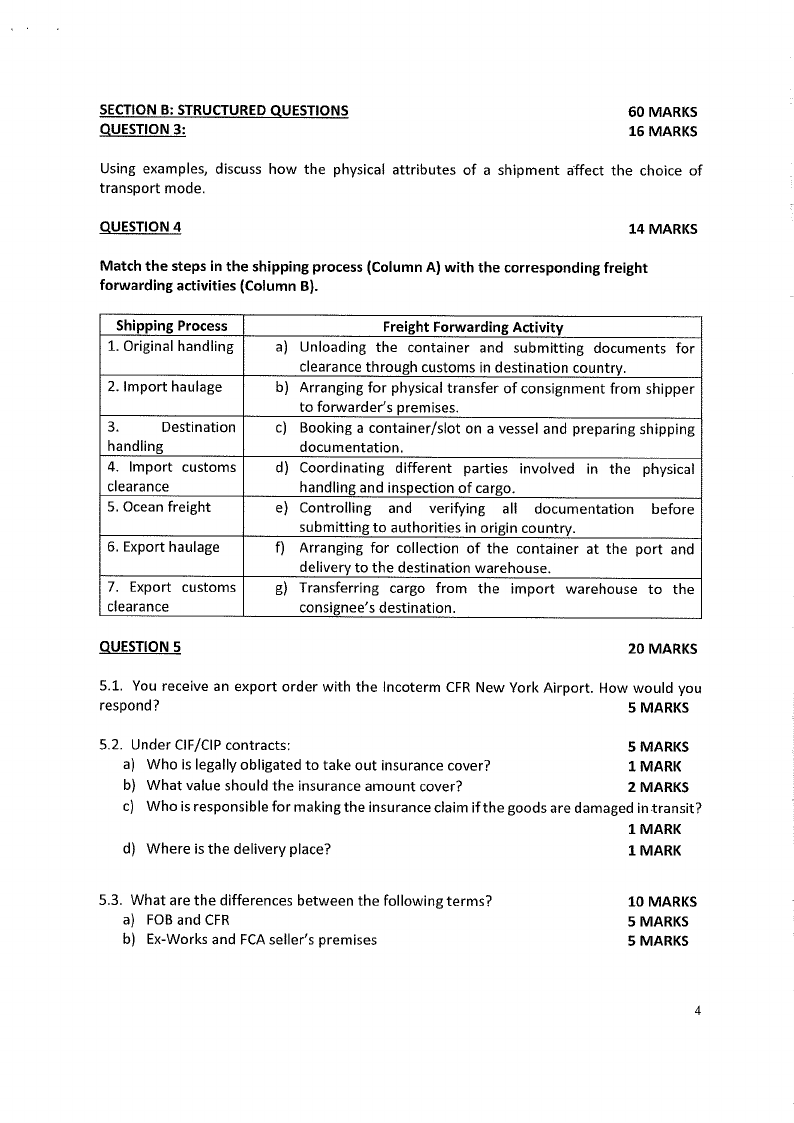
SECTION B: STRUCTURED QUESTIONS
QUESTION 3:
60 MARKS
16 MARKS
Using examples, discuss how the physical attributes of a shipment affect the choice of
transport mode.
QUESTION4
14MARKS
Match the steps in the shipping process (Column A) with the corresponding freight
forwarding activities (Column B).
Shipping Process
1. Original handling
2. Import haulage
3.
Destination
handling
4. Import customs
clearance
5. Ocean freight
6. Export haulage
7. Export customs
clearance
Freight Forwarding Activity
a) Unloading the container and submitting documents for
clearance through customs in destination country.
b) Arranging for physical transfer of consignment from shipper
to forwarder's premises.
c) Booking a container/slot on a vessel and preparing shipping
documentation.
d) Coordinating different parties involved in the physical
handling and inspection of cargo.
e) Controlling and verifying aII documentation before
submitting to authorities in origin country.
f) Arranging for collection of the container at the port and
delivery to the destination warehouse.
g) Transferring cargo from the import warehouse to the
consignee's destination.
QUESTION 5
20 MARKS
5.1. You receive an export order with the lncoterm CFR New York Airport. How would you
respond?
5 MARKS
5.2. Under CIF/CIP contracts:
5 MARKS
a) Who is legally obligated to take out insurance cover?
1 MARK
b) What value should the insurance amount cover?
2 MARKS
c) Who is responsible for making the insurance claim if the goods are damaged in transit?
lMARK
d) Where is the delivery place?
lMARK
5.3. What are the differences between the following terms?
a) FOB and CFR
b) Ex-Works and FCA seller's premises
10 MARKS
5 MARKS
5 MARKS
4
|
|
5 Page 5 |
▲back to top |
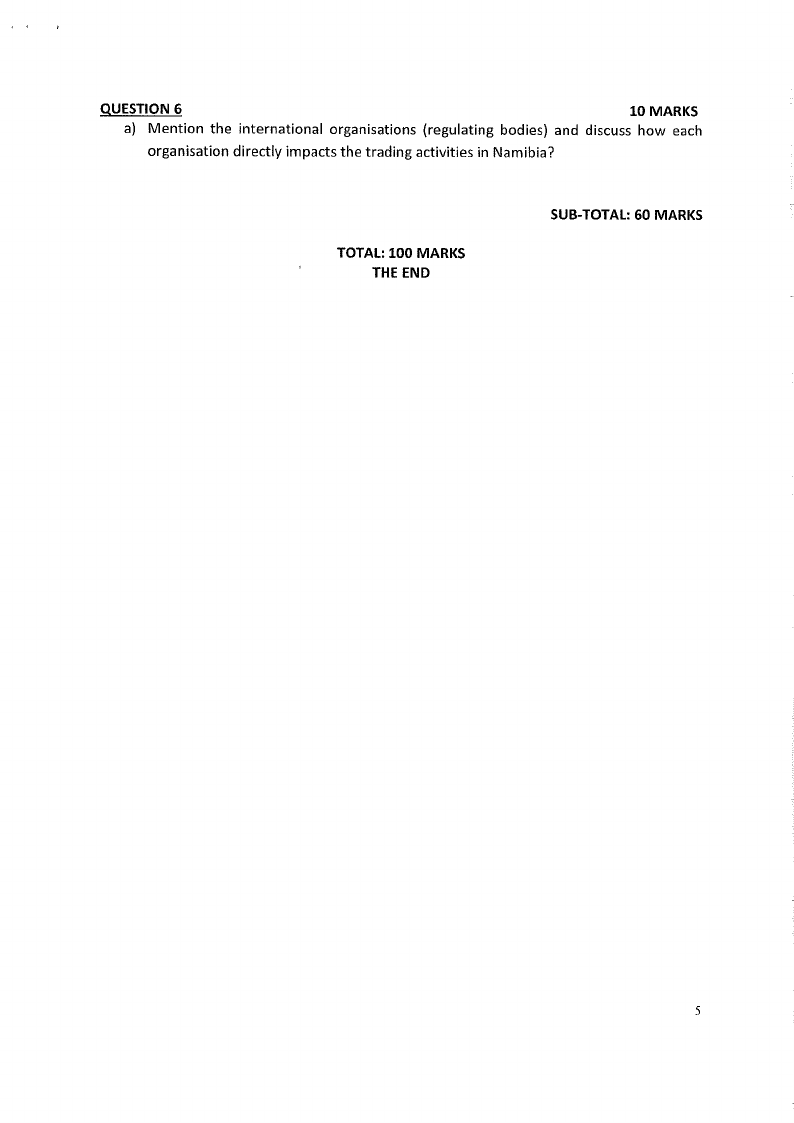
QUESTION 6
10 MARKS
a) Mention the international organisations (regulating bodies) and discuss how each
organisation directly impacts the trading activities in Namibia?
TOTAL: 100 MARKS
THE END
SUB-TOTAL: 60 MARKS
5