


 |
IPP521S - INTRODUCTION TO PHONETICS AND PHONOLOGY - 1ST OPP - NOVEMBER 2025 |
|
|
1 Page 1 |
▲back to top |
nAmlBIA UnlVERSITY
OF SCIEnCE Ano TECHnOLOGY
FACULTY OF COMMERCE, HUMAN SCIENCES AND EDUCATION
DEPARTMENT OF COMMUNICATION AND LANGUAGES
QUALIFICATION: BACHELOR OF ENGLISH AND LINGUISTICS
QUALIFICATION CODE: (07BENL)
LEVEL: 5
COURSE CODE: IPP521S
COURSE NAME: Introduction to Phonetics and Phonology
SESSION: NOVEMBER 2025
TIME:
3 HOURS
PAPER: THEORY
MARKS: 100
EXAMINER(S}
FIRST OPPORTUNITY EXAMINATION PAPER
Dr Sylvia N lthindi
Dr Hambeleleni Hamunyela
MODERATOR: Dr Anneli Nghikembua
INSTRUCTIONS
1. Answer ALL the questions.
2. Read all the questions carefully before answering.
3. Number the answers clearly
THIS QUESTION PAPER CONSISTS OF 5 PAGES, INCLUDING THE COVER PAGE
1
|
|
2 Page 2 |
▲back to top |
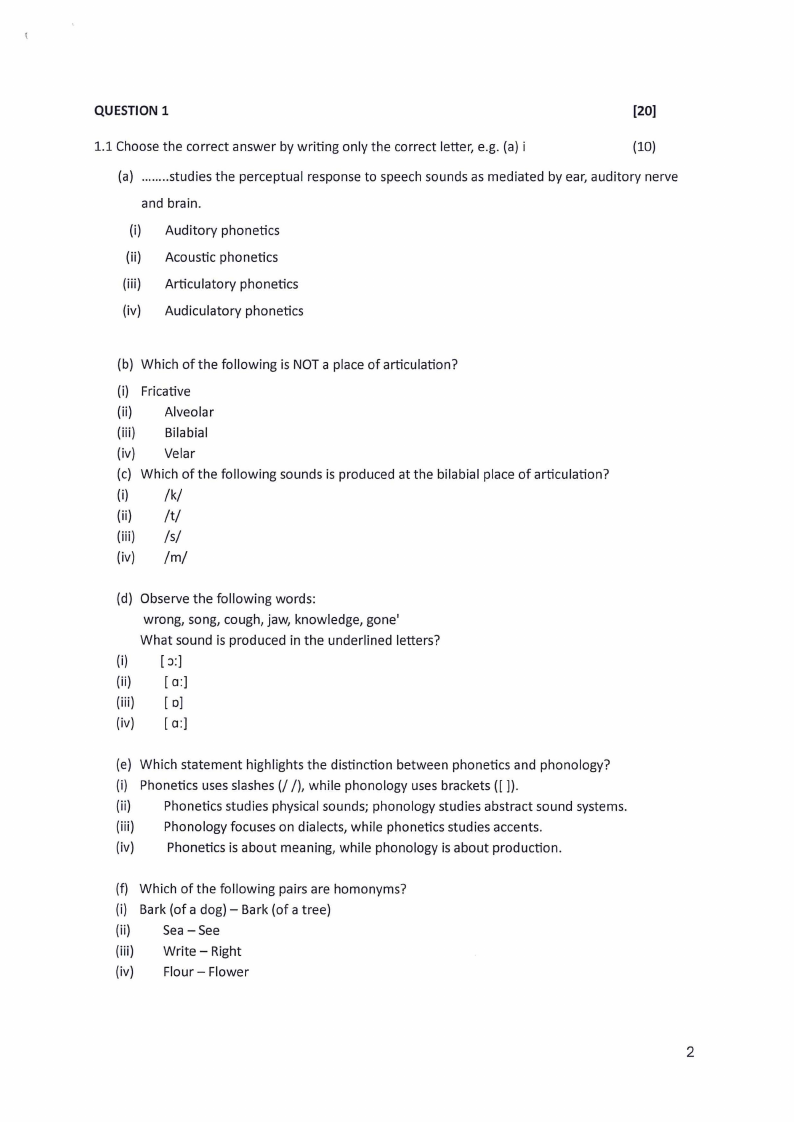
QUESTION 1
[20]
1.1 Choose the correct answer by writing only the correct letter, e.g. (a) i
(10)
(a) ........studies the perceptual response to speech sounds as mediated by ear, auditory nerve
and brain.
(i) Auditory phonetics
(ii) Acoustic phonetics
(iii) Articulatory phonetics
(iv) Audiculatory phonetics
(b) Which of the following is NOT a place of articulation?
(i) Fricative
(ii) Alveolar
(iii) Bilabial
(iv) Velar
(c) Which of the following sounds is produced at the bilabial place of articulation?
(i) /k/
(ii) It/
(iii) /s/
(iv) /m/
(d) Observe the following words:
wrong, song, cough, jaw, knowledge, gone'
What sound is produced in the underlined letters?
(i) [ J:]
(ii) [ a:]
(iii) [ o]
(iv) [ a:]
(e) Which statement highlights the distinction between phonetics and phonology?
(i) Phonetics uses slashes(//), while phonology uses brackets ([ ]).
(ii) Phonetics studies physical sounds; phonology studies abstract sound systems.
(iii) Phonology focuses on dialects, while phonetics studies accents .
(iv)
Phonetics is about meaning, while phonology is about production .
(f) Which of the following pairs are homonyms?
(i) Bark (of a dog) - Bark (of a tree)
(ii) Sea - See
(iii) Write - Right
(iv) Flour - Flower
2
|
|
3 Page 3 |
▲back to top |
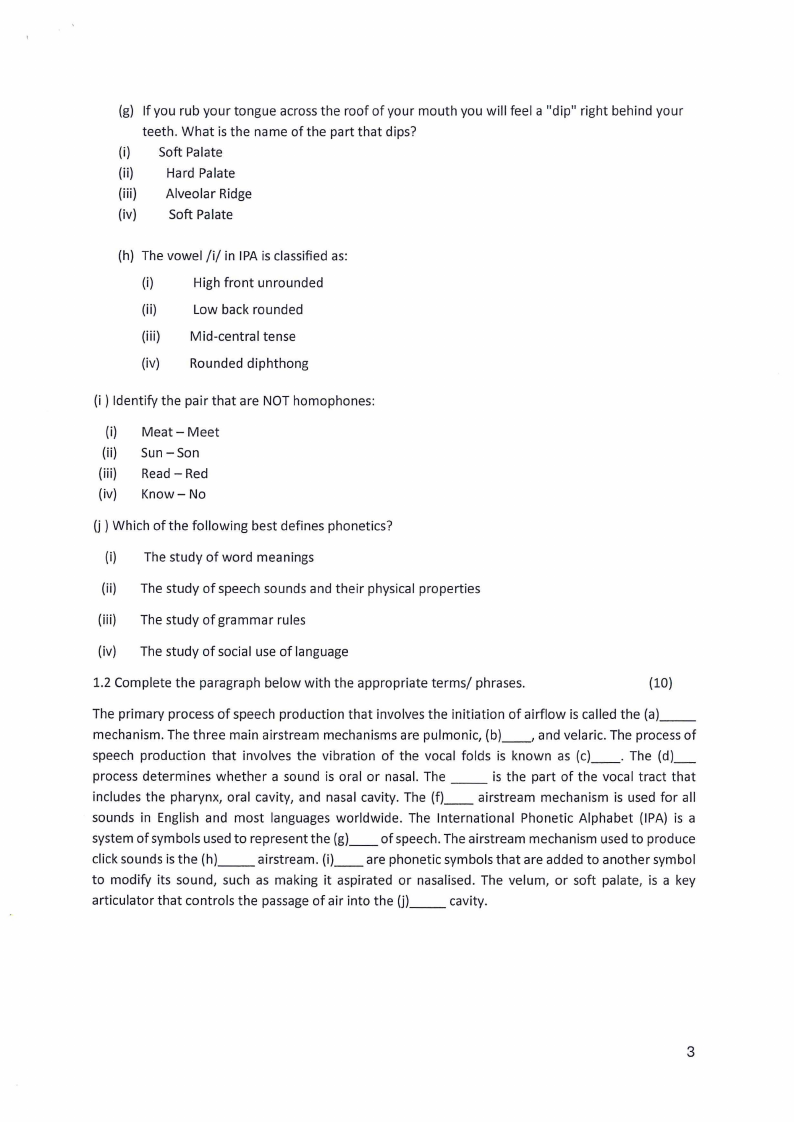
(g) If you rub your tongue across the roof of your mouth you will feel a "dip" right behind your
teeth. What is the name of the part that dips?
(i) Soft Palate
(ii) Hard Palate
(iii) Alveolar Ridge
(iv) Soft Palate
(h) The vowel /i/ in IPA is classified as:
(i)
High front unrounded
(ii)
Low back rounded
(iii) Mid-central tense
(iv) Rounded diphthong
(i ) Identify the pair that are NOT homophones:
(i) Meat- Meet
(ii) Sun-Son
(iii) Read - Red
(iv) Know-No
(j ) Which of the following best defines phonetics?
(i) The study of word meanings
(ii) The study of speech sounds and their physical properties
(iii) The study of grammar rules
(iv) The study of social use of language
1.2 Complete the paragraph below with the appropriate terms/ phrases.
{10)
The primary process of speech production that involves the initiation of airflow is called the (a)_ _
mechanism. The three main airstream mechanisms are pulmonic, (b)__, and velaric. The process of
speech production that involves the vibration of the vocal folds is known as (c)__. The (d)_
process determines whether a sound is oral or nasal. The _ _ is the part of the vocal tract that
includes the pharynx, oral cavity, and nasal cavity. The (f)__ airstream mechanism is used for all
sounds in English and most languages worldwide . The International Phonetic Alphabet (IPA) is a
system of symbols used to represent the (g)__ of speech. The airstream mechanism used to produce
click sounds is the (h)_ _ airstream. (i)__ are phonetic symbols that are added to another symbol
to modify its sound, such as making it aspirated or nasalised. The velum, or soft palate, is a key
articulator that controls the passage of air into the (j)_ _ cavity.
3
|
|
4 Page 4 |
▲back to top |
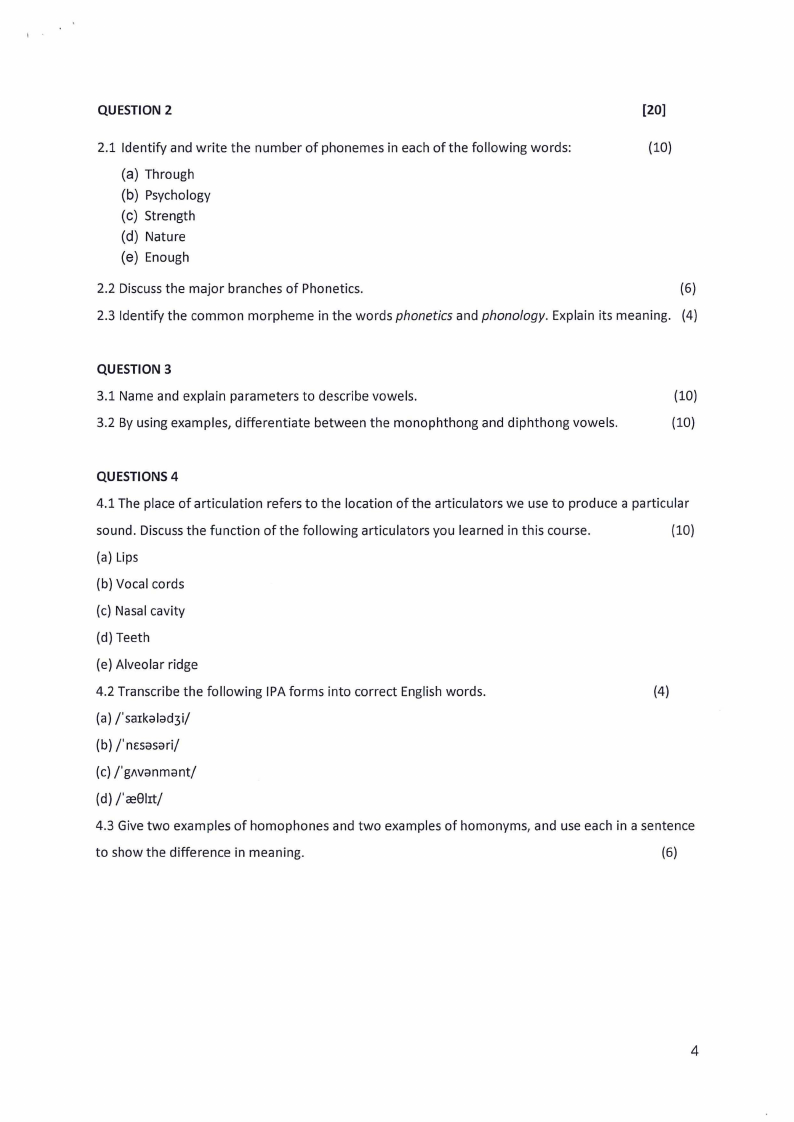
QUESTION 2
[20)
2.1 Identify and write the number of phonemes in each of the following words:
(10)
(a) Through
(b) Psychology
(c) Strength
(d) Nature
(e) Enough
2.2 Discuss the major branches of Phonetics.
(6)
2.3 Identify the common morpheme in the words phonetics and phonology. Explain its meaning. (4)
QUESTION 3
3.1 Name and explain parameters to describe vowels.
{10)
3.2 By using examples, differentiate between the monophthong and diphthong vowels.
(10)
QUESTIONS 4
4.1 The place of articulation refers to the location of the articulators we use to produce a particular
sound . Discuss the function of the following articulators you learned in this course .
(10)
(a) Lips
(b) Vocal cords
(c) Nasal cavity
(d) Teeth
(e) Alveolar ridge
4.2 Transcribe the following IPA forms into correct English words.
(4)
(a) /'sarkalad3i/
(b) /'nEsasari/
(c) / 'g1wanmant/
(d) /'ce81rt/
4.3 Give two examples of homophones and two examples of homonyms, and use each in a sentence
to show the difference in meaning.
(6)
4
|
|
5 Page 5 |
▲back to top |
QUESTION 5
5.1 Draw a diagrammatic representation of the syllable structure of the word "skin".
(5)
5.2 Describe the following phonological processes discussed in this course. Illustrate your answers
with relevant practical examples.
(15)
(a) Reduplication
(b) Metathesis
(c) Cluster reduction
Total: 100 Marks
5