


 |
OLM621C-OPERATIONAL LOGISTICS MANAGEMENT-2ND OPP- JULY 2025 |
|
|
1 Page 1 |
▲back to top |
nAmlBIA
UnlVERSITY
OF SCIEnCE Ano
TECHnOLOGY
HP-65B
HAROLDPUPKEWITZ
GraduateSchoolof Business
FACULTY OF COMMERCE; HUMAN SCIENCES AND EDUCATION
HAROLD PUPKEWITZ GRADUATE SCHOOL OF BUSINESS
QUALIFICATION: DIPLOMA IN BUSINESS PROCESS MANAGEMENT
QUALIFICATION CODE: 0GDBPM
LEVEL: 6
COURSE CODE: OLM621 C
COURSE NAME: OPERATIONAL LOGISTICS
MANAGEMENT
SESSION: JULY 2025
DURATION: 3 HOURS
PAPER: PAPER 1
MARKS: 100
SECOND OPPORTUNITY EXAMINATION QUESTION PAPER
EXAMINER(S)
DR GLORIA TSHOOPARA
MODERATOR:
MS HILMA NUUYANDJA
INSTRUCTIONS
1. Answer ALL the questions.
2. Write clearly and neatly.
3. Number the answers clearly.
PERMISSIBLE MATERIALS
1. Examination paper
2. Examination script
THIS QUESTION PAPER CONSISTS OF 5 PAGES (INCLUDING THIS FRONT PAGE)
11Page
|
|
2 Page 2 |
▲back to top |
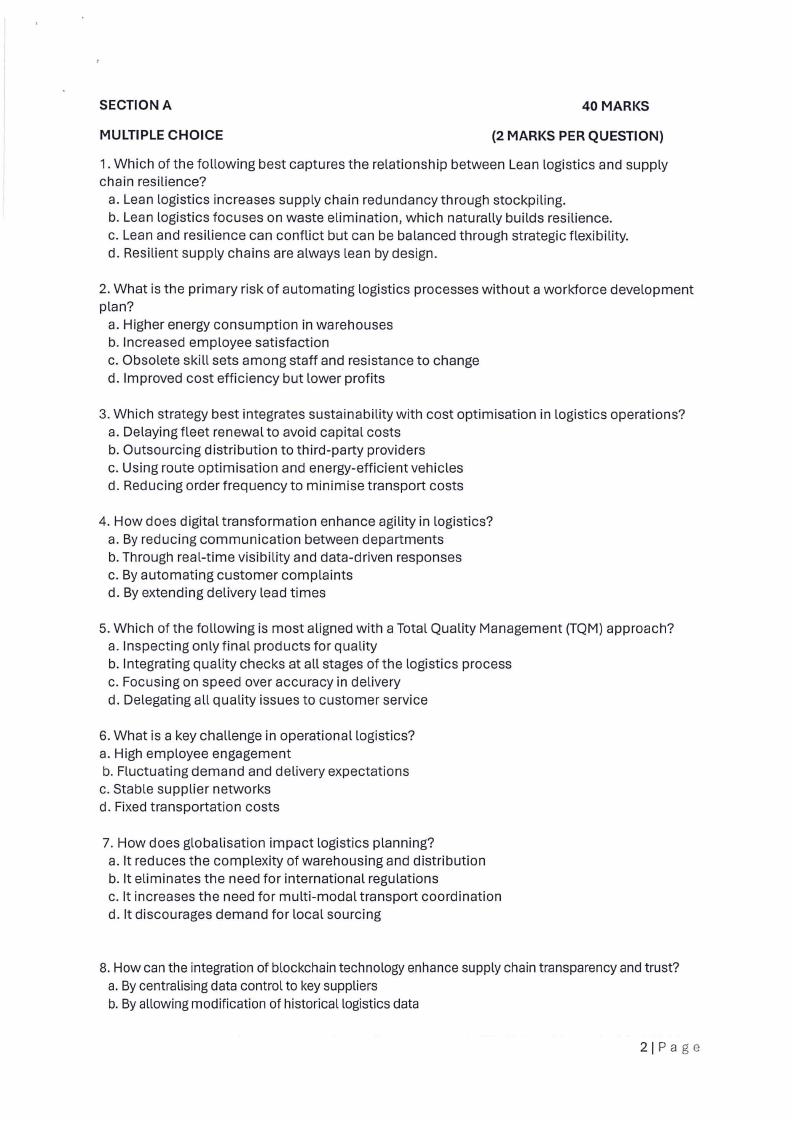
SECTION A
40 MARKS
MULTIPLE CHOICE
(2 MARKS PER QUESTION)
1. Which of the following best captures the relationship between Lean logistics and supply
chain resilience?
a. Lean logistics increases supply chain redundancy through stockpiling.
b. Lean logistics focuses on waste elimination, which naturally builds resilience.
c. Lean and resilience can conflict but can be balanced through strategic flexibility.
d. Resilient supply chains are always lean by design.
2. What is the primary risk of automating logistics processes without a workforce development
plan?
a. Higher energy consumption in warehouses
b. Increased employee satisfaction
c. Obsolete skill sets among staff and resistance to change
d. Improved cost efficiency but lower profits
3. Which strategy best integrates sustainability with cost optimisation in logistics operations?
a. Delaying fleet renewal to avoid capital costs
b. Outsourcing distribution to third-party providers
c. Using route optimisation and energy-efficient vehicles
d. Reducing order frequency to minimise transport costs
4. How does digital transformation enhance agility in logistics?
a. By reducing communication between departments
b. Through real-time visibility and data-driven responses
c. By automating customer complaints
d. By extending delivery lead times
5. Which of the following is most aligned with a Total Quality Management (TQM) approach?
a. Inspecting only final products for quality
b. Integrating quality checks at all stages of the logistics process
c. Focusing on speed over accuracy in delivery
d. Delegating all quality issues to customer service
6. What is a key challenge in operational logistics?
a. High employee engagement
b. Fluctuating demand and delivery expectations
c. Stable supplier networks
d. Fixed transportation costs
7. How does globalisation impact logistics planning?
a. It reduces the complexity of warehousing and distribution
b. It eliminates the need for international regulations
c. It increases the need for multi-modal transport coordination
d. It discourages demand for local sourcing
8. How can the integration of blockchain technology enhance supply chain transparency and trust?
a. By centralising data control to key suppliers
b. By allowing modification of historical logistics data
21Page
|
|
3 Page 3 |
▲back to top |
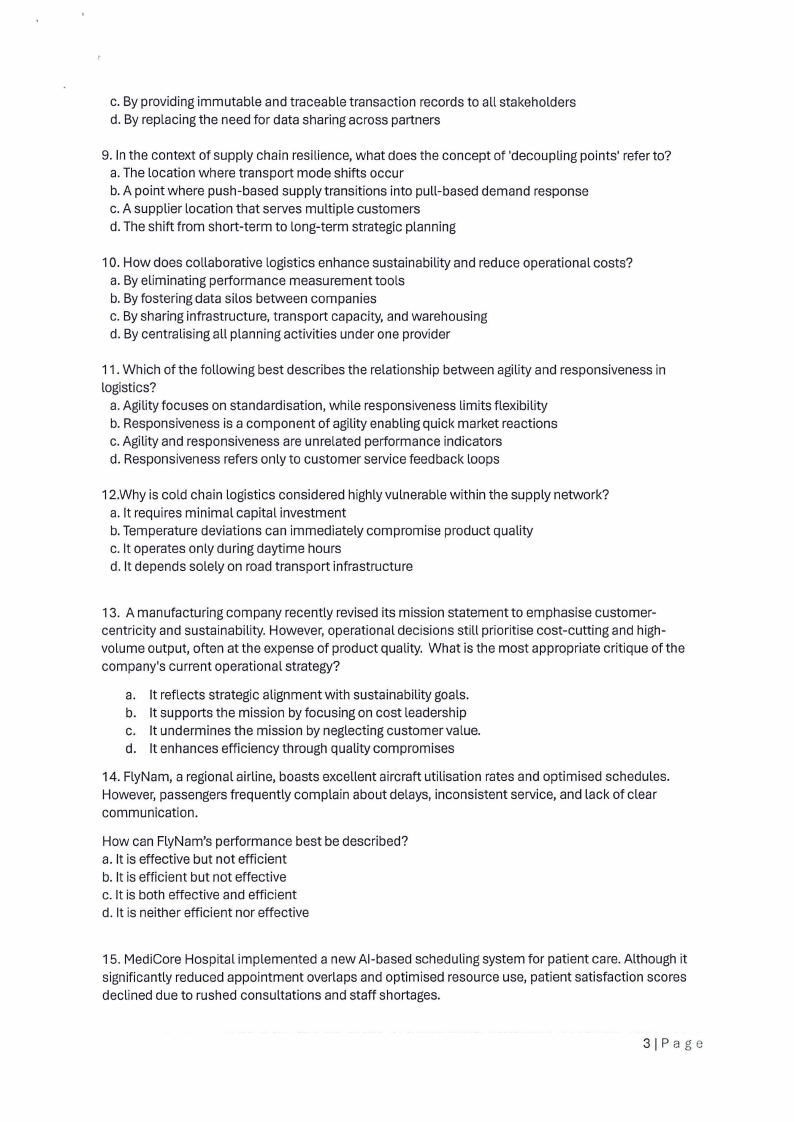
c. By providing immutable and traceable transaction records to all stakeholders
d. By replacing the need for data sharing across partners
9. In the context of supply chain resilience, what does the concept of 'decoupling points' refer to?
a. The location where transport mode shifts occur
b. A point where push-based supply transitions into pull-based demand response
c. A supplier location that serves multiple customers
d. The shift from short-term to long-term strategic planning
10. How does collaborative logistics enhance sustainability and reduce operational costs?
a. By eliminating performance measurement tools
b. By fostering data silos between companies
c. By sharing infrastructure, transport capacity, and warehousing
d. By centralising all planning activities under one provider
11. Which of the following best describes the relationship between agility and responsiveness in
logistics?
a. Agility focuses on standardisation, while responsiveness limits flexibility
b. Responsiveness is a component of agility enabling quick market reactions
c. Agility and responsiveness are unrelated performance indicators
d. Responsiveness refers only to customer service feedback loops
12.Why is cold chain logistics considered highly vulnerable within the supply network?
a. It requires minimal capital investment
b. Temperature deviations can immediately compromise product quality
c. It operates only during daytime hours
d. It depends solely on road transport infrastructure
13. A manufacturing company recently revised its mission statement to emphasise customer-
centricity and sustainability. However, operational decisions still prioritise cost-cutting and high-
volume output, often at the expense of product quality. What is the most appropriate critique of the
company's current operational strategy?
a. It reflects strategic alignment with sustainability goals.
b. It supports the mission by focusing on cost leadership
c. It undermines the mission by neglecting customer value.
d. It enhances efficiency through quality compromises
14. FlyNam, a regional airline, boasts excellent aircraft utilisation rates and optimised schedules.
However, passengers frequently complain about delays, inconsistent service, and lack of clear
communication.
How can FlyNam's performance best be described?
a. It is effective but not efficient
b. It is efficient but not effective
c. It is both effective and efficient
d. It is neither efficient nor effective
15. MediCore Hospital implemented a new Al-based scheduling system for patient care. Although it
significantly reduced appointment overlaps and optimised resource use, patient satisfaction scores
declined due to rushed consultations and staff shortages.
3IPage
|
|
4 Page 4 |
▲back to top |
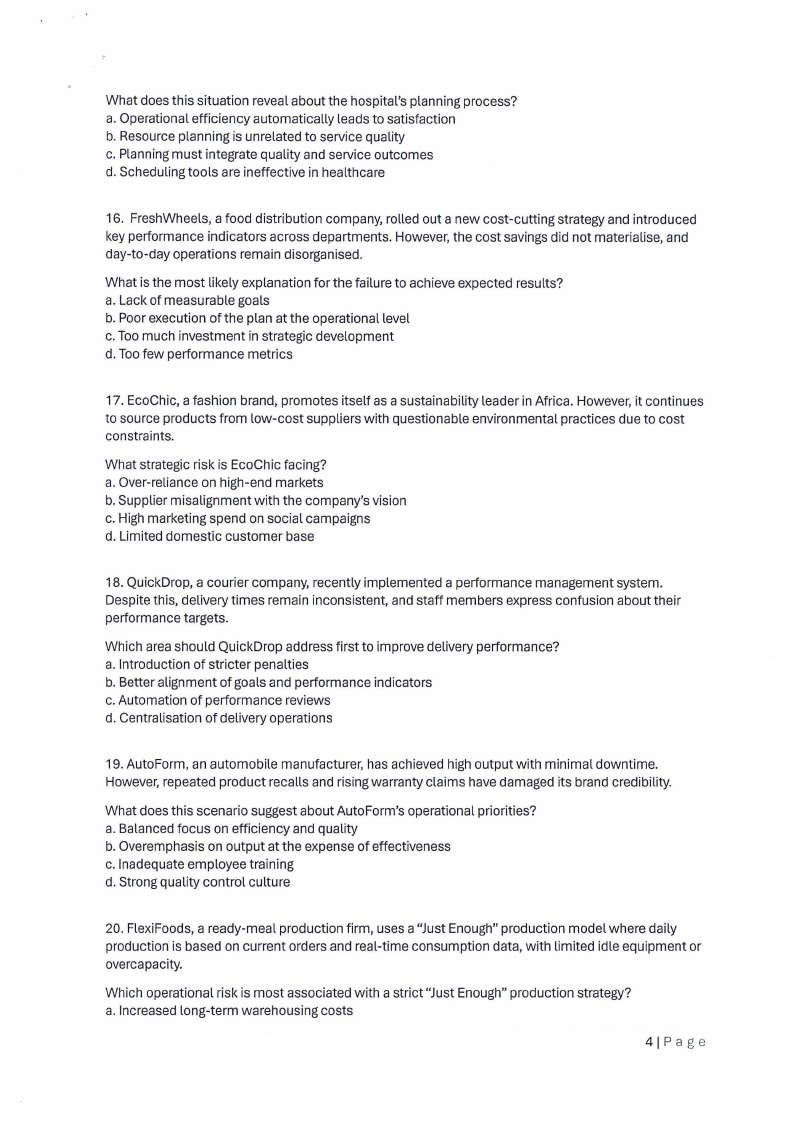
What does this situation reveal about the hospital's planning process?
a. Operational efficiency automatically leads to satisfaction
b. Resource planning is unrelated to service quality
c. Planning must integrate quality and service outcomes
d. Scheduling tools are ineffective in healthcare
16. FreshWheels, a food distribution company, rolled out a new cost-cutting strategy and introduced
key performance indicators across departments. However, the cost savings did not materialise, and
day-to-day operations remain disorganised.
What is the most likely explanation for the failure to achieve expected results?
a. Lack of measurable goals
b. Poor execution of the plan at the operational level
c. Too much investment in strategic development
d. Too few performance metrics
17. EcoChic, a fashion brand, promotes itself as a sustainability leader in Africa. However, it continues
to source products from low-cost suppliers with questionable environmental practices due to cost
constraints.
What strategic risk is EcoChic facing?
a. Over-reliance on high-end markets
b. Supplier misalignment with the company's vision
c. High marketing spend on social campaigns
d. Limited domestic customer base
18. QuickDrop, a courier company, recently implemented a performance management system.
Despite this, delivery times remain inconsistent, and staff members express confusion about their
performance targets.
Which area should QuickDrop address first to improve delivery performance?
a. Introduction of stricter penalties
b. Better alignment of goals and performance indicators
c. Automation of performance reviews
d. Centralisation of delivery operations
19. AutoForm, an automobile manufacturer, has achieved high output with minimal downtime.
However, repeated product recalls and rising warranty claims have damaged its brand credibility.
What does this scenario suggest about Auto Form's operational priorities?
a. Balanced focus on efficiency and quality
b. Overemphasis on output at the expense of effectiveness
c. Inadequate employee training
d. Strong quality control culture
20. FlexiFoods, a ready-meal production firm, uses a "Just Enough" production model where daily
production is based on current orders and real-time consumption data, with limited idle equipment or
overcapacity.
Which operational risk is most associated with a strict "Just Enough" production strategy?
a. Increased long-term warehousing costs
41Page
|
|
5 Page 5 |
▲back to top |
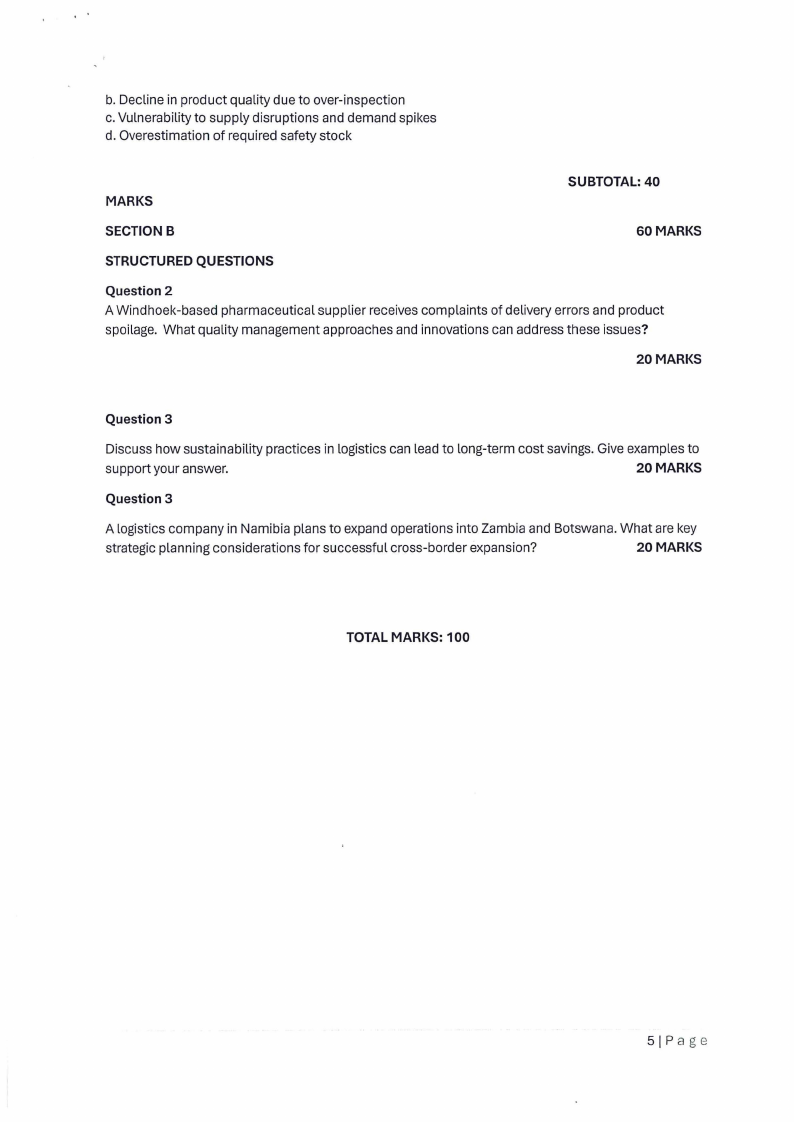
b. Decline in product quality due to over-inspection
c. Vulnerability to supply disruptions and demand spikes
d. Overestimation of required safety stock
MARKS
SUBTOTAL: 40
SECTION B
60 MARKS
STRUCTURED QUESTIONS
Question 2
A Windhoek-based pharmaceutical supplier receives complaints of delivery errors and product
spoilage. What quality management approaches and innovations can address these issues?
20 MARKS
Question 3
Discuss how sustainability practices in logistics can lead to long-term cost savings. Give examples to
support your answer.
20 MARKS
Question 3
A logistics company in Namibia plans to expand operations into Zambia and Botswana. What are key
strategic planning considerations for successful cross-border expansion?
20 MARKS
TOTAL MARKS: 100
51Page