


 |
PTS710S-PLANT STUDIES 2- 2ND OPP-JULY 2025 |
|
|
1 Page 1 |
▲back to top |
n Am I BI A u n IVE RSITY
OF SCIEnCE Ano TECHnOLOGY
FACULTY OF HEALTH, NATURAL RESOURCES AND APPLIED SCIENCES
DEPARTMENT OF NATURAL RESOURCES SCIENCES
QUALIFICATION: BACHELOR OF NATURAL RESOURCE MANAGEMENT
QUALIFICATION CODE: 07BNRS
LEVEL: 7
COURSE CODE: PTS710S
COURSE NAME: PLANT STUDIES 2
SESSION: JULY 2025
DURATION: 2 HOURS
PAPER: THEORY {PAPER 1}
MARKS: 100
SECOND OPPORTUNITY EXAMINATION QUESTION PAPER
EXAMINER{S) PROF. JONATHAN MUTAU KAMWI
MODERATOR: PROF. E KWEMBEYA
INSTRUCTIONS
1. Answer ALL the questions.
2. Read all the questions carefully before answering.
3. Number the answers clearly
THIS QUESTION PAPER CONSISTS OF _3_ PAGES {Including this front page)
|
|
2 Page 2 |
▲back to top |
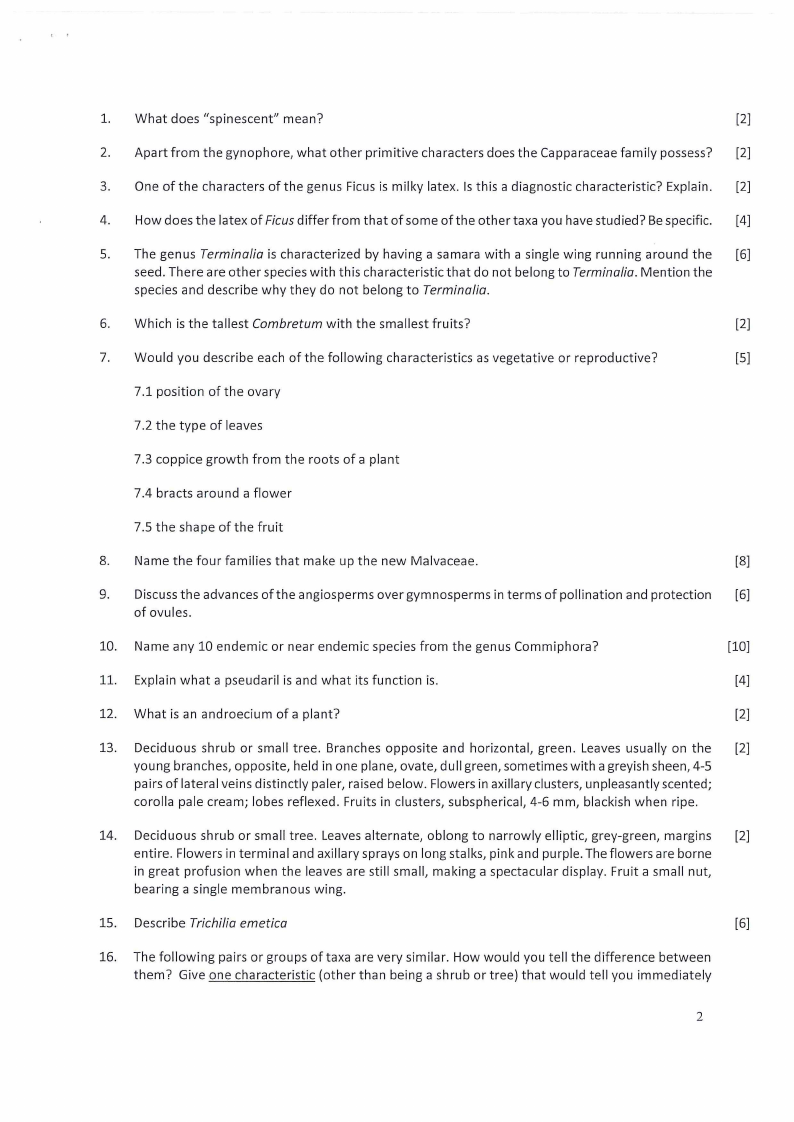
1. What does "spinescent" mean?
[2)
2. Apart from the gynophore, what other primitive characters does the Capparaceae family possess? [2)
3. One of the characters of the genus Ficus is milky latex. Is this a diagnostic characteristic? Explain. [2)
4. How does the latex of Ficus differ from that of some of the other taxa you have studied? Be specific. [4)
5. The genus Terminalia is characterized by having a samara with a single wing running around the [6)
seed. There are other species with this characteristic that do not belong to Terminalia. Mention the
species and describe why they do not belong to Terminalia.
6. Which is the tallest Combretum with the smallest fruits?
[2)
7. Would you describe each of the following characteristics as vegetative or reproductive?
[SJ
7.1 position of the ovary
7.2 the type of leaves
7.3 coppice growth from the roots of a plant
7.4 bracts around a flower
7.5 the shape of the fruit
8. Name the four families that make up the new Malvaceae.
[8)
9. Discuss the advances of the angiosperms over gymnosperms in terms of pollination and protection [6)
of ovules.
10. Name any 10 endemic or near endemic species from the genus Commiphora?
[10)
11. Explain what a pseudaril is and what its function is.
[4)
12. What is an androecium of a plant?
[2)
13. Deciduous shrub or small tree. Branches opposite and horizontal, green. Leaves usually on the [2)
young branches, opposite, held in one plane, ovate, dull green, sometimes with a greyish sheen, 4-5
pairs of lateral veins distinctly paler, raised below. Flowers in axillary clusters, unpleasantly scented;
corolla pale cream; lobes reflexed. Fruits in clusters, subspherical, 4-6 mm, blackish when ripe.
14. Deciduous shrub or small tree. Leaves alternate, oblong to narrowly elliptic, grey-green, margins [2)
entire. Flowers in terminal and axillary sprays on long stalks, pink and purple. The flowers are borne
in great profusion when the leaves are still small, making a spectacular display. Fruit a small nut,
bearing a single membranous wing.
15. Describe Trichi/ia emetica
[6)
16. The following pairs or groups of taxa are very similar. How would you tell the difference between
them? Give one characteristic (other than being a shrub or tree) that would tell you immediately
2
|
|
3 Page 3 |
▲back to top |
which of the two it is.
16.1 Acacia erubescens & Acacia fleckii
[2]
16.2 Boscia foetida & Maerua parvifolia
[2]
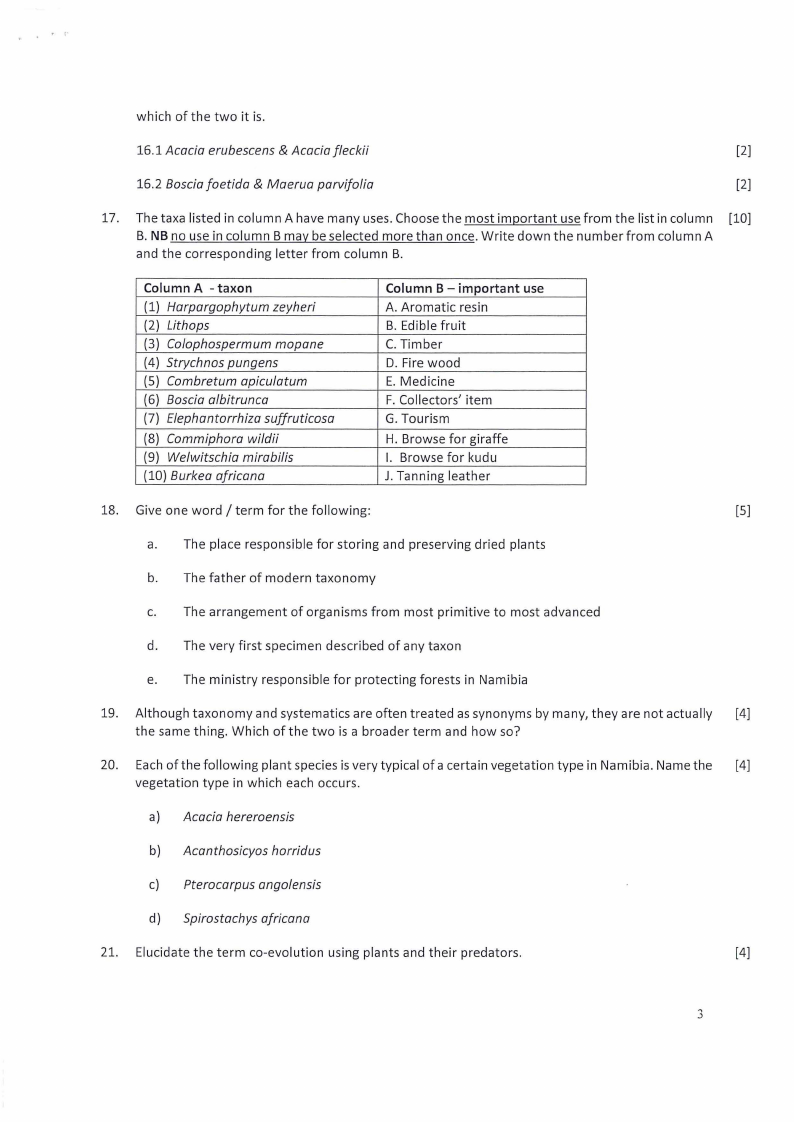
17. The taxa listed in column A have many uses. Choose the most important use from the list in column [10]
B. NB no use in column B may be selected more than once. Write down the number from column A
and the corresponding letter from column B.
Column A - taxon
(1) Harpargophytum zeyheri
(2) Lithops
(3) Co/ophospermum mopane
(4) Strychnos pungens
(5) Combretum apiculatum
(6) Boscia albitrunca
(7) Elephantorrhiza suffruticosa
(8) Commiphora wildii
(9) Welwitschia mirabi/is
(10) Burkea africana
Column B - important use
A. Aromatic resin
B. Edible fruit
C. Timber
D. Fire wood
E. Medicine
F. Collectors' item
G. Tourism
H. Browse for giraffe
I. Browse for kudu
J. Tanning leather
18. Give one word/ term for the following:
[5]
a. The place responsible for storing and preserving dried plants
b. The father of modern taxonomy
c. The arrangement of organisms from most primitive to most advanced
d. The very first specimen described of any taxon
e. The ministry responsible for protecting forests in Namibia
19. Although taxonomy and systematics are often treated as synonyms by many, they are not actually [4]
the same thing. Which of the two is a broader term and how so?
20. Each of the following plant species is very typical of a certain vegetation type in Namibia. Name the [4]
vegetation type in which each occurs.
a) Acacia hereroensis
b) Acanthosicyos horridus
c) Pterocarpus angolensis
d) Spirostachys africana
21. Elucidate the term co-evolution using plants and their predators.
[4]
3