


 |
PSL510S - PSYCHOLOGY OF LEARNING A - 1ST OPP - JUNE 2025 |
|
|
1 Page 1 |
▲back to top |
nAmI BIA unIVERSITY
OF SCIEnCE Ano TECHnOLOGY
FACULTY OF COMMERCE, HUMAN SCIENCE AND EDUCATION
DEPARTMENTOF TECHNICALAND VOCATIONALEDUCATIONAND TRAINING
QUALIFICATION:DIPLOMA IN TECHNICALAND VOCATIONALEDUCATIONAND TRAINING:
TRAINER
QUALIFICATIONCODE: 0GDTVT
LEVEL: S
COURSECODE:PSLSlOS
COURSENAME: PSYCHOLOGYOF LEARNINGA
SESSION:JUNE 2025
PAPER: 1
DURATION: 3 HOURS
MARKS: 100
FIRSTOPPORTUNITYEXAMINATION QUESTION PAPER
EXAMINER(S) MS R. QUEST
MODERATOR: DR 0. KACHEPA
INSTRUCTIONS
1. Answer ALLthe questions.
2. Read all the questions carefully before answering.
3. Number the answers clearly
THIS QUESTION PAPERCONSISTSOF _6_ PAGES(Including this front page)
|
|
2 Page 2 |
▲back to top |
Section A
1. Multiple Questions. Choose one correct answer.
1.1 Who is considered the father of operant conditioning?
A) John Watson
B) B.F.Skinner
C) Albert Bandura
D) Ivan Pavlov
(10 X 1 =10)
(1)
1.2 Which learning theory emphasises the influence of rewards and punishments on behaviour?
(1)
A) Classicalconditioning
B) Operant conditioning
C) Social learning theory
D) Cognitive learning theory
1.3 According to behaviourism, learning is best achieved through:
(1)
A) Observation and imitation
B) Direct experience and reinforcement
C) Problem-solving and critical thinking
D) Cognitive processing and information storage
1.4 Social learning theory emphasises the role of:
(1)
A) Rewards and punishments
B) Classicalconditioning
C) Observation and imitation
D) Cognitive development
1.5 According to cognitive learning theory, learning involves:
(1)
A) Conditioning through rewards and punishments
B) Development of internal mental processes
C) Social interactions and modelling
D) Association of stimuli and responses
1.6 Who is known for the concept of self-actualisation in learning?
(1)
A) Albert Bandura
B) Abraham Maslow
C) Jean Piaget
D) B.F.Skinner
2
|
|
3 Page 3 |
▲back to top |
1.7 Which learning theory focuses on the individual's potential and self-growth?
(1)
A) Behaviourism
B) Cognitivism
C) Humanism
D) Connectivism
1.8 In connectivism, learning is primarily seen as:
(1)
A) Memorising facts
B) Forming networks and connections
C) Responding to stimuli
D) Reaching self-actualisation
1.9 Who is most closely associated with social constructivism?
(1)
A) Jean Piaget
B) Lev Vygotsky
C) B.F.Skinner
D) Carl Rogers
1.10 What is the main focus of constructivist learning theory?
(1)
A) External reinforcement
B) Building knowledge through experience
C) Memorisation
D) Punishment and reward
Section B
2. Read the following statements about assessment in education. Indicate true if you agree
with the statement and false if you don't agree.
(10 x 1 =10)
2.1 Learning Classroom Assessment Techniques {CATs)evaluate learning strategies outside the
classroom.
(1)
2.2 According to the Behaviourist learning theory, knowledge exists inside the student.
(1)
2.3 Social constructivists believe that knowledge is constructed (developed) through interaction
with others.
(1)
2.4 Theory provides us with explanations and principles of any phenomena we observe and
experience.
(1)
2.5 Learning according to behaviourism is an observable and measurable response to external
stimuli.
(1)
3
|
|
4 Page 4 |
▲back to top |
2.6 While behaviourism and cognitivism learning theories place the focus on the student,
humanism places the focus on the teacher.
(1)
2.7 The Internet is a network of computers and the same devices all connected together.
(1)
2.8 Classical conditioning was invented by the work of Skinner.
(1)
2.9 Cognitive learning occurs through the internal process of information similar to how the
human brain functions.
(1)
2.10 Carl Roger's philosophy stressed that human beings have a natural tendency to learn. (1)
Section C
3. Define the following learning theories as indicated below:
3.1 Behaviourist learning theory
3.2 Cognitivist learning theory
3.3 Social constructivist learning theory
3.4 Humanist learning theory
3.5 Connectivist learning theory
(5 X 2=10)
(2)
(2)
(2)
(2)
(2)
4. Jean Piaget proposes four stages of cognitive development. Name only the specific stage
according to the years of the individuals.
(4 x 2 = 8)
5. Explain why TVET trainer students should learn Piaget's Theory. Name four facts. (4 x 2 = 8)
6. Look at the picture below of Pavlov's classical conditioning and explain the process of
conditioning in chronological order from 1 to 4.
(4 x 3 = 12)
1
2
4
|
|
5 Page 5 |
▲back to top |
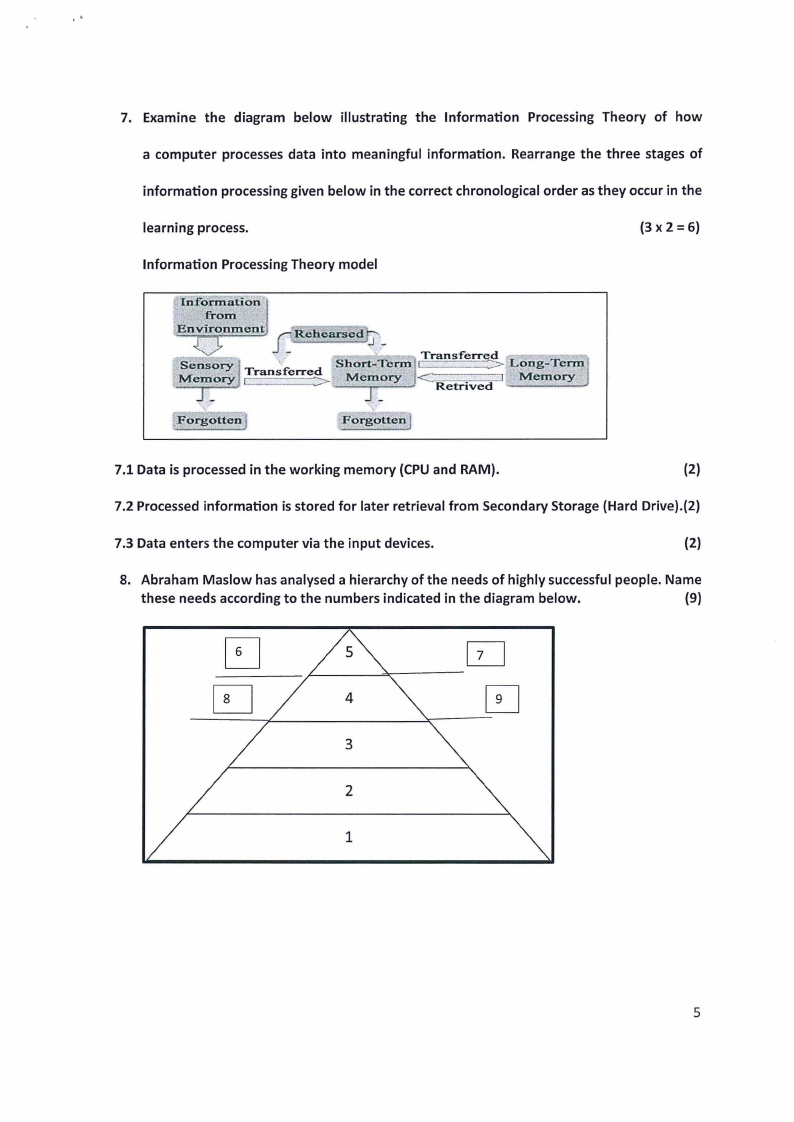
7. Examine the diagram below illustrating the Information Processing Theory of how
a computer processes data into meaningful information. Rearrange the three stages of
information processing given below in the correct chronological order as they occur in the
learning process.
(3 X 2 = 6)
Information Processing Theory model
; Inf°"OI'JJ'.lation
.fr6.m.
'Envfro,nment rReheansed
J_------J
_
-
·
Transf'errcd
::::=======:::::> Sensory Transf'erred
,M em.ory -
Sbort-Teun ~--------·
Memory
<- Retrived·
Long-Tenn
1 Me,m,ory
Forgotten
7.1 Data is processed in the working memory (CPU and RAM).
(2)
7.2 Processed information is stored for later retrieval from Secondary Storage (Hard Drive).(2)
7.3 Data enters the computer via the input devices.
(2)
8. Abraham Maslow has analysed a hierarchy of the needs of highly successful people. Name
these needs according to the numbers indicated in the diagram below.
(9)
,L---~------
EJ
3
2
1
5
|
|
6 Page 6 |
▲back to top |
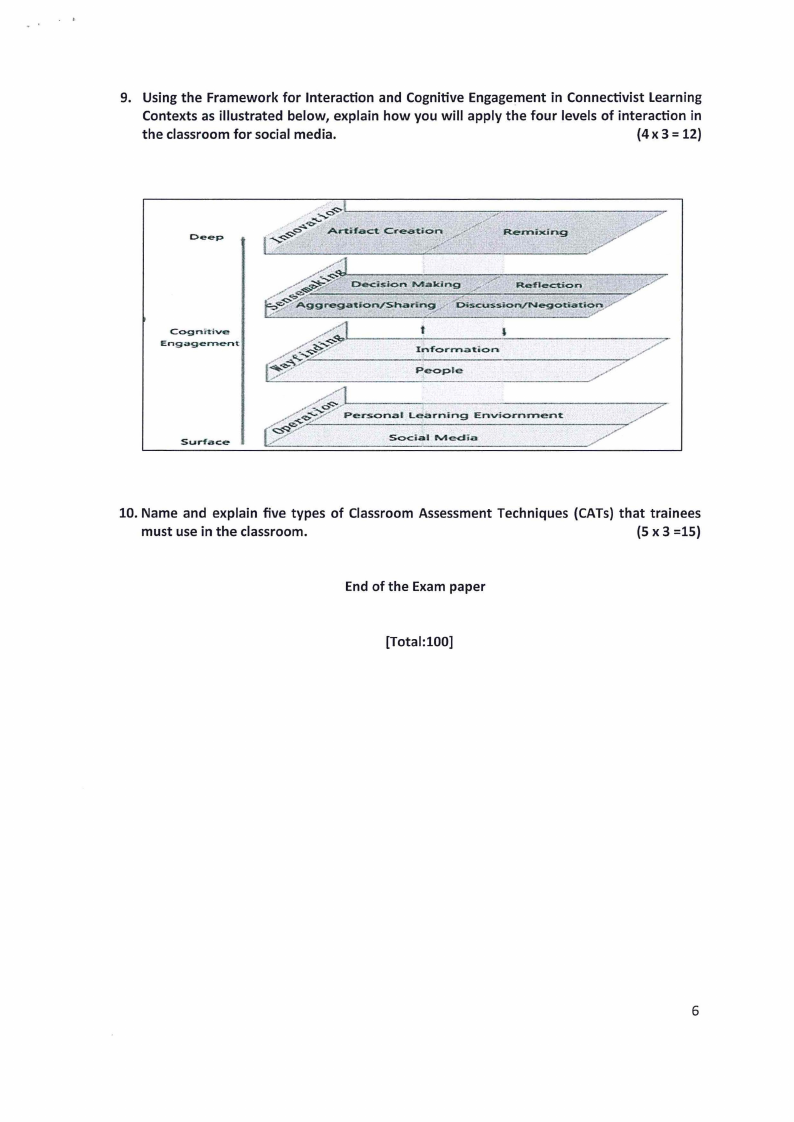
9. Using the Framework for Interaction and Cognitive Engagement in Connectivist Learning
Contexts as illustrated below, explain how you will apply the four levels of interaction in
the classroom for social media.
(4 x 3 = 12)
Deep
Cognil'l-ve
Engagement
,
Surface
Decision
t,haJ<Jng /
tion/Sharing/~'b.scus.s
,-
t
Informat:,on
People
Reflection
o,VN0!9oti..;i
'ersonal
Learning
Env.iomment:
Social Media
10. Name and explain five types of Classroom Assessment Techniques (CATs) that trainees
must use in the classroom.
(5 x 3 =15)
End of the Exam paper
[Total:100]
6