


 |
PSL510S - PSYCHOLOGY OF LEARNING A - 2ND OPP - JULY 2025 |
|
|
1 Page 1 |
▲back to top |
nAmlBIA unlVERSITY
OF SCIEnCE Ano TECHnOLOGY
FACULTY OF COMMERCE, HUMAN SCIENCE AND EDUCATION
DEPARTMENT OF TECHNICAL AND VOCATIONAL EDUCATION AND TRAINING
QUALIFICATION: DIPLOMA IN TECHNICAL AND VOCATIONAL EDUCATION AND TRAINING:
TRAINER
QUALIFICATION CODE: 0GDTVT
LEVEL: 5
COURSE CODE: PSLSl0S
COURSE NAME: PSYCHOLOGY OF LEARNING A
SESSION: JULY 2025
PAPER: 2
DURATION: 3 HOURS
MARKS: 100
EXAMINER(S)
SECOND OPPORTUNITY EXAMINATION QUESTION PAPER
MS R. QUEST
MODERATOR: DR 0. KACHEPA
INSTRUCTIONS
1. Answer ALLthe questions.
2. Read all the questions carefully before answering.
3. Number the answers clearly
THIS QUESTION PAPER CONSISTS OF_ 4_ PAGES (Including this front page)
|
|
2 Page 2 |
▲back to top |
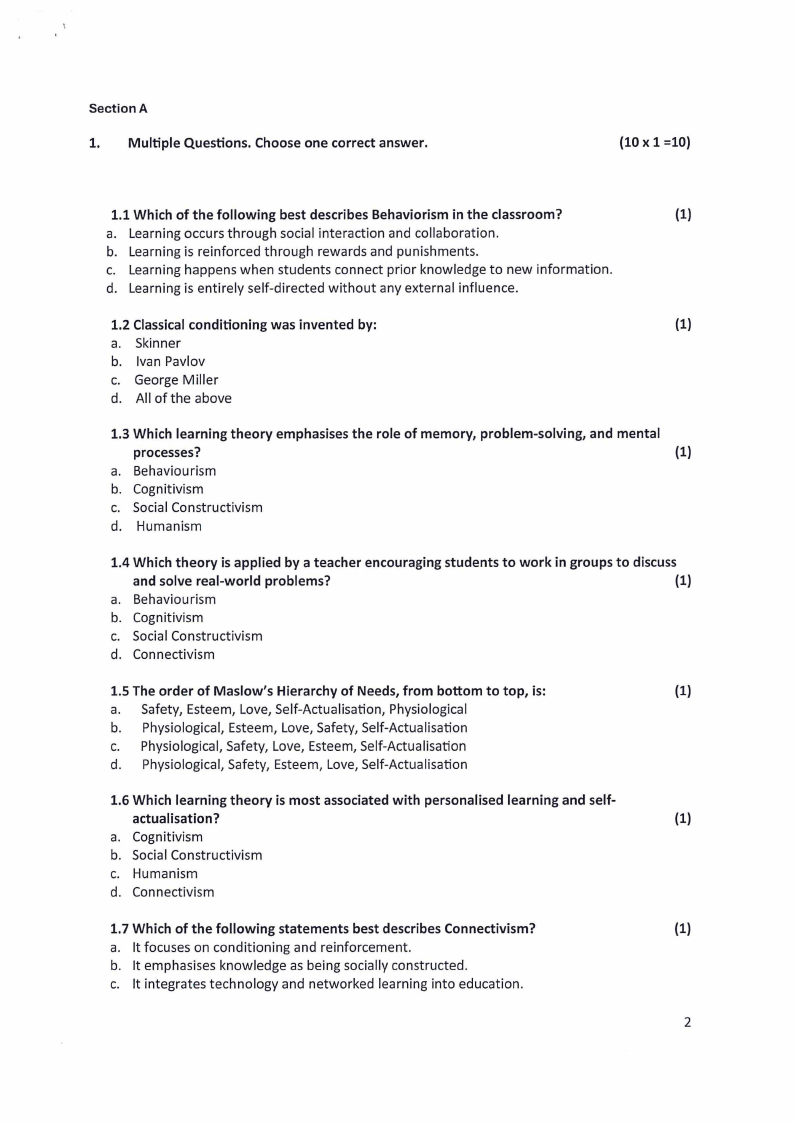
Section A
1. Multiple Questions. Choose one correct answer.
(10 X 1 =10)
1.1 Which of the following best describes Behaviorism in the classroom?
(1)
a. Learning occurs through social interaction and collaboration.
b. Learning is reinforced through rewards and punishments.
c. Learning happens when students connect prior knowledge to new information.
d. Learning is entirely self-directed without any external influence.
1.2 Classicalconditioning was invented by:
(1)
a. Skinner
b. Ivan Pavlov
c. George Miller
d. All of the above
1.3 Which learning theory emphasises the role of memory, problem-solving, and mental
processes?
(1)
a. Behaviourism
b. Cognitivism
c. Social Constructivism
d. Humanism
1.4 Which theory is applied by a teacher encouraging students to work in groups to discuss
and solve real-world problems?
(1)
a. Behaviourism
b. Cognitivism
c. Social Constructivism
d. Connectivism
1.5 The order of Maslow's Hierarchy of Needs, from bottom to top, is:
(1)
a. Safety, Esteem, Love, Self-Actualisation, Physiological
b. Physiological, Esteem, Love, Safety, Self-Actualisation
c. Physiological, Safety, Love, Esteem, Self-Actualisation
d. Physiological, Safety, Esteem, Love, Self-Actualisation
1.6 Which learning theory is most associated with personalised learning and self-
actualisation?
(1)
a. Cognitivism
b. Social Constructivism
c. Humanism
d. Connectivism
1.7 Which of the following statements best describes Connectivism?
(1)
a. It focuses on conditioning and reinforcement.
b. It emphasises knowledge as being socially constructed.
c. It integrates technology and networked learning into education.
2
|
|
3 Page 3 |
▲back to top |
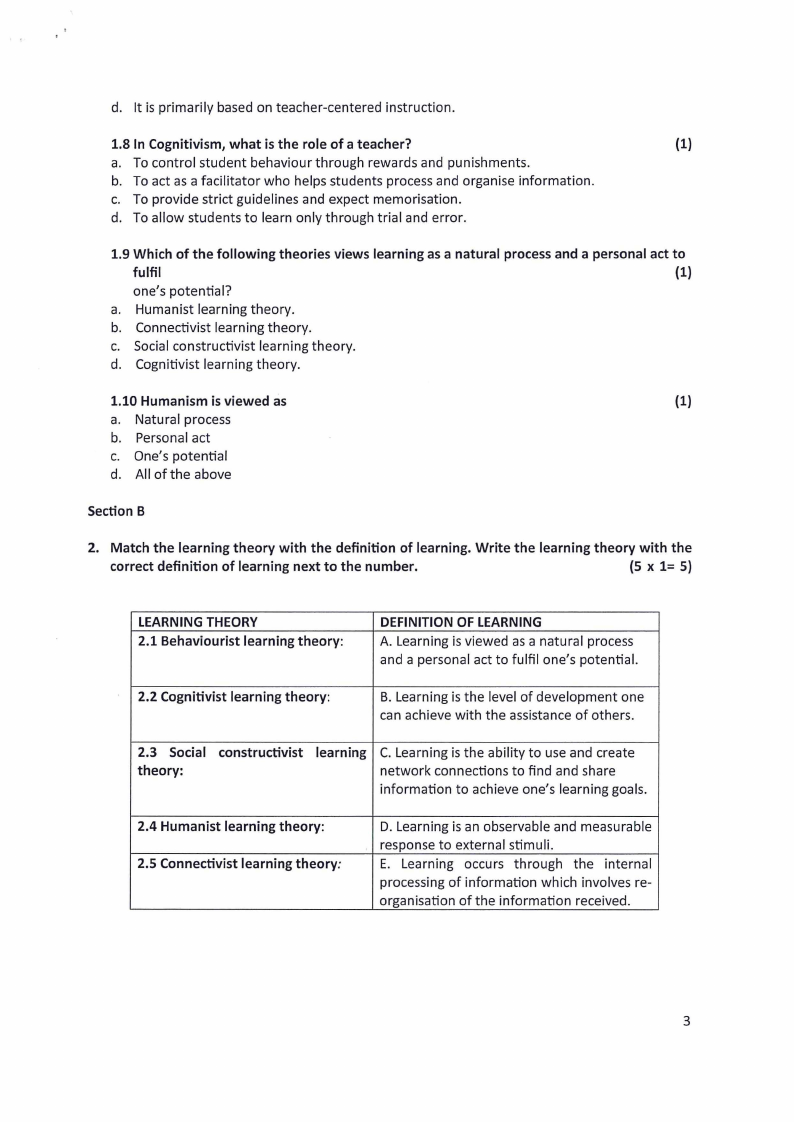
d. It is primarily based on teacher-centered instruction.
1.8 In Cognitivism, what is the role of a teacher?
(1)
a. To control student behaviour through rewards and punishments.
b. To act as a facilitator who helps students process and organise information.
c. To provide strict guidelines and expect memorisation.
d. To allow students to learn only through trial and error.
1.9 Which of the following theories views learning as a natural process and a personal act to
fulfil
(1)
one's potential?
a. Humanist learning theory.
b. Connectivist learning theory.
c. Social constructivist learning theory.
d. Cognitivist learning theory.
1.10 Humanism is viewed as
(1)
a. Natural process
b. Personal act
c. One's potential
d. All of the above
Section B
2. Match the learning theory with the definition of learning. Write the learning theory with the
correct definition of learning next to the number.
(5 x 1= 5)
LEARNINGTHEORY
2.1 Behaviourist learning theory:
DEFINITION OF LEARNING
A. Learning is viewed as a natural process
and a personal act to fulfil one's potential.
2.2 Cognitivist learning theory:
B. Learning is the level of development one
can achieve with the assistance of others.
2.3 Social constructivist learning C. Learning is the ability to use and create
theory:
network connections to find and share
information to achieve one's learning goals.
2.4 Humanist learning theory:
2.5 Connectivist learning theory:
D. Learning is an observable and measurable
response to external stimuli.
E. Learning occurs through the internal
processing of information which involves re-
organisation of the information received.
3
|
|
4 Page 4 |
▲back to top |
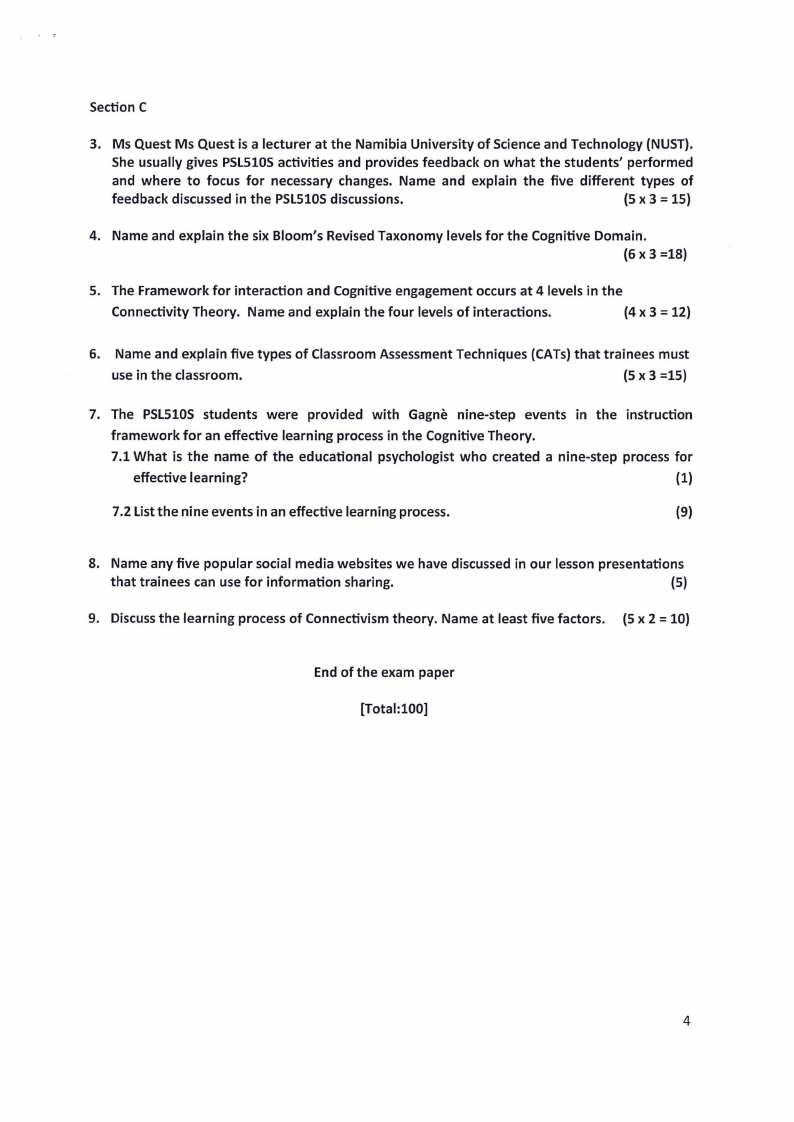
Section C
3. Ms Quest Ms Quest is a lecturer at the Namibia University of Science and Technology (NUST).
She usually gives PSL510Sactivities and provides feedback on what the students' performed
and where to focus for necessary changes. Name and explain the five different types of
feedback discussed in the PSL510Sdiscussions.
(5 x 3 = 15)
4. Name and explain the six Bloom's Revised Taxonomy levels for the Cognitive Domain.
(6 X 3 =18)
5. The Framework for interaction and Cognitive engagement occurs at 4 levels in the
Connectivity Theory. Name and explain the four levels of interactions.
(4 x 3 = 12)
6. Name and explain five types of Classroom Assessment Techniques (CATs) that trainees must
use in the classroom.
(5 x 3 =15)
7. The PSL510S students were provided with Gagne nine-step events in the instruction
framework for an effective learning process in the Cognitive Theory.
7.1 What is the name of the educational psychologist who created a nine-step process for
effective learning?
(1)
7.2 List the nine events in an effective learning process.
(9)
8. Name any five popular social media websites we have discussed in our lesson presentations
that trainees can use for information sharing.
(5)
9. Discuss the learning process of Connectivism theory. Name at least five factors. (5 x 2 = 10)
End of the exam paper
[Total:100]
4