


 |
GSD801S - GLOBAL SUPPLY CHAIN DILIGENCE - 1ST OPP -JUNE 2025 |
|
|
1 Page 1 |
▲back to top |
nAmlBIA unlVERSITY
OF SCIEn CE Ano TECHn OLOGY
FACULTY OF COMMERCE, HUMAN SCIENCESAND EDUCATION
DEPARTMENT OF MARKETING, LOGISTICS AND SPORTS MANAGEMENT
QUALIFICATION: POSTGRADUATE DIPLOMA: PROCUREMENT MANAGEMENT
QUALIFICATION CODE: 08PDPM
COURSE CODE: GSD801S
LEVEL: 8
COURSE NAME: GLOBAL SUPPLY CHAIN DILIGENCE
SESSION: JUNE 2025
PAPER: THEORY
DURATION: 3 HOURS
MARKS: 100
FIRST OPPORTUNITY EXAMINATION QUESTION PAPER
EXAMINER(S) MS. SELMA KAMBONDE
MODERATOR: MR. TANGENI MWASHEKELE
INSTRUCTIONS
1. Answer all questions.
2. Write clearly and neatly.
3. Number the answers.
THIS QUESTION PAPER CONSISTS OF 5 PAGES (Including this front page)
1
|
|
2 Page 2 |
▲back to top |
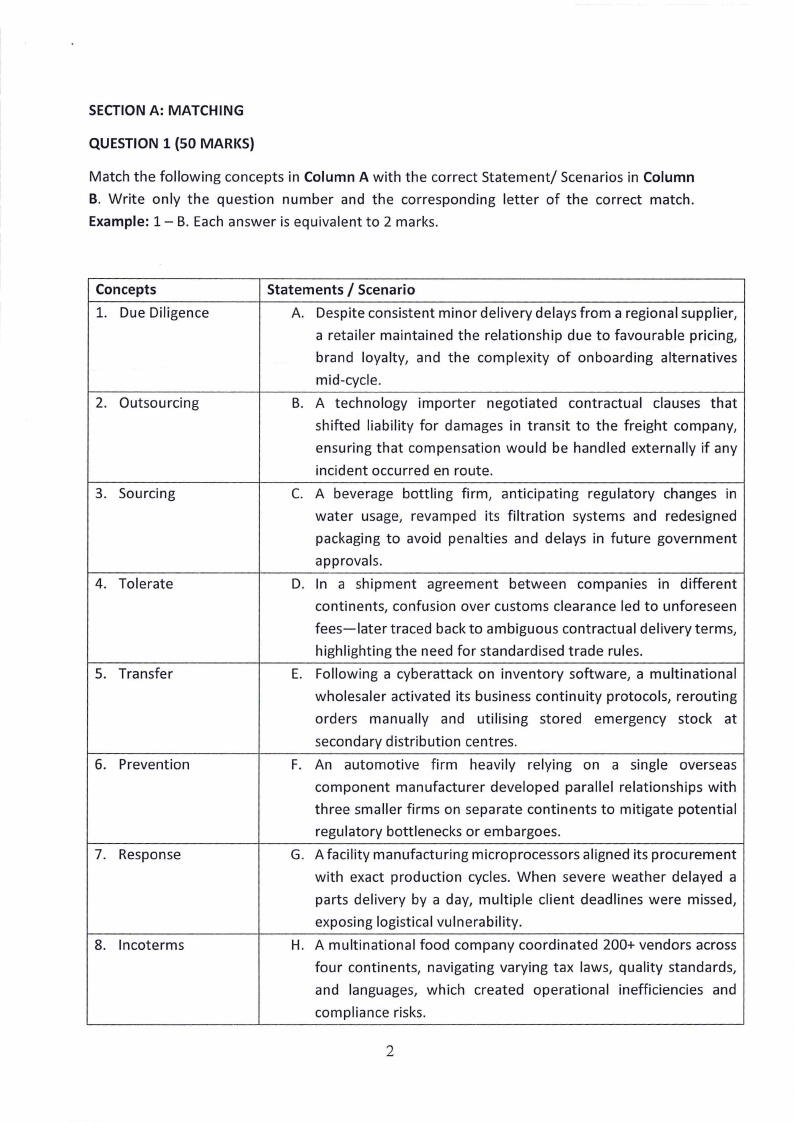
SECTION A: MATCHING
QUESTION 1 {SOMARKS)
Match the following concepts in Column A with the correct Statement/ Scenarios in Column
B. Write only the question number and the corresponding letter of the correct match.
Example: 1- B. Each answer is equivalent to 2 marks.
Concepts
1. Due Diligence
2. Outsourcing
3. Sourcing
4. Tolerate
5. Transfer
6. Prevention
7. Response
8. lncoterms
Statements/ Scenario
A. Despite consistent minor delivery delays from a regional supplier,
a retailer maintained the relationship due to favourable pricing,
brand loyalty, and the complexity of onboarding alternatives
mid-cycle.
B. A technology importer negotiated contractual clauses that
shifted liability for damages in transit to the freight company,
ensuring that compensation would be handled externally if any
incident occurred en route.
C. A beverage bottling firm, anticipating regulatory changes in
water usage, revamped its filtration systems and redesigned
packaging to avoid penalties and delays in future government
approvals.
D. In a shipment agreement between companies in different
continents, confusion over customs clearance led to unforeseen
fees-later traced back to ambiguous contractual delivery terms,
highlighting the need for standardised trade rules.
E. Following a cyberattack on inventory software, a multinational
wholesaler activated its business continuity protocols, rerouting
orders manually and utilising stored emergency stock at
secondary distribution centres.
F. An automotive firm heavily relying on a single overseas
component manufacturer developed parallel relationships with
three smaller firms on separate continents to mitigate potential
regulatory bottlenecks or embargoes.
G. A facility manufacturing microprocessors aligned its procurement
with exact production cycles. When severe weather delayed a
parts delivery by a day, multiple client deadlines were missed,
exposing logistical vulnerability.
H. A multinational food company coordinated 200+ vendors across
four continents, navigating varying tax laws, quality standards,
and languages, which created operational inefficiencies and
compliance risks.
2
|
|
3 Page 3 |
▲back to top |
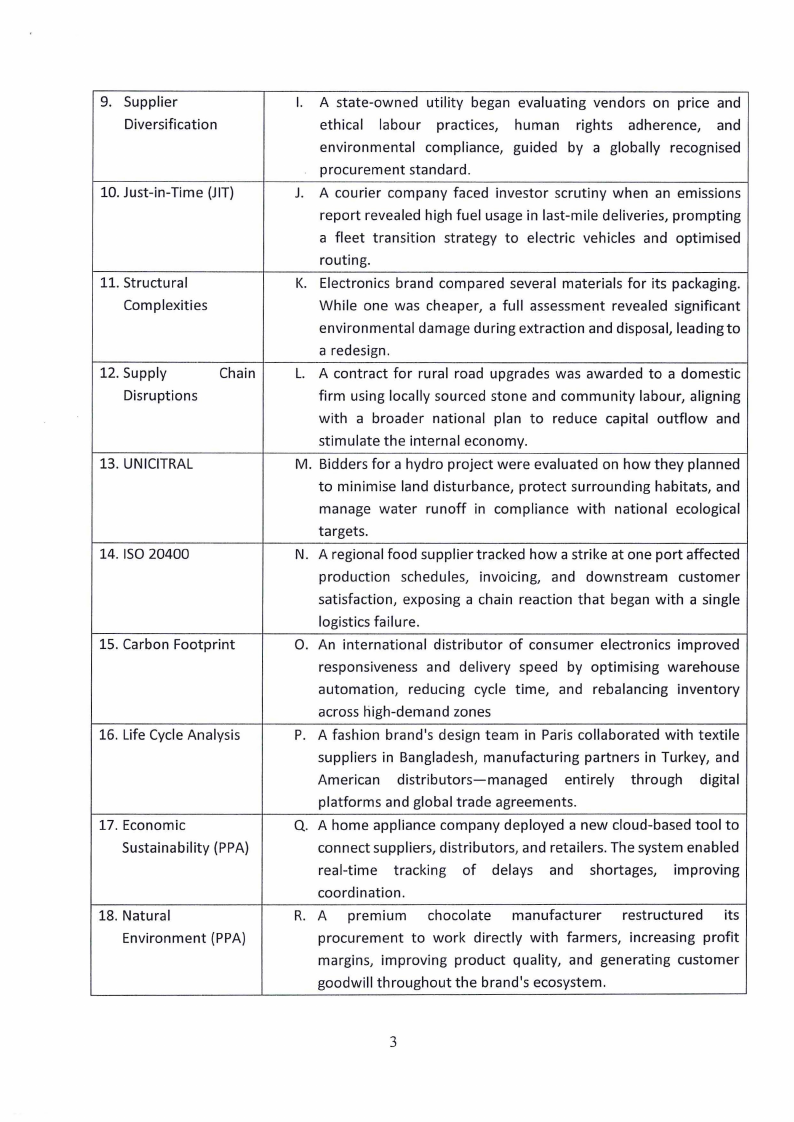
9. Supplier
Diversification
10. Just-in-Time (JIT)
11. Structural
Complexities
12. Supply
Disruptions
Chain
13. UNICITRAL
14. ISO 20400
15. Carbon Footprint
16. Life Cycle Analysis
17. Economic
Sustainability (PPA)
18. Natural
Environment (PPA)
I. A state-owned utility began evaluating vendors on price and
ethical labour practices, human rights adherence, and
environmental compliance, guided by a globally recognised
procurement standard.
J. A courier company faced investor scrutiny when an emissions
report revealed high fuel usage in last-mile deliveries, prompting
a fleet transition strategy to electric vehicles and optimised
routing.
K. Electronics brand compared several materials for its packaging.
While one was cheaper, a full assessment revealed significant
environmental damage during extraction and disposal, leading to
a redesign.
L. A contract for rural road upgrades was awarded to a domestic
firm using locally sourced stone and community labour, aligning
with a broader national plan to reduce capital outflow and
stimulate the internal economy.
M. Bidders for a hydro project were evaluated on how they planned
to minimise land disturbance, protect surrounding habitats, and
manage water runoff in compliance with national ecological
targets.
N. A regional food supplier tracked how a strike at one port affected
production schedules, invoicing, and downstream customer
satisfaction, exposing a chain reaction that began with a single
logistics failure.
0. An international distributor of consumer electronics improved
responsiveness and delivery speed by optimising warehouse
automation, reducing cycle time, and rebalancing inventory
across high-demand zones
P. A fashion brand's design team in Paris collaborated with textile
suppliers in Bangladesh, manufacturing partners in Turkey, and
American distributors-managed
entirely through digital
platforms and global trade agreements.
Q. A home appliance company deployed a new cloud-based tool to
connect suppliers, distributors, and retailers. The system enabled
real-time tracking of delays and shortages, improving
coordination.
R. A premium chocolate manufacturer restructured its
procurement to work directly with farmers, increasing profit
margins, improving product quality, and generating customer
goodwill throughout the brand's ecosystem.
3
|
|
4 Page 4 |
▲back to top |
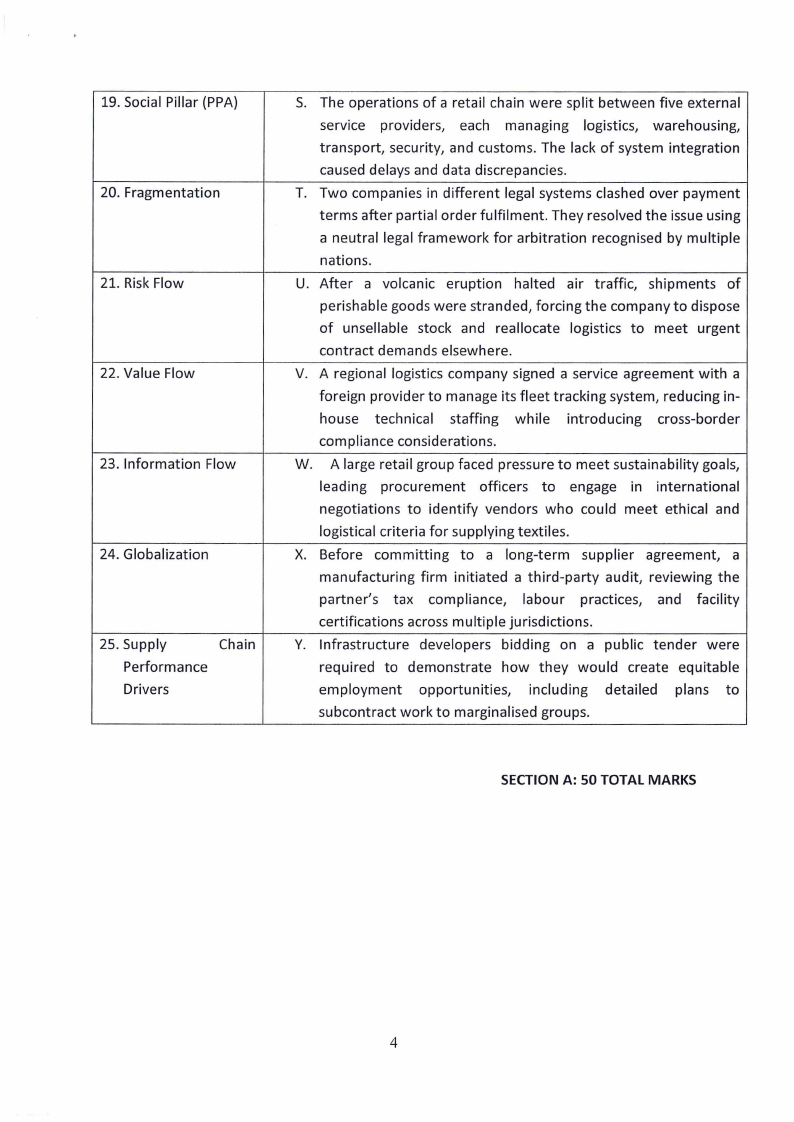
19. Social Pillar {PPA)
20. Fragmentation
21. Risk Flow
22. Value Flow
23. Information Flow
24. Globalization
25. Supply
Performance
Drivers
Chain
S. The operations of a retail chain were split between five external
service providers, each managing logistics, warehousing,
transport, security, and customs. The lack of system integration
caused delays and data discrepancies.
T. Two companies in different legal systems clashed over payment
terms after partial order fulfilment. They resolved the issue using
a neutral legal framework for arbitration recognised by multiple
nations.
u. After a volcanic eruption halted air traffic, shipments of
perishable goods were stranded, forcing the company to dispose
of unsellable stock and reallocate logistics to meet urgent
contract demands elsewhere.
V. A regional logistics company signed a service agreement with a
foreign provider to manage its fleet tracking system, reducing in-
house technical staffing while introducing cross-border
compliance considerations.
w. A large retail group faced pressure to meet sustainability goals,
leading procurement officers to engage in international
negotiations to identify vendors who could meet ethical and
logistical criteria for supplying textiles.
X. Before committing to a long-term supplier agreement, a
manufacturing firm initiated a third-party audit, reviewing the
partner's tax compliance, labour practices, and facility
certifications across multiple jurisdictions.
Y. Infrastructure developers bidding on a public tender were
required to demonstrate how they would create equitable
employment opportunities, including detailed plans to
subcontract work to marginalised groups.
SECTION A: 50 TOTAL MARKS
4
|
|
5 Page 5 |
▲back to top |
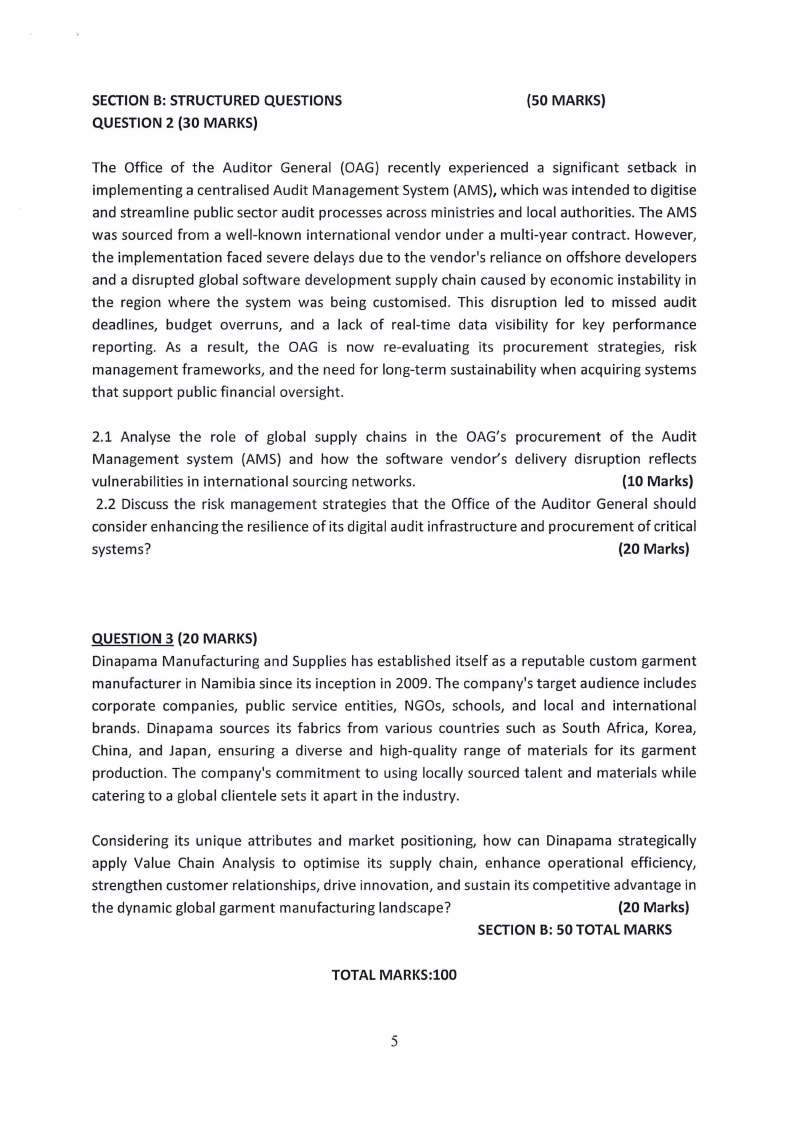
SECTION B: STRUCTURED QUESTIONS
QUESTION 2 (30 MARKS)
(50 MARKS)
The Office of the Auditor General (OAG) recently experienced a significant setback in
implementing a centralised Audit Management System (AMS), which was intended to digitise
and streamline public sector audit processes across ministries and local authorities. The AMS
was sourced from a well-known international vendor under a multi-year contract. However,
the implementation faced severe delays due to the vendor's reliance on offshore developers
and a disrupted global software development supply chain caused by economic instability in
the region where the system was being customised. This disruption led to missed audit
deadlines, budget overruns, and a lack of real-time data visibility for key performance
reporting. As a result, the OAG is now re-evaluating its procurement strategies, risk
management frameworks, and the need for long-term sustainability when acquiring systems
that support public financial oversight.
2.1 Analyse the role of global supply chains in the OAG's procurement of the Audit
Management system (AMS) and how the software vendor's delivery disruption reflects
vulnerabilities in international sourcing networks.
(10 Marks)
2.2 Discuss the risk management strategies that the Office of the Auditor General should
consider enhancing the resilience of its digital audit infrastructure and procurement of critical
systems?
(20 Marks)
QUESTION 3 (20 MARKS)
Dinapama Manufacturing and Supplies has established itself as a reputable custom garment
manufacturer in Namibia since its inception in 2009. The company's target audience includes
corporate companies, public service entities, NGOs, schools, and local and international
brands. Dinapama sources its fabrics from various countries such as South Africa, Korea,
China, and Japan, ensuring a diverse and high-quality range of materials for its garment
production. The company's commitment to using locally sourced talent and materials while
catering to a global clientele sets it apart in the industry.
Considering its unique attributes and market positioning, how can Dinapama strategically
apply Value Chain Analysis to optimise its supply chain, enhance operational efficiency,
strengthen customer relationships, drive innovation, and sustain its competitive advantage in
the dynamic global garment manufacturing landscape?
(20 Marks)
SECTION B: 50 TOTAL MARKS
TOTAL MARKS:100
5