


 |
SFM711S - STRATEGIC FLEET MANAGEMENT - 1ST OPP -JUNE 2025 |
|
|
1 Page 1 |
▲back to top |
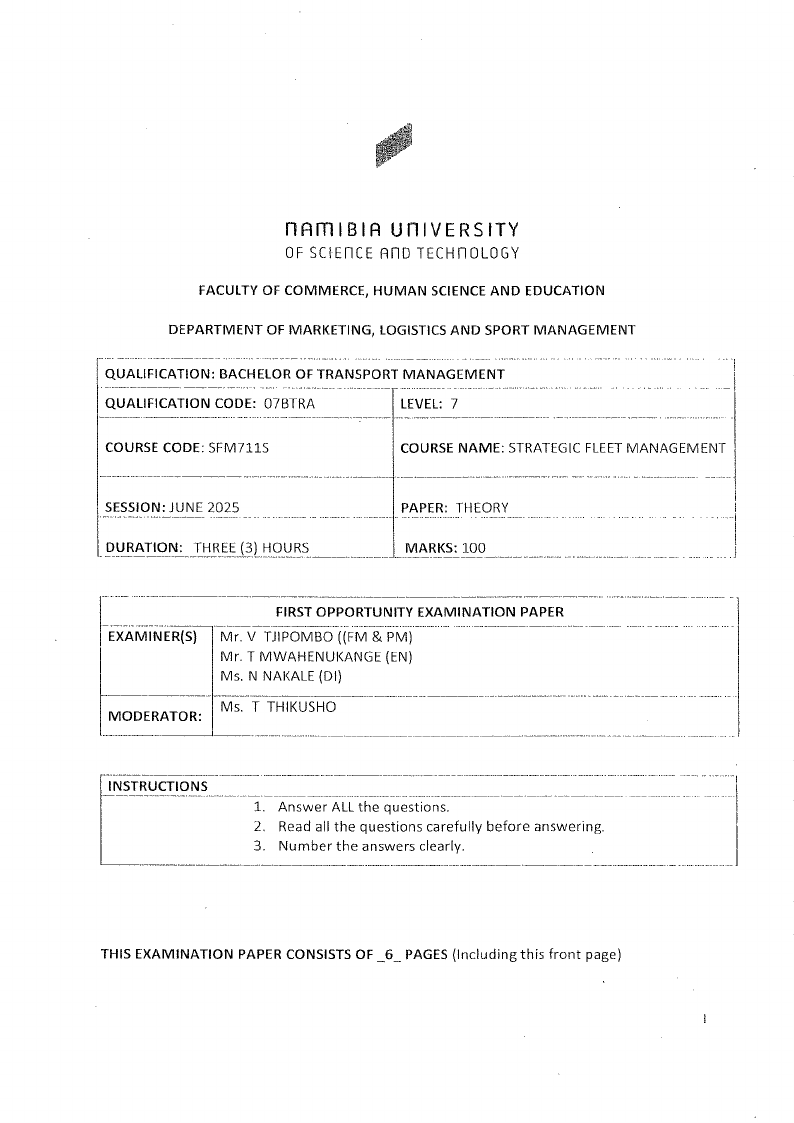
nRmlBIR UnlVERSITY
OF SCIEnCE Ano TECHnOLOGY
FACULTY OF COMMERCE, HUMAN SCIENCE AND EDUCATION
DEPARTMENT OF MARKETING, LOGISTICSAND SPORT MANAGEMENT
QUALIFICATION: BACHELOR OF TRANSPORT MANAGEMENT
QUALIFICATION CODE: 07BTRA
LEVEL: 7
COURSE CODE: SFM7115
COURSE NAME: STRATEGIC FLEET MANAGEMENT
SESSION: JUNE 2025
DURATION: THREE (3)HOURS~--
PAPER: THE. O··--R···Y··,-..-·-, ---- -
MARKS: 100
EXAMINER(S)
MODERATOR:
FIRST OPPORTUNITY EXAMINATION PAPER
Mr. V TJIPOMBO ((FM & PM)
Mr. T MWAHENUl<ANGE (EN)
Ms. N NAl<ALE (DI)
Ms. T THIKUSHO
INSTRUCTIONS
1. Answer ALL the questions.
2. Read all the questions carefully before answering.
3. Number the answers clearly.
THIS EXAMINATION PAPER CONSISTS OF _6_ PAGES (Including this front page)
|
|
2 Page 2 |
▲back to top |
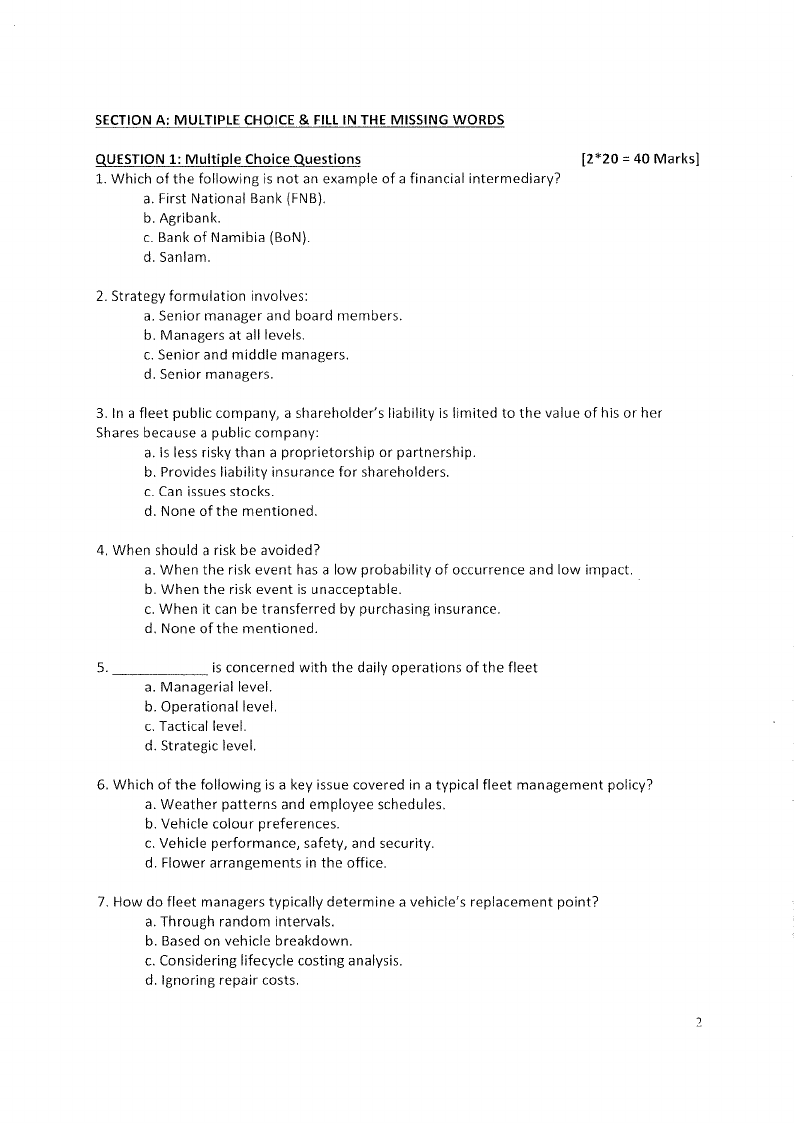
SECTION A: MULTIPLE CHOICE & FILL IN THE MISSING WORDS
QUESTION 1: Multiple Choice Questions
1. Which of the following is not an example of a financial intermediary?
a. First National Bank (FNB).
b. Agribank.
c. Bank of Namibia (BoN).
d. Sanlam.
[2*20 = 40 Marks]
2. Strategy formulation involves:
a. Senior manager and board members.
b. Managers at all levels.
c. Senior and middle managers.
d. Senior managers.
3. In a fleet public company, a shareholder's liability is limited to the value of his or her
Shares because a public company:
a. Is less risky than a proprietorship or partnership.
b. Provides liability insurance for shareholders.
c. Can issues stocks.
d. None of the mentioned.
4. When should a risk be avoided?
a. When the risk event has a low probability of occurrence and low impact.
b. When the risk event is unacceptable.
c. When it can be transferred by purchasing insurance.
d. None of the mentioned.
5. ______
is concerned with the daily operations of the fleet
a. Managerial level.
b. Operational level.
c. Tactical level.
d. Strategic level.
6. Which of the following is a key issue covered in a typical fleet management
a. Weather patterns and employee schedules.
b. Vehicle colour preferences.
c. Vehicle performance, safety, and security.
d. Flower arrangements in the office.
policy?
7. How do fleet managers typically determine a vehicle's replacement
a. Through random intervals.
b. Based on vehicle breakdown.
c. Considering lifecycle costing analysis.
d. Ignoring repair costs.
point?
2
|
|
3 Page 3 |
▲back to top |
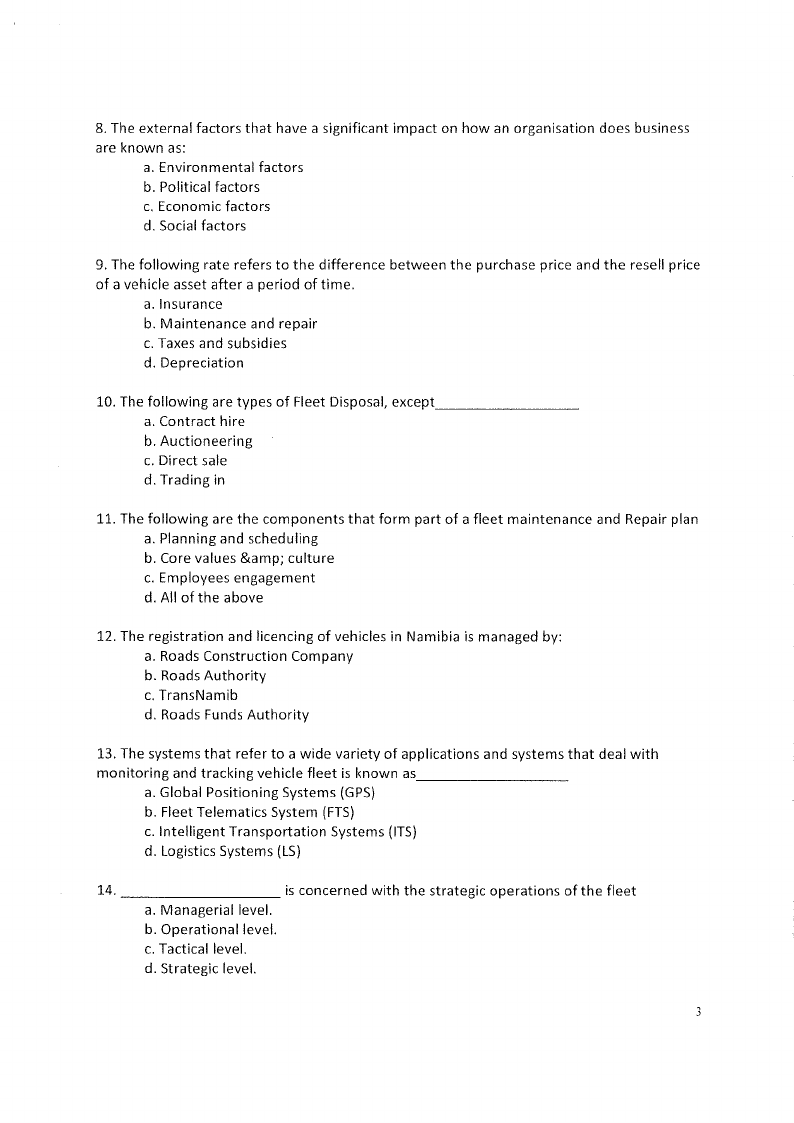
8. The external factors that have a significant impact on how an organisation does business
are known as:
a. Environmental factors
b. Political factors
c. Economic factors
d. Social factors
9. The following rate refers to the difference between the purchase price and the resell price
of a vehicle asset after a period of time.
a. Insurance
b. Maintenance and repair
c. Taxes and subsidies
d. Depreciation
10. The following are types of Fleet Disposal, except _______
_
a. Contract hire
b. Auctioneering
c. Direct sale
d. Trading in
11. The following are the components that form part of a fleet maintenance and Repair plan
a. Planning and scheduling
b. Core values & culture
c. Employees engagement
d. All of the above
12. The registration and licencing of vehicles in Namibia is managed by:
a. Roads Construction Company
b. Roads Authority
c. TransNamib
d. Roads Funds Authority
13. The systems that refer to a wide variety of applications and systems that deal with
monitoring and tracking vehicle fleet is known as---------
a. Global Positioning Systems (GPS)
b. Fleet Telematics System (FTS)
c. Intelligent Transportation Systems (ITS)
d. Logistics Systems (LS)
14. _________
is concerned with the strategic operations of the fleet
a. Managerial level.
b. Operational level.
c. Tactical level.
d. Strategic level.
3
|
|
4 Page 4 |
▲back to top |
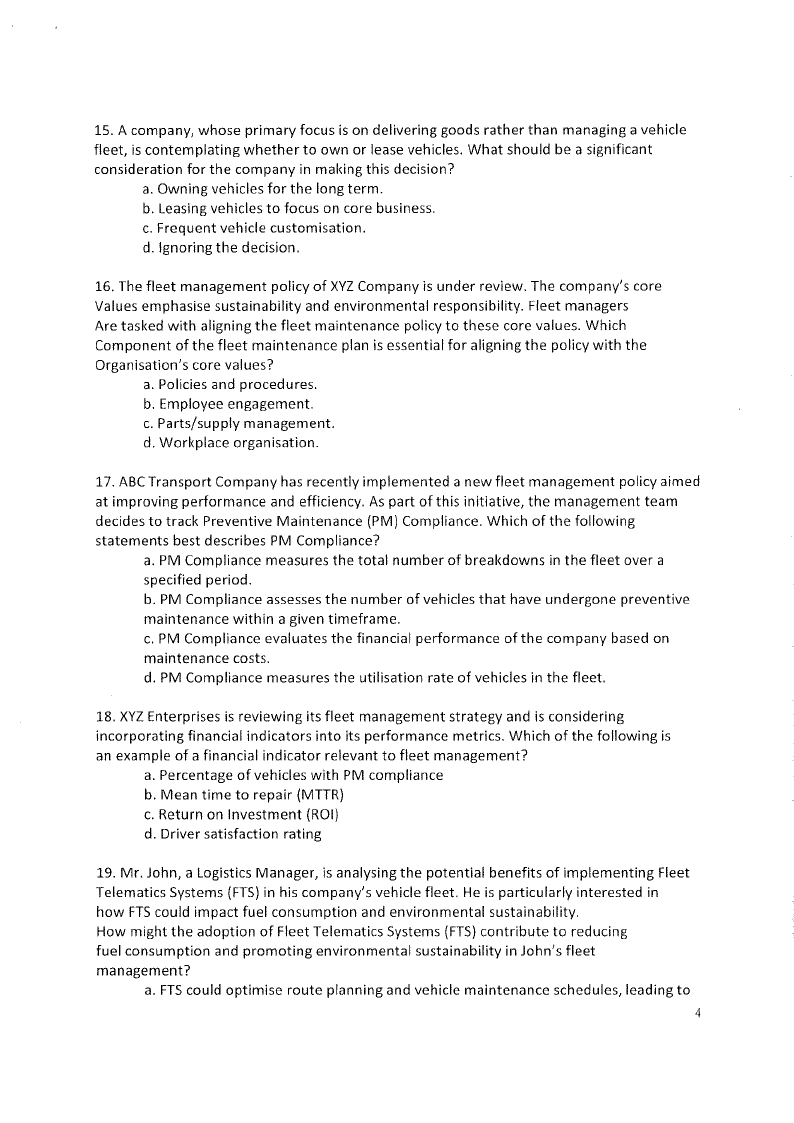
15. A company, whose primary focus is on delivering goods rather than managing a vehicle
fleet, is contemplating whether to own or lease vehicles. What should be a significant
consideration for the company in making this decision?
a. Owning vehicles for the long term.
b. Leasing vehicles to focus on core business.
c. Frequent vehicle customisation.
d. Ignoring the decision.
16. The fleet management policy of XYZCompany is under review. The company's core
Values emphasise sustainability and environmental responsibility. Fleet managers
Are tasked with aligning the fleet maintenance policy to these core values. Which
Component of the fleet maintenance plan is essential for aligning the policy with the
Organisation's core values?
a. Policies and procedures.
b. Employee engagement.
c. Parts/supply management.
d. Workplace organisation.
17. ABC Transport Company has recently implemented a new fleet management policy aimed
at improving performance and efficiency. As part of this initiative, the management team
decides to track Preventive Maintenance (PM) Compliance. Which of the following
statements best describes PM Compliance?
a. PM Compliance measures the total number of breakdowns in the fleet over a
specified period.
b. PM Compliance assesses the number of vehicles that have undergone preventive
maintenance within a given timeframe.
c. PM Compliance evaluates the financial performance of the company based on
maintenance costs.
d. PM Compliance measures the utilisation rate of vehicles in the fleet.
18. XYZ Enterprises is reviewing its fleet management strategy and is considering
incorporating financial indicators into its performance metrics. Which of the following is
an example of a financial indicator relevant to fleet management?
a. Percentage of vehicles with PM compliance
b. Mean time to repair (MTTR)
c. Return on Investment (ROI)
d. Driver satisfaction rating
19. Mr. John, a Logistics Manager, is analysing the potential benefits of implementing Fleet
Telematics Systems (FTS)in his company's vehicle fleet. He is particularly interested in
how FTScould impact fuel consumption and environmental sustainability.
How might the adoption of Fleet Telematics Systems (FTS)contribute to reducing
fuel consumption and promoting environmental sustainability in John's fleet
management?
a. FTScould optimise route planning and vehicle maintenance schedules, leading to
4
|
|
5 Page 5 |
▲back to top |
reduced fuel consumption and lower emissions, thus promoting environmental
sustainability.
b. FTScould increase idling time and fuel wastage due to inaccurate data collection,
resulting in higher fuel consumption and environmental degradation.
c. FTSmight complicate fuel tracking and reporting processes, leading to
inefficiencies in fuel management and minimal impact on environmental
sustainability.
d. FTScould introduce complexities in vehicle operations and maintenance, causing
disruptions that outweigh any potential fuel savings and environmental benefits.
20. A logistics company operates internationally and requires a telematics solution that
offers comprehensive coverage across multiple regions. Which criterion should the fleet
managers prioritise during the selection process.
a. Usability Features
b. Integration Features
c. Service Region
d. Know your business needs, goals, and vision
QUESTION 2: Fill in the missing words
[2*5 = 10 Marks)
2.1. ______
Ensuring that every aspect of fleet management is going according to
schedule and set targets are being met.
2.2. ______
Ensuring that all fleet management processes, procedures and practices
are well integrated without duplication or gaps, getting every stakeholder to do what is
expected of him.
2.3. ______
It is a method of monitoring cars, trucks, equipment and other assets by
using GPS technology and on-board diagnostics (OBD) to plot the asset's movements on a
computerized map. Also known as fleet tracking or GPSvehicle tracking.
2.4. ______
A concept in fleet management that seeks to evaluate different vehicle
costs by factoring in all costs associated with owning that vehicle(s) from acquisition costs to
maintenance costs to its future value doing disposal. The idea is to have a comprehensive
view to the costs as opposed to merely choose a vehicle based on its acquisition cost.
2.5. ______
The extent to which vehicles or equipment are within or exceed
established replacement criteria.
Sub-total: 50 Marks
5
|
|
6 Page 6 |
▲back to top |
SECTION B: STRUCTURED QUESTIONS
Question 1
(30 Marks)
You are the newly appointed Fleet Manager for a Namibian transport company tasked with
overseeing the operations of a diverse fleet comprising trucks, vans, and specialised vehicles.
Your task is to derive the key considerations when selecting a type of a fleet insurance cover.
Therefore, in order to answer the below questions properly, think around themes such as
nature of business, type and number of fleets, insurance premiums, government regulatory
requirements.
1.1. Using examples, outline and explain the various types of risks that can affect fleet
operations of a freight company?
(10 Marks]
1.2. Discuss the core elements of fleet risk management policy or program? (10 Marks)
1.3. Explain the various types of fleet insurance and conditions under which each is
appropriate?
(10 Marks)
Question 2
(20 Marks)
2.1. How does an understanding of the bath-tub model help in making fleet maintenance
decisions? (10 Marks)
2.2. Under what conditions are the following fleet maintenance methods appropriate?
a). Reactive maintenance? (5 Marks)
b). Scheduled maintenance? (5 Marks]
Sub-total: 50 Marks
END OF EXAMINATION PAPER
Paper total: 100 Marks
6