SOT612S - Sales And Operations Management - 2nd Opp- Nov 2025


SOT612S - Sales And Operations Management - 2nd Opp- Nov 2025


1 Pages 1-10

▲back to top


1.1 Page 1

▲back to top


nAmlBIA UnlVERSITY
OF SCIEnCE Ano TECHnOLOGY
FACULTY OF COMMERCE, HUMAN SCIENCE AND EDUCATION
DEPARTMENT OF MARKETING, LOGISTICS AND SPORT MANAGEMENT
QUALIFICATION: BACHELOR OF MARKETING
QUALIFICATION CODE: 07BMAK
LEVEL: 6
COURSE CODE: SOT612S
COURSE NAME: SALES AND OPERATIONS
MANAGEMENT
SESSION: NOVEMBER 2025
PAPER: THEORY
DURATION: 3 HOURS
MARKS: 100
SECOND OPPORTUNITY EXAMINATION QUESTION PAPER
EXAMINER{S) MR. C. KAZONDOVI
MODERATOR: PROF. M. CHUFAMA
INSTRUCTIONS
1, Answer All the questions.
2. Write clearly and neatly.
3. Use the tables provided on [page 11 and 12] to answer Section A,
Question One (1) AND Question Two (2) respectively: Detach and
insert it into your answer booklet.
THIS QUESTION PAPER CONSISTS OF 12 PAGES (Including this front page)
1

1.2 Page 2

▲back to top


1.3 Page 3

▲back to top


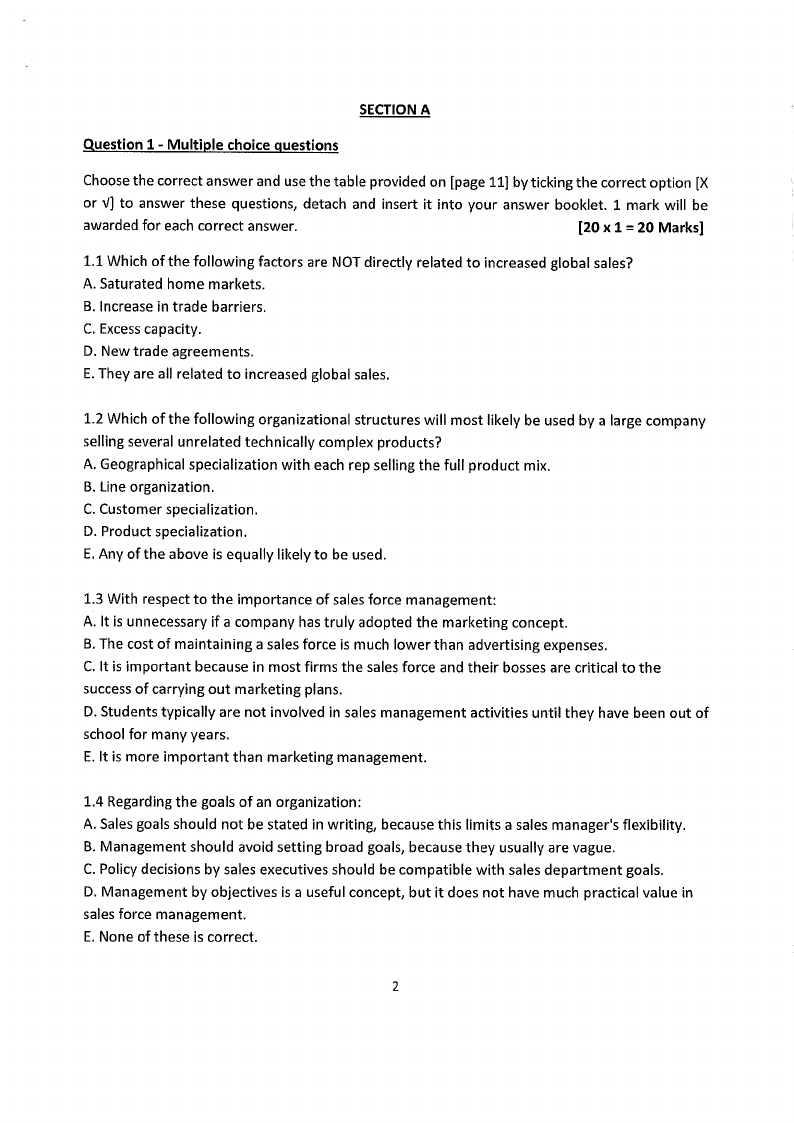
SECTION A
Question 1 - Multiple choice questions
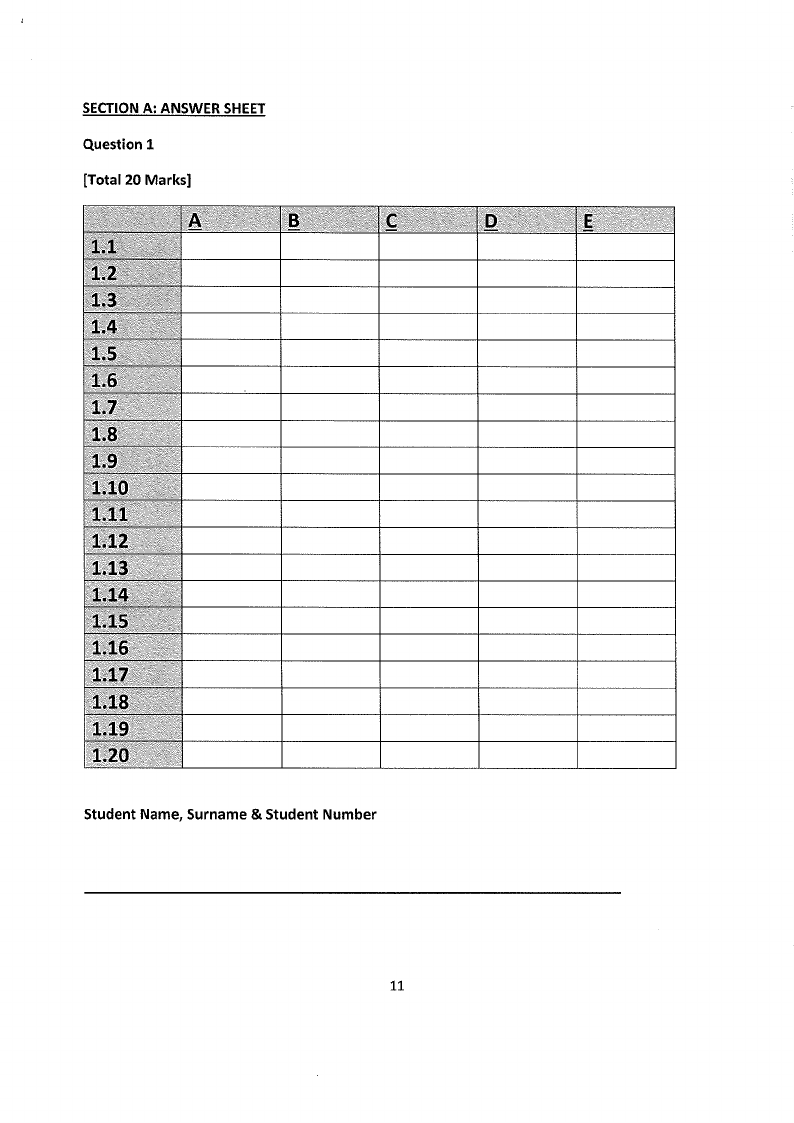
Choose the correct answer and use the table provided on [page 11] by ticking the correct option [X
or 11) to answer these questions, detach and insert it into your answer booklet. 1 mark will be
awarded for each correct answer.
[20 x 1 = 20 Marks]
1.1 Which of the following factors are NOT directly related to increased global sales?
A. Saturated home markets.
B. Increase in trade barriers.
C. Excess capacity.
D. New trade agreements.
E. They are all related to increased global sales.
1.2 Which of the following organizational structures will most likely be used by a large company
selling several unrelated technically complex products?
A. Geographical specialization with each rep selling the full product mix.
B. Line organization.
C. Customer specialization.
D. Product specialization.
E. Any of the above is equally likely to be used.
1.3 With respect to the importance of sales force management:
A. It is unnecessary if a company has truly adopted the marketing concept.
B. The cost of maintaining a sales force is much lower than advertising expenses.
C. It is important because in most firms the sales force and their bosses are critical to the
success of carrying out marketing plans.
D. Students typically are not involved in sales management activities until they have been out of
school for many years.
E. It is more important than marketing management.
1.4 Regarding the goals of an organization:
A. Sales goals should not be stated in writing, because this limits a sales manager's flexibility.
B. Management should avoid setting broad goals, because they usually are vague.
C. Policy decisions by sales executives should be compatible with sales department goals.
D. Management by objectives is a useful concept, but it does not have much practical value in
sales force management.
E. None of these is correct.
2

1.4 Page 4

▲back to top


1.5 Page 5

▲back to top


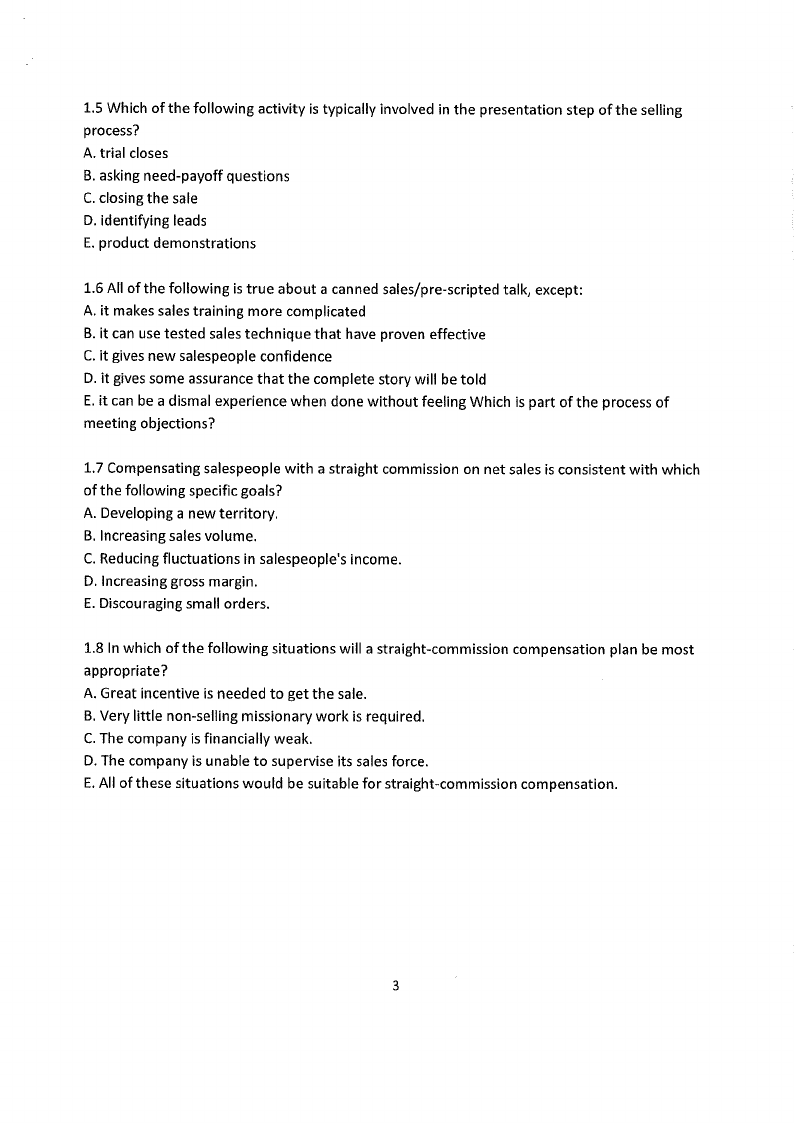
1.5 Which of the following activity is typically involved in the presentation step of the selling
process?
A. trial closes
B. asking need-payoff questions
C. closing the sale
D. identifying leads
E. product demonstrations
1.6 All of the following is true about a canned sales/pre-scripted talk, except:
A. it makes sales training more complicated
B. it can use tested sales technique that have proven effective
C. it gives new salespeople confidence
D. it gives some assurance that the complete story will be told
E. it can be a dismal experience when done without feeling Which is part of the process of
meeting objections?
1.7 Compensating salespeople with a straight commission on net sales is consistent with which
of the following specific goals?
A. Developing a new territory.
B. Increasing sales volume.
C. Reducing fluctuations in salespeople's income.
D. Increasing gross margin.
E. Discouraging small orders.
1.8 In which of the following situations will a straight-commission compensation plan be most
appropriate?
A. Great incentive is needed to get the sale.
B. Very little non-selling missionary work is required.
C. The company is financially weak.
D. The company is unable to supervise its sales force.
E. All of these situations would be suitable for straight-commission compensation.
3

1.6 Page 6

▲back to top


1.7 Page 7

▲back to top


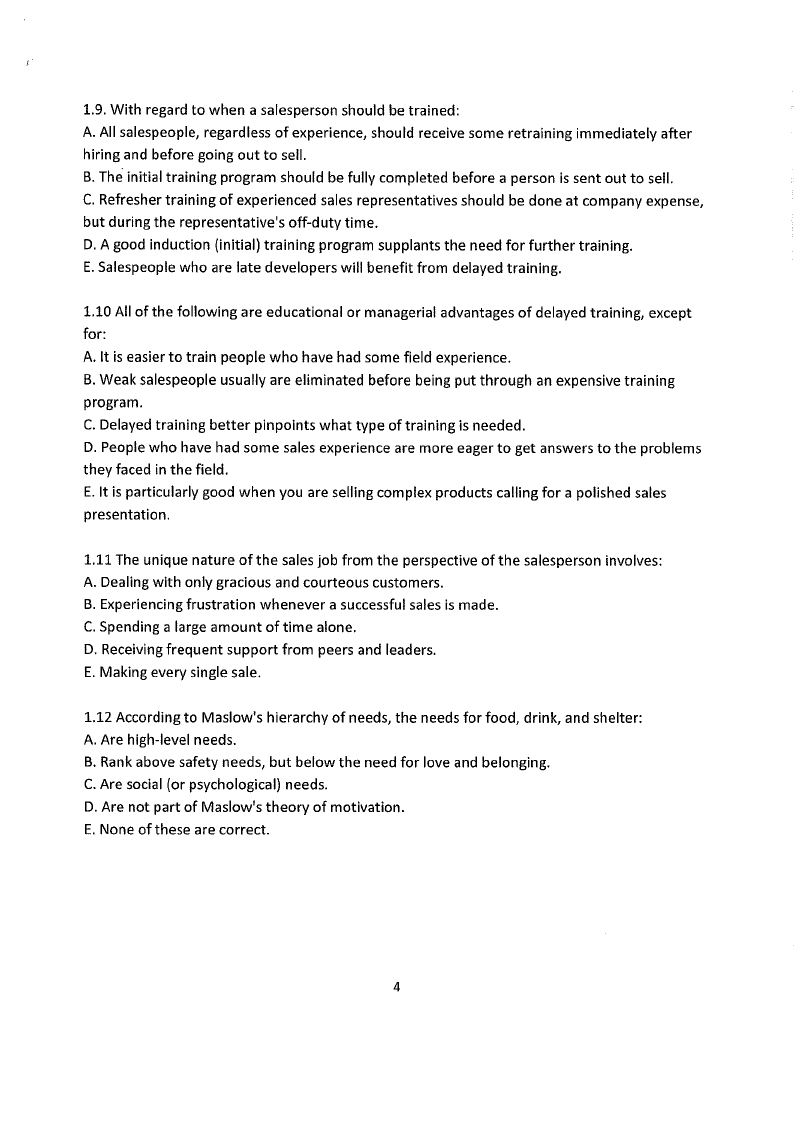
1.9. With regard to when a salesperson should be trained:
A. All salespeople, regardless of experience, should receive some retraining immediately after
hiring and before going out to sell.
B. The initial training program should be fully completed before a person is sent out to sell.
C. Refresher training of experienced sales representatives should be done at company expense,
but during the representative's off-duty time.
D. A good induction (initial) training program supplants the need for further training.
E. Salespeople who are late developers will benefit from delayed training.
1.10 All of the following are educational or managerial advantages of delayed training, except
for:
A. It is easier to train people who have had some field experience.
B. Weak salespeople usually are eliminated before being put through an expensive training
program.
C. Delayed training better pinpoints what type of training is needed.
D. People who have had some sales experience are more eager to get answers to the problems
they faced in the field.
E. It is particularly good when you are selling complex products calling for a polished sales
presentation.
1.11 The unique nature of the sales job from the perspective of the salesperson involves:
A. Dealing with only gracious and courteous customers.
B. Experiencing frustration whenever a successful sales is made.
C. Spending a large amount of time alone.
D. Receiving frequent support from peers and leaders.
E. Making every single sale.
1.12 According to Maslow's hierarchy of needs, the needs for food, drink, and shelter:
A. Are high-level needs.
B. Rank above safety needs, but below the need for love and belonging.
C. Are social (or psychological) needs.
D. Are not part of Maslow's theory of motivation.
E. None of these are correct.
4

1.8 Page 8

▲back to top


1.9 Page 9

▲back to top


1.13 In the design of a compensation plan, a factor over which a sales rep has some control, but
which cannot be measured objectively is:
A. Orders from new accounts.
B. Gross margin by product line.
C. Number of product demonstrations made.
D. Number of shelf and window displays obtained.
E. Customer goodwill developed toward company.
1.14 Which of the following job elements is hardest to measure objectively in a sales force
compensation plan?
A. The value of the salespeople's efforts spent in training their customers' sales force.
B. The reps' entertainment expenses.
C. The gross margin by product line that a rep contributes.
D. The volume of sales received over the phone or by mail.
E. The number of calls made on new accounts.
1.15 Which of the following factors is likely to contribute the least to your leadership ability?
A. You own the company.
B. People have confidence in you.
C. You are creative.
D. You have a high level of social skills.
E. You have a high energy level.
1.16 One key difference between a company's sales forecast and this firm's sales potential is
that:
A. The sales forecast is usually a larger figure.
B. The sales potential must be determined first.
C. The sales potential assumes that a certain strategic plan exists.
D. The sales forecast is an estimate of sales the firm expects to make under a proposed
Marketing plan.
E. The sales potential covers the company's entire market, while the forecast is made for
individual market segments.
5

1.10 Page 10

▲back to top


2 Pages 11-20

▲back to top


2.1 Page 11

▲back to top


1.17 Which of the following best illustrates the "80-20" principle?
A. Eighty percent of our products are sold in 80 percent of our territories.
B. Sales increased 15 percent last year.
C. Seventy-two percent of our customers account for only 12 percent of our sales.
D. Volume increased 80 percent, but profits increased only 20 percent.
E. Total sales increased 12 percent, but sales in the western region declined 3 percent
1.18 Misdirected marketing effort occurs in many firms because:
A. The salespeople do not ordinarily make their quota.
B. Companies typically find that their sales forecasts are below the figure for sales potentials.
C. Companies do not earn a satisfactory return on investment.
D. Management lacks reliable standards for determining what results should be expected from
marketing expenditures.
E. The opening statement is false in that mis-directed marketing effort does not occur in
companies which show a good profit rate.
1.19 Which of the following is the best example of a quantitative factor used as a basis for
evaluating sales force performance?
A. acceptance of responsibility.
B. number of orders generated.
C. ability to manage their time.
D. knowledge of the products sold.
E. relations with their customers.
1.20 A quantitative factor which is useful for measuring output (results) in a sales rep's
performance is:
A. Direct selling expense.
B. Gross margin.
C. Days worked.
D. Advertising displays set up.
E. Meeting held with dealers.
Question 2
True or False Questions
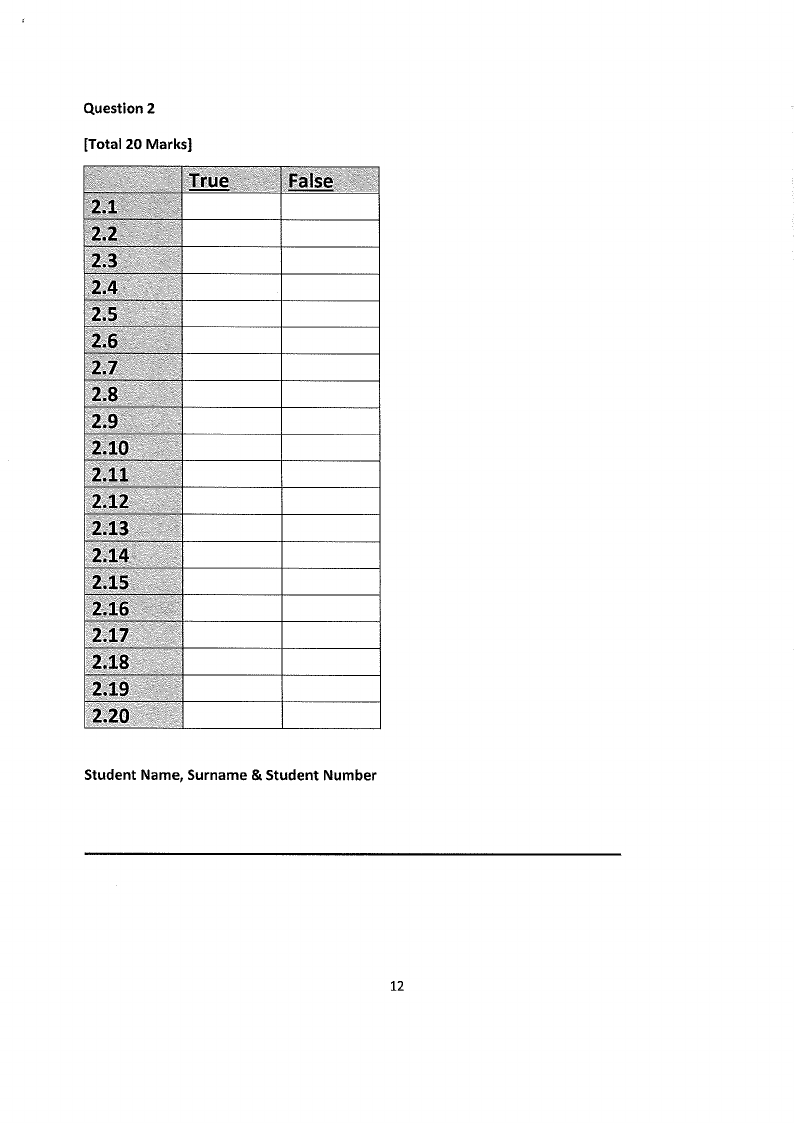
Use the table provided on [page 12] by ticking the correct option [X or v] to answer these questions,
detach and insert it into your answer booklet. 1 mark will be awarded for each correct answer.
(20 x 1 = 20 Marks]
6

2.2 Page 12

▲back to top


2.3 Page 13

▲back to top


2.1 In today's marketing environment, geographical specialization is not used very much in sales
force organizations.
2.2 When a sales force is organized by product line, a major drawback is that sometimes more
than one salesperson from a company calls on the same customer.
2.3 The most significant differentiating feature of an outside personal selling job is that there is
so much face-to-face interaction between salespeople and their managers.
2.4 Once the total company planning process is completed, essentially the same procedure can
be repeated for the marketing program.
2.5 A straight salary plan is the most widely used method for compensating a sales force.
2.6 In designing compensation plans in recent years, there has been not really been a shift in
emphasis away from sales volume alone toward profitable sales volume.
2.7 The organizational concept of a selling centre (team selling) has developed, in part at least,
to match the expertise of buying centres.
2.8 Selling teams have evolved in order for retailers to be more responsive to needs of the
buying centres.
2.9 A good sales training program should not waste time covering the company's organizational
hierarchy and procedures.
2.10 A lack of reinforcement is one reason why training programs are not effective.
2.11 Once a need is satisfied, it may become unfulfilled again.
2.12 Sales Managers often do not know whether salespeople value one incentive versus
another.
2.13 Management cannot design a sales compensation plan that has both stability and
flexibility.
2.14 Companies rarely place limits on the earnings of their salespeople.
2.15 By far, personal contact is the most important indirect supervisory technique.
2.16 A decline in a firm's sales volume indicates that competition is getting a larger share of the
market.
7

2.4 Page 14

▲back to top


2.5 Page 15

▲back to top


2.17 A firm's market share may be decreasing while its sales volume is increasing.
2.18 The evaluation of salespeople serves as means of directing salespeople's efforts.
2.19 Three hundred sixty-degree feedback involves getting feedback primarily from all of the
salesperson's customers.
2.20 An evaluation of sales force performance can enable management to discover particularly
effective sales techniques and incorporate them into the firm's training program.
SECTION B
[Total 60 Marks]
Question 3
3.1) Sales forecasting is a critical function for Sales Managers, especially in business-to-business
(B2B) environments where planning, budgeting, and resource allocation depend on accurate
projections. Various forecasting methods are available, each with its own strengths and
limitations.
Select any four (4) forecasting methods available to a Sales Manager. For each method:
a.) Provide two (2) advantages that make the method useful in a B2B context.
b.) Provide two (2) disadvantages or limitations that may affect its reliability or applicability.
c.) Explain when the method is best used with a practical example.
(20 marks)
3.2) Motivation consists of three key dimensions:
a.) the choice to do actions to accomplish a specific task or outcome,
b.) the intensity of effort expended toward those actions, and
c.) the persistence of effort over time.
Explain each of these dimensions in detail with examples (3x3 = 9 marks), and describe (1 mark)
how they work together to influence performance in a business-to-business (B2B) sales
environment.
(10 marks)
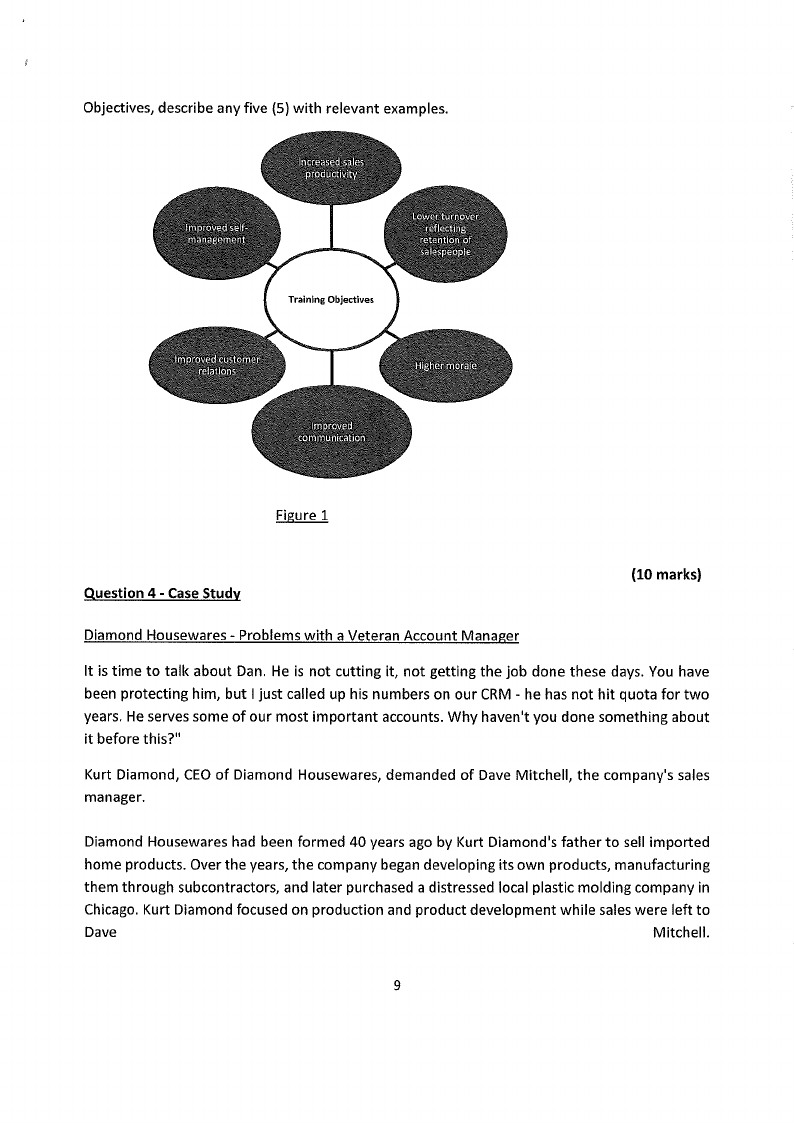
3.3) Most companies expect to influence the productivity of their field sales organizations
through the design and delivery of their training programs. Figure 1 underneath depicts six (6)
8

2.6 Page 16

▲back to top


2.7 Page 17

▲back to top


Objectives, describe any five (5) with relevant examples.
Figure 1
Question 4 - Case Study
(10 marks)
Diamond Housewares - Problems with a Veteran Account Manager
It is time to talk about Dan. He is not cutting it, not getting the job done these days. You have
been protecting him, but I just called up his numbers on our CRM - he has not hit quota for two
years. He serves some of our most important accounts. Why haven't you done something about
it before this?"
Kurt Diamond, CEO of Diamond Housewares, demanded of Dave Mitchell, the company's sales
manager.
Diamond Housewares had been formed 40 years ago by Kurt Diamond's father to sell imported
home products. Over the years, the company began developing its own products, manufacturing
them through subcontractors, and later purchased a distressed local plastic molding company in
Chicago. Kurt Diamond focused on production and product development while sales were left to
Dave
Mitchell.
9

2.8 Page 18

▲back to top


2.9 Page 19

▲back to top


The company remained financially sound and profitable due to steady new product
introductions. Advertising was minimal; promotional efforts focused on trade shows. Sales
offices and showrooms were maintained in major trade marts. Dan Ricker, based at the Dallas
Trade Mart, handled key accounts including Costco (similar to Metro Hyper in Namibia).
Ricker had been hired straight out of college and had a long personal connection with the
Diamond family, though their personalities were quite different. He built a highly profitable
business in the southwestern territory by developing department stores and emerging mass
distribution accounts.
Dave Mitchell was surprised at Kurt Diamond's sudden focus on Ricker. Typically, Diamond
intervened only if sales slumped or new products failed. Mitchell had been sales manager for
about 10 years, keeping the role steady while Ricker had previously turned down the sales
manager position, fearing a pay cut from his high straight-commission earnings.
Ricker's performance, however, had declined in recent years. Mitchell reminded Diamond of
Ricke r's long-standing loyalty and past contributions, explaining that he faced personal pressures
- his adult children had financial and legal troubles, which added to his stress. Despite these
challenges, Mitchell was hopeful that Ricker could return to full productivity.
Diamond, however, was concerned that Ricker was burned out, tired of working, and failing to
perform. If action wasn't taken, key customers could be lost. The discussion was interrupted by
a call from the Costco buyer, emphasizing the urgency of addressing the situation.
Questions:
1. What steps should Dave Mitchell take regarding Dan Ricker's declining performance, balancing
fairness, accountability, and customer retention?
(10 marks)
2. Imagine you are Dan Ricker. How would you respond to the recommendations proposed in the
first question, while addressing both professional and personal challenges?
(10 marks)
Grand Total = 100 marks
THE END
10

2.10 Page 20

▲back to top


3 Pages 21-30

▲back to top


3.1 Page 21

▲back to top


SECTION A: ANSWER SHEET
Question 1
[Total 20 Marks]
;~:,,J:__"
;"j;fi '
Student Name, Surname & Student Number
11

3.2 Page 22

▲back to top


3.3 Page 23

▲back to top


Question 2
[Total 20 Marks]
Student Name, Surname & Student Number
12

3.4 Page 24

▲back to top