LPM511S - LAW FOR PUBLIC MANAGERS 1A - 1ST OPP - JUNE 2025


LPM511S - LAW FOR PUBLIC MANAGERS 1A - 1ST OPP - JUNE 2025


1 Page 1

▲back to top


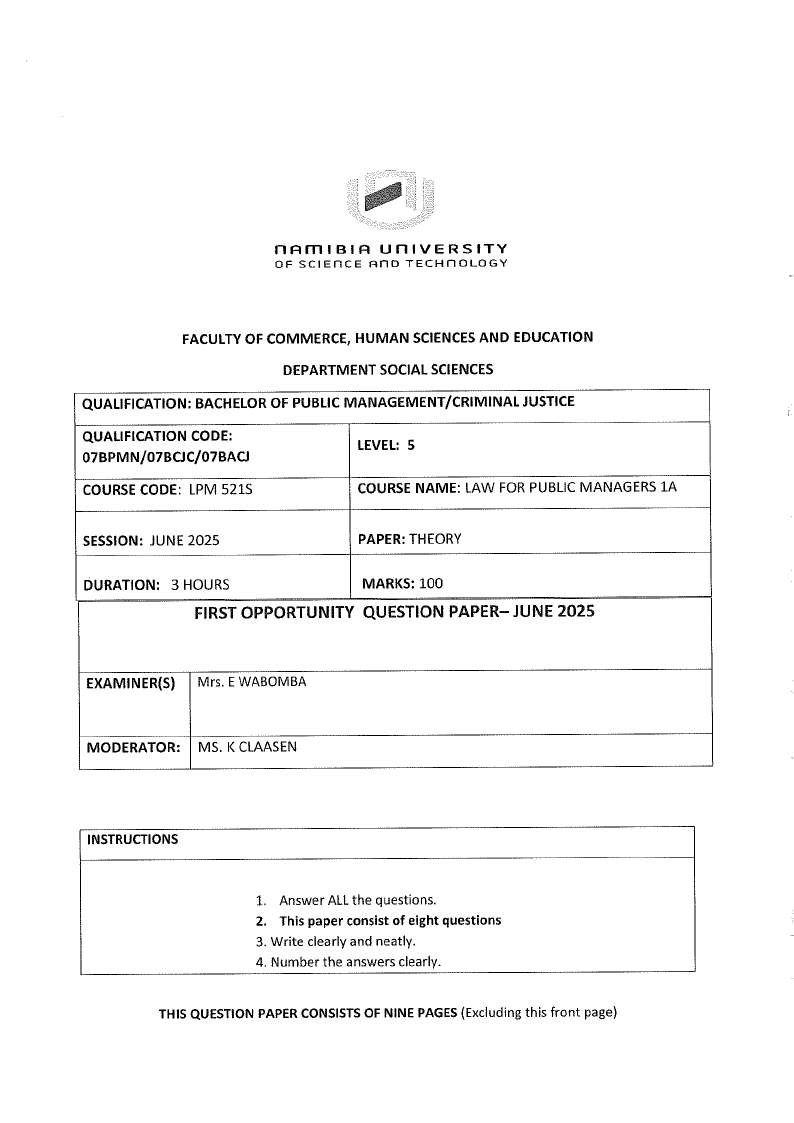
nAmlBIA
OF SCIEnCE
UnlVERSITY
AnD TECHnOLOGY
FACULTY OF COMMERCE, HUMAN SCIENCES AND EDUCATION
DEPARTMENT SOCIAL SCIENCES
QUALIFICATION: BACHELOR OF PUBLIC MANAGEMENT/CRIMINAL JUSTICE
QUALIFICATION CODE:
07BPMN/07BCJC/07BACJ
COURSE CODE: LPM 521S
LEVEL: S
COURSE NAME: LAW FOR PUBLIC MANAGERS lA
SESSION: JUNE 2025
PAPER: THEORY
DURATION: 3 HOURS
MARKS: 100
FIRST OPPORTUNITY QUESTION PAPER- JUNE 2025
EXAMINER(S) Mrs. E WABOMBA
MODERATOR: MS. K CLAASEN
INSTRUCTIONS
1. Answer ALL the questions.
2. This paper consist of eight questions
3. Write clearly and neatly.
4. Number the answers clearly.
THIS QUESTION PAPERCONSISTSOF NINE PAGES(Excluding this front page)

2 Page 2

▲back to top


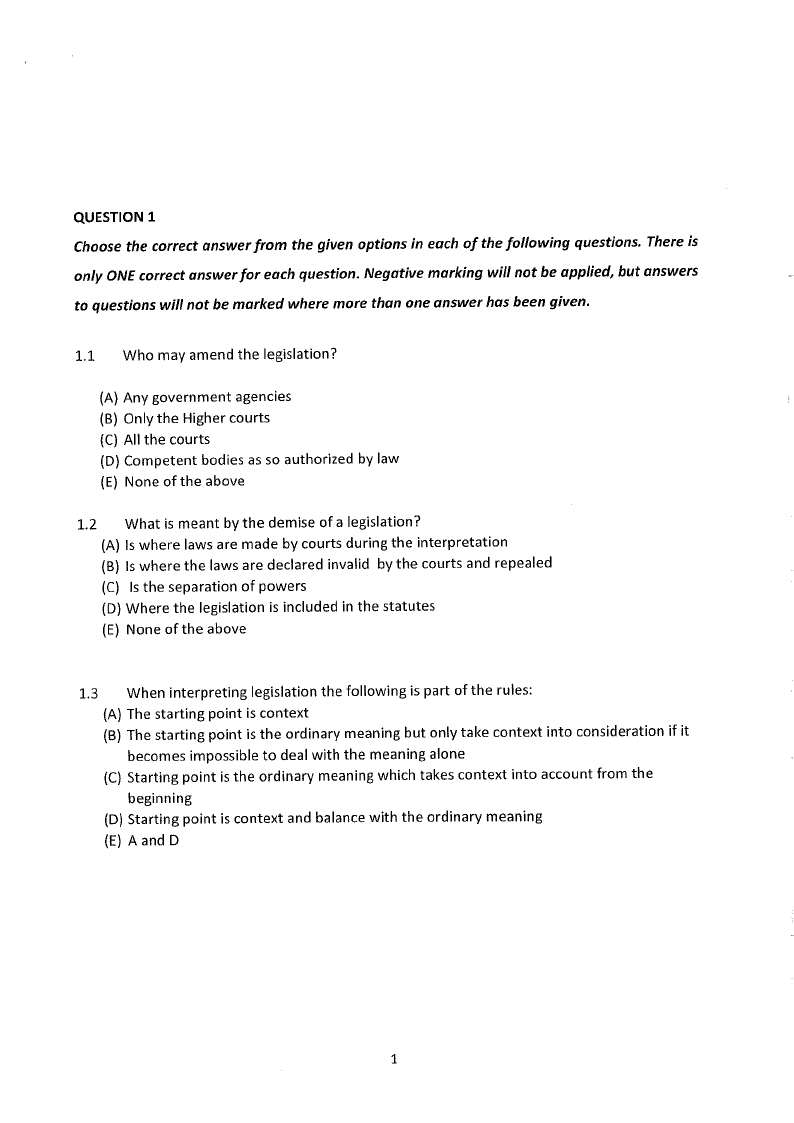
QUESTION 1
Choose the correct answer from the given options in each of the following questions. There is
only ONEcorrect answer far each question. Negative marking will not be applied, but answers
to questions will not be marked where more than one answer has been given.
1.1 Who may amend the legislation?
(A) Any government agencies
(B) Only the Higher courts
(C) All the courts
(D) Competent bodies as so authorized by law
(E) None of the above
1.2 What is meant by the demise of a legislation?
(A) Is where laws are made by courts during the interpretation
(B) Is where the laws are declared invalid by the courts and repealed
(C) Is the separation of powers
(D) Where the legislation is included in the statutes
(E) None of the above
1.3 When interpreting legislation the following is part of the rules:
(A) The starting point is context
(B) The starting point is the ordinary meaning but only take context into consideration if it
becomes impossible to deal with the meaning alone
(C) Starting point is the ordinary meaning which takes context into account from the
beginning
(D) Starting point is context and balance with the ordinary meaning
(E) A and D
1

3 Page 3

▲back to top


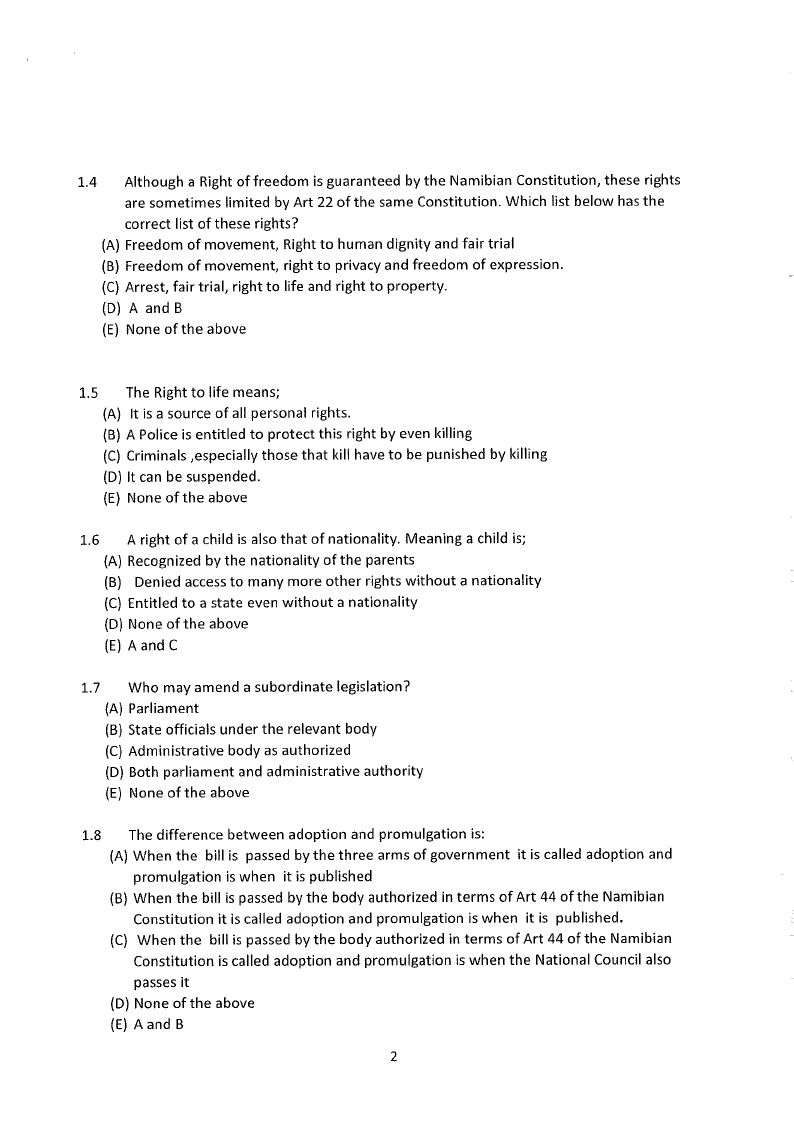
1.4 Although a Right of freedom is guaranteed by the Namibian Constitution, these rights
are sometimes limited by Art 22 of the same Constitution. Which list below has the
correct list of these rights?
(A) Freedom of movement, Right to human dignity and fair trial
(B) Freedom of movement, right to privacy and freedom of expression.
(C) Arrest, fair trial, right to life and right to property.
(D) A and B
(E) None of the above
1.5 The Right to life means;
(A) It is a source of all personal rights.
(B) A Police is entitled to protect this right by even killing
(C) Criminals ,especially those that kill have to be punished by killing
(D) It can be suspended.
(E) None of the above
1.6 A right of a child is also that of nationality. Meaning a child is;
(A) Recognized by the nationality of the parents
(B) Denied access to many more other rights without a nationality
(C) Entitled to a state even without a nationality
(D) None of the above
(E) A and C
1.7 Who may amend a subordinate legislation?
(A) Parliament
(B) State officials under the relevant body
(C) Administrative body as authorized
(D) Both parliament and administrative authority
(E) None of the above
1.8 The difference between adoption and promulgation is:
(A) When the bill is passed by the three arms of government it is called adoption and
promulgation is when it is published
(B) When the bill is passed by the body authorized in terms of Art 44 of the Namibian
Constitution it is called adoption and promulgation is when it is published.
(C) When the bill is passed by the body authorized in terms of Art 44 of the Namibian
Constitution is called adoption and promulgation is when the National Council also
passes it
(D) None of the above
(E) A and B
2

4 Page 4

▲back to top


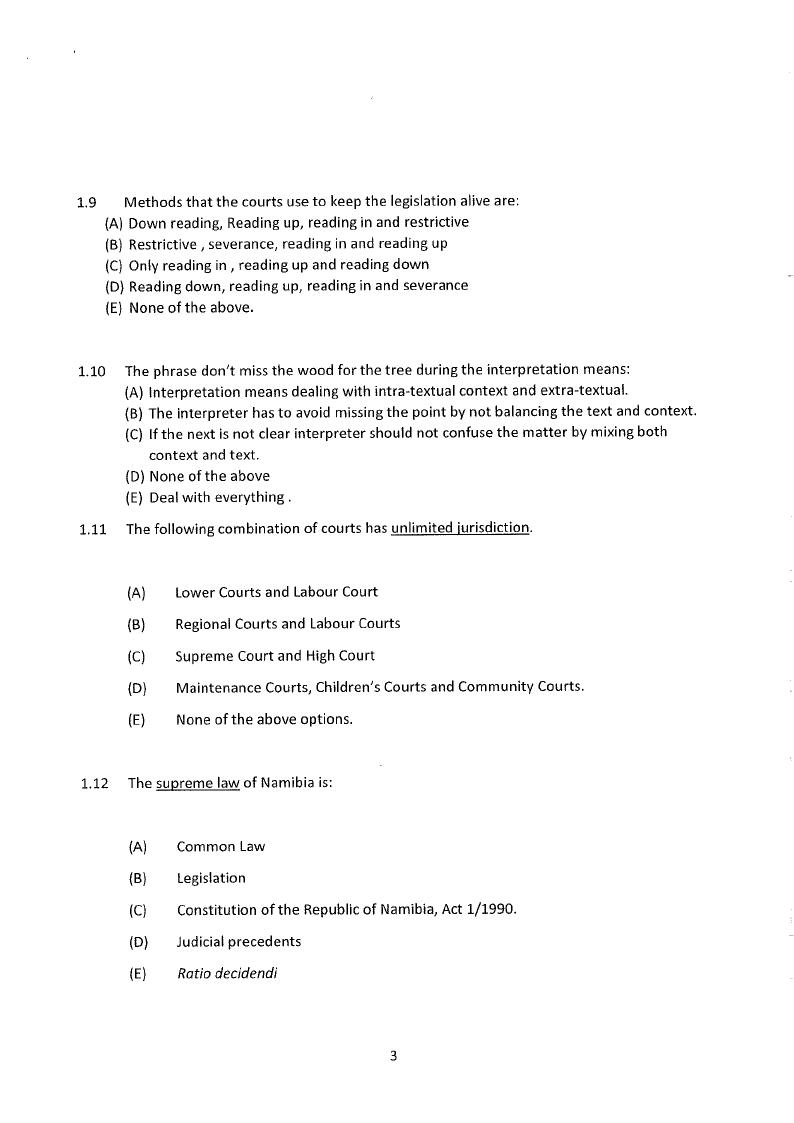
1.9 Methods that the courts use to keep the legislation alive are:
(A) Down reading, Reading up, reading in and restrictive
(B) Restrictive, severance, reading in and reading up
(C) Only reading in, reading up and reading down
(D) Reading down, reading up, reading in and severance
(E) None of the above.
1.10 The phrase don't miss the wood for the tree during the interpretation means:
(A) Interpretation means dealing with intra-textual context and extra-textual.
(B) The interpreter has to avoid missing the point by not balancing the text and context.
(C) lfthe next is not clear interpreter should not confuse the matter by mixing both
context and text.
(D) None of the above
(E) Deal with everything.
1.11 The following combination of courts has unlimited jurisdiction.
(A) Lower Courts and Labour Court
(B) Regional Courts and Labour Courts
{C) Supreme Court and High Court
(D) Maintenance Courts, Children's Courts and Community Courts.
(E) None of the above options.
1.12 The supreme law of Namibia is:
(A) Common Law
(B) Legislation
(C) Constitution of the Republic of Namibia, Act 1/1990.
(D) Judicial precedents
(E) Ratio decidendi
3

5 Page 5

▲back to top


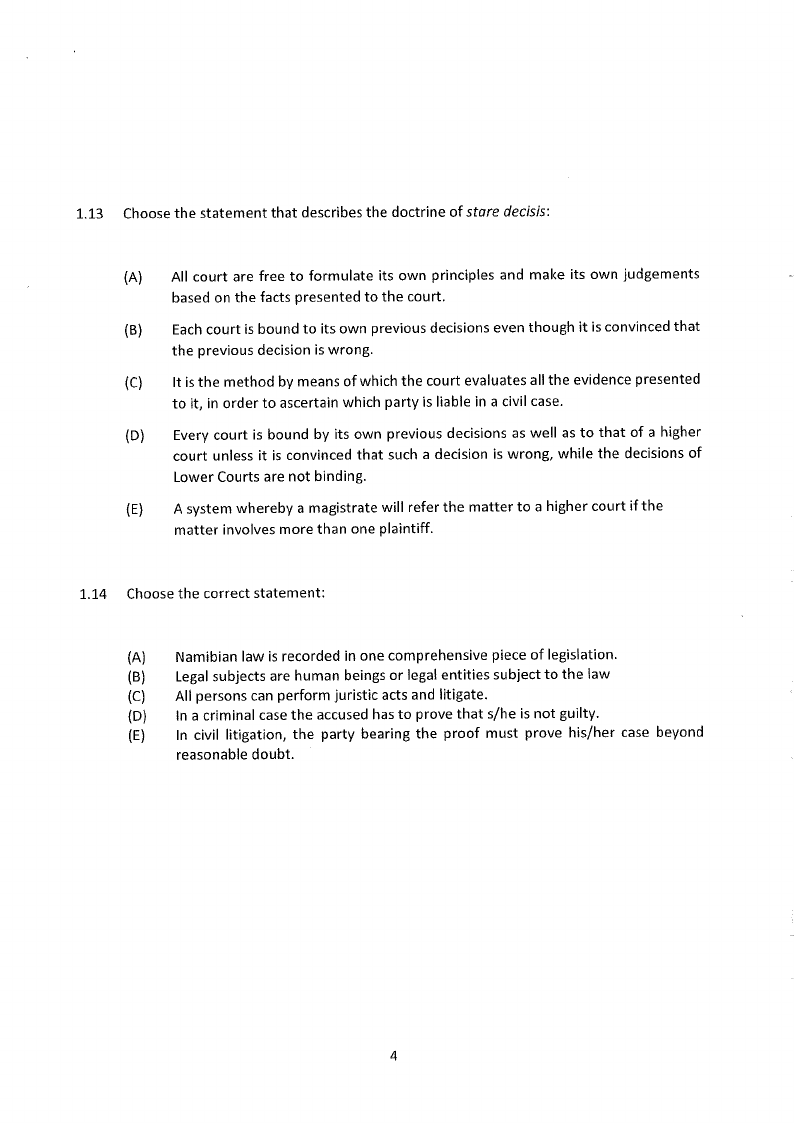
1.13 Choose the statement that describes the doctrine of stare decisis:
(A) All court are free to formulate its own principles and make its own judgements
based on the facts presented to the court.
(B) Each court is bound to its own previous decisions even though it is convinced that
the previous decision is wrong.
(C) It is the method by means of which the court evaluates all the evidence presented
to it, in order to ascertain which party is liable in a civil case.
(D) Every court is bound by its own previous decisions as well as to that of a higher
court unless it is convinced that such a decision is wrong, while the decisions of
Lower Courts are not binding.
(E) A system whereby a magistrate will refer the matter to a higher court if the
matter involves more than one plaintiff.
1.14 Choose the correct statement:
(A) Namibian law is recorded in one comprehensive piece of legislation.
(B) Legal subjects are human beings or legal entities subject to the law
(C) All persons can perform juristic acts and litigate.
(D) In a criminal case the accused has to prove thats/he is not guilty.
(E) In civil litigation, the party bearing the proof must prove his/her case beyond
reasonable doubt.
4

6 Page 6

▲back to top


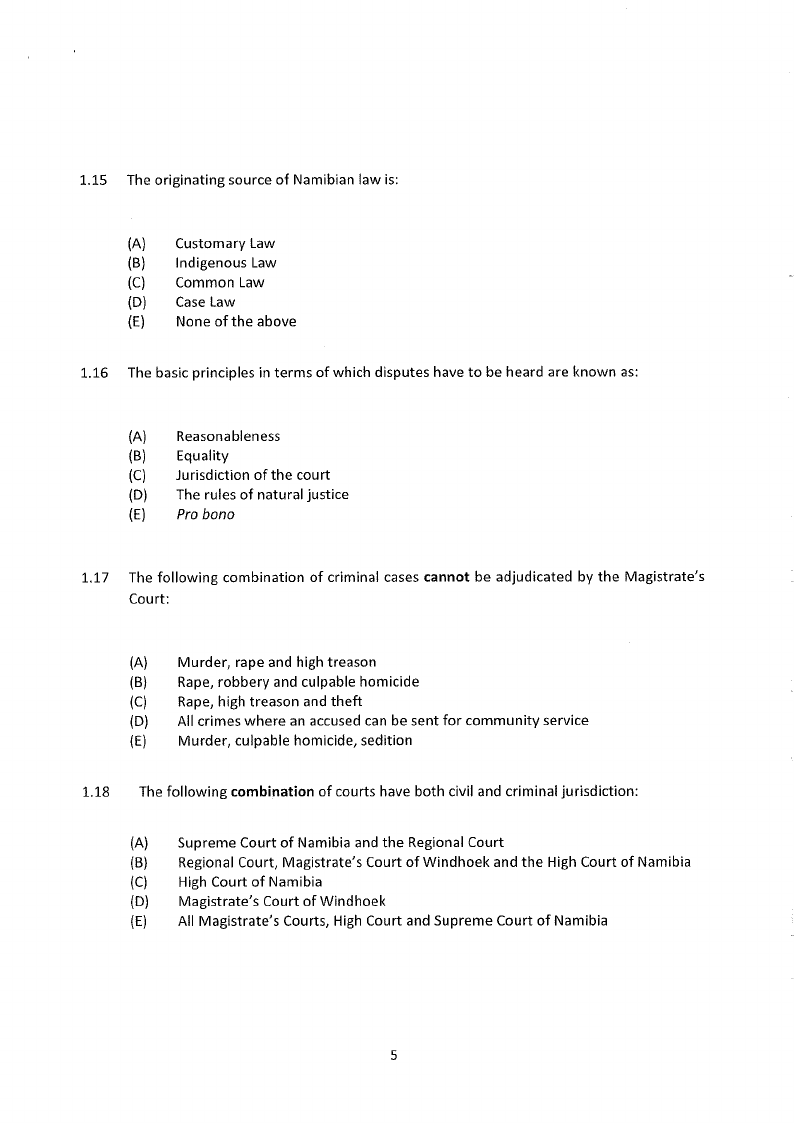
1.15 The originating source of Namibian law is:
(A) Customary Law
(B) Indigenous Law
(C) Common Law
(D) Case Law
(E) None of the above
1.16 The basic principles in terms of which disputes have to be heard are known as:
(A) Reasonableness
(B) Equality
(C) Jurisdiction of the court
(D) The rules of natural justice
(E) Pro bona
1.17 The following combination of criminal cases cannot be adjudicated by the Magistrate's
Court:
(A) Murder, rape and high treason
(B) Rape, robbery and culpable homicide
(C) Rape, high treason and theft
(D) All crimes where an accused can be sent for community service
(E) Murder, culpable homicide, sedition
1.18 The following combination of courts have both civil and criminal jurisdiction:
(A) Supreme Court of Namibia and the Regional Court
(B) Regional Court, Magistrate's Court of Windhoek and the High Court of Namibia
(C) High Court of Namibia
(D) Magistrate's Court of Windhoek
(E) All Magistrate's Courts, High Court and Supreme Court of Namibia
5

7 Page 7

▲back to top


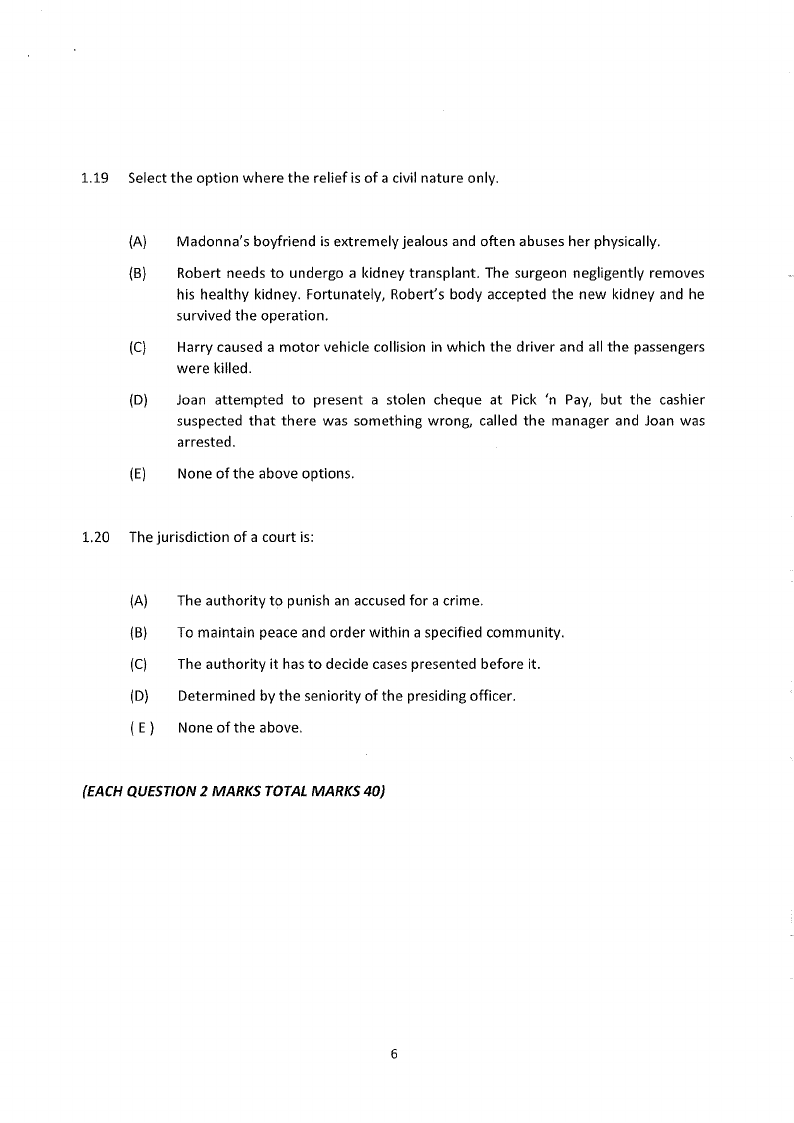
1.19 Select the option where the relief is of a civil nature only.
(A) Madonna's boyfriend is extremely jealous and often abuses her physically.
(B) Robert needs to undergo a kidney transplant. The surgeon negligently removes
his healthy kidney. Fortunately, Robert's body accepted the new kidney and he
survived the operation.
(C) Harry caused a motor vehicle collision in which the driver and all the passengers
were killed.
(D) Joan attempted to present a stolen cheque at Pick 'n Pay, but the cashier
suspected that there was something wrong, called the manager and Joan was
arrested.
(E) None of the above options.
1.20 The jurisdiction of a court is:
(A) The authority to punish an accused for a crime.
(B) To maintain peace and order within a specified community.
(C) The authority it has to decide cases presented before it.
(D) Determined by the seniority of the presiding officer.
( E) None of the above.
(EACH QUESTION 2 MARKS TOTAL MARKS 40}
6

8 Page 8

▲back to top


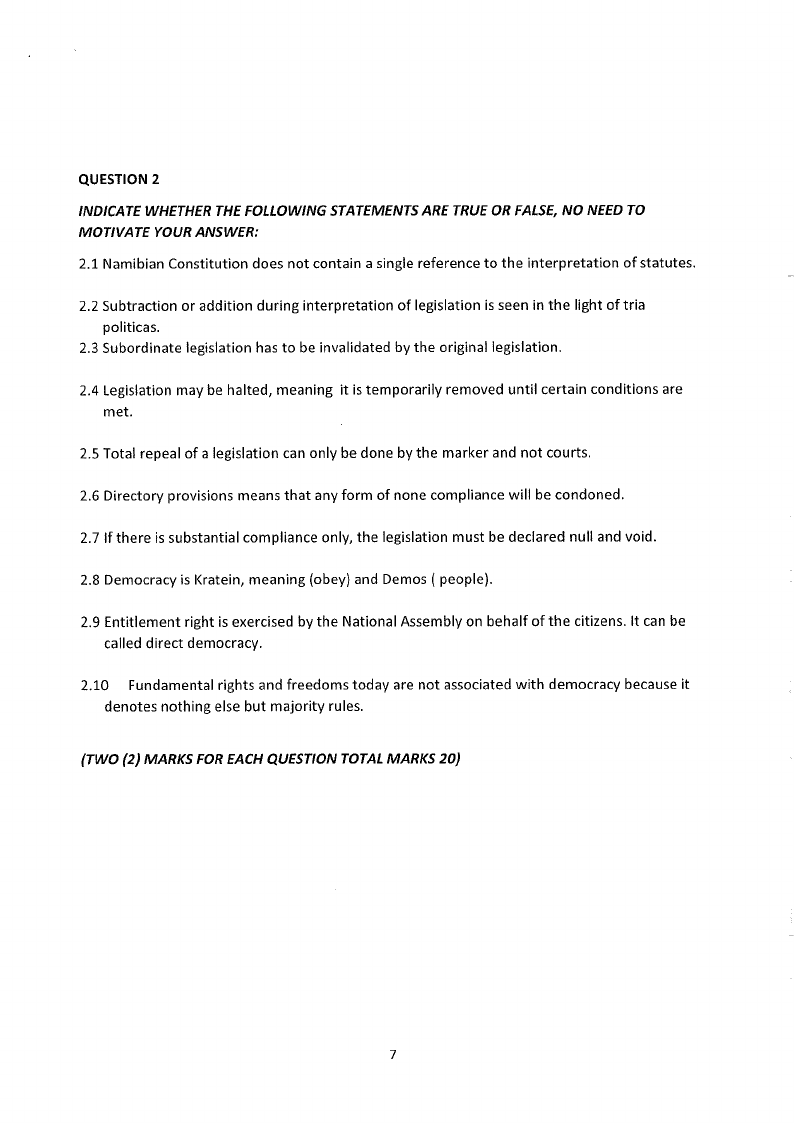
QUESTION 2
INDICATE WHETHER THE FOLLOWING STATEMENTS ARE TRUE OR FALSE, NO NEED TO
MOTIVATE YOUR ANSWER:
2.1 Namibian Constitution does not contain a single reference to the interpretation of statutes.
2.2 Subtraction or addition during interpretation of legislation is seen in the light of tria
politicas.
2.3 Subordinate legislation has to be invalidated by the original legislation.
2.4 Legislation may be halted, meaning it is temporarily removed until certain conditions are
met.
2.5 Total repeal of a legislation can only be done by the marker and not courts.
2.6 Directory provisions means that any form of none compliance will be condoned.
2.7 If there is substantial compliance only, the legislation must be declared null and void.
2.8 Democracy is Kratein, meaning (obey) and Demos ( people).
2.9 Entitlement right is exercised by the National Assembly on behalf of the citizens. It can be
called direct democracy.
2.10 Fundamental rights and freedoms today are not associated with democracy because it
denotes nothing else but majority rules.
(TWO (2) MARKS FOR EACH QUESTION TOTAL MARKS 20}
7

9 Page 9

▲back to top


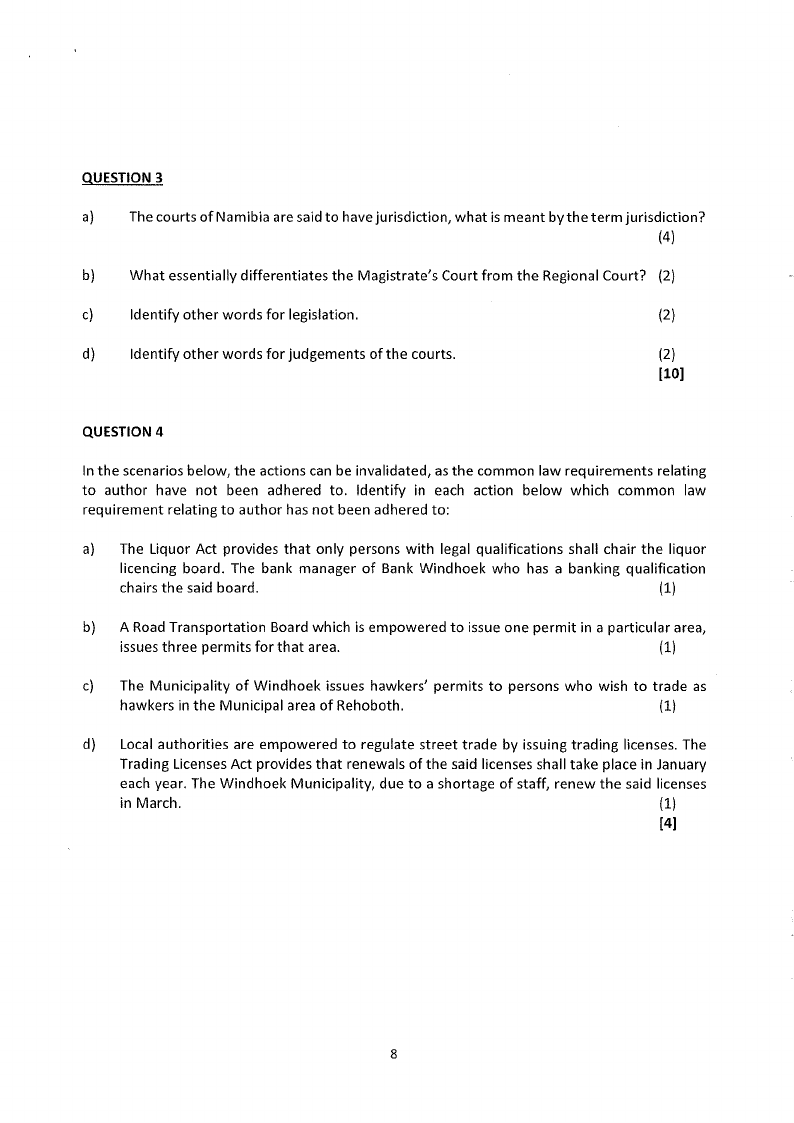
QUESTION 3
a) The courts of Namibia are said to have jurisdiction, what is meant by the term jurisdiction?
(4)
b) What essentially differentiates the Magistrate's Court from the Regional Court? (2)
c)
Identify other words for legislation.
(2)
d)
Identify other words for judgements of the courts.
(2)
[10]
QUESTION 4
In the scenarios below, the actions can be invalidated, as the common law requirements relating
to author have not been adhered to. Identify in each action below which common law
requirement relating to author has not been adhered to:
a) The Liquor Act provides that only persons with legal qualifications shall chair the liquor
licencing board. The bank manager of Bank Windhoek who has a banking qualification
chairs the said board.
(1)
b) A Road Transportation Board which is empowered to issue one permit in a particular area,
issues three permits for that area.
(1)
c) The Municipality of Windhoek issues hawkers' permits to persons who wish to trade as
hawkers in the Municipal area of Rehoboth.
(1)
d) Local authorities are empowered to regulate street trade by issuing trading licenses. The
Trading Licenses Act provides that renewals of the said licenses shall take place in January
each year. The Windhoek Municipality, due to a shortage of staff, renew the said licenses
in March.
(1)
[4]
8

10 Page 10

▲back to top


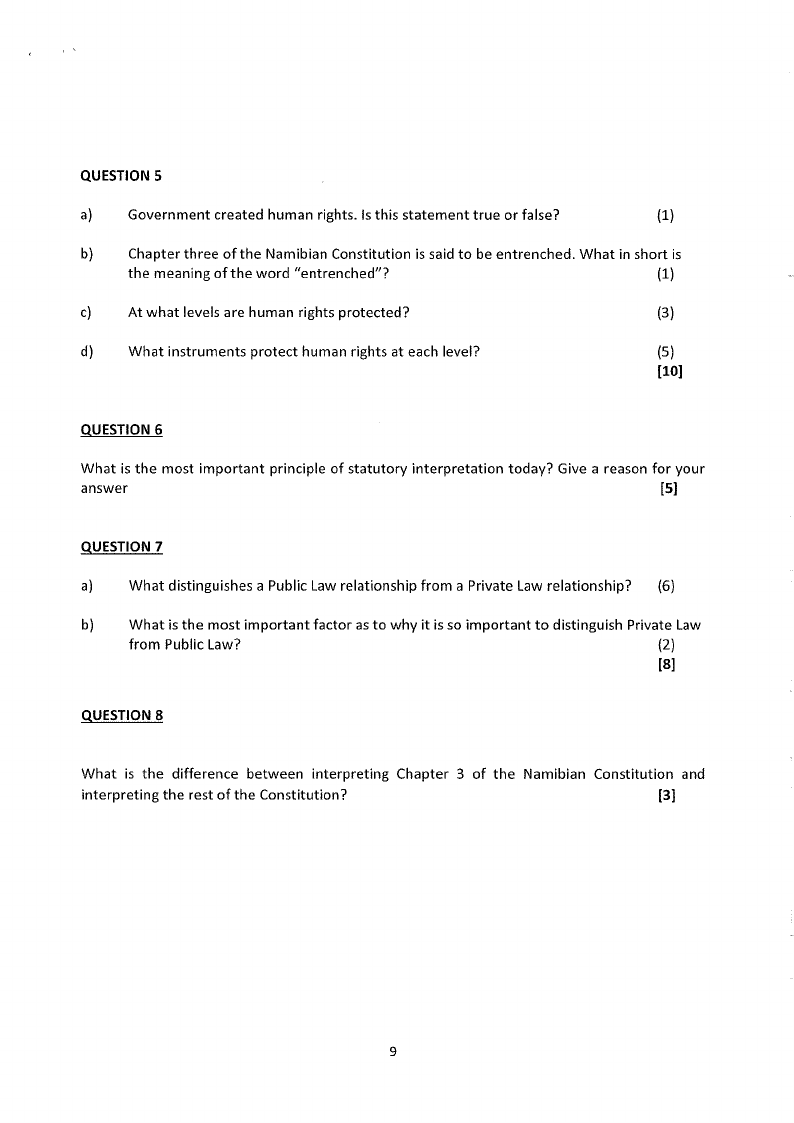
QUESTIONS
a)
Government created human rights. Is this statement true or false?
(1)
b)
Chapter three of the Namibian Constitution is said to be entrenched. What in short is
the meaning of the word "entrenched"?
(1)
c)
At what levels are human rights protected?
(3)
d)
What instruments protect human rights at each level?
(5)
[10]
QUESTION 6
What is the most important principle of statutory interpretation today? Give a reason for your
answer
[SJ
QUESTION 7
a)
What distinguishes a Public Law relationship from a Private Law relationship?
(6)
b)
What is the most important factor as to why it is so important to distinguish Private Law
from Public Law?
(2)
[8]
QUESTION 8
What is the difference between interpreting Chapter 3 of the Namibian Constitution and
interpreting the rest of the Constitution?
[3]
9