


 |
ILG511S - INTRODUCTION TO LINGUISTICS - 1ST OPP - JUNE 2025 |
|
|
1 Page 1 |
▲back to top |
nAmI BI AunIVE RSITY
OF SCIEnCE Ano TECHnOLOGY
FACULTY OF COMMERCE, HUMAN SCIENCESAND EDUCATION
DEPARTMENT OF COMMUNICATION & LANGUAGES
QUALIFICATION: BACHELOR OF ENGLISH AND LINGUISTICS
QUALIFICATION CODE: {07BENL)
LEVEL:5
COURSE CODE: ILGSllS
COURSE NAME: Introduction to Linguistics
SESSION: JUNE 2025
TIME:
3H00
PAPER:THEORY
MARKS: 100
EXAMINER(S)
FIRST OPPORTUNITY EXAMINATION PAPER
Dr Sylvia N lthindi
Ms Hambeleleni Hamunyela
MODERATOR: Dr Anneli Nghikembua
INSTRUCTIONS
1. Answer all questions.
2. Read all the questions carefully before answering.
3. Make sure your name and surname, question number, and the
date appear on the answer script.
4. Please ensure that your writing is legible, neat and presentable.
THIS QUESTION PAPER CONSISTS OF 6 PAGES, INCLUDING THE COVER PAGE
|
|
2 Page 2 |
▲back to top |
QUESTION 1
1.1 Choose the correct answer by writing only the correct letter in your answer book. (10)
(a) What is the primary focus of linguistics?
(i) The study of language structure and use
(ii) The study of ancient civilizations
(iii) The practice of translation
(iv) The development of new languages
(b) Which of the following best describes "language as a political tool"?
(i) Language is used only for personal communication.
(ii) Language has no influence on governance or power.
(iii) Language can be used to unite or divide people in political discourse.
(iv) Language is purely a means of cultural expression.
(c) Which design feature of language allows humans to discuss past or hypothetical
events?
(i) Displacement
(ii)
Duality of patterning
(iii) Cultural transmission
(iv) Semanticity
(d) Which of the following is an example of the haptic form of language?
(i)
Spoken words.
(ii) Written text
(iii) Braille
(iv) Sign language
(e) A minimal unit of sound that distinguishes meaning between words is called a:
(i)
Morpheme
(ii) Allophone
(iii) Phoneme
2
|
|
3 Page 3 |
▲back to top |
(iv) Syllable
(f) Which organ is primarily responsible for producing voiced sounds?
(i)
Teeth
(ii) Lips
(iii) Vocal cords
(iv) Hard palate
(g) Which of these is a free morpheme?
(i)
ness
(ii)
u n-
(iii) tree
(iv) ing
(h) Which of the following words is monomorphic?
(i) Eat
(ii) Running
(iii) Cats
(iv) Unhappily
(i) A monomorphic word contains:
(i) Multiple morphemes
(ii) One morpheme
(iii) Only derivational affixes
(iv) Both free and bound morphemes
(j) Morphology primarily studies:
(j) Speech sound patterns
(ii) Word structure and formation
(iii) Sentence meaning
(iv) Language acquisition
3
|
|
4 Page 4 |
▲back to top |
1.2 Indicate whether the following statements are true or false.
(5)
(a) The words "bed" and."bad" constitute a minimal pair in English.
(b) The term orthography refers to the spelling system of a language.
(c) The word "worm" contains a long vowel sound.
(d) Phonetics is the study of the abstract sound system of a language.
(e) The [t] in "stop" and the [th] in "top" are distinct phonemes in English.
1.3 Fill in the blanks by writing the appropriate missing terms.
(5)
(a) The plural /s/ in "cats" [s] vs. "dogs" [z] are examples of ____
because they are
predictable variants of the same phoneme.
(b) The morpheme "tele-" in "television" is a _____
morpheme because it cannot stand
alone.
(c) Words that have opposite meanings, such as "hot" and "cold," are called __ .
(d) The words "flower" and "flour" are examples of __ because they sound the same but
have different meanings.
(e) The suffix "-ed" in "talked" is an example of an _____
morpheme because it modifies
tense without changing the word's category.
QUESTION 2
2.1 Name and explain any five branches of Linguistics you learned in this course. (10)
2.2 Determine whether the following scenarios represent linguistic competence or linguistic
performance.
(5)
(a) Kahimbi is learning German and has nearly perfect pronunciation.
(b) Simon has two Egyptian roommates and has learned how to tell a few jokes in Arabic.
(c) Darris can write perfect Ancient Greek script.
(d) Helen, an Australian, lived in Namibia for 3 years and learned the appropriate way to greet
elders living in her village.
(e) Esther knows the past tense rule for "swim" (swam) but accidentally says "swimmed".
2.3 Explain why Braille is also referred to as a haptic form of language.
(5)
4
|
|
5 Page 5 |
▲back to top |
QUESTION 3
3.1 Discussthe branches of philology and their relationships to linguistics.
{10)
3.2 How did Noam Chomsky revolutionise the field of linguistics?
{10)
QUESTION 4
4.1 A speech sound is any sound produced by the human vocal organs that is used in spoken
language. By using examples, discuss the properties of speech sounds you learned in this
course.
{9)
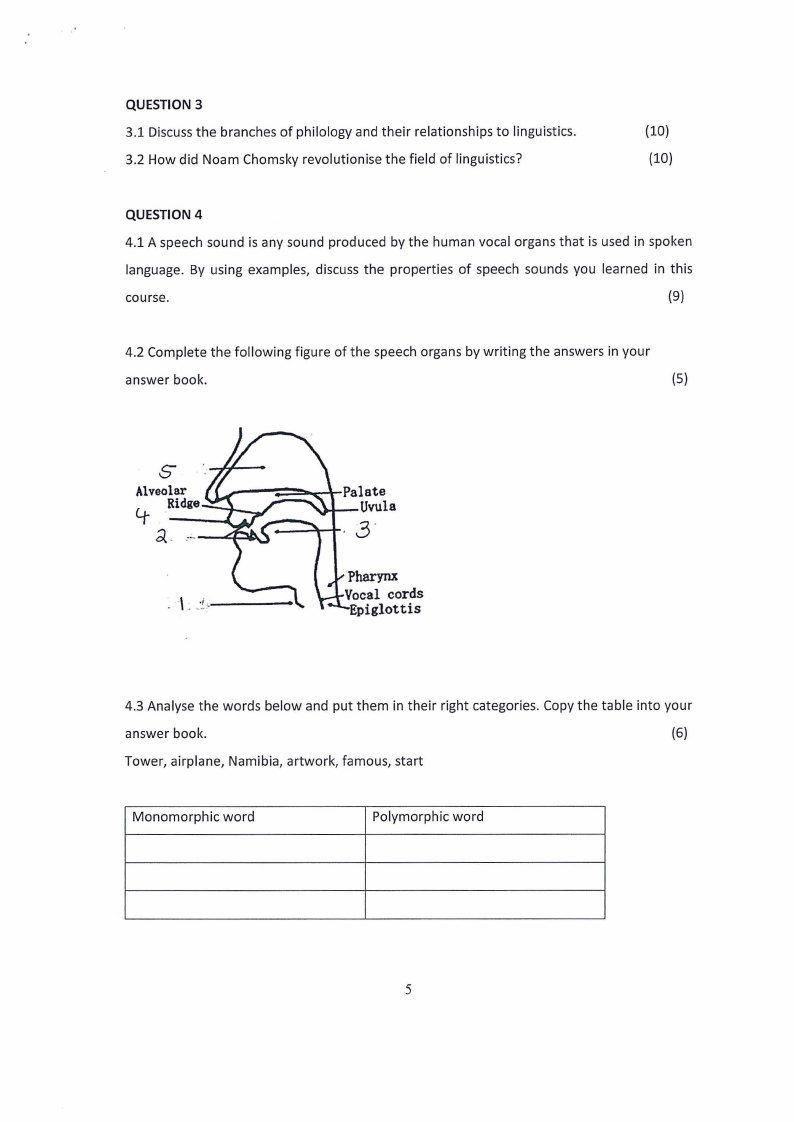
4.2 Complete the following figure of the speech organs by writing the answers in your
answer book.
(5)
Pharynx
Vocal cords
Epiglottis
4.3 Analyse the words below and put them in their right categories. Copy the table into your
answer book.
(6)
Tower, airplane, Namibia, artwork, famous, start
Monomorphic word
Polymorphic word
5
|
|
6 Page 6 |
▲back to top |
QUESTION 5
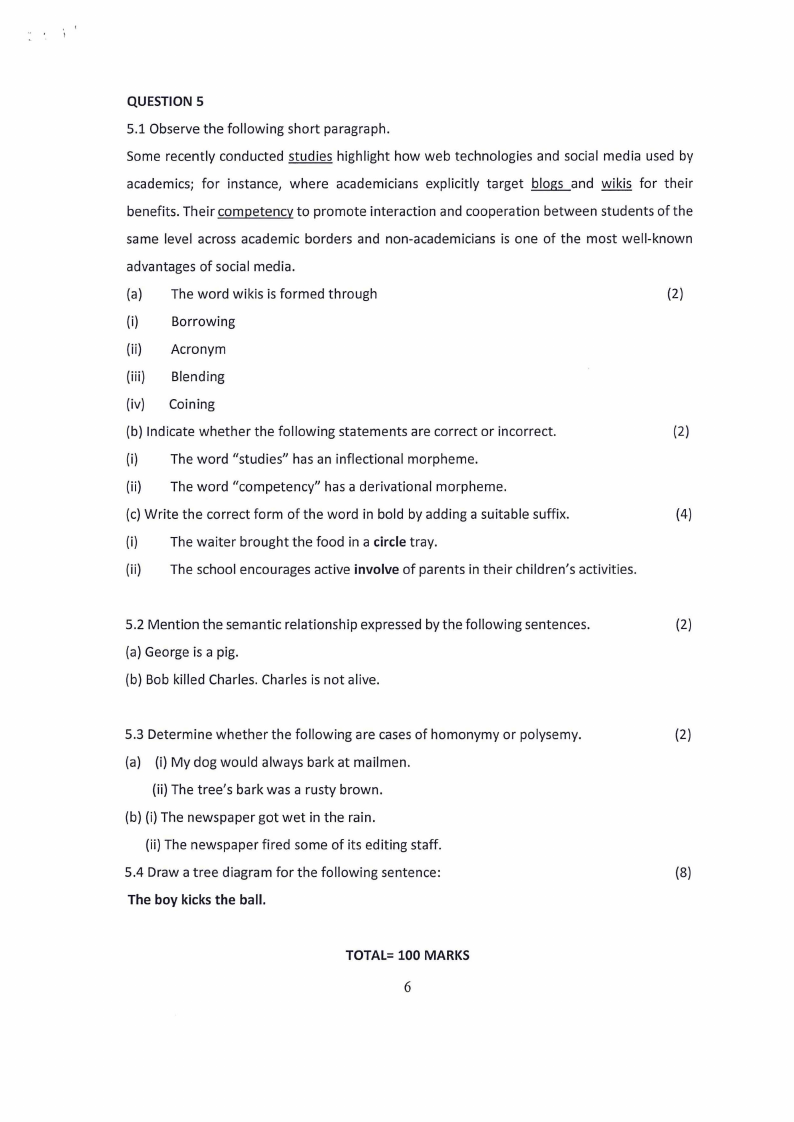
5.1 Observe the following short paragraph.
Some recently conducted studies highlight how web technologies and social media used by
academics; for instance, where academicians explicitly target ~and
wikis for their
benefits. Their competency to promote interaction and cooperation between students of the
same level across academic borders and non-academicians is one of the most well-known
advantages of social media.
(a) The word wikis is formed through
(2)
(i) Borrowing
(ii) Acronym
(iii) Blending
(iv) Coining
(b) Indicate whether the following statements are correct or incorrect.
(2)
(i) The word "studies" has an inflectional morpheme.
(ii) The word "competency" has a derivational morpheme.
(c) Write the correct form of the word in bold by adding a suitable suffix.
(4)
(i) The waiter brought the food in a circletray.
(ii) The school encourages active involve of parents in their children's activities.
5.2 Mention the semantic relationship expressed by the following sentences.
(2)
(a) George is a pig.
(b) Bob killed Charles. Charles is not alive.
5.3 Determine whether the following are casesof homonymy or polysemy.
(2)
(a) (i) My dog would always bark at mailmen.
(ii) The tree's bark was a rusty brown.
(b) (i) The newspaper got wet in the rain.
(ii) The newspaper fired some of its editing staff.
5.4 Draw a tree diagram for the following sentence:
(8)
The boy kicksthe ball.
TOTAL= 100 MARKS
6