


 |
OPM611S - OPERATIONS MANAGEMENT - 2ND OPP - JUNE 2025 |
|
|
1 Page 1 |
▲back to top |
nAmlBIA unlVERSITY
OF SCIEn CE Ano TECHn OLOGY
FACULTY OF COMMERCE, HUMAN SCIENCESAND EDUCATION
DEPARTMENT OF GOVERNANCE AND MANAGEMENT SCIENCES
QUALIFICATION: BACHELOR OF BUSINESS MANAGEMENT
QUALIFICATION CODE: 07BBMN
LEVEL: 7
COURSE CODE: OPM611S
COURSE NAME: OPERATIONS MANAGEMENT
SESSION: JULY 2025
DURATION: 2 HOURS
PAPER: PAPER 1/1
MARKS: 100
SECOND OPPORTUNITY EXAMINATION QUESTION PAPER
EXAMINER(S)
MSCKAUAMI
MR MICHAEL NEEMA
MODERATOR: MR ERNEST MBANGA
INSTRUCTIONS
1. Answer ALL the questions.
2. Show all formulae and calculations as marks will be
awarded for them.
3. Write clearly and neatly.
4. Number the answers clearly.
PERMISSIBLE MATERIALS
1. Calculator.
THIS QUESTION PAPER CONSISTS OF 6 PAGES (Including this front page)
1
|
|
2 Page 2 |
▲back to top |
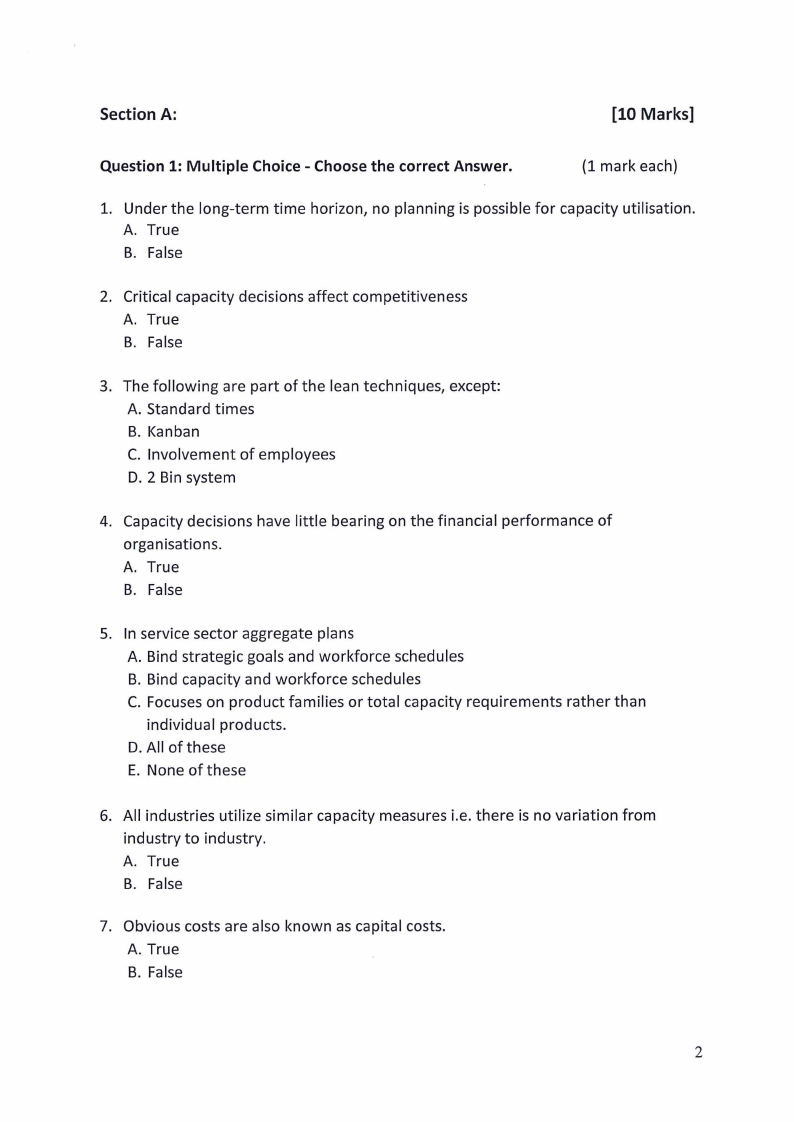
Section A:
[10 Marks]
Question 1: Multiple Choice - Choose the correct Answer.
(1 mark each)
1. Under the long-term time horizon, no planning is possible for capacity utilisation.
A. True
B. False
2. Critical capacity decisions affect competitiveness
A. True
B. False
3. The following are part of the lean techniques, except:
A. Standard times
B. Kanban
C. Involvement of employees
D. 2 Bin system
4. Capacity decisions have little bearing on the financial performance of
organisations.
A. True
B. False
5. In service sector aggregate plans
A. Bind strategic goals and workforce schedules
B. Bind capacity and workforce schedules
C. Focuses on product families or total capacity requirements
individual products.
D. All of these
E. None of these
rather than
6. All industries utilize similar capacity measures i.e. there is no variation from
industry to industry.
A. True
B. False
7. Obvious costs are also known as capital costs.
A. True
B. False
2
|
|
3 Page 3 |
▲back to top |
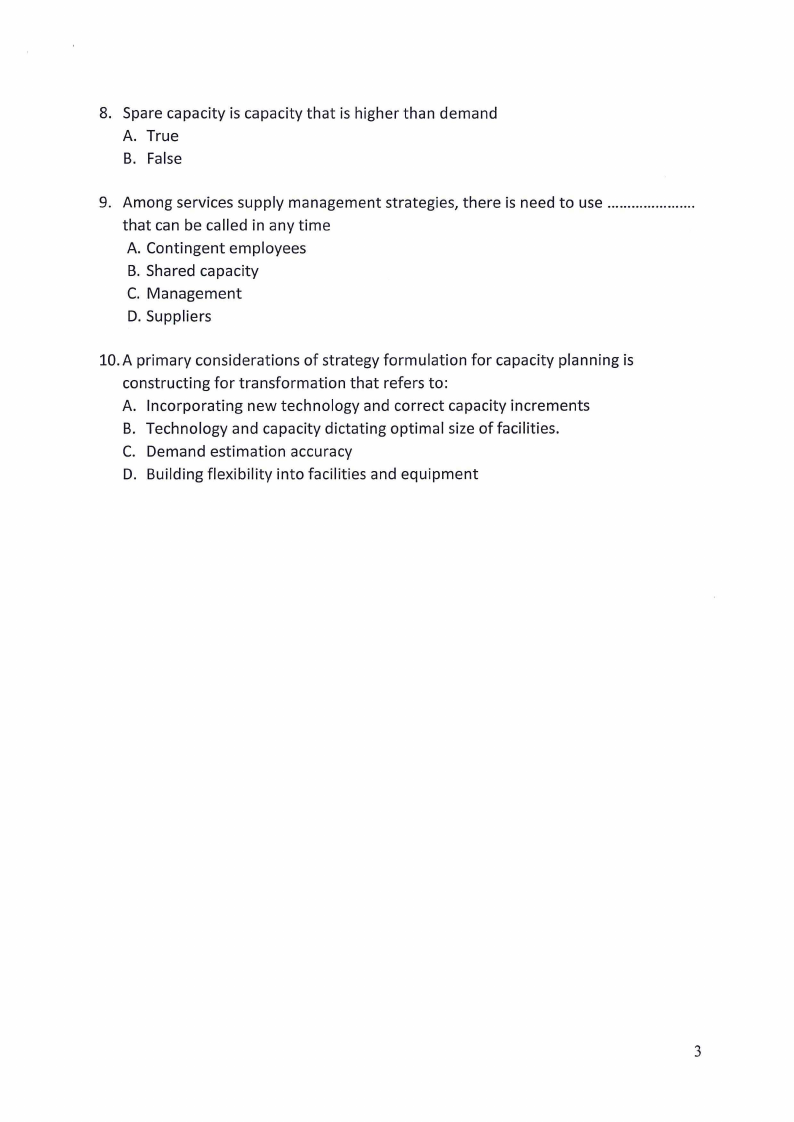
8. Spare capacity is capacity that is higher than demand
A. True
B. False
9. Among services supply management strategies, there is need to use .................... .
that can be called in any time
A. Contingent employees
B. Shared capacity
C. Management
D. Suppliers
10. A primary considerations of strategy formulation for capacity planning is
constructing for transformation that refers to:
A. Incorporating new technology and correct capacity increments
B. Technology and capacity dictating optimal size of facilities.
C. Demand estimation accuracy
D. Building flexibility into facilities and equipment
3
|
|
4 Page 4 |
▲back to top |
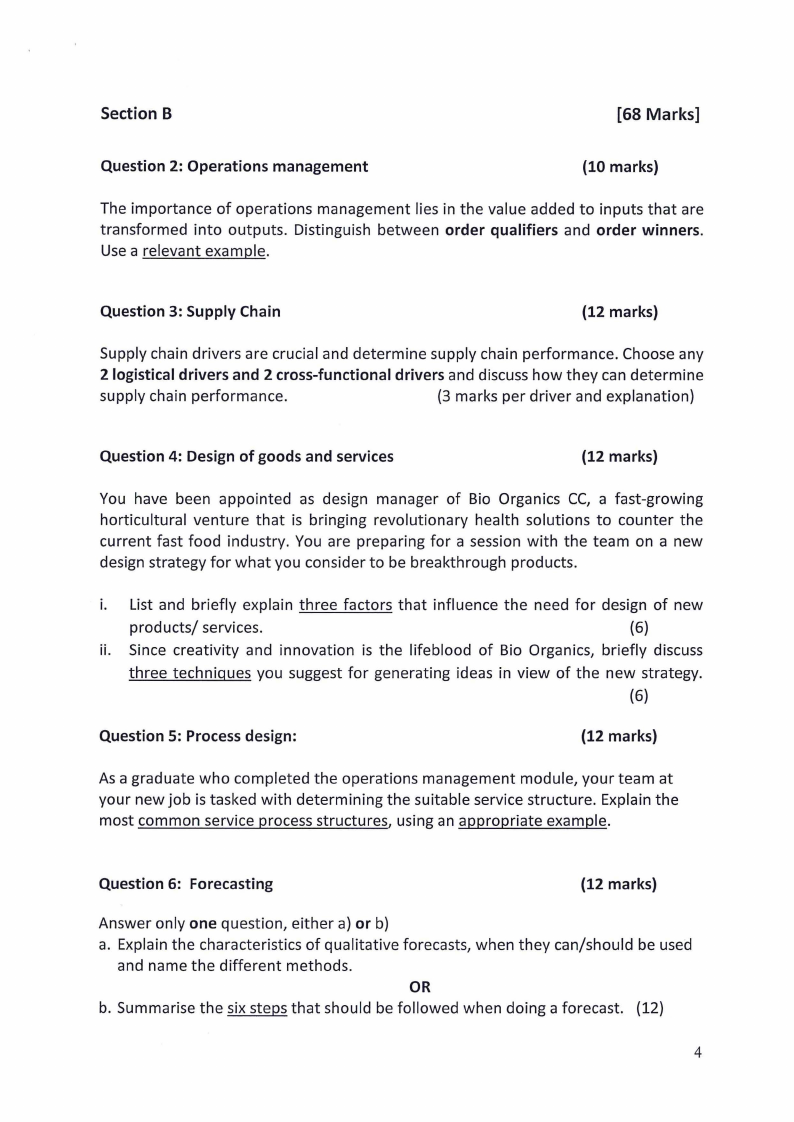
Section B
[68 Marks]
Question 2: Operations management
{10 marks)
The importance of operations management lies in the value added to inputs that are
transformed into outputs. Distinguish between order qualifiers and order winners.
Use a relevant example.
Question 3: Supply Chain
{12 marks)
Supply chain drivers are crucial and determine supply chain performance. Choose any
2 logistical drivers and 2 cross-functional drivers and discuss how they can determine
supply chain performance.
(3 marks per driver and explanation)
Question 4: Design of goods and services
{12 marks)
You have been appointed as design manager of Bio Organics CC, a fast-growing
horticultural venture that is bringing revolutionary health solutions to counter the
current fast food industry. You are preparing for a session with the team on a new
design strategy for what you consider to be breakthrough products.
i. List and briefly explain three factors that influence the need for design of new
products/ services.
(6)
ii. Since creativity and innovation is the lifeblood of Bio Organics, briefly discuss
three techniques you suggest for generating ideas in view of the new strategy.
(6)
Question 5: Process design:
(12 marks)
As a graduate who completed the operations management module, your team at
your new job is tasked with determining the suitable service structure. Explain the
most common service process structures, using an appropriate example.
Question 6: Forecasting
{12 marks)
Answer only one question, either a) orb)
a. Explain the characteristics of qualitative forecasts, when they can/should be used
and name the different methods.
OR
b. Summarise the six steps that should be followed when doing a forecast. (12)
4
|
|
5 Page 5 |
▲back to top |
Question 7: Inventory management
Answer only one question, either a) orb)!
a) Briefly explain the different inventory counting systems.
OR
b) Name the main reasons for holding inventory.
(10 marks)
(10)
(10)
5
|
|
6 Page 6 |
▲back to top |
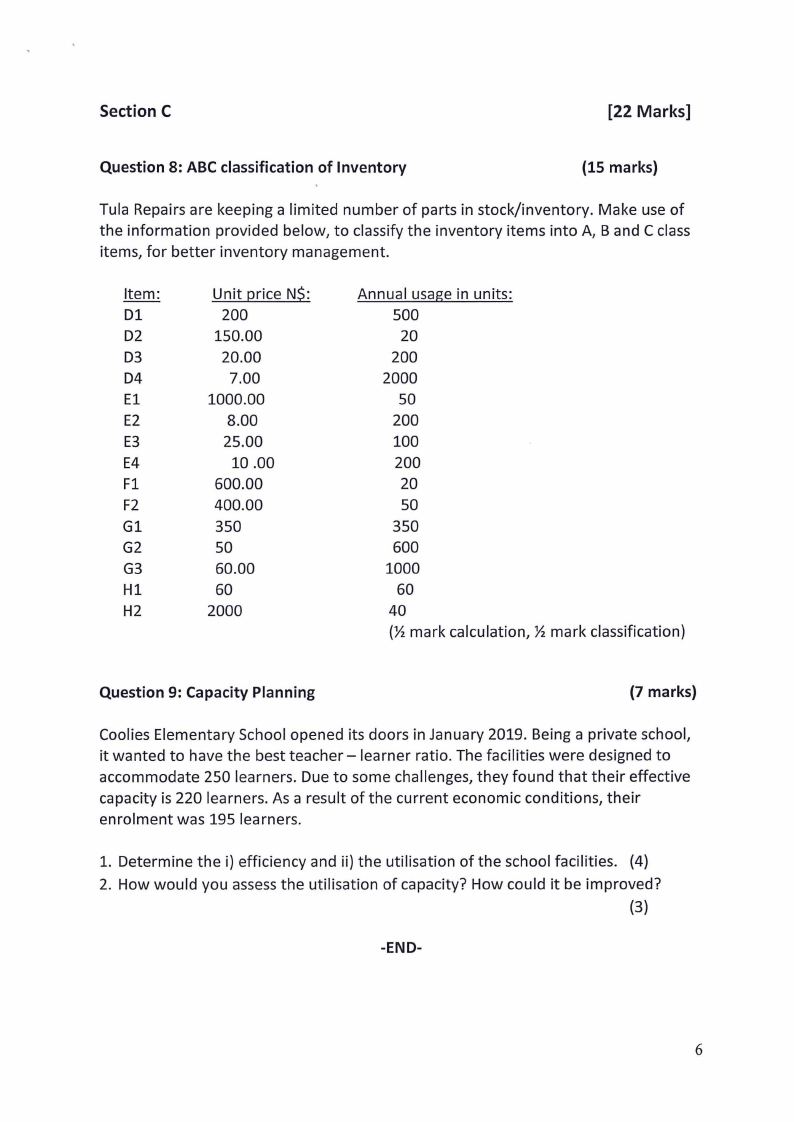
Section C
[22 Marks]
Question 8: ABC classification of Inventory
(15 marks)
Tula Repairs are keeping a limited number of parts in stock/inventory. Make use of
the information provided below, to classify the inventory items into A, B and C class
items, for better inventory management.
Item:
D1
D2
D3
D4
El
E2
E3
E4
Fl
F2
G1
G2
G3
H1
H2
Unit Qrice NS:
200
150.00
20.00
7.00
1000.00
8.00
25.00
10.00
600.00
400.00
350
so
60.00
60
2000
Annual usage in units:
500
20
200
2000
so
200
100
200
20
so
350
600
1000
60
40
(½ mark calculation,½
mark classification)
Question 9: Capacity Planning
(7 marks)
Coolies Elementary School opened its doors in January 2019. Being a private school,
it wanted to have the best teacher- learner ratio. The facilities were designed to
accommodate 250 learners. Due to some challenges, they found that their effective
capacity is 220 learners. As a result of the current economic conditions, their
enrolment was 195 learners.
1. Determine the i) efficiency and ii) the utilisation of the school facilities. (4)
2. How would you assess the utilisation of capacity? How could it be improved?
(3)
-END-
6