


 |
PMV611S - PRINCIPLES AND METHODS OF VALUATION - 2ND OPP - JULY 2025 |
|
|
1 Page 1 |
▲back to top |
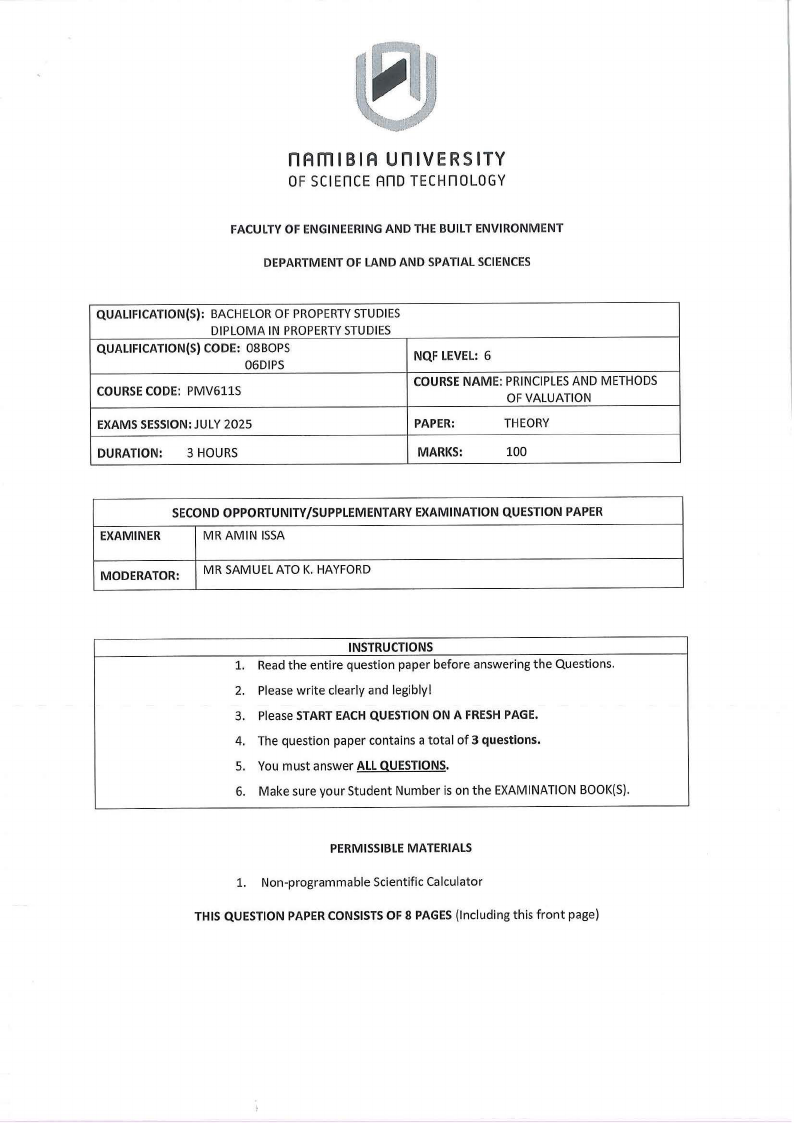
n Am I BIA u n IVER s ITY
OFSCIEnCEAno TECHnOLOGY
FACULTYOF ENGINEERINGAND THEBUILTENVIRONMENT
DEPARTMENTOF LANDAND SPATIALSCIENCES
QUALIFICATION{S):BACHELOROF PROPERTYSTUDIES
DIPLOMA IN PROPERTYSTUDIES
QUALIFICATION{SC) ODE: 08BOPS
06DIPS
COURSECODE: PMV611S
NQF LEVEL:6
COURSENAME: PRINCIPLESAND METHODS
OF VALUATION
EXAMSSESSIONJ: ULY 2025
PAPER:
THEORY
DURATION: 3 HOURS
MARKS:
100
SECONDOPPORTUNITY/SUPPLEMENTARYEXAMINATION QUESTIONPAPER
EXAMINER
MR AMIN ISSA
MODERATOR: MR SAMUEL ATO K. HAYFORD
INSTRUCTIONS
1. Read the entire question paper before answering the Questions.
2. Please write clearly and legibly I
3. Please STARTEACHQUESTIONON A FRESHPAGE.
4. The question paper contains a total of 3 questions.
5. You must answer ALLQUESTIONS.
6. Make sure your Student Number is on the EXAMINATION BOOK(S).
PERMISSIBLEMATERIALS
1. Non-programmable Scientific Calculator
THIS QUESTIONPAPERCONSISTSOF 8 PAGES(Including this front page)
|
|
2 Page 2 |
▲back to top |
Principles and Methods of Valuation
PMV611S
Question 1
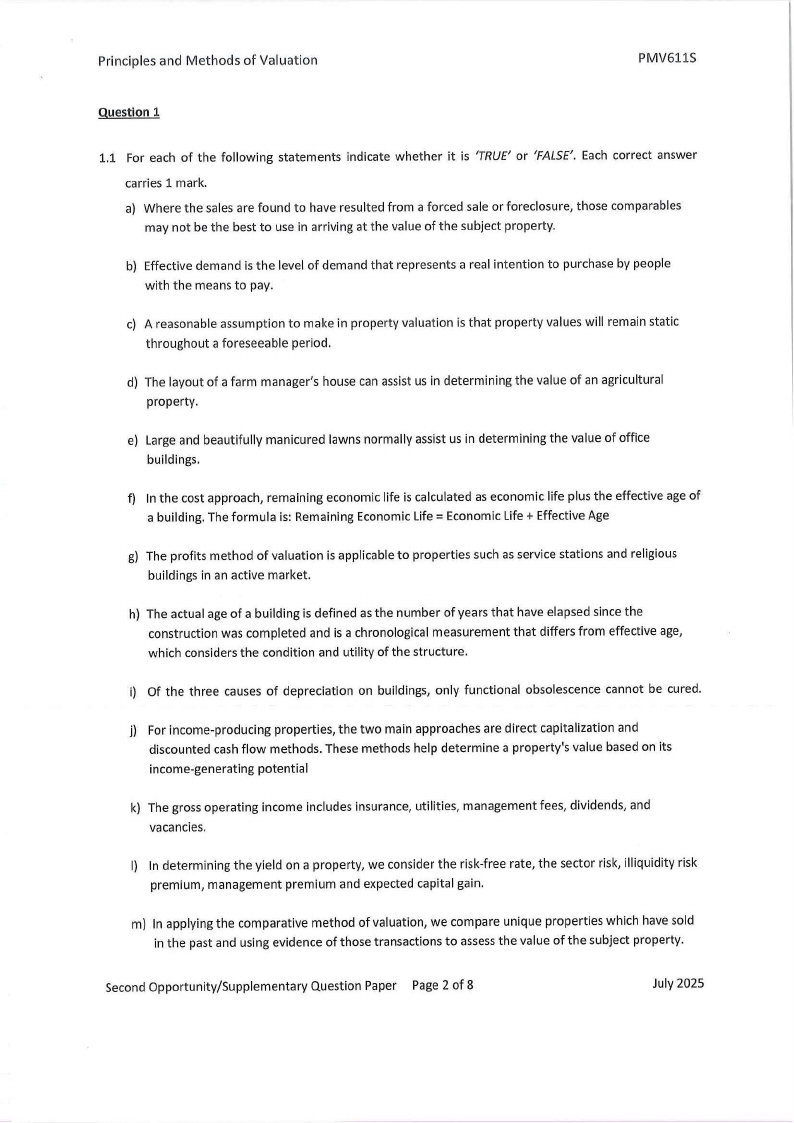
1.1 For each of the following statements indicate whether it is 'TRUE' or 'FALSE'. Each correct answer
carries 1 mark.
a) Where the sales are found to have resulted from a forced sale or foreclosure, those comparables
may not be the best to use in arriving at the value of the subject property.
b) Effective demand is the level of demand that represents a real intention to purchase by people
with the means to pay.
c) A reasonable assumption to make in property valuation is that property values will remain static
throughout a foreseeable period.
d} The layout of a farm manager's house can assist us in determining the value of an agricultural
property.
e) Large and beautifully manicured lawns normally assist us in determining the value of office
buildings.
f) In the cost approach, remaining economic life is calculated as economic life plus the effective age of
a building. The formula is: Remaining Economic Life= Economic Life+ Effective Age
g) The profits method of valuation is applicable to properties such as service stations and religious
buildings in an active market.
h) The actual age of a building is defined as the number of years that have elapsed since the
construction was completed and is a chronological measurement that differs from effective age,
which considers the condition and utility of the structure.
i) Of the three causes of depreciation on buildings, only functional obsolescence cannot be cured.
j) For income-producing properties, the two main approaches are direct capitalization and
discounted cash flow methods. These methods help determine a property's value based on its
income-generating potential
k) The gross operating income includes insurance, utilities, management fees, dividends, and
vacancies.
I) In determining the yield on a property, we consider the risk-free rate, the sector risk, illiquidity risk
premium, management premium and expected capital gain.
m) In applying the comparative method of valuation, we compare unique properties which have sold
in the past and using evidence of those transactions to assessthe value of the subject property.
Second Opportunity/Supplementary Question Paper Page 2 of 8
July 2025
|
|
3 Page 3 |
▲back to top |
Principles and Methods of Valuation
PMV611S
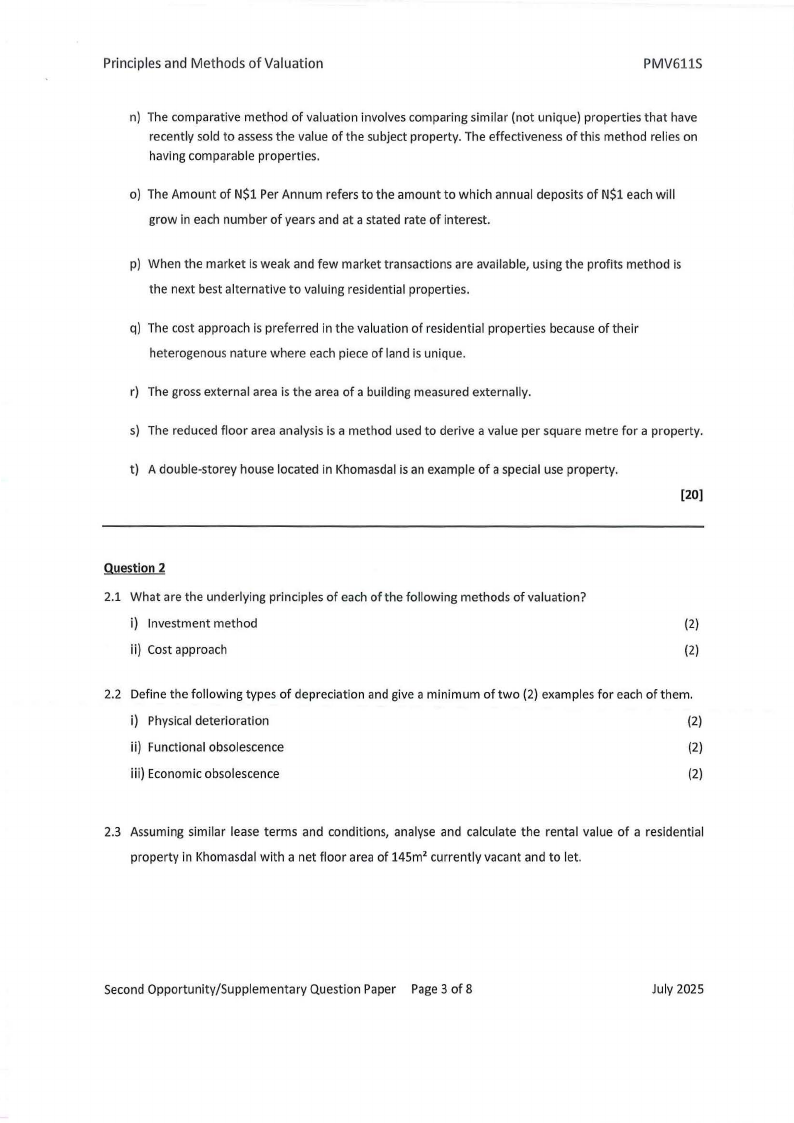
n) The comparative method of valuation involves comparing similar (not unique) properties that have
recently sold to assessthe value of the subject property. The effectiveness of this method relies on
having comparable properties.
o) The Amount of N$1 Per Annum refers to the amount to which annual deposits of N$1 each will
grow in each number of years and at a stated rate of interest.
p) When the market is weak and few market transactions are available, using the profits method is
the next best alternative to valuing residential properties.
q) The cost approach is preferred in the valuation of residential properties because of their
heterogenous nature where each piece of land is unique.
r) The gross external area is the area of a building measured externally.
s) The reduced floor area analysis is a method used to derive a value per square metre for a property.
t) A double-storey house located in Khomasdal is an example of a special use property.
[20]
Question2
2.1 What are the underlying principles of each of the following methods of valuation?
i) Investment method
(2)
ii) Cost approach
(2)
2.2 Define the following types of depreciation and give a minimum of two (2) examples for each of them.
i) Physical deterioration
(2)
ii) Functional obsolescence
(2)
iii) Economic obsolescence
(2)
2.3 Assuming similar lease terms and conditions, analyse and calculate the rental value of a residential
property in Khomasdal with a net floor area of 145m2 currently vacant and to let.
Second Opportunity/Supplementary Question Paper Page3 of 8
July 2025
|
|
4 Page 4 |
▲back to top |
Principles and Methods of Valuation
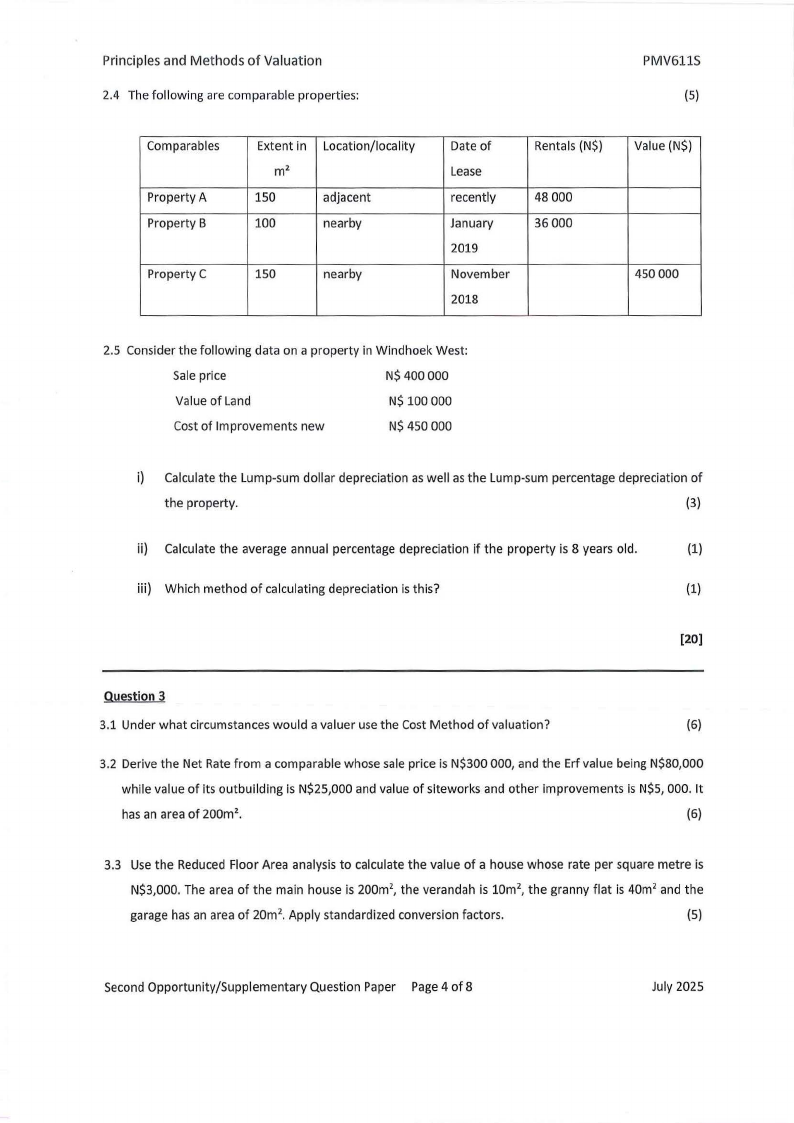
2.4 The following are comparable properties:
PMV611S
(5)
Comparables
Property A
Property B
Extent in Location/locality
m2
150
adjacent
100
nearby
Property C
150
nearby
Date of
Lease
recently
January
2019
November
2018
Rentals (N$)
48 000
36000
Value (N$)
450 000
2.5 Consider the following data on a property in Windhoek West:
Sale price
N$ 400 000
Value of Land
N$100 000
Cost of Improvements new
N$ 450 000
i) Calculate the Lump-sum dollar depreciation as well as the Lump-sum percentage depreciation of
the property.
(3)
ii) Calculate the average annual percentage depreciation if the property is 8 years old.
(1)
iii) Which method of calculating depreciation is this?
(1)
[20)
Question 3
3.1 Under what circumstances would a valuer use the Cost Method of valuation?
(6)
3.2 Derive the Net Rate from a comparable whose sale price is N$300 000, and the Erf value being N$80,000
while value of its outbuilding is N$25,000 and value of siteworks and other improvements is N$5, 000. It
has an area of 200m 2.
(6)
3.3 Use the Reduced Floor Area analysis to calculate the value of a house whose rate per square metre is
N$3,000. The area of the main house is 200m 2, the verandah is 10m 2, the granny flat is 40m 2 and the
garage has an area of 20m 2• Apply standardized conversion factors.
(5)
Second Opportunity/Supplementary Question Paper Page 4 of 8
July 2025
|
|
5 Page 5 |
▲back to top |
Principles and Methods of Valuation
PMV611S
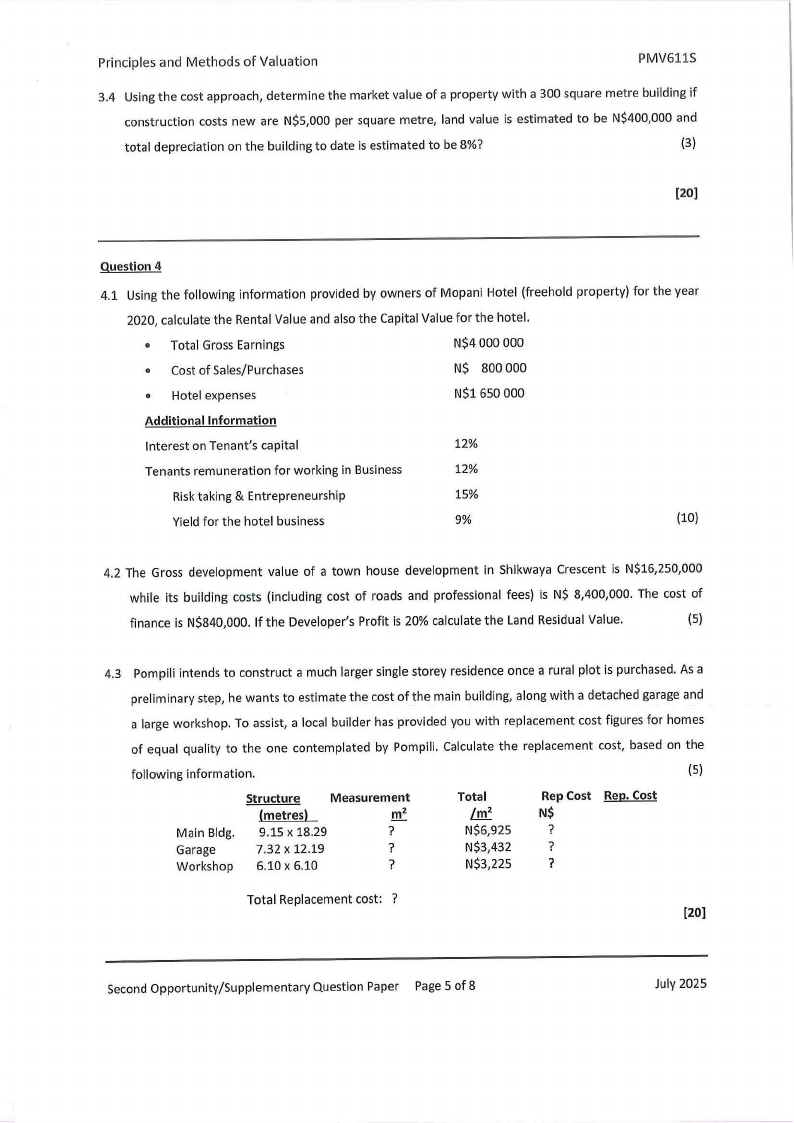
3.4 Using the cost approach, determine the market value of a property with a 300 square metre building if
construction costs new are N$5,000 per square metre, land value is estimated to be N$400,000 and
total depreciation on the building to date is estimated to be 8%?
{3)
[20)
Question 4
4.1 Using the following information provided by owners of Mopani Hotel {freehold property) for the year
2020, calculate the Rental Value and also the Capital Value for the hotel.
• Total Gross Earnings
N$4 000 000
• Cost of Sales/Purchases
• Hotel expenses
N$ 800 000
N$1650 000
Additional Information
Interest on Tenant's capital
12%
Tenants remuneration for working in Business
12%
Risktaking & Entrepreneurship
15%
Yield for the hotel business
9%
{10)
4.2 The Gross development value of a town house development in Shikwaya Crescent is N$16,250,000
while its building costs {including cost of roads and professional fees) is N$ 8,400,000. The cost of
finance is N$840,000. If the Developer's Profit is 20% calculate the Land Residual Value.
{5)
4.3 PompiIi intends to construct a much larger single storey residence once a rural plot is purchased. As a
preliminary step, he wants to estimate the cost of the main building, along with a detached garage and
a large workshop. To assist, a local builder has provided you with replacement cost figures for homes
of equal quality to the one contemplated by Pompili. Calculate the replacement cost, based on the
following information.
(5)
Structure
(metres}
Measurement
m2
Main Bldg. 9.15 X 18.29
?
Garage
7.32 X 12.19
?
Workshop 6.10 X 6.10
?
Total
/m2
N$6,925
N$3,432
N$3,225
Rep Cost
N$
?
?
?
Rep. Cost
Total Replacement cost: ?
[20)
SecondOpportunity/Supplementary Question Paper Page5 of 8
July 2025
|
|
6 Page 6 |
▲back to top |
Principles and Methods of Valuation
QuestionS
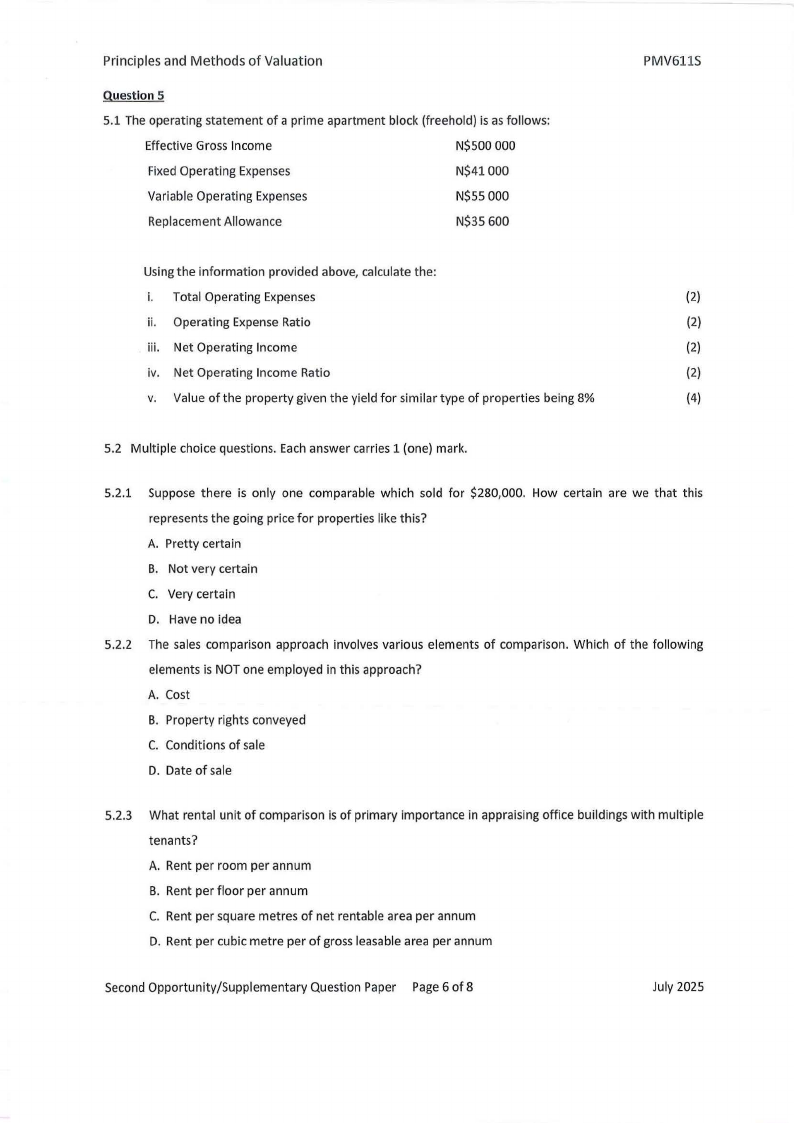
5.1 The operating statement of a prime apartment block (freehold) is as follows:
Effective Gross Income
N$500 000
Fixed Operating Expenses
N$41000
Variable Operating Expenses
N$55 000
Replacement Allowance
N$35 600
PMV611S
Using the information provided above, calculate the:
i. Total Operating Expenses
(2)
ii. Operating Expense Ratio
(2)
iii. Net Operating Income
(2)
iv. Net Operating Income Ratio
(2)
v. Value of the property given the yield for similar type of properties being 8%
(4)
5.2 Multiple choice questions. Each answer carries 1 (one) mark.
5.2.1 Suppose there is only one comparable which sold for $280,000. How certain are we that this
represents the going price for properties like this?
A. Pretty certain
B. Not very certain
C. Very certain
D. Have no idea
5.2.2 The sales comparison approach involves various elements of comparison. Which of the following
elements is NOTone employed in this approach?
A. Cost
B. Property rights conveyed
C. Conditions of sale
D. Date of sale
5.2.3 What rental unit of comparison is of primary importance in appraising office buildings with multiple
tenants?
A. Rent per room per annum
B. Rent per floor per annum
C. Rent per square metres of net rentable area per annum
D. Rent per cubic metre per of gross leasable area per annum
SecondOpportunity/Supplementary Question Paper Page6 of 8
July 2025
|
|
7 Page 7 |
▲back to top |
Principles and Methods of Valuation
PMV611S
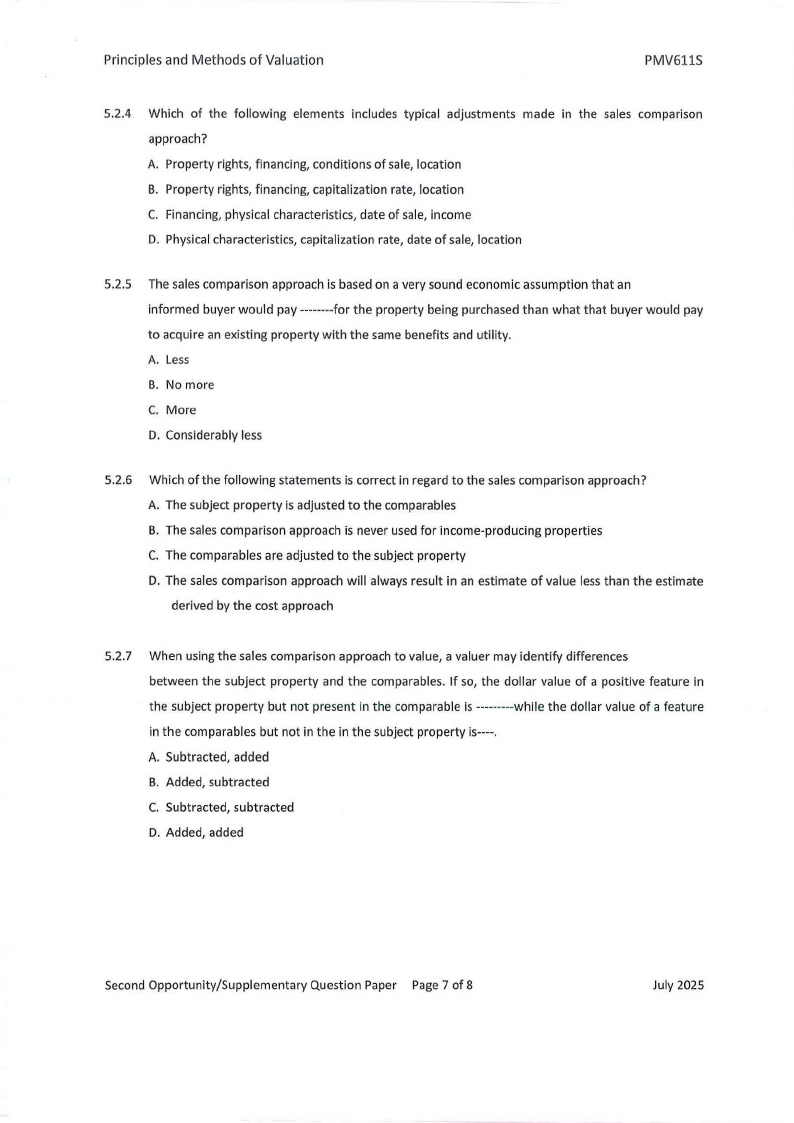
5.2.4 Which of the following elements includes typical adjustments made in the sales comparison
approach?
A. Property rights, financing, conditions of sale, location
B. Property rights, financing, capitalization rate, location
C. Financing, physical characteristics, date of sale, Income
D. Physical characteristics, capitalization rate, date of sale, location
5.2.5 The sales comparison approach is based on a very sound economic assumption that an
informed buyer would pay --------for the property being purchased than what that buyer would pay
to acquire an existing property with the same benefits and utility.
A. Less
B. No more
C. More
D. Considerably less
5.2.6 Which of the following statements is correct in regard to the sales comparison approach?
A. The subject property is adjusted to the comparables
B. The sales comparison approach is never used for income-producing properties
C. The comparables are adjusted to the subject property
D. The sales comparison approach will always result in an estimate of value less than the estimate
derived by the cost approach
5.2.7 When using the sales comparison approach to value, a valuer may identify differences
between the subject property and the comparables. If so, the dollar value of a positive feature in
the subject property but not present in the comparable is ---------while the dollar value of a feature
in the com parables but not in the in the subject property is----.
A. Subtracted, added
B. Added, subtracted
C. Subtracted, subtracted
D. Added, added
Second Opportunity/Supplementary Question Paper Page7 of 8
July 2025
|
|
8 Page 8 |
▲back to top |
Principles and Methods of Valuation
PMV611S
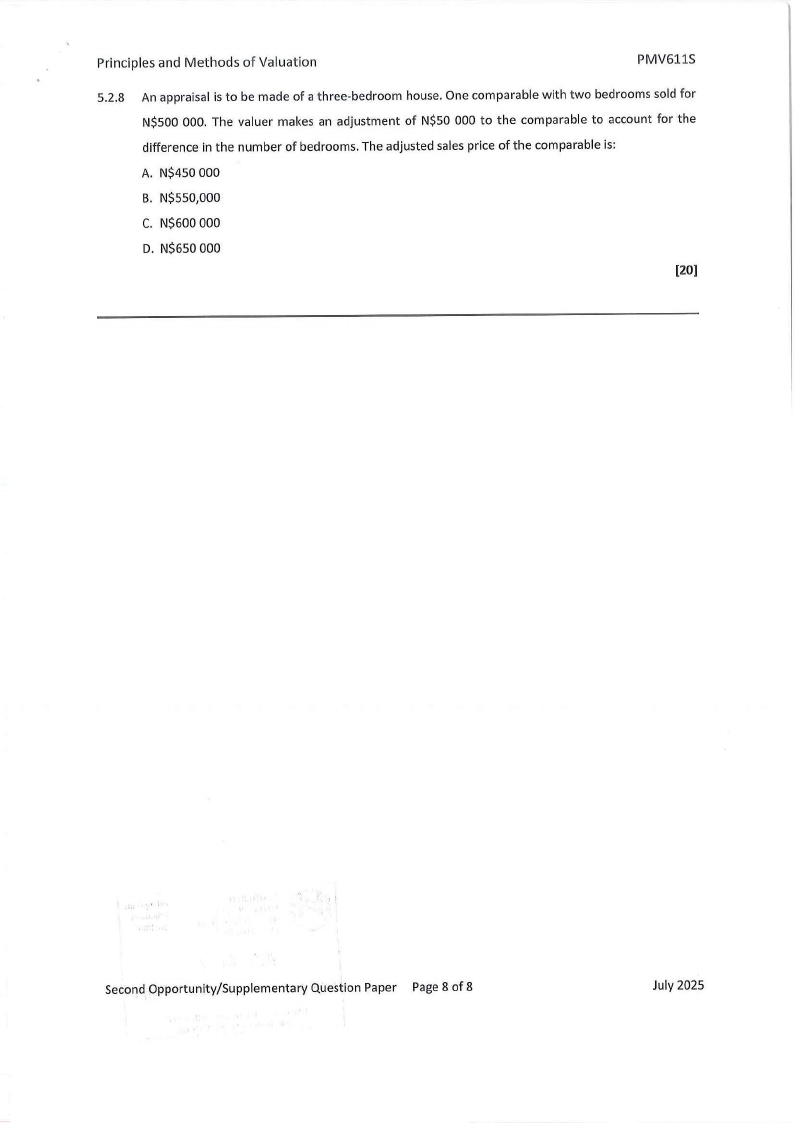
5.2.8 An appraisal is to be made of a three-bedroom house. One comparable with two bedrooms sold for
N$500 000. The valuer makes an adjustment of N$50 000 to the comparable to account for the
difference in the number of bedrooms. The adjusted sales price of the comparable is:
A. N$450 000
B. N$550,000
C. N$600 000
D. N$650 000
[20)
SecondOpportunity/Supplementary Question Paper Page8 of 8
July 2025