


 |
PSR521S - Procurement And Supply Chain Risk Management - 2nd Opp -Nov 2025 |
|
|
1 Page 1 |
▲back to top |
nAmlBIA UnlVERSITY
OF SCI En CE Ano TECH n OLOGY
FACULTY OF COMMERCE, HUMAN SCIENCES AND EDUCATION
DEPARTMENT OF MARKETING, LOGISTICS AND SPORT MANAGEMENT
QUALIFICATION: BACHELOR OF PROCUREMENT & SUPPLY CHAIN MANAGEMENT
QUALIFICATION CODE: 07BPSM
COURSE CODE: PSR521S
SESSION: JANUARY 2026
LEVEL: 5
COURSE NAME: PROCUREMENT AND SUPPLY
CHAIN RISK MANAGEMENT
PAPER: THEORY
DURATION: 3 HOURS
MARKS: 100
EXAMINER(S)
SECOND OPPORTUNITY EXAMINATION QUESTION PAPER
MS. E JESAYA (DI)
MS. S NAMBINGA (FT)
MS H KAULINGE (FT/PF)
MS J TJITUKA (FT)
MR N OOSTHUIZEN(FT)
MR. T MWAHENUKANGE (EF/ED)
MODERATOR: MS. S KAMBONDE
INSTRUCTIONS
1. Answer ALL the questions.
2. Read all the questions carefully before answering.
3. Number the answers clearly.
THIS QUESTION PAPER CONSISTS OF 5 PAGES (Including this front page)
|
|
2 Page 2 |
▲back to top |
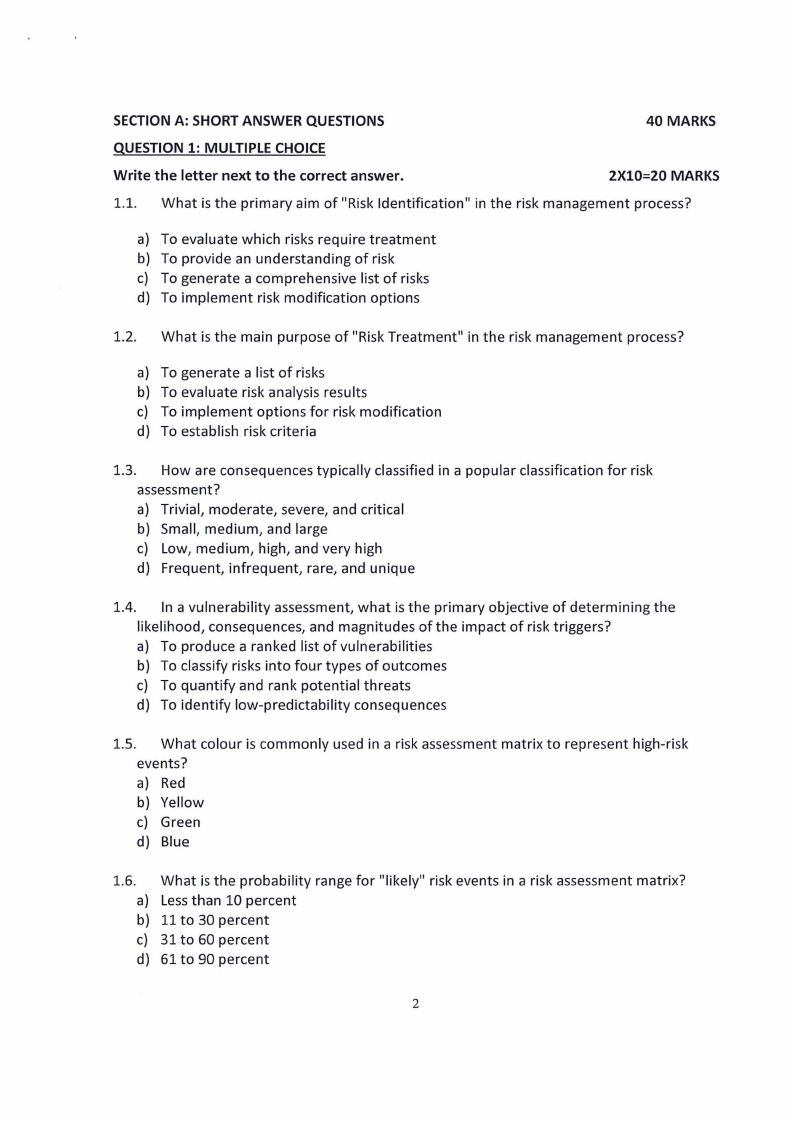
SECTION A: SHORT ANSWER QUESTIONS
40 MARKS
QUESTION 1: MULTIPLE CHOICE
Write the letter next to the correct answer.
2X10=20 MARKS
1.1. What is the primary aim of "Risk Identification" in the risk management process?
a) To evaluate which risks require treatment
b) To provide an understanding of risk
c) To generate a comprehensive list of risks
d) To implement risk modification options
1.2. What is the main purpose of "Risk Treatment" in the risk management process?
a) To generate a list of risks
b) To evaluate risk analysis results
c) To implement options for risk modification
d) To establish risk criteria
1.3. How are consequences typically classified in a popular classification for risk
assessment?
a) Trivial, moderate, severe, and critical
b) Small, medium, and large
c) Low, medium, high, and very high
d) Frequent, infrequent, rare, and unique
1.4. In a vulnerability assessment, what is the primary objective of determining the
likelihood, consequences, and magnitudes of the impact of risk triggers?
a) To produce a ranked list of vulnerabilities
b) To classify risks into four types of outcomes
c) To quantify and rank potential threats
d) To identify low-predictability consequences
1.5. What colour is commonly used in a risk assessment matrix to represent high-risk
events?
a) Red
b) Yellow
c) Green
d) Blue
1.6. What is the probability range for "likely" risk events in a risk assessment matrix?
a) Less than 10 percent
b) 11 to 30 percent
c) 31 to 60 percent
d) 61 to 90 percent
2
|
|
3 Page 3 |
▲back to top |
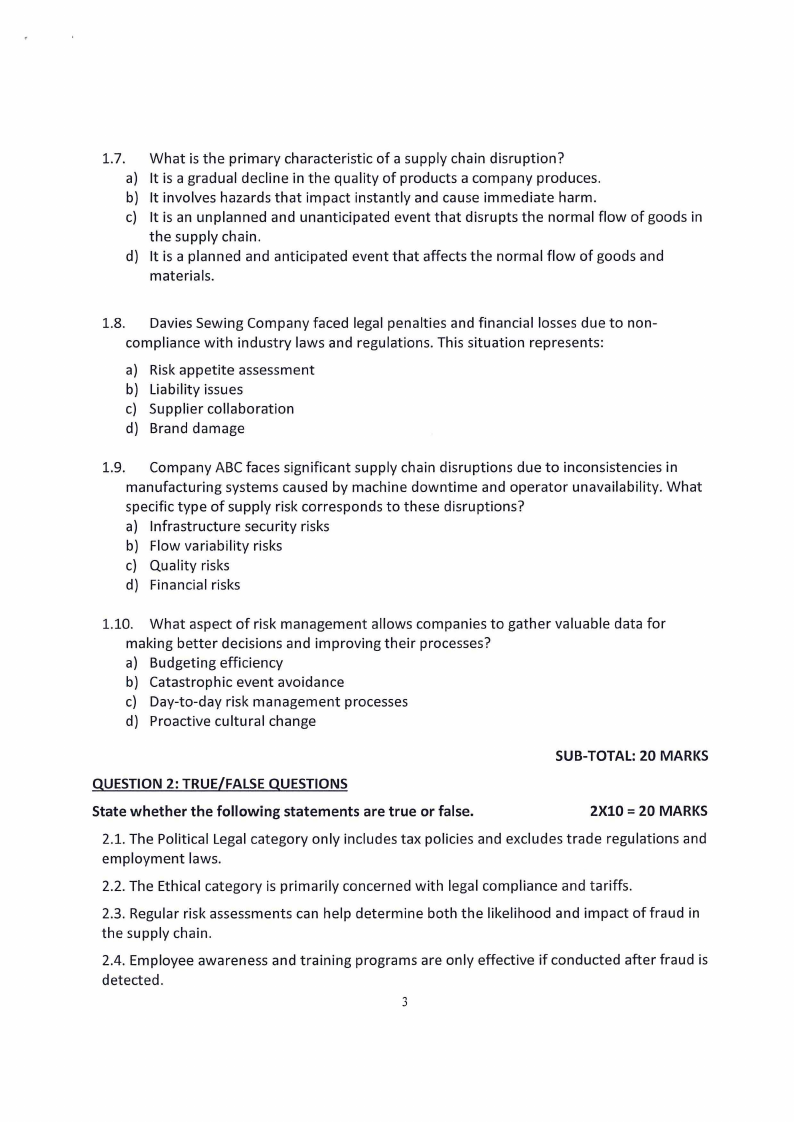
1.7. What is the primary characteristic of a supply chain disruption?
a) It is a gradual decline in the quality of products a company produces.
b) It involves hazards that impact instantly and cause immediate harm.
c) It is an unplanned and unanticipated event that disrupts the normal flow of goods in
the supply chain.
d) It is a planned and anticipated event that affects the normal flow of goods and
materials.
1.8. Davies Sewing Company faced legal penalties and financial losses due to non-
compliance with industry laws and regulations. This situation represents:
a) Risk appetite assessment
b) Liability issues
c) Supplier collaboration
d) Brand damage
1.9. Company ABC faces significant supply chain disruptions due to inconsistencies in
manufacturing systems caused by machine downtime and operator unavailability. What
specific type of supply risk corresponds to these disruptions?
a) Infrastructure security risks
b) Flow variability risks
c) Quality risks
d) Financial risks
1.10. What aspect of risk management allows companies to gather valuable data for
making better decisions and improving their processes?
a) Budgeting efficiency
b) Catastrophic event avoidance
c) Day-to-day risk management processes
d) Proactive cultural change
SUB-TOTAL: 20 MARKS
QUESTION 2: TRUE/FALSE QUESTIONS
State whether the following statements are true or false.
2X10 = 20 MARKS
2.1. The Political Legal category only includes tax policies and excludes trade regulations and
employment laws.
2.2. The Ethical category is primarily concerned with legal compliance and tariffs.
2.3. Regular risk assessments can help determine both the likelihood and impact of fraud in
the supply chain.
2.4. Employee awareness and training programs are only effective if conducted after fraud is
detected.
3
|
|
4 Page 4 |
▲back to top |
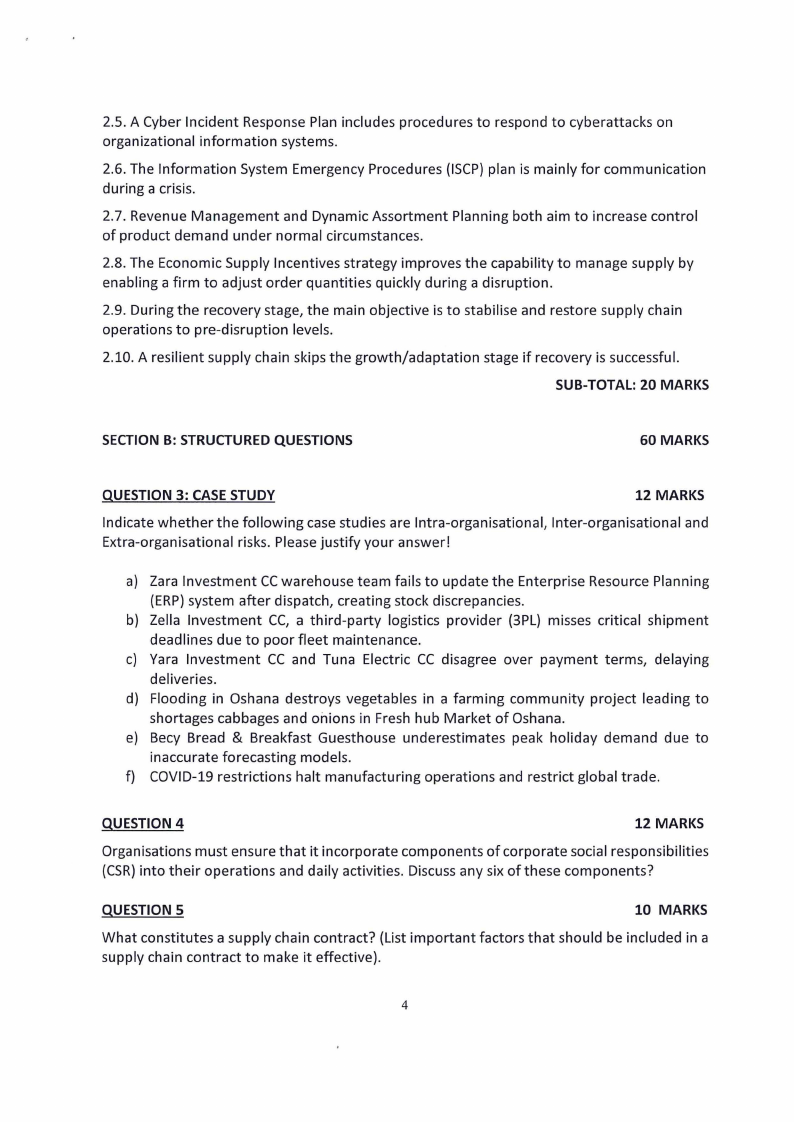
2.5. A Cyber Incident Response Plan includes procedures to respond to cyberattacks on
organizational information systems.
2.6. The Information System Emergency Procedures (ISCP) plan is mainly for communication
during a crisis.
2.7. Revenue Management and Dynamic Assortment Planning both aim to increase control
of product demand under normal circumstances.
2.8. The Economic Supply Incentives strategy improves the capability to manage supply by
enabling a firm to adjust order quantities quickly during a disruption.
2.9. During the recovery stage, the main objective is to stabilise and restore supply chain
operations to pre-disruption levels.
2.10. A resilient supply chain skips the growth/adaptation stage if recovery is successful.
SUB-TOTAL: 20 MARKS
SECTION B: STRUCTURED QUESTIONS
60 MARKS
QUESTION 3: CASE STUDY
12 MARKS
Indicate whether the following case studies are Intra-organisational, Inter-organisational and
Extra-organisational risks. Please justify your answer!
a) Zara Investment CC warehouse team fails to update the Enterprise Resource Planning
(ERP) system after dispatch, creating stock discrepancies.
b) Zella Investment CC, a third-party logistics provider (3PL) misses critical shipment
deadlines due to poor fleet maintenance.
c) Yara Investment CC and Tuna Electric CC disagree over payment terms, delaying
deliveries.
d) Flooding in Oshana destroys vegetables in a farming community project leading to
shortages cabbages and onions in Fresh hub Market of Oshana.
e) Becy Bread & Breakfast Guesthouse underestimates peak holiday demand due to
inaccurate forecasting models.
f) COVID-19 restrictions halt manufacturing operations and restrict global trade.
QUESTION 4
12 MARKS
Organisations must ensure that it incorporate components of corporate social responsibilities
(CSR) into their operations and daily activities. Discuss any six of these components?
QUESTION 5
10 MARKS
What constitutes a supply chain contract? (List important factors that should be included in a
supply chain contract to make it effective).
4
|
|
5 Page 5 |
▲back to top |
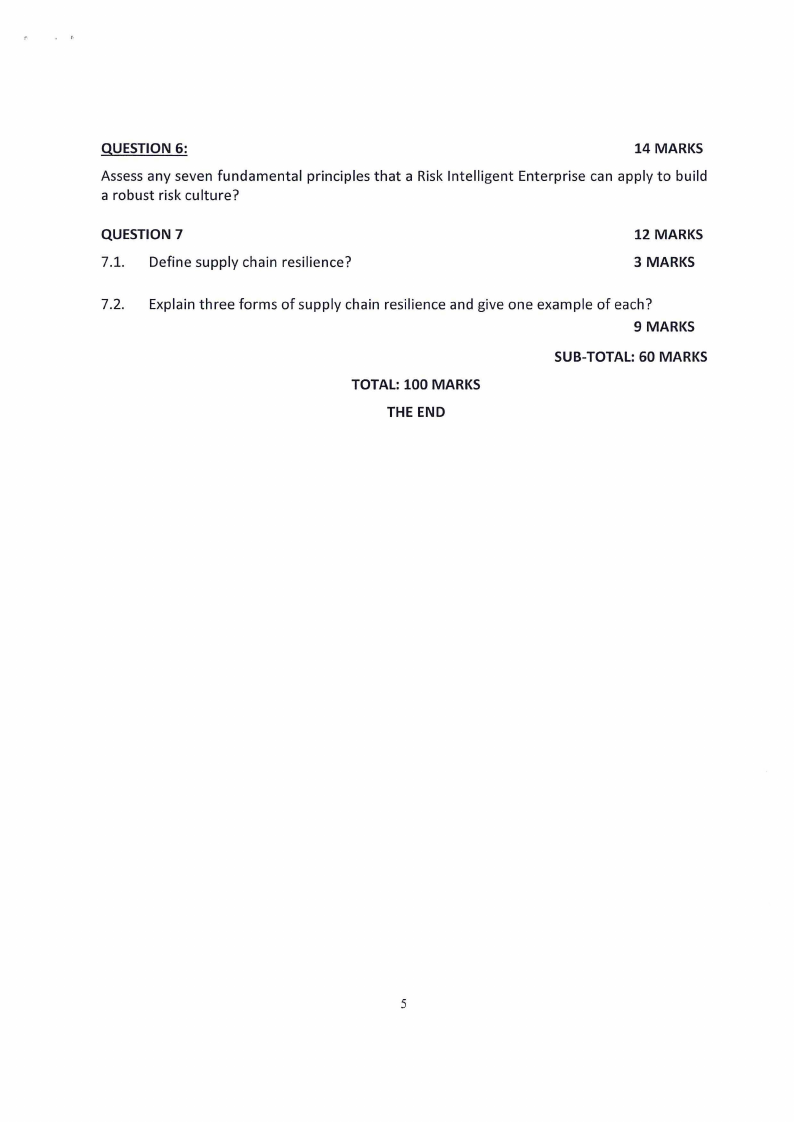
QUESTION 6:
14 MARKS
Assess any seven fundamental principles that a Risk Intelligent Enterprise can apply to build
a robust risk culture?
QUESTION 7
7.1. Define supply chain resilience?
12 MARKS
3 MARKS
7.2. Explain three forms of supply chain resilience and give one example of each?
9 MARKS
SUB-TOTAL: 60 MARKS
TOTAL: 100 MARKS
THE END
5