


 |
PLP810S - PUBLIC LAW AND POLICY IN EDUCATION - 1ST OPP - JUNE 2025 |
|
|
1 Page 1 |
▲back to top |
nAm I BI A un IVERSITY
OF SCIEnCE AnD TECHnOLOGY
FACULTY OF COMMERCE, HUMAN SCIENCE AND EDUCATION
DEPARTMENT OF TECHNICAL, VOCATIONAL EDUCATION AND TRAINING
QUALIFICATION: BACHELOR OF EDUCATION IN EDUCATIONAL PLANNING AND
ADMINISTRATION HONOURS
QUALIFICATION CODE: 08BEPH
LEVEL: 8
COURSE CODE: PLP810S
COURSE NAME: PUBLIC LAW AND POLICY IN
EDUCATION
SESSION: JUNE 2025
DURATION: 3 HOURS
PAPER: 1
MARKS: 100
FIRST OPPORTUNITY EXAMINATION QUESTION PAPER
EXAMINER(S) DR. N SISINYIZE
MODERATOR: DR SAMUEL H. HAMUKOSHI
INSTRUCTIONS
1. Answer ALL the questions.
2. Question 1 consist of multiple choice, choose only one option of
your choice.
3. Read all the questions carefully before answering.
4. Number the answers clearly
THIS QUESTION PAPER CONSISTS OF _5_ PAGES (Including this front page)
llPage
|
|
2 Page 2 |
▲back to top |
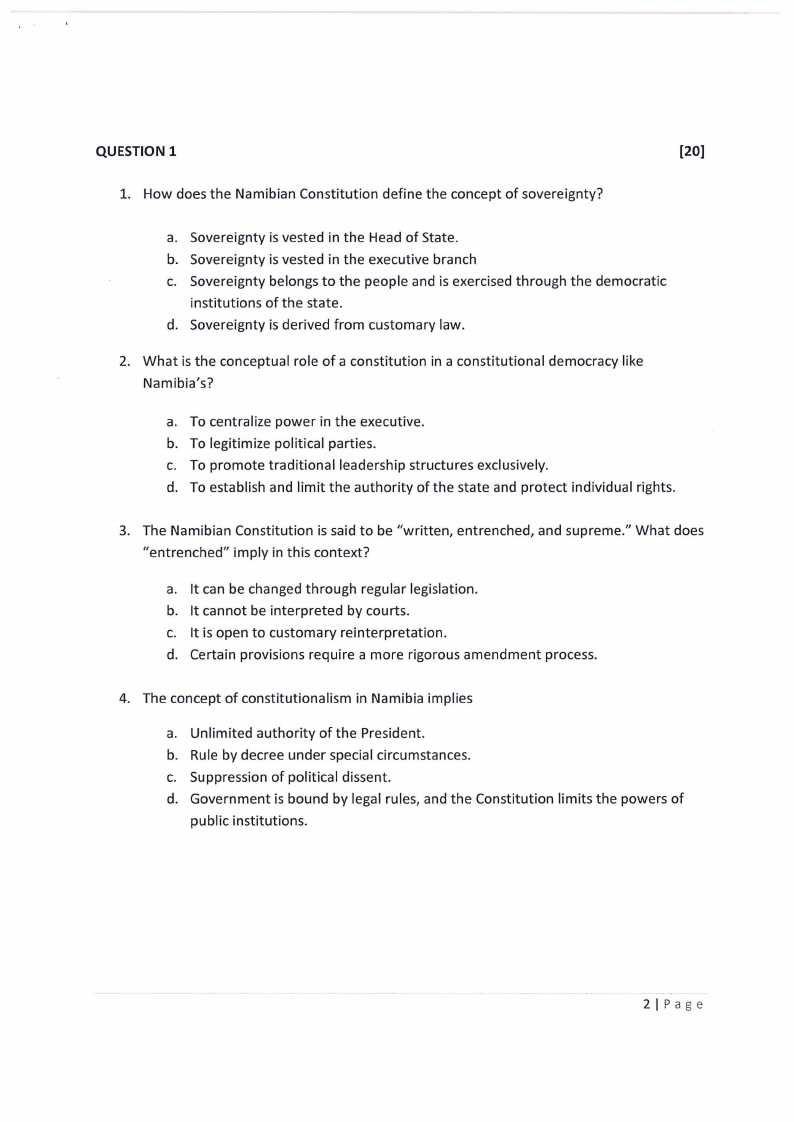
QUESTION 1
[20]
1. How does the Namibian Constitution define the concept of sovereignty?
a. Sovereignty is vested in the Head of State.
b. Sovereignty is vested in the executive branch
c. Sovereignty belongs to the people and is exercised through the democratic
institutions of the state.
d. Sovereignty is derived from customary law.
2. What is the conceptual role of a constitution in a constitutional democracy like
Namibia's?
a. To centralize power in the executive.
b. To legitimize political parties.
c. To promote traditional leadership structures exclusively.
d. To establish and limit the authority of the state and protect individual rights.
3. The Namibian Constitution is said to be "written, entrenched, and supreme." What does
"entrenched" imply in this context?
a. It can be changed through regular legislation.
b. It cannot be interpreted by courts.
c. It is open to customary reinterpretation.
d. Certain provisions require a more rigorous amendment process.
4. The concept of constitutionalism in Namibia implies
a. Unlimited authority of the President.
b. Rule by decree under special circumstances.
c. Suppression of political dissent.
d. Government is bound by legal rules, and the Constitution limits the powers of
public institutions.
21Page
|
|
3 Page 3 |
▲back to top |
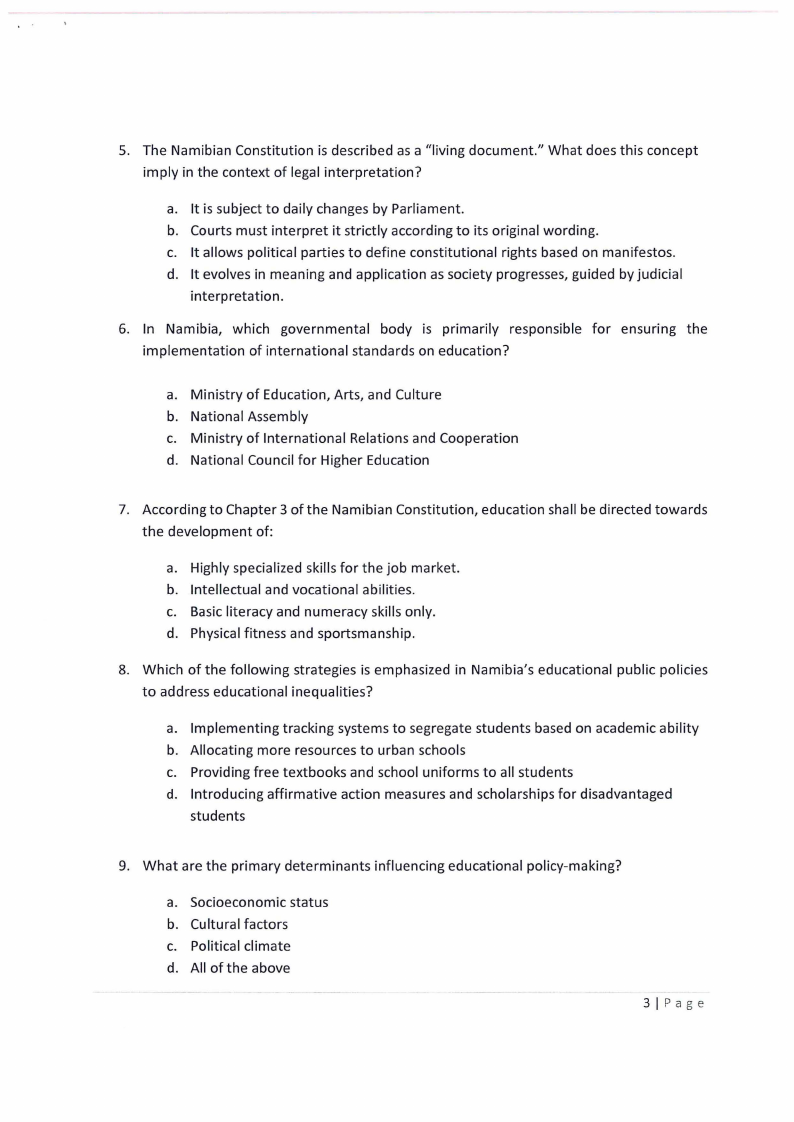
5. The Namibian Constitution is described as a "living document." What does this concept
imply in the context of legal interpretation?
a. It is subject to daily changes by Parliament.
b. Courts must interpret it strictly according to its original wording.
c. It allows political parties to define constitutional rights based on manifestos.
d. It evolves in meaning and application as society progresses, guided by judicial
interpretation.
6. In Namibia, which governmental body is primarily responsible for ensuring the
implementation of international standards on education?
a. Ministry of Education, Arts, and Culture
b. National Assembly
c. Ministry of International Relations and Cooperation
d. National Council for Higher Education
7. According to Chapter 3 of the Namibian Constitution, education shall be directed towards
the development of:
a. Highly specialized skills for the job market.
b. Intellectual and vocational abilities.
c. Basic literacy and numeracy skills only.
d. Physical fitness and sportsmanship.
8. Which of the following strategies is emphasized in Namibia's educational public policies
to address educational inequalities?
a. Implementing tracking systems to segregate students based on academic ability
b. Allocating more resources to urban schools
c. Providing free textbooks and school uniforms to all students
d. Introducing affirmative action measures and scholarships for disadvantaged
students
9. What are the primary determinants influencing educational policy-making?
a. Socioeconomic status
b. Cultural factors
c. Political climate
d. All of the above
3IPage
|
|
4 Page 4 |
▲back to top |
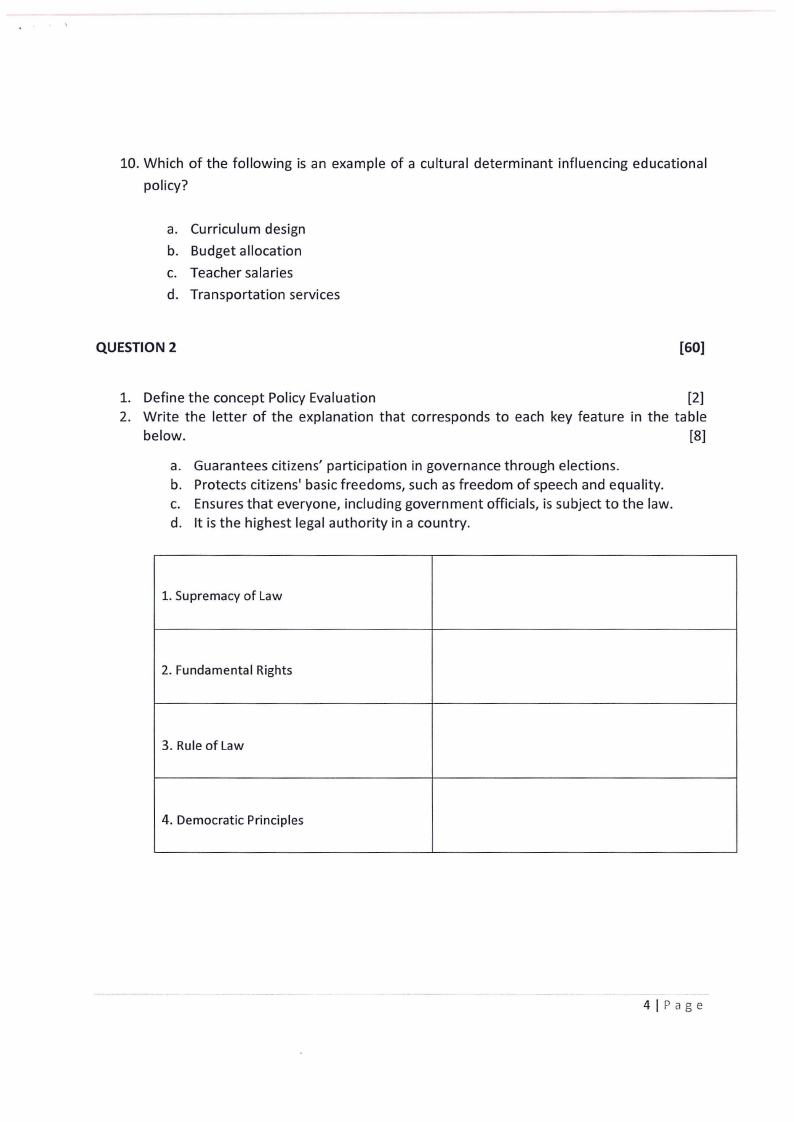
10. Which of the following is an example of a cultural determinant influencing educational
policy?
a. Curriculum design
b. Budget allocation
c. Teacher salaries
d. Transportation services
QUESTION 2
[GO]
1. Define the concept Policy Evaluation
[2]
2. Write the letter of the explanation that corresponds to each key feature in the table
below.
[8]
a. Guarantees citizens' participation in governance through elections.
b. Protects citizens' basic freedoms, such as freedom of speech and equality.
c. Ensures that everyone, including government officials, is subject to the law.
d. It is the highest legal authority in a country.
1. Supremacy of Law
2. Fundamental Rights
3. Rule of Law
4. Democratic Principles
41Page
|
|
5 Page 5 |
▲back to top |
3. Briefly provide an explanation of the content covered in the following chapters of the
Namibian Constitution
[10]
a. Chapter 4
b. Chapter 10
C. Chapter 12
d. Chapter 17
e. Chapter 21
4. Define the following concepts as adopted in the Namibia Constitution
[10]
a. Republic
(2)
b. Sovereign
(2)
C. Secular
(2)
d. Democratic
(2)
e. Unitary
(2)
5. Explain how each of the following determinants influences educational policies
[18]
a. Political context
b. Social and Cultural
c. Economic context
d. Legal and regulatory frameworks
e. Technology
f. Research
6. With aid of examples, explain the difference between policy change and policy
termination
[12]
QUESTION 3
[20)
1. Explain at least five (5) steps involved in formalising the policy proposal into a legislative
or administrative action
[10]
2. As an educational policy analyst, you have been assigned the task of formulating a policy
on educational planning. Discuss the stages of the public policy-making process that will
guide you in completing this assignment.
[10]
[100)
[END OF PAPER]
SI Page