


 |
PLP810S - PUBLIC LAW AND POLICY IN EDUCATION - 2ND OPP - JULY 2025 |
|
|
1 Page 1 |
▲back to top |
nAmlBIA unlVERSITY
OF SCIEn CE Ano TECHn OLOGY
FACULTY OF COMMERCE, HUMAN SCIENCEAND EDUCATION
DEPARTMENT OF TECHNICAL, VOCATIONAL EDUCATION AND TRAINING
QUALIFICATION: BACHELOR OF EDUCATION IN EDUCATIONAL PLANNING AND
ADMINISTRATION HONOURS
QUALIFICATION CODE: 08BEPH
LEVEL: 8
COURSE CODE: PLP810S
COURSE NAME: PUBLIC LAW AND POLICY IN
EDUCATION
SESSION: JULY 2025
DURATION: 3 HOURS
PAPER: 2
MARKS: 100
SECOND OPPORTUNITY EXAMINATION QUESTION PAPER
EXAMINER(S} DR. N SISINYIZE
MODERATOR: DR SAMUEL H. HAMUKOSHI
INSTRUCTIONS
1. Answer ALL the questions.
2. Question 1 consist of multiple choice, choose only one option of
your choice.
3. Read all the questions carefully before answering.
4. Number the answers clearly
THIS QUESTION PAPER CONSISTS OF_ 4_ PAGES {Including this front page)
Page J 1
|
|
2 Page 2 |
▲back to top |
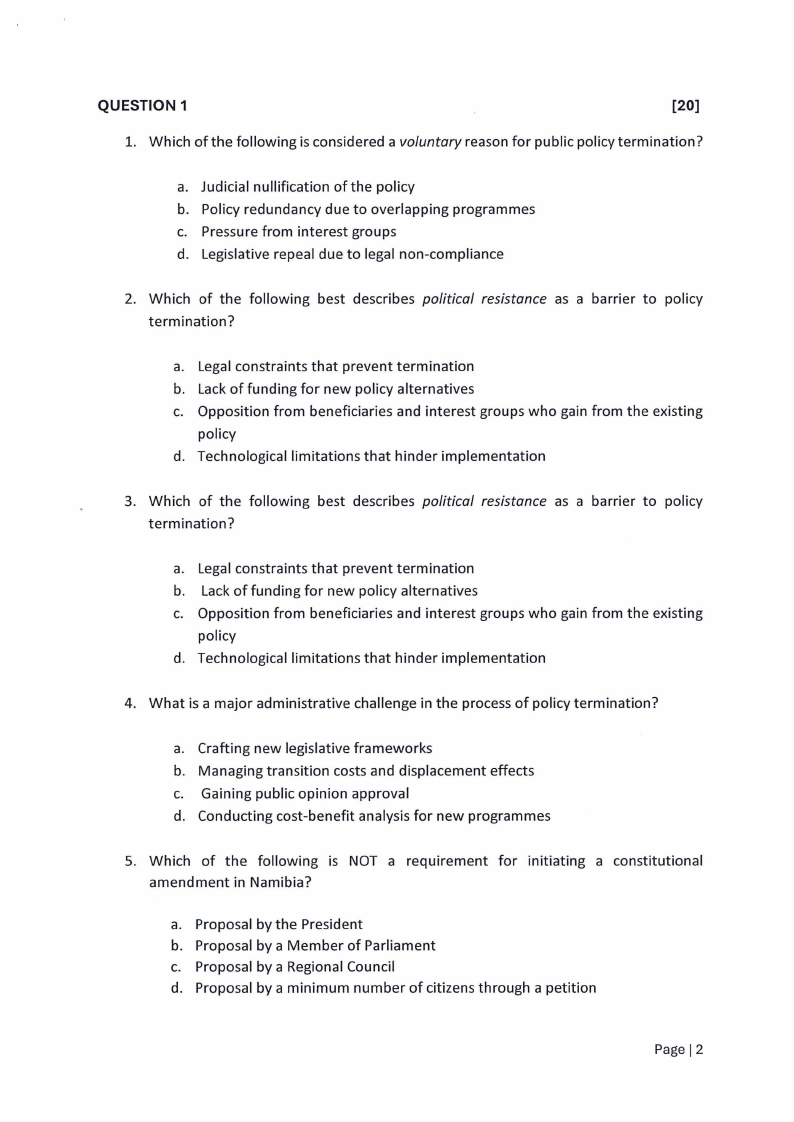
QUESTION 1
[20]
1. Which of the following is considered a voluntary reason for public policy termination?
a. Judicial nullification of the policy
b. Policy redundancy due to overlapping programmes
c. Pressure from interest groups
d. Legislative repeal due to legal non-compliance
2. Which of the following best describes political resistance as a barrier to policy
termination?
a. Legal constraints that prevent termination
b. Lack of funding for new policy alternatives
c. Opposition from beneficiaries and interest groups who gain from the existing
policy
d. Technological limitations that hinder implementation
3. Which of the following best describes political resistance as a barrier to policy
termination?
a. Legal constraints that prevent termination
b. Lack of funding for new policy alternatives
c. Opposition from beneficiaries and interest groups who gain from the existing
policy
d. Technological limitations that hinder implementation
4. What is a major administrative challenge in the process of policy termination?
a. Crafting new legislative frameworks
b. Managing transition costs and displacement effects
c. Gaining public opinion approval
d. Conducting cost-benefit analysis for new programmes
5. Which of the following is NOT a requirement for initiating a constitutional
amendment in Namibia?
a. Proposal by the President
b. Proposal by a Member of Parliament
c. Proposal by a Regional Council
d. Proposal by a minimum number of citizens through a petition
Page 12
|
|
3 Page 3 |
▲back to top |
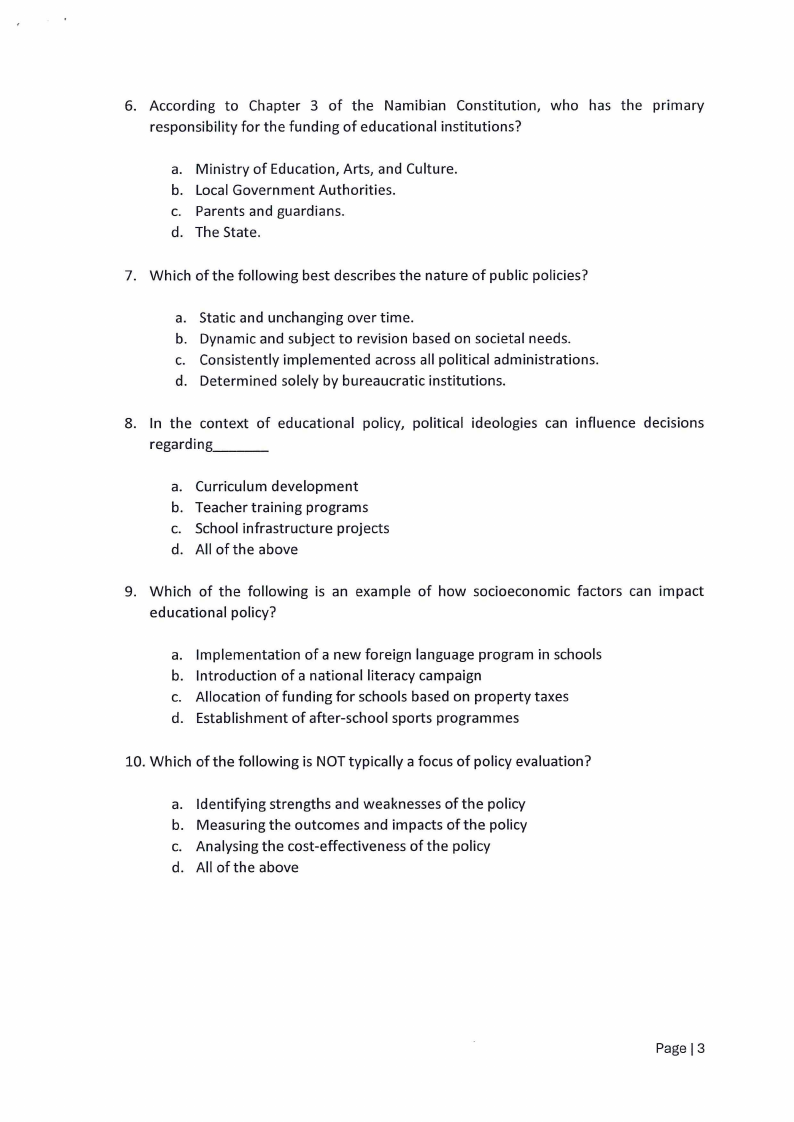
6. According to Chapter 3 of the Namibian Constitution, who has the primary
responsibility for the funding of educational institutions?
a. Ministry of Education, Arts, and Culture.
b. Local Government Authorities.
c. Parents and guardians.
d. The State.
7. Which of the following best describes the nature of public policies?
a. Static and unchanging over time.
b. Dynamic and subject to revision based on societal needs.
c. Consistently implemented across all political administrations.
d. Determined solely by bureaucratic institutions.
8. In the context of educational policy, political ideologies can influence decisions
regarding __ _
a. Curriculum development
b. Teacher training programs
c. School infrastructure projects
d. All of the above
9. Which of the following is an example of how socioeconomic factors can impact
educational policy?
a. Implementation of a new foreign language program in schools
b. Introduction of a national literacy campaign
c. Allocation of funding for schools based on property taxes
d. Establishment of after-school sports programmes
10. Which of the following is NOT typically a focus of policy evaluation?
a. Identifying strengths and weaknesses of the policy
b. Measuring the outcomes and impacts of the policy
c. Analysing the cost-effectiveness of the policy
d. All of the above
Page I 3
|
|
4 Page 4 |
▲back to top |
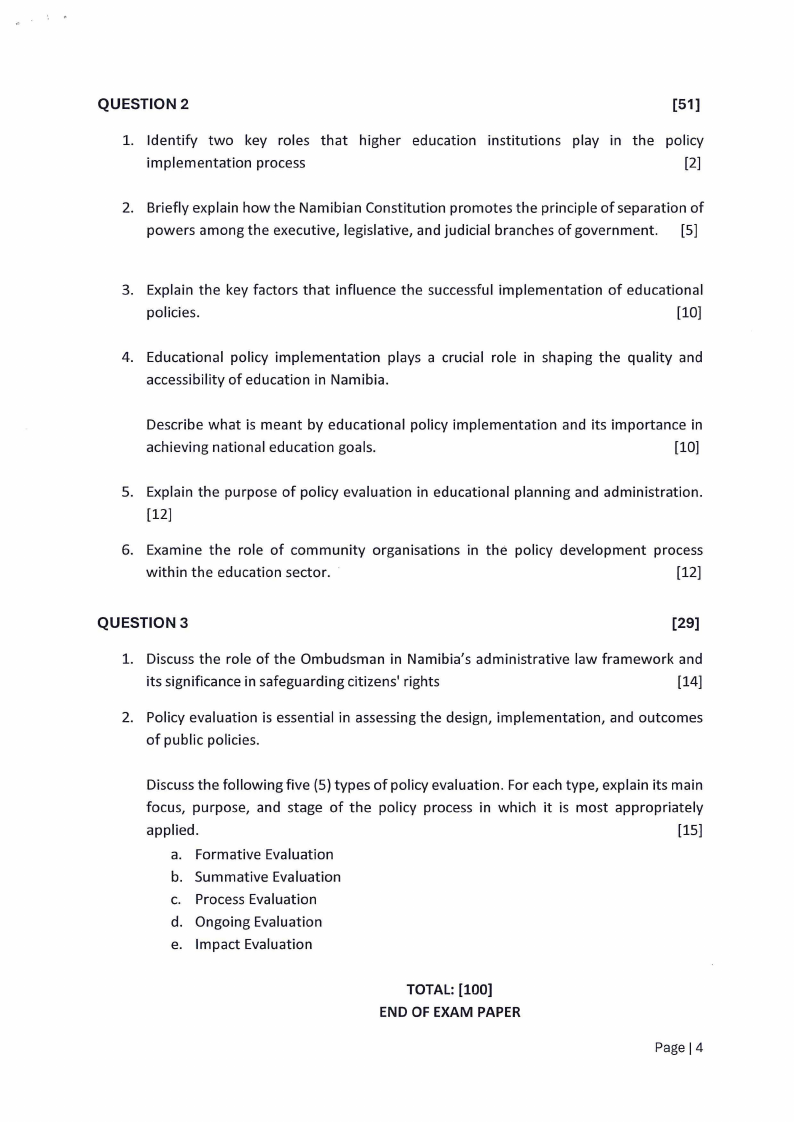
QUESTION 2
[51]
1. Identify two key roles that higher education institutions play in the policy
implementation process
[2]
2. Briefly explain how the Namibian Constitution promotes the principle of separation of
powers among the executive, legislative, and judicial branches of government. [5]
3. Explain the key factors that influence the successful implementation of educational
policies.
[10]
4. Educational policy implementation plays a crucial role in shaping the quality and
accessibility of education in Namibia.
Describe what is meant by educational policy implementation and its importance in
achieving national education goals.
[10]
5. Explain the purpose of policy evaluation in educational planning and administration.
[12]
6. Examine the role of community organisations in the policy development process
within the education sector.
[12]
QUESTION 3
[29]
1. Discuss the role of the Ombudsman in Namibia's administrative law framework and
its significance in safeguarding citizens' rights
[14]
2. Policy evaluation is essential in assessing the design, implementation, and outcomes
of public policies.
Discuss the following five (5) types of policy evaluation. For each type, explain its main
focus, purpose, and stage of the policy process in which it is most appropriately
applied.
[15]
a. Formative Evaluation
b. Summative Evaluation
C. Process Evaluation
d. Ongoing Evaluation
e. Impact Evaluation
TOTAL: [100]
END OF EXAM PAPER
Page 14