


 |
DPP720S - DEVELOPMENT POLICIES AND PROCESSES - 1ST OPP - NOV 2025 |
|
|
1 Page 1 |
▲back to top |
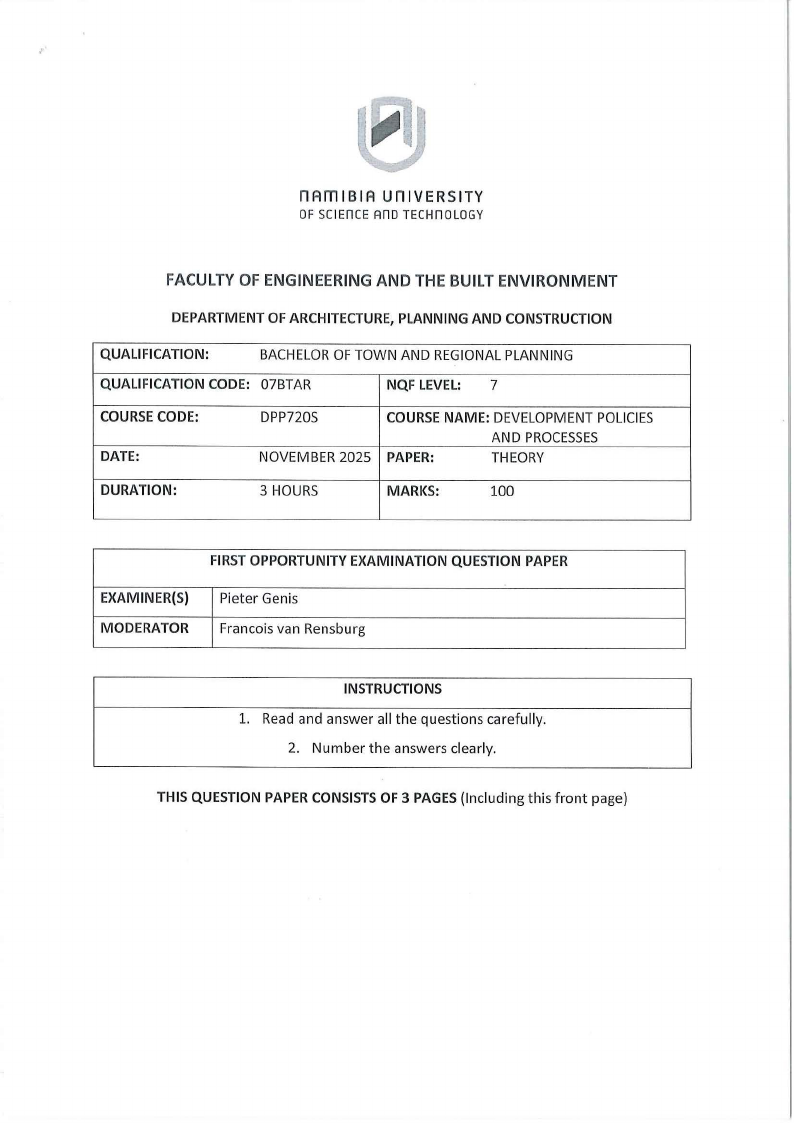
nAmlBIA UnlV ERSITY
OF SCIEn CE Ano TECHnOLOGY
FACULTY OF ENGIN EERING AND THE BUILT ENVIRONM ENT
DEPARTMENT OF ARCHITECTURE, PLANNING AND CONSTRU CTION
QUALIFI CATION:
BACHELOR OF TOWN AND REGIONAL PLANNING
QUALIFI CATION CODE: 07BTAR
NQF LEVEL: 7
COURSE CODE:
DATE:
DPP720S
COURSE NAME: DEVELOPMENT POLICIES
AND PROCESSES
NOVEMBER 2025 PAPER:
THEORY
DURATION:
3 HOURS
MARl<S:
100
FIRST OPPORTUNITY EXAMINATION QUESTION PAPER
EXAMIN ER(S)
MODERATOR
Pieter Genis
Francois van Rensburg
INSTRUCTIONS
1. Read and answer all the questions carefully.
2. Number the answers clearly.
THIS QUESTION PAPER CONSISTS OF 3 PAGES (Including this front page)
|
|
2 Page 2 |
▲back to top |
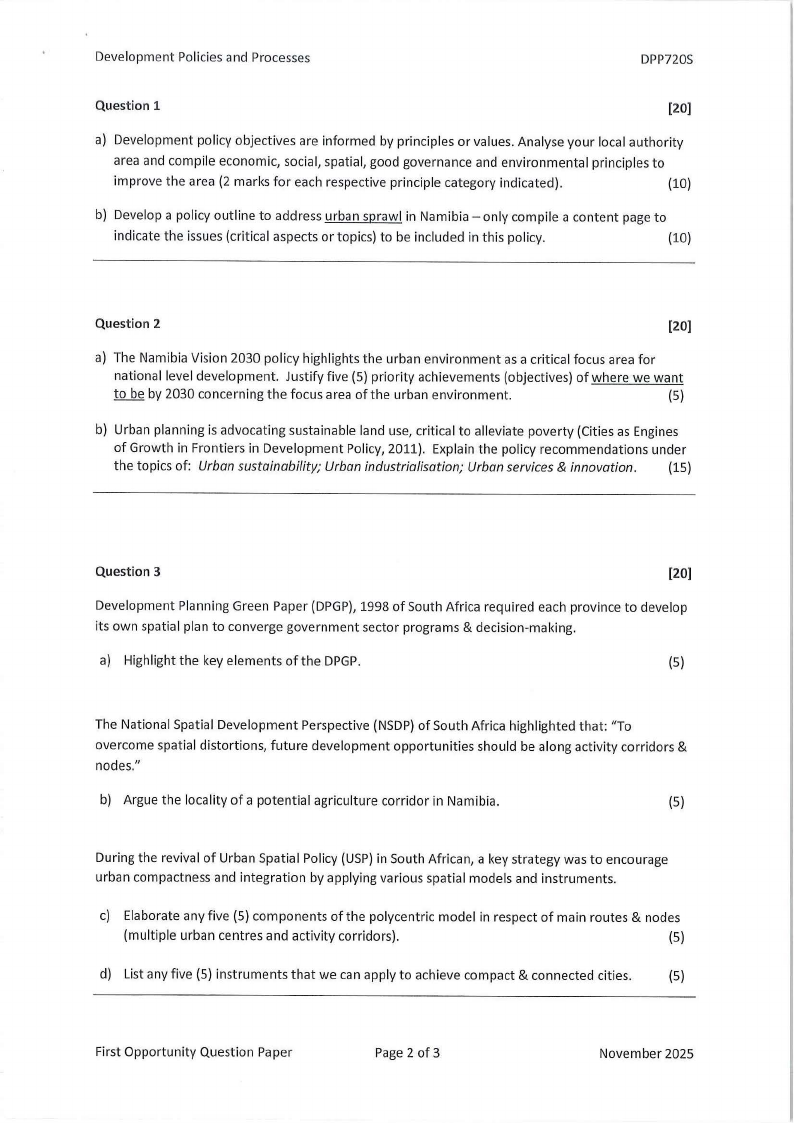
Development Policies and Processes
DPP720S
Question 1
[20]
a) Development policy objectives are informed by principles or values. Analyse your local authority
area and compile economic, social, spatial, good governance and environmental principles to
improve the area (2 marks for each respective principle category indicated).
(10)
b) Develop a policy outline to address urban sprawl in Namibia - only compile a content page to
indicate the issues (critical aspects or topics) to be included in this policy.
(10)
Question 2
[20]
a) The Namibia Vision 2030 policy highlights the urban environment as a critical focus area for
national level development. Justify five (5) priority achievements (objectives) of where we want
to be by 2030 concerning the focus area of the urban environment.
(5)
b) Urban planning is advocating sustainable land use, critical to alleviate poverty (Cities as Engines
of Growth in Frontiers in Development Policy, 2011). Explain the policy recommendations under
the topics of: Urban sustainability; Urban industrialisation; Urban services & innovation. (15)
Question 3
[20]
Development Planning Green Paper (DPGP), 1998 of South Africa required each province to develop
its own spatial plan to converge government sector programs & decision-making.
a) Highlight the key elements of the DPGP.
(5)
The National Spatial Development Perspective (NSDP) of South Africa highlighted that: "To
overcome spatial distortions, future development opportunities should be along activity corridors &
nodes."
b) Argue the locality of a potential agriculture corridor in Namibia.
(5)
During the revival of Urban Spatial Policy (USP) in South African, a key strategy was to encourage
urban compactness and integration by applying various spatial models and instruments.
c) Elaborate any five (5) components of the polycentric model in respect of main routes & nodes
(multiple urban centres and activity corridors).
(5)
d) List any five (5) instruments that we can apply to achieve compact & connected cities.
(5)
First Opportunity Question Paper
Page 2 of 3
November 2025
|
|
3 Page 3 |
▲back to top |
Development Policies and Processes
DPP720S
Question 4
[20)
The format of a policy may range from a very simple statement regarding a specific issue to a full
explanation of - how it was arrived at, why it has been formulated and what it entails.
a) You are required to compile an urban spatial policy on activity corridors. As a policy summary
recommendation, define the concept of activity corridors (1 mark) and discuss how the policy
was arrived at (2 marks), why it has been formulated (2 marks) and what it entails (5 marks).
(10)
b) Preparing development policy requires consultation. Elaborate on surveys and the media as
consultation methods.
(10)
Question 5
[20)
Addressing urbanisation and urban development in a sustainable way requires integrated
policymaking and strategies.
a)
Ana lyse the reasons of industrial investment, as critical policy/strategy considerations to
address urbanisation.
(5)
b)
Compile a road map for the urban future of Namibia in respect of addressing the
institutional cha llenge with reference to the Urban and Regiona l Planning Act, 2018.
(5)
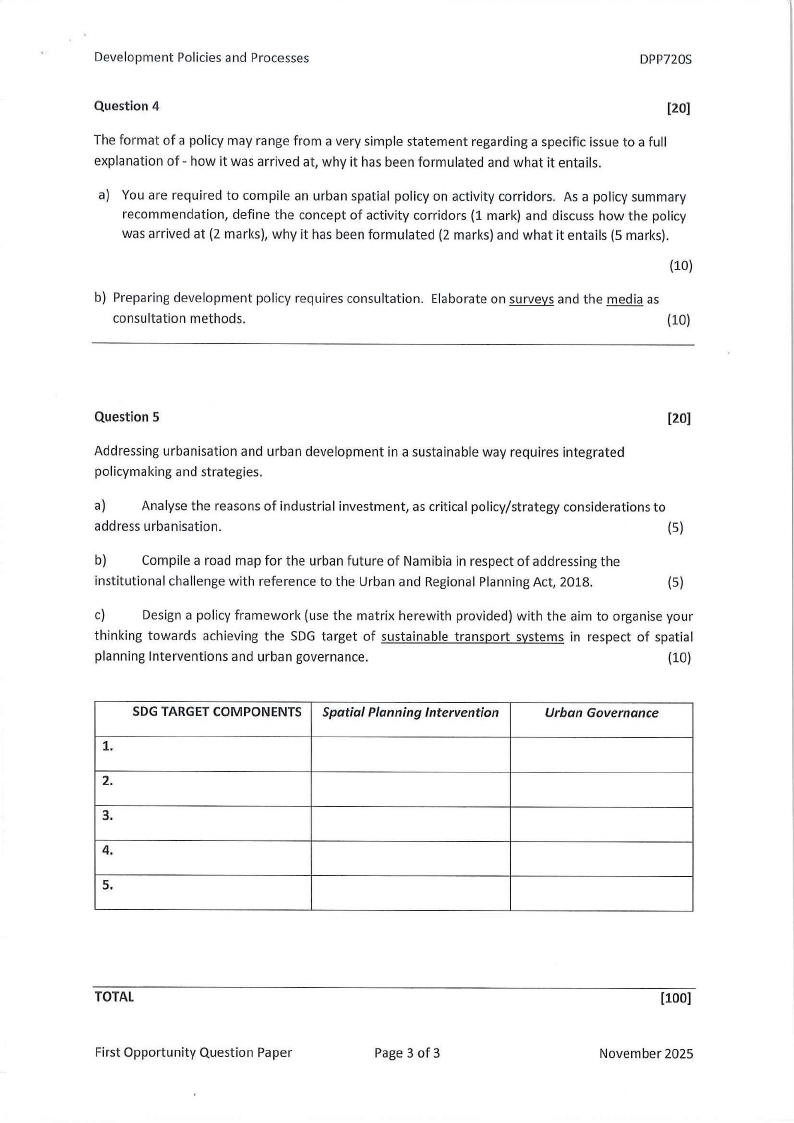
c)
Design a po licy framework (use the matrix herewith provided) with the aim to organise your
thinking towards achieving the SDG target of sustainable transport systems in respect of spatial
planning Interventions and urban governance.
(10)
SDG TARGET COMPONENTS Spatial Planning Intervention
1.
2.
3.
4.
5.
Urban Governance
TOTAL
First Opportunity Question Paper
Page 3 of 3
[100)
November 2025