


 |
GCO621S - GENDER COMMUNICATION - 2ND OPP - DECEMBER 2025 |
|
|
1 Page 1 |
▲back to top |

n Am I BI A Un IVER 5,ITY
OF SCIEnCE Ano TECHnO LOGY
FACULTY OF COMMERCE, HUMAN SCIENCES AND EDUCATION
DEPARTMENT OF COMMUNICATION AND LANGUAGES
QUALIFICATION: BACHELOR OF COMMUNICATION
QUALIFICATION CODE: 07BCMM
LEVEL: 6
COURSE CODE: GCO6215
SESSION: DECEMBER 2025
COURSE NAME: GENDER COMMUNICATION
PAPER:THEORY
DURATION: 3 HOURS
MARKS: 100
EXAMINER:
MODERATOR:
SECOND OPPORTUNITY EXAM PAPER
DR. W. NJUGUNA
PROF M. MHENE
INSTRUCTIONS
ANSWER THREE QUESTIONS IN TOTAL. QUESTION ONE (1) IS COMPULSORY
1. Write clearly and neatly
2. Read all questions carefully
3. Number the answers clearly
PERMISSIBLE MATERIALS
1. Examination paper
2. Examination script
THIS PAPER CONSISTS OF 5 PAGES
(Including this cover page)
|
|
2 Page 2 |
▲back to top |
SECTION A- COMPULSORY
QUESTION 1
Opinion on Gender Equality
[40 marks]
Read the story below entitled, Understanding gender equality in a local context. In view of
your understanding of the world where primarily it has been from a male perspective and
women's voices are not heard, do the following:
a) Write at least a 250-word summary of the story as you understand it, highlighting the
writer's key points.
[15 marks]
b) In consideration of varied discussions in class and relevant contents of the National
Gender Policy 2010-2020, SADC Protocol on Gender & Development, etc, explain your
views on gender equality and the boy child vs the girl child in the past five (5) years
since the 2010-2020 policy lapsed. Whatever answers you provide, support them with
examples, providing solutions or why status quo should be maintained. [13 marks]
c) Highlight and extensively explain four (4) take-aways from the Gender Communication
Course and how you will use them going forward.
[12 marks]
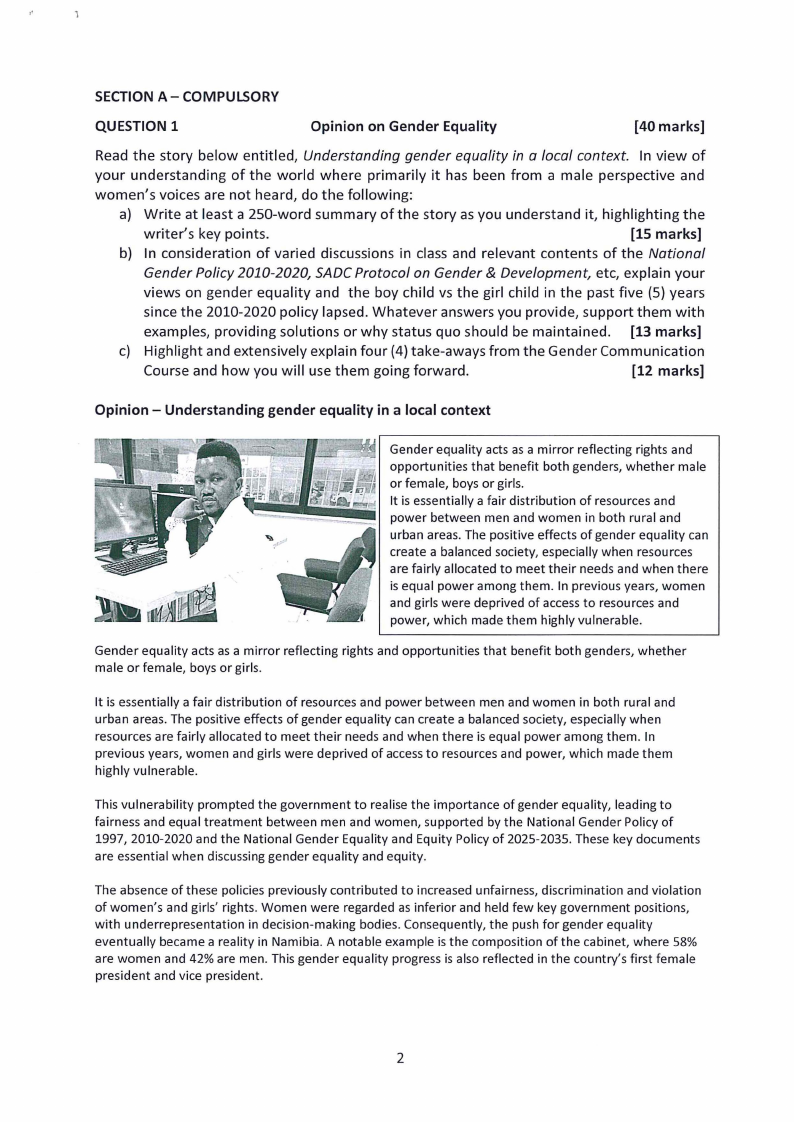
Opinion - Understanding gender equality in a local context
Gender equality acts as a mirror reflecting rights and
opportunities that benefit both genders, whether male
or female, boys or girls.
It is essentially a fair distribution of resources and
power between men and women in both rural and
urban areas. The positive effects of gender equality can
create a balanced society, especially when resources
are fairly allocated to meet their needs and when there
is equal power among them. In previous years, women
and girls were deprived of access to resources and
power, which made them highly vulnerable.
Gender equality acts as a mirror reflecting rights and opportunities that benefit both genders, whether
male or female, boys or girls.
It is essentially a fair distribution of resources and power between men and women in both rural and
urban areas. The positive effects of gender equality can create a balanced society, especially when
resources are fairly allocated to meet their needs and when there is equal power among them . In
previous years, women and girls were deprived of access to resources and power, which made them
highly vulnerable.
This vulnerability prompted the government to realise the importance of gender equality, leading to
fairness and equal treatment between men and women, supported by the National Gender Policy of
1997, 2010-2020 and the National Gender Equality and Equity Policy of 2025-2035. These key documents
are essential when discussing gender equality and equity.
The absence of these policies previously contributed to increased unfairness, discrimination and violation
of women's and girls' rights . Women were regarded as inferior and held few key government positions,
with underrepresentation in decision-making bodies. Consequently, the push for gender equality
eventually became a reality in Namibia . A notable example is the composition of the cabinet, where 58%
are women and 42% are men. This gender equality progress is also reflected in the country's first female
president and vice president.
2
|
|
3 Page 3 |
▲back to top |
The Global Gender Gap report states that Namibia is leading Africa in addressing the gender gap, with an
81.1% score, ranking 8th globally, and being the only African nation in the top 10. This achievement
benefits not only women but also men, boys and girls across the nation . Gender equality is made
possible through the implementation of international instruments and treaties, as well as education that
changes perceptions, especially among traditional leaders and the public. It ensures women and girls are
treated fairly and empowered to lead the country's economic development.
Today, it is common to see young women appointed to lead ministries, regions and major institutions -
an accomplishment difficult for nations with high gender inequality. In contrast, gender inequality is
highly detrimental compared to gender equality, which considers all needs of men, women, girls and boys
in decision-making.
While gender equality does not directly eliminate issues like resource distribution flaws, violence,
unemployment, corruption or poverty, it helps minimise them.
However, in our homeland, these problems remain prevalent, raising questions about the relevance of
gender equality amid such challenges.
One might ask: can gender equality still be meaningful in the face of resource distribution flaws, high
unemployment, corruption, poverty and gender-based violence {GBV)? The answer depends on the
remedies in place to ensure positive impacts.
These remedies include job creation programmes from the government and public entities, as well as
business empowerment initiatives supported by most government ministries and private sector partners.
Regard ing corruption, the government established the Anti-Corruption Commission to combat such
activities.
Concerning poverty, strategies are implemented to assist marginalised groups, including orphans, people
with disabilities and pensioners. Solutions for GBV include establishing investigation units, shelters for
victims and national awareness campaigns.
Yet, questions remain : are these remedies ineffective, or are citizens not playing their part in
strengthening gender equality? Are leaders aware that ignoring these issues or neglecting marginalised
individuals can undermine gender equality? Is gender equality solely focused on power distribution,
neglecting key aspects such as fair resource sharing?
I believe gender equality should prioritise factors that enhance the livelihoods of all Namibians,
benefitting the majority and ultimately fostering a balanced "50/50 gender representation in
government," reflecting a focus on people's needs.
Ultimately, the government and its leaders should dedicate their energy, authority and knowledge to
ensure gender equality through service delivery, addressing social challenges that hinder social stability.
* Tobias Nanhinda is a librarian at the gender ministry. The views in this article are entirely his and do not
represent his employer. https ://neweralive.na/opinion-understanding-gender-equality-in-a-local-context
SECTION B - CHOOSE ONLY TWO QUESTIONS
QUESTION 2
Gendered Media
[30 marks]
"Media influence how we perceive people of all genders, in general, and ourselves, in
particular. The historical trend of emphasizing gender-stereotyped roles and images
continues today and is sometimes challenged by alternative images of women, men, LGBTQ
people, and relationships. Below the surface, however, most media continue to reflect
3
|
|
4 Page 4 |
▲back to top |
traditional gender norms. These representations foster unrealistic gender ideals, encourage
us to pathologize (regard or treat as psychologically unusual or unhealthy) normal human
bodies and functions, and normalize violence against women. Understanding the overt and
subtle gender messages in media empowers us to be more critical consumers. As individuals
and citizens, we have a responsibility to criticize media representations that demean men
and women and that contribute to attitudes that harm us and our relationships." (In
Gendered Lives, 2019, p.236)
Based on your knowledge of gendered media, use of social media etc,
a) Extensively discuss above statement, providing and explaining clearly at least three
(3) local examples that show you understand what the statement means. [10 marks]
b) Think of the ways that you personally use social media - be it WhatsApp, Facebook,
lnstagram, TikTok, Telegram, You Tube, Tinder or any other. Picking three social
media apps, explain with at least three (3) examples, how you would use social
media to counter stereotypes that media creates.
[9 marks]
c) With at least two (2) examples for men and two (2) for women, explain how media
messages about gender roles and ideals affect the way men and women in your
culture carry out day to day activities and how this might influence the self-
perception and aspirations of each gender in the long term?
[11 marks]
QUESTION 3
Sustainable Development Goals
[30 Marks]
Sustainable development goals number 5 (gender equality) and 10 (reducing inequality)
highlight the need to promote greater equality and social inclusion.
a) From your own perspective and with a minimum of five examples, is gender equality
achievable?
[15 marks]
b) Extensively highlight some of the challenges hindering the efforts towards equality
and suggest at least five (5) possible interventions.
[15 marks]
QUESTION 4
Gender Mainstreaming
[30 marks]
Gender mainstreaming was established as a major global strategy for the promotion of
gender equality in the Beijing Platform for Action from the Fourth United Nations World
Conference on Women in Beijing in 1995. Furthermore, gender equality is guaranteed under
Constitution of Namibia, Article 10 (Equality and Freedom from Discrimination): "l. All
persons shall be equal before the law and 2. No persons may be discriminated against on
the grounds of sex, race, colour, ethnic origin, religion, creed or social or economic status.
Gender mainstreaming should therefore play a role in enforcing above rights in different
areas ofthe nation . From your experience as a student, an employee or any other roles you
hold, explain the following:
a) With two examples, discuss how you understand gender mainstreaming? [4 marks]
b) Name and explain the five principles of gender mainstreaming.
[10 marks]
c) With at least four examples, explain how gender mainstreaming can be effectively
carried out in an institution of higher learning such as NUST.
[8 marks]
4
|
|
5 Page 5 |
▲back to top |

d) Suggest ways that the Government of Namibia and other partners can ensure gender
mainstreaming is successful in various areas of the Namibian society including in the
cultural set-up.
[8 marks]
END OF PAPER - GOOD LUCK
5