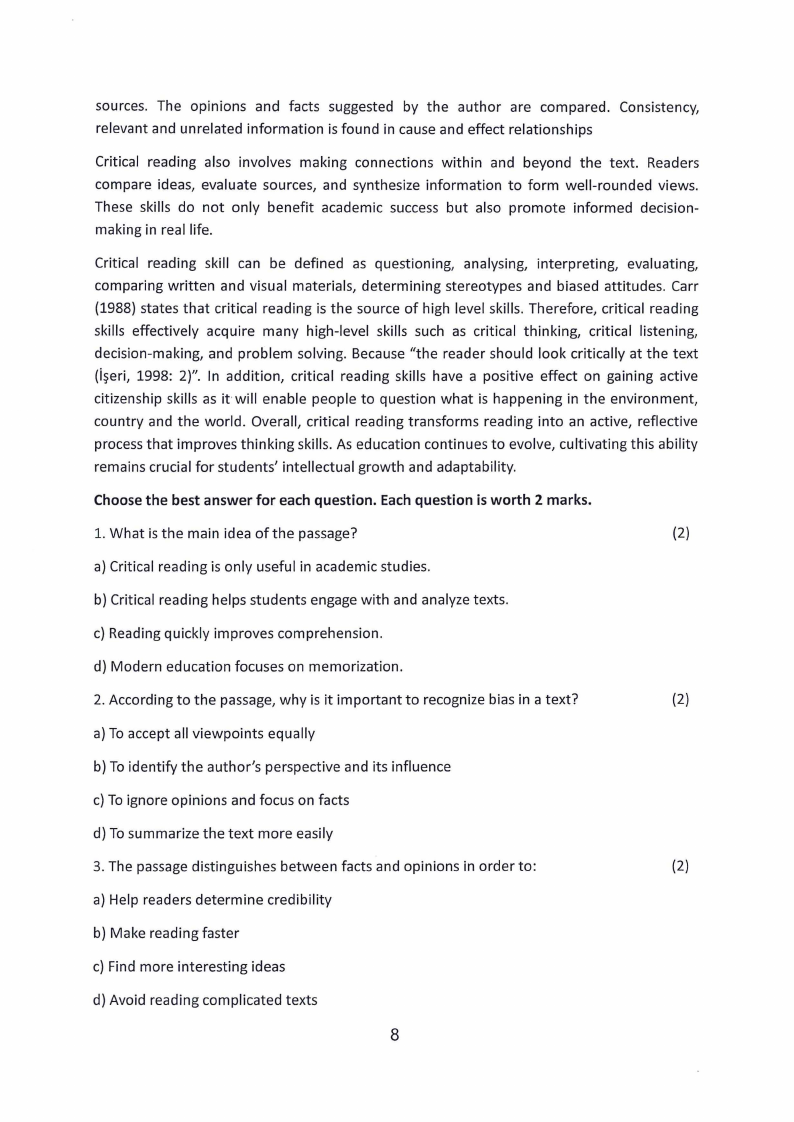
SECTION C: CRITICAL READING AND SUMMARISING
[40 Marks]
Read the Passage below and answer the questions that follow.
The Role of Critical Reading in Modern Education
by Ahmet Utku OZENSOY
With the introduction of computers into human and social life, the increase in human
knowledge has accelerated. Advances in internet technology have accelerated this increase.
This incredible increase in knowledge has brought to the fore such elements as the research
of the information, analysis, questioning, interpretation, reproduction, using in new
situations, and evaluation of the information, problemsolving. Therefore, critical thinking,
critical listening, critical writing, and critical reading have become more important in all life
areas. Critical reading is an essential skill in modern education. It enables students not just
to understand a text but to engage with it thoughtfully and analytically. Instead of passively
absorbing information, critical readers actively question and evaluate the material, which
encourages deeper comprehension and better retention .
One key aspect of critical reading is recognising bias and assumptions in a text. Authors
often present their ideas from particular perspectives, sometimes unconsciously. A critical
reader identifies these biases and considers how they influence the argument or narrative.
The text can be evaluated by finding that the author's facts to support his views are
incomplete, wrong, sufficient or inadequate. Thus, the reader can look critically at the text
he is reading. According to Ada Ii {2010), distinguishing facts and opinions is one of the basic
elements of critical reading. Distinguishing expressions that vary from person to person and
expressions based on a data or finding sound sources can be verified by sound sources and
are the cornerstones of healthy thinking. After the reader realises which of the statements in
the text he read is based on evidence and the author's views, he can determine whether
facts support the views expressed in the text.
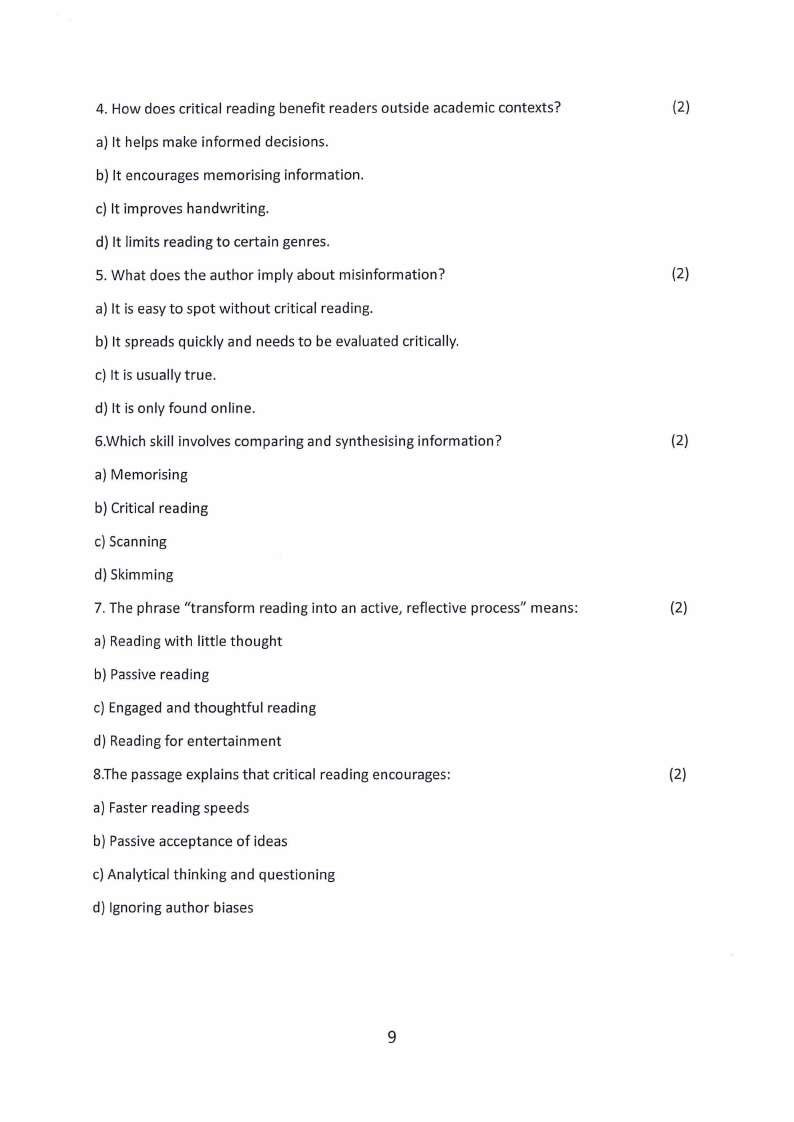
Another important element is distinguishing between facts and opinions. Knowing the
difference helps readers assess whether the information is credible and supported by
evidence. This ability is vital in today's world where misinformation can spread quickly.
Critical reading can be defined as analysing written and visual materials according to
objective criteria, distinguishing facts and opinions, making questioning, decision making
according to logic, making comparisons and evaluations. For this, it is necessary to start by
assuming that the written material reflects the author's own opinions, thoughts and
arguments, not the facts.
Therefore, one of the most important elements of critical reading is to reveal the factors
such as the author's reason for writing the written material, their opinions, expectations,
and perspectives. Then the text's main idea is determined and to what extent the main idea
is supported is examined. The information in the written material is compared from reliable
7