


 |
DSA612S - DISTRIBUTED SYSTEMS AND APPLICATIONS - 1ST OPP - NOV 2025 |
|
|
1 Page 1 |
▲back to top |
nAmlBIA UnlVERSITY
OF SC IEnCE Ano TECHnOLOGY
FACULTY OF COM PUTING AND INFORM ATICS
DEPARTMENT OF SOFTWARE ENGINEERING
QUALIFICATION: BACHELOR OF COMPUTER SCIENCE
QUALIFICATION CODE: 07BCMS, 07BAIT
COURSE: DISTRI BUTED SYSTEM S AND AP PLICATIONS
DATE: OCTOBER 2025
DURATION : 3 HRS
LEV EL: 6
COURSE CODE: DSA612S
PAPER: TH EORY
MARKS: 80
EX A M I N ER(S)
FIRST OPPORTUNITY EXAMINATION QU ESTION PAPER
M s. NDINELAGO NASHANDI
MODERATOR:
PROF JOSE QUENUM
THIS QUESTION PAPER CONSISTS OF 8 PAGES
(Inclu ding this front page)
|
|
2 Page 2 |
▲back to top |
INSTRUCTIONS TO STUDENTS:
1. Read all the questions, passages, scenarios, etc., carefully before answering.
2. Answer all the questions.
3. Number each answer clearly and correctly.
4. Write neatly and legibly.
5. Making use of any crib notes may lead to disqualification and disciplinary action.
6. Use the allocated marks as a guideline when answering question s.
7. Looking at other students' work is strictly prohibited.
8 . This paper consists of eight (8) pages, including the cover page.
9. The paper consists of 3 sections: A, Band C.
Page 2 of 8
|
|
3 Page 3 |
▲back to top |
SECTION A: 5 marks
Multiple Choice Questions (WRITE the correct letter)
1. Which of the fo llowing best describes a distributed system? [1 mark]
A. A single computer runn ing multiple applications simultaneously.
B. A collection of independent, autonomous hosts connected through a
communication network.
C. A computer system that shares memory, clock, and operating system among al l
nodes.
D. A single operating system managing multiple interconnected computers.
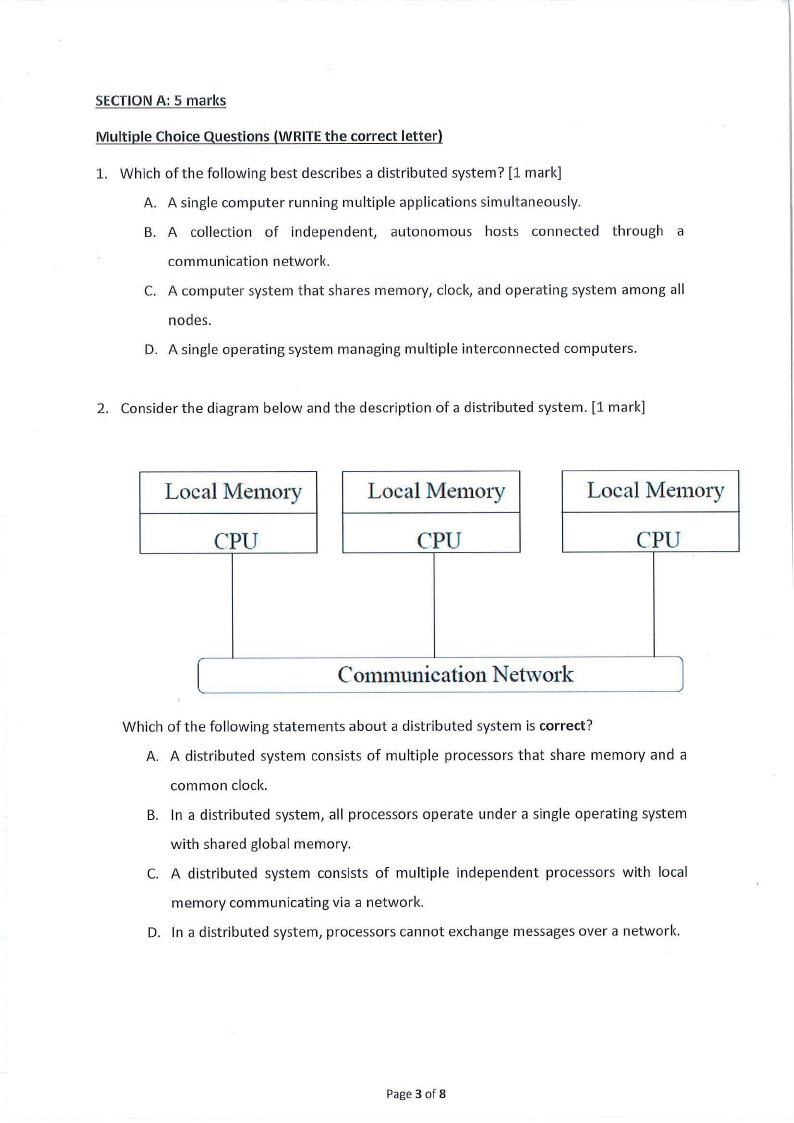
2. Consider the diagram below and the description of a distributed system. [1 mark]
Local Me111ory
CPU
Local Men1ory
CPU
Local Me111ory
CPU
[
Conununication Nen~rork
l
Which of the following statements about a distributed system is correct?
A. A distributed system consists of multiple processors that share memory and a
common clock.
B. In a di stributed system, all processors operate under a single operating system
with shared global memory.
C. A distributed system consists of multiple independent processors w ith local
memory communicating via a network.
D. In a distributed system, processors cannot exchange messages over a network.
Page3of8
|
|
4 Page 4 |
▲back to top |
3. Why should replicated fil'es be placed on failure-independent machines?
A. To improve system speed
B. To ensure they do not fail together
C. To reduce memory usage
D. To eliminate consistency issues
4. Which of th e following best describes the purpose of logical clocks in distributed systems?
A. To synchronise all system clocks to a universal time reference.
B. To establish a total ordering of events across all distributed processes.
C. To ensure causality by allowing a partial ordering of events in a distributed system.
D. To measure the time elapsed between any two events in a distributed system.
5. In the Network Files System (NFS} architecture, which layer provides the abstraction that
allows multiple operating systems to access files uniformly?
A. RPC client stub
B. Virtual File System (VFS) layer
C. Local file system interface
D. System call layer
Page 4 of 8
|
|
5 Page 5 |
▲back to top |
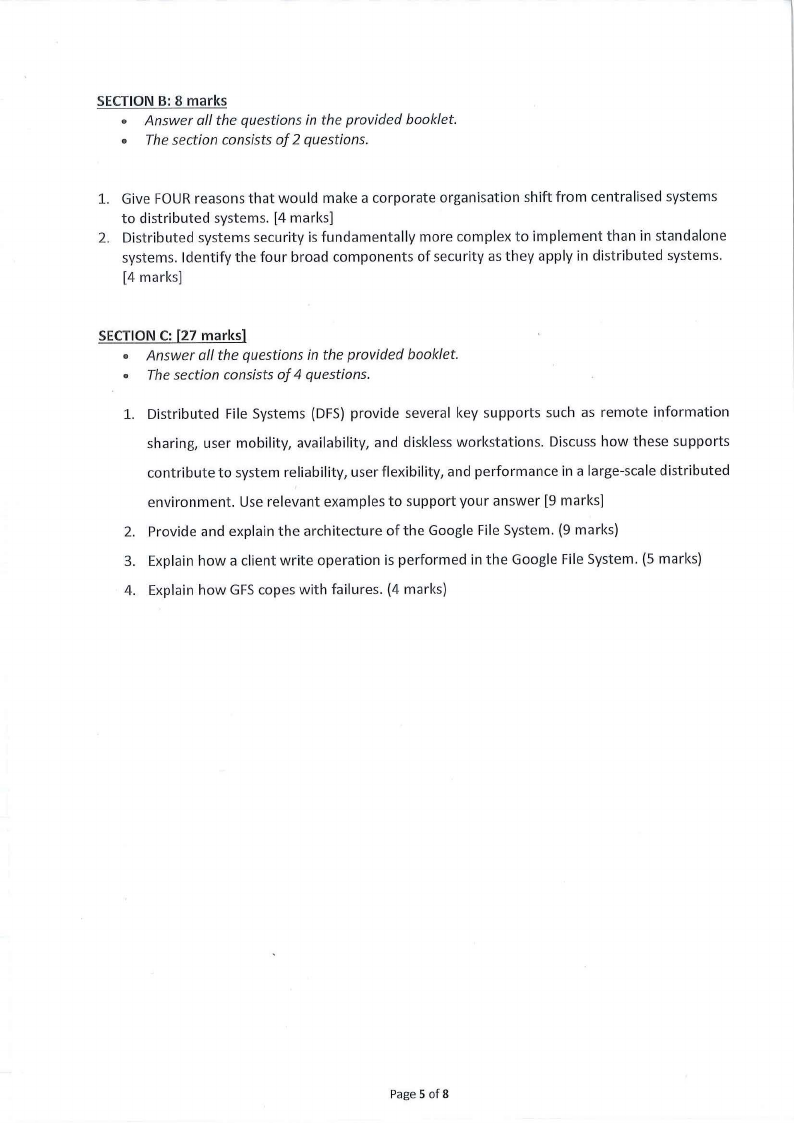
SECTION B: 8 marks
• Answer all the questions in the provided booklet.
• The section consists of 2 questions.
1. Give FOUR reasons that wou ld make a corporate organisation sh ift from centra lised systems
to distributed systems. [4 marks]
2. Distributed systems security is fundamentally more complex to implement than in standalone
systems. Identify the four broad components of security as they apply in distributed systems.
[4 marks]
SECTION C: [27 marks]
• Answer all the questions in the provided booklet.
• The section consists of 4 questions.
1. Distributed File Systems (DFS) provide severa l key supports such as remote information
sharing, user mobility, availabi lity, and diskless workstations. Discuss how these supports
contribute to system reliability, user flexibility, and performance in a large-scale distributed
environment. Use relevant examples to support your answer [9 marks]
2. Provide and explain the arch itecture of the Google File System. (9 marks)
3. Explain how a client write operation is performed in the Google Fi le System. (5 marks)
4. Explain how GFS copes with failures. (4 marks)
Page 5 of 8
|
|
6 Page 6 |
▲back to top |
SECTION D: (16 marks]
• Answer all the questions in the provided booklet.
• The section consists of 2 questions.
1. With the aid of a diagram, explain how the Publish/Subscribe communication model operates.
Discuss why this paradigm is considered a promising approach for modern distributed systems,
highlighting the functionalities and system requirements it addresses.
[10 marks]
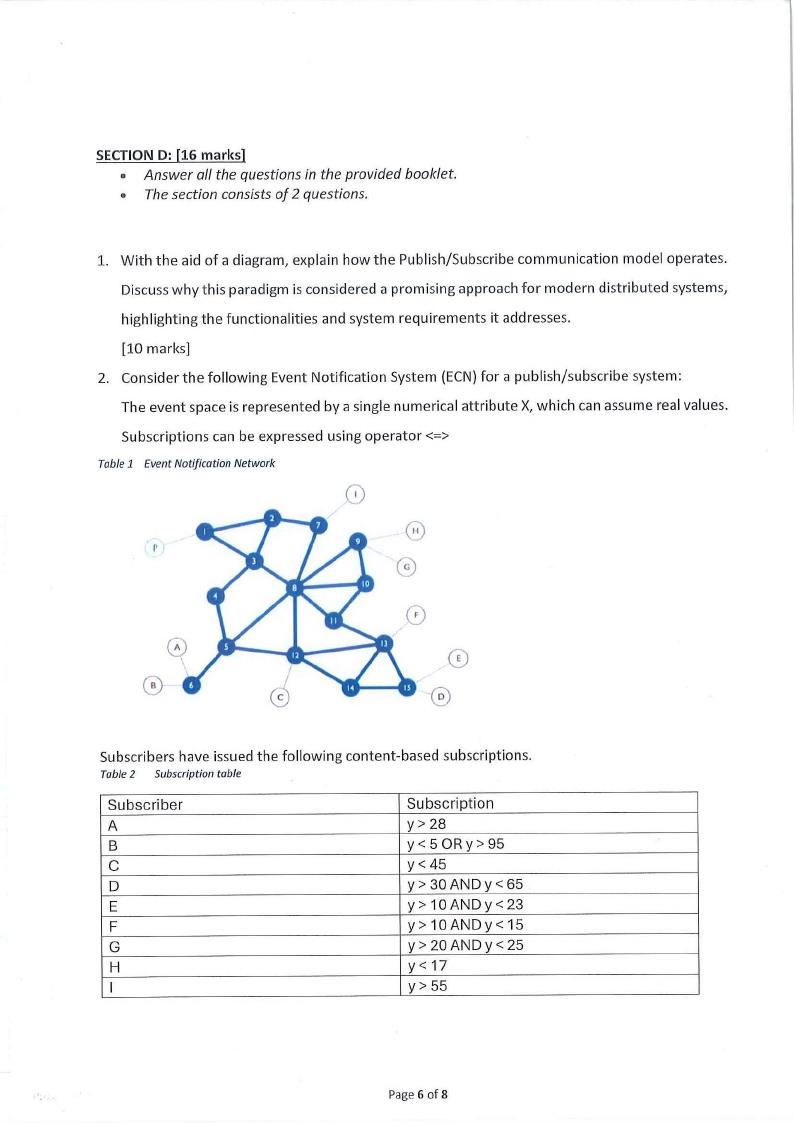
2. Consider the following Event Notification System (ECN) for a publish/subscribe system:
The event space is represented by a single numerical attribute X, which can assume real values.
Subscriptions can be expressed using operator<=>
Table 1 Event Notification Network
0
0
p
0
0
0
0
0
Subscribers have issued the following content-based subscriptions.
Table 2 Subscription table
Subscriber
A
B
C
D
E
F
G
H
I
Subscription
y> 28
y < 5 OR y > 95
y<45
y > 30 AND y < 65
y > 10 AND y < 23
y > 10 AND y < 15
y>20ANDy<25
y<17
y> 55
Page 6 of 8
|
|
7 Page 7 |
▲back to top |
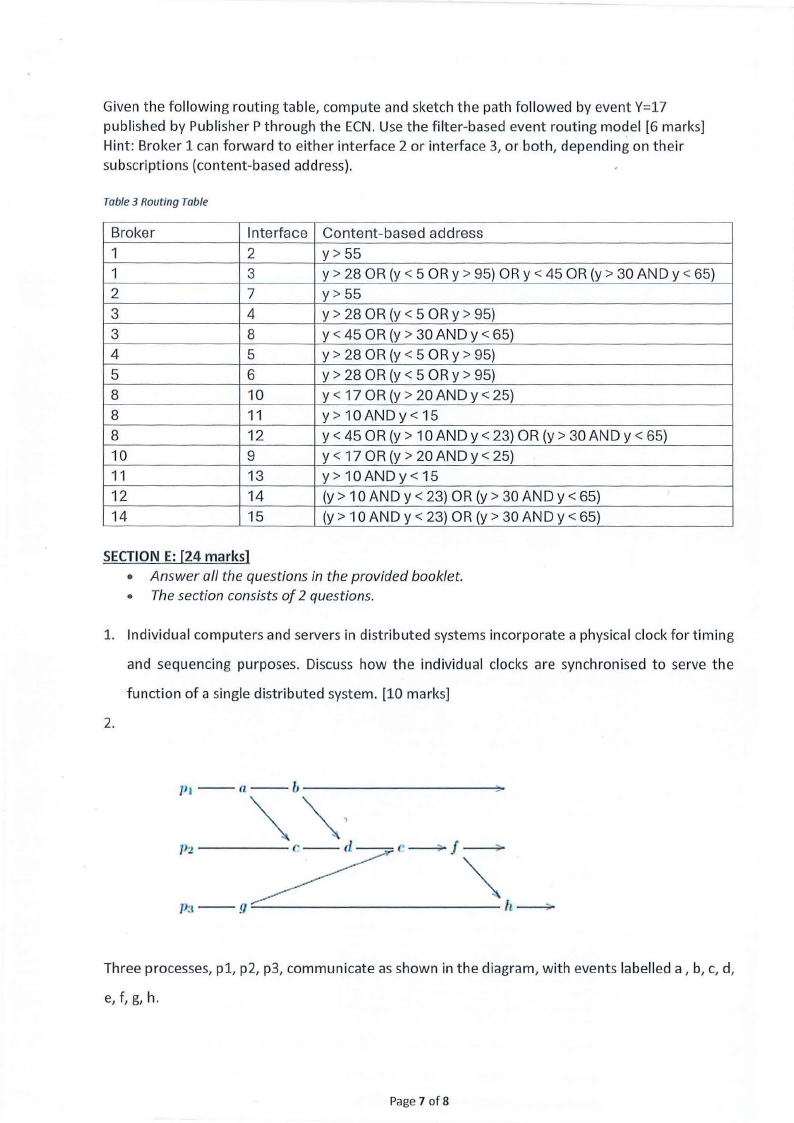
Given th e followin g routing table, compute and sketch the path followed by event Y=17
published by Publisher Pthrough the ECN. Use the fi lter-based event routing model [6 marks]
Hint: Broker 1 ca n forward to either interface 2 or interface 3, or both, depending on their
subscriptions (content-based address).
Table 3 Routing Table
Broker
1
1
2
3
3
4
5
8
8
8
10
11
12
14
I n terfac e
2
3
7
4
8
5
6
10
11
12
9
13
14
15
Content-based address
y> 55
y > 28 OR (y < 5 OR y > 95) OR y < 45 OR (y > 30 AND y < 65)
y > 55
y > 28 OR (y < 5 OR y > 95)
y < 45 OR (y > 30 AND y < 65)
y > 28 OR (y < 5 OR y > 95)
y > 28 OR (y < 5 OR y > 95)
y < 17 OR (y > 20 AND y < 25)
y > 10 AND y < 15
y < 45 OR (y > 10 AND y < 23) OR (y > 30 AND y < 65)
y < 17 OR (y > 20 AND y < 25)
y > 10 AND y < 15
(y > 10 AND y < 23) OR (y > 30 AND y < 65)
(y > 10 AND y < 23) OR (y > 30 AND y < 65)
SECTION E: [24 marks]
• Answer all the questions in the provided booklet.
• The section consists of 2 questions.
1. Individual computers and servers in distributed syst ems incorporate a physical clock for timing
and sequencing purposes. Discuss how the individu al clocks are synchronised to serve the
function of a single distributed system. [10 marks]
2.
11, - - a - - b - - - - - - - - - -~
1>2 - - - - - c - - <L - - c ~ r - -
Pa - - 9 - - - -- - - - - - - - - - h ~
Three processes, pl, p2, p3, commun icate as shown in the diagram, with events labelled a, b, c, d,
e, f, g, h.
Page 7 of 8
|
|
8 Page 8 |
▲back to top |
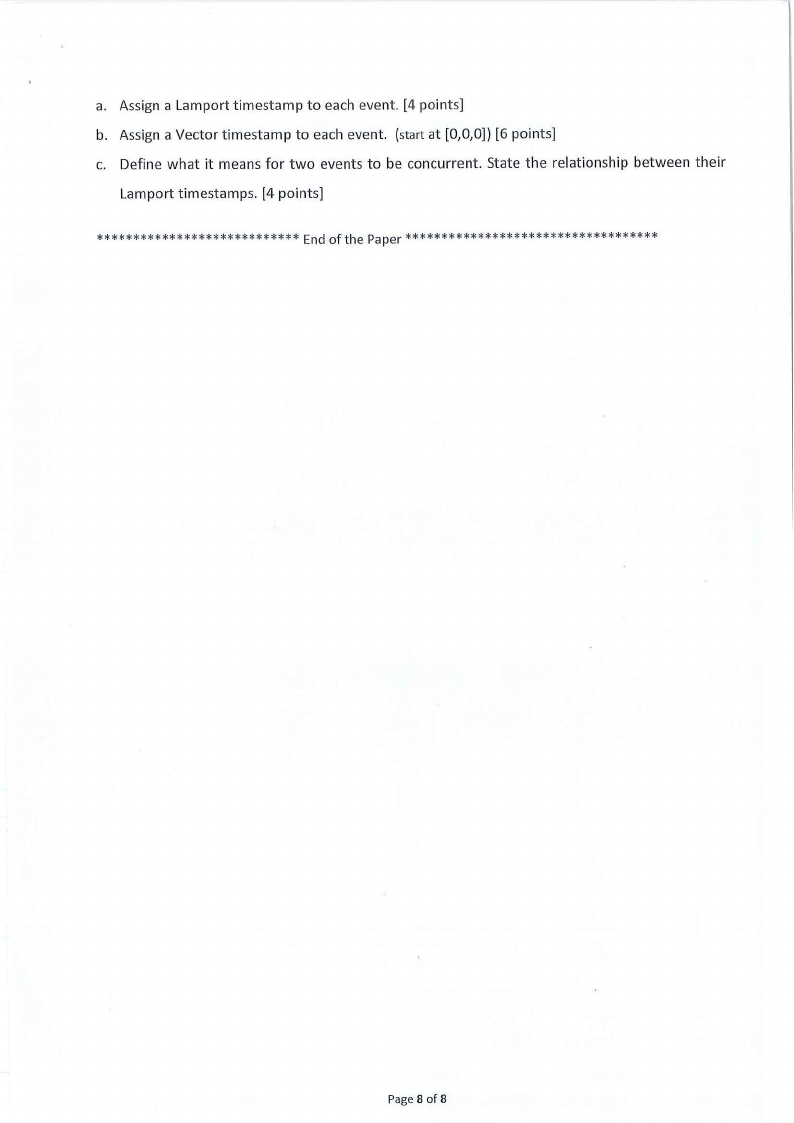
a. Assign a Lamport timest amp to each event. [4 points]
b. Assign a Vector timest amp to each event. (start at [0,0,0]} [6 points]
c. Defin e what it means for t w o eve nts to be concurrent. St ate th e relationship between their
Lamport timestamps. [4 points]
** ************************* * End of the Pape r ***********************************
Page 8 of 8