


 |
IGD411S - INTRODUCTION TO GEOSPATIAL DATA - 2ND OPP - JULY 2025 |
|
|
1 Page 1 |
▲back to top |
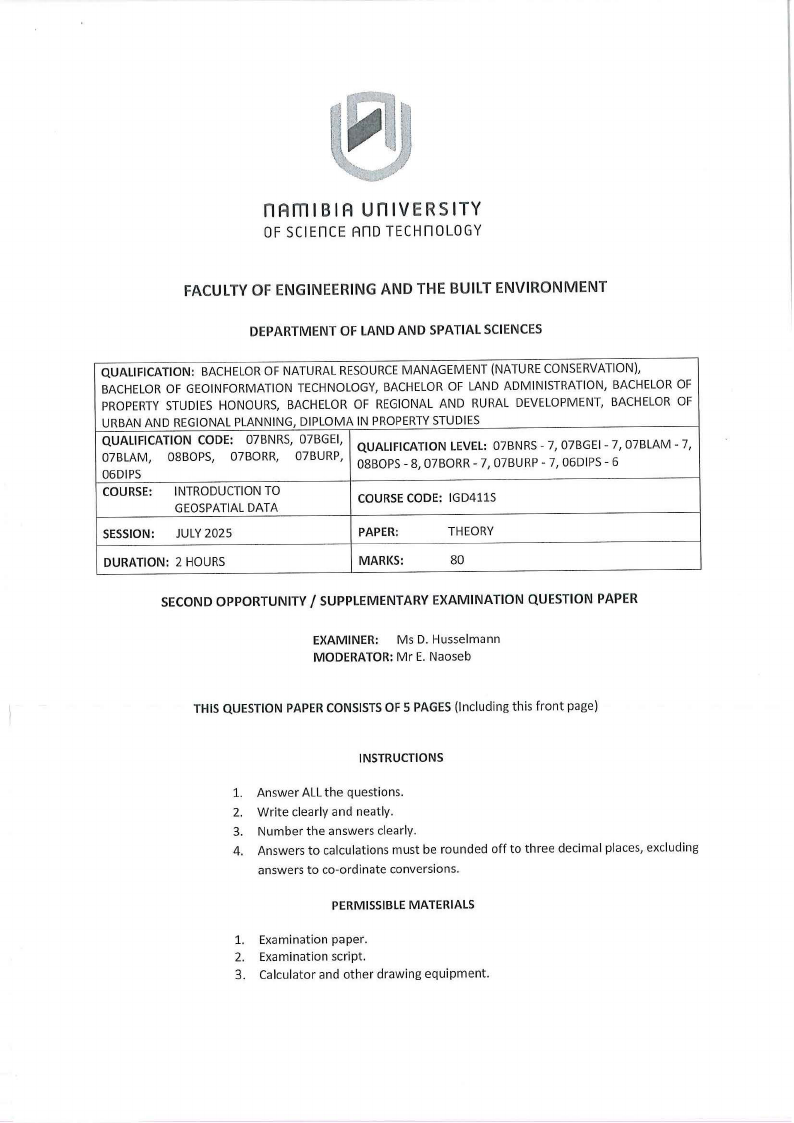
nAmtBIA untVERSITY
OF SCIEnCE Ano TECHnOLOGY
FACULTYOF ENGINEERINGAND THE BUILTENVIRONMENT
DEPARTMENTOF LANDAND SPATIALSCIENCES
QUALIFICATION: BACHELOR OF NATURAL RESOURCEMANAGEMENT (NATURE CONSERVATION),
BACHELOR OF GEOINFORMATION TECHNOLOGY, BACHELOR OF LAND ADMINISTRATION, BACHELOR OF
PROPERTY STUDIES HONOURS, BACHELOR OF REGIONAL AND RURAL DEVELOPMENT, BACHELOR OF
URBAN AND REGIONAL PLANNING, DIPLOMA IN PROPERTYSTUDIES
QUALIFICATION CODE: 07BNRS, 07BGEI,
07BLAM, 08BOPS, 07BORR, 07BURP,
06DIPS
QUALIFICATIONLEVEL:07BNRS - 7, 07BGEI - 7, 07BLAM - 7,
08BOPS - 8, 07BORR - 7, 07BURP - 7, 06DIPS - 6
COURSE: INTRODUCTION TO
GEOSPATIAL DATA
COURSECODE: IGD411S
SESSION: JULY 2025
PAPER:
THEORY
DURATION: 2 HOURS
MARKS:
80
SECONDOPPORTUNITY/ SUPPLEMENTARYEXAMINATION QUESTION PAPER
EXAMINER: Ms D. Husselmann
MODERATOR:Mr E. Naoseb
THIS QUESTIONPAPERCONSISTSOF 5 PAGES(Including this front page)
INSTRUCTIONS
1. Answer ALL the questions.
2. Write clearly and neatly.
3. Number the answers clearly.
4. Answers to calculations must be rounded off to three decimal places, excluding
answers to co-ordinate conversions.
PERMISSIBLEMATERIALS
1. Examination paper.
2. Examination script.
3. Calculator and other drawing equipment.
|
|
2 Page 2 |
▲back to top |
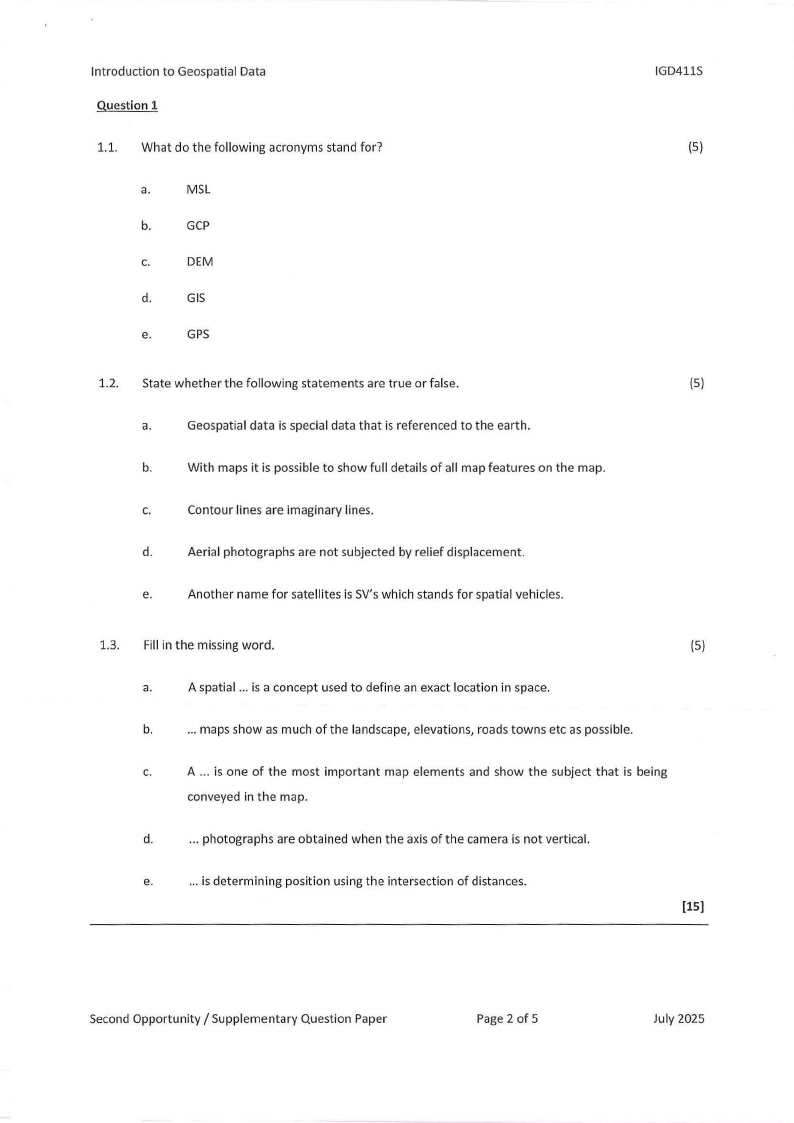
Introduction to Geospatial Data
Question 1
1.1. What do the following acronyms stand for?
a.
MSL
b.
GCP
c.
DEM
d.
GIS
e.
GPS
IGD411S
(5)
1.2. State whether the following statements are true or false.
(5)
a.
Geospatial data is special data that is referenced to the earth.
b.
With maps it is possible to show full details of all map features on the map.
c.
Contour lines are imaginary lines.
d.
Aerial photographs are not subjected by relief displacement.
e.
Another name for satellites is SV's which stands for spatial vehicles.
1.3. Fill in the missing word.
(5)
a.
A spatial ... is a concept used to define an exact location in space.
b.
... maps show as much of the landscape, elevations, roads towns etc as possible.
c.
A ... is one of the most important map elements and show the subject that is being
conveyed in the map.
d.
... photographs are obtained when the axis of the camera is not vertical.
e.
... is determining position using the intersection of distances.
[15)
Second Opportunity/ Supplementary Question Paper
Page 2 of 5
July 2025
|
|
3 Page 3 |
▲back to top |
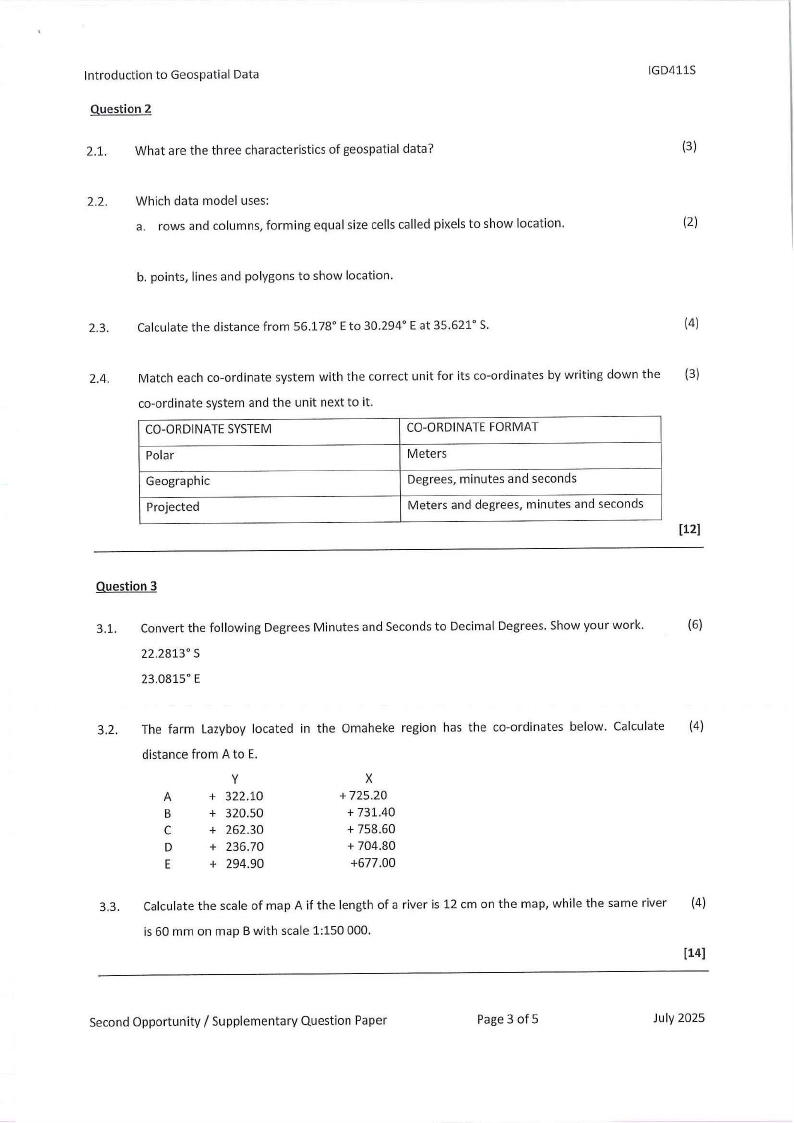
Introduction to Geospatial Data
Question 2
2.1. What are the three characteristics of geospatial data?
IGD411S
(3)
2.2. Which data model uses:
a. rows and columns, forming equal size cells called pixels to show location.
(2)
b. points, lines and polygons to show location.
2.3. Calculate the distance from 56.178° E to 30.294° Eat 35.621° S.
(4)
2.4.
Match each co-ordinate system with the correct unit for its co-ordinates by writing down the (3)
co-ordinate system and the unit next to it.
CO-ORDINATESYSTEM
CO-ORDINATEFORMAT
Polar
Meters
Geographic
Degrees, minutes and seconds
Projected
Meters and degrees, minutes and seconds
(12]
Question 3
3.1. Convert the following Degrees Minutes and Seconds to Decimal Degrees. Show your work.
(6)
22.2813° s
23.0815° E
3.2. The farm Lazyboy located in the Omaheke region has the co-ordinates below. Calculate (4)
distance from A to E.
y
A
+ 322.10
B
+ 320.50
C
+ 262.30
D
+ 236.70
E
+ 294.90
X
+ 725.20
+ 731.40
+ 758.60
+ 704.80
+677.00
3.3. Calculate the scale of map A if the length of a river is 12 cm on the map, while the same river (4)
is 60 mm on map B with scale 1:150 000.
(14]
Second Opportunity/ Supplementary Question Paper
Page 3 of 5
July 2025
|
|
4 Page 4 |
▲back to top |
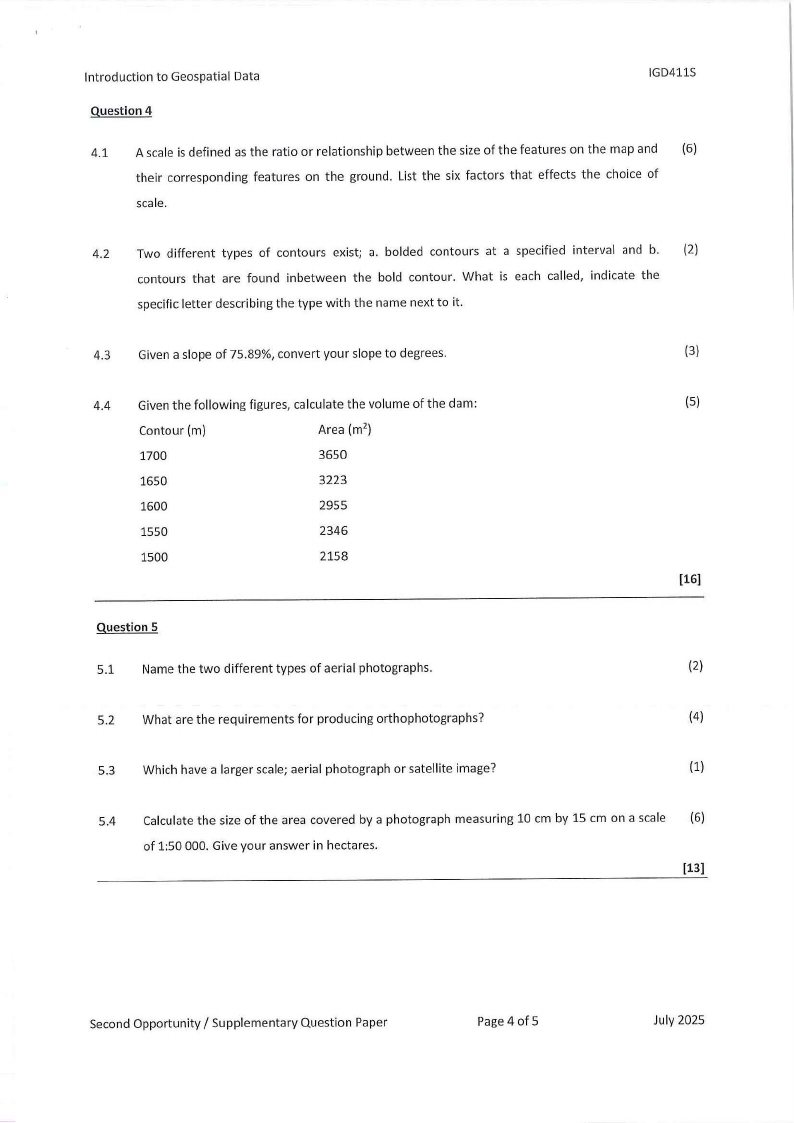
Introduction to Geospatial Data
IGD411S
Question 4
4.1 A scale is defined as the ratio or relationship between the size of the features on the map and (6)
their corresponding features on the ground. List the six factors that effects the choice of
scale.
4.2 Two different types of contours exist; a. bolded contours at a specified interval and b. (2)
contours that are found inbetween the bold contour. What is each called, indicate the
specific letter describing the type with the name next to it.
4.3 Given a slope of 75.89%, convert your slope to degrees.
(3)
4.4 Given the following figures, calculate the volume of the dam:
(5)
Contour (m)
Area (m2)
1700
3650
1650
3223
1600
2955
1550
2346
1500
2158
[16)
Question 5
5.1 Name the two different types of aerial photographs.
(2)
5.2 What are the requirements for producing orthophotographs?
(4)
5.3 Which have a larger scale; aerial photograph or satellite image?
(1)
5.4 Calculate the size of the area covered by a photograph measuring 10 cm by 15 cm on a scale (6)
of 1:50 000. Give your answer in hectares.
[13]
Second Opportunity/ Supplementary Question Paper
Page 4 of 5
July 2025
|
|
5 Page 5 |
▲back to top |
Introduction to Geospatial Data
Question 6
6.1 List the four types of DOP measures.
6.2 List six GPS/GNSSerror sources, excluding human error.
IGD411S
(4)
(6)
[10]
Second Opportunity/ Supplementary Question Paper
Page 5 of 5
July 2025