IFM712S-INTERNATIONAL FINANCE -1ST OPP-NOV 2025


IFM712S-INTERNATIONAL FINANCE -1ST OPP-NOV 2025


1 Page 1

▲back to top


nAmlBIA unlVERSITY
OF SCIEnCE Ano TECHnOLOGY
FACULTY OF COMMERCE, HUMAN SCIENCES AND EDUCATION
DEPARTMENT OF ECONOMICS, ACCOUNTING AND FINANCE
QUALIFICATION: BACHELOR OF ECONOMICS
QUALIFICATION CODE: O7BEC0
LEVEL: 7
COURSE CODE: IFN712S
COURSE NAME: INTERNATIONAL FINANCE
SESSION: NOVEMBER 2025
DURATION : 3 HOURS
PAPER: THEORY
MARKS: 100
FIRST OPPORTUNITY EXAMINATION QUESTION PAPER
EXAMINER(S) Ms K. Kavezeri
MODERATOR: Mr I. Nashivela
INSTRUCTIONS
1. Answer ALL the questions.
2. Write clearly and neatly.
3. Number the answers clearly.
PERMISSIBLE MATERIALS
1. Pens/pencils/erasers
2. Calculator
3. Ruler
THIS QUESTION PAPER CONSISTS OF 9 PAGES (Including this front page)

2 Page 2

▲back to top


QUESTION 1
[25 Marks]
Select the letter that best represents your choice.
1. The international capital market is
A) the place where you can rent earth moving equipment anywhere in the world.
B) a set of arrangements by which individuals and firms exchange money now for promises to
pay in the future.
C) the arrangement where banks build up their capital by borrowing from the Central Bank.
D) the place where emerging economies accept capital invested by banks.
E) exclusively concerned with the debt crisis that ended in the 1990s.
2. International monetary analysis focuses on
A) the real side of the international economy.
B) the international trade side of the international economy.
C) the international investment side of the international economy.
D) the issues of international cooperation between Central Banks.
E) the monetary side of the international economy, such as currency exchange.
3. In open economies
A) saving and investment are necessarily equal.
B) as in a closed economy, saving and investment are not necessarily equal.
C) saving and investment are not necessarily equal as they are in a closed economy.
D) saving and investment are necessarily equal contrary to the case of a closed economy.
E) investment always refers to the domestic stock market.
4. GNP equals GDP
A) minus net receipts of factor income from the rest of the world.
B) plus receipts of factor income from the rest of the world.
C) minus receipts of factor income from the rest of the world.
D) plus net receipts of factor income from the rest of the world.
E) minus depreciation.
2

3 Page 3

▲back to top


5. Government purchases are defined as
A) only goods purchased by federal, state, or local governments.
B) all goods and services purchased by the federal government.
C) all goods and services purchased by the federal or state government.
D) all goods and services purchased by the federal, state, or local government.
E) goods and services purchased from the government.
6. Central banks often intervene in currency markets. This activity is called
A) managed floating.
B) fixing exchange rates.
C) currency warfare.
D) super-pegging.
E) flexible floating.
7. The CA is equal to
A) Y- (C - I+ G).
B) Y + (C + I + G).
C) Y - (C + I + G).
D) Y - (C + I - G).
E) Y + (C - I - G).
8. What is the best way to describe aggregate demand?
A) quantity required to satisfy equilibrium
B) exports decrease; imports increase
C) amount of a country's goods and services demanded by household and firms throughout the
world
D) individual's demand
E) domestic demand of foreign imports.
9. For open economies,
A) S = I.
B) S =I+ CA.
C) S = I - CA.
D) S >I+ CA.
E) S<I+ CA.
3

4 Page 4

▲back to top


10. An appreciation of a country's currency
A) decreases the relative price of its exports and lowers the relative price of its imports.
B) raises the relative price of its exports and raises the relative price of its imports.
C) lowers the relative price of its exports and raises the relative price of its imports.
D) raises the relative price of its exports and lowers the relative price of its imports.
E) raises the relative price of its exports and does not affect the relative price of its imports.
11. A foreign exchange swap
A) is a spot sale of a currency.
B) is a forward repurchase of the currency.
C) is a spot sale of a currency combined with a forward repurchase of the currency.
D) is a spot sale of a currency combined with a forward sale of the currency.
E) make up a negligible proportion of all foreign exchange trading.
12. A country's current account
A) balance equals the change in its net foreign wealth.
B) balance equals the change in its foreign wealth.
C) surplus equals the change in its foreign wealth.
D) deficit equals the change in its foreign wealth.
E) balance equals its GNP.
13. Which of the following is NOT an example of a financial derivative?
A) forwards
B)bonds
C) swaps
D) futures
E) options
14. Which of the following is NOT a major actor in the foreign exchange market?
A) corporations
B) central banks
C) commercial banks
D) non-bank financial institutions
E) tourists
4

5 Page 5

▲back to top


15. The action of arbitrage is
A) the process of buying a currency cheap and selling it dear.
B) the process of buying a currency dear and selling it cheap.
C) the process of buying and selling currency at the same price.
D) the process of selling currency at different prices in different markets.
E) the process of buying a currency and holding onto it to take it off the market.
16. The exchange rate between currencies depends on
A) the interest rate that can be earned on deposits of those currencies.
B) the interest rate that can be earned on deposits of those currencies and the expected future
exchange rate.
C) the expected future exchange rate.
D) national output.
E) the interest rate that can be earned on deposits of those countries and the national output.
17. The aggregate money demand depends on
A) the interest rate.
B) the price level.
C) real national income.
D) the interest rate, price level, and real national income.
E) the price level and the liquidity of the asset.
18. An individual's need for liquidity would increase if
A) the average value of transactions carried out by the individual fell.
B) the average value of transactions carried out by the individual rose.
C) the individual got a ra ise.
D) the individual received a new ATM card .
E) the individual wanted to avoid risks.
5

6 Page 6

▲back to top


19. Which one of the following statements is the MOST accurate?
A) A decrease in the money supply lowers the interest rate while an increase in the money
supply raises the interest rate, given the price level and output.
B) An increase in the money supply lowers the interest rate while a fall in the money supply
raises the interest rate, given the price level.
C) An increase in the money supply lowers the interest rate while a fall in the money supply
raises the interest rate, given the output level.
D) An increase in the money supply lowers the interest rate while a fall in the money supply
raises the interest rate, given the price level and output.
E) An increase in the money supply does not usually affect the interest rate.
20. The money supply schedule is
A) horizontal because MS is set by the central bank while P is taken as given.
B) horizontal because MS is set by the central bank.
C) vertical because M5 is set by the households and firms while P is taken as given.
D) vertical because ·Ms and Pare set by the central bank.
E) vertical because MS is set by the central bank while P is taken as given.
21. The domestic currency price of a representative foreign expenditure basket is
A) P, the domestic price level.
B) E, the nominal exchange rate.
C) P times E, the domestic price level times the domestic price level.
D) p*, the foreign price level.
E) p* times E, the foreign price level times the nominal exchange rate.
22. A reduction in a country's money supply causes
A) its currency to depreciate in the foreign exchange market.
B) its currency to appreciate in the foreign exchange market.
C) does not affect its currency in the foreign market.
D) does affect its currency in the foreign market in an ambiguous manor.
E) affects other countries currency in the foreign market.
6

7 Page 7

▲back to top


23. Under Purchasing Power Parity
A) E$/E = PUS/PE.
B) E$/E = PE/PES.
C) E$/E = PUS+ PE.
D) E$/E = PUS - PE.
E) E$/P = PUS/PE.
24. Under the monetary approach to the exchange rate
A) a reduction in the money supply will cause immediate currency depreciation.
B) a rise in the money supply will cause currency depreciation.
C) a rise in the money supply will cause immediate currency appreciation.
D) a rise in the money supply will cause depreciation.
E) a rise in the money supply will cause immediate currency depreciation.
25. A change in the level of the supply of money
A) increases the long-run values of the interest rate and real output.
B) decreases the long-run values of the interest rate and real output.
C) has no effect on the long-run values of the interest rate, but may affect real output.
D) has no effect on the long-run values of real output, but may affect the interest rate.
E) has no effect on the long-run values of the interest rate and real output.
7

8 Page 8

▲back to top


QUESTION 2
[25 Marks]
1. Study the simplified data for an open economy given below and answer the questions
that follow.
• Consumption (C): $500 billion
• Investment (I): $150 billion
• Government Spending (G): $200 billion
• Exports (X): $100 billion
• Imports (M): $120 billion
Based on the information given above, calculate following:
(a) Gross Domestic Product (GDP)
(3)
(b) Net Exports
(2)
(c) National Saving (assuming no other data)
(2)
(d) Explain the economic significance of the net exports value in this context (2)
2. Explain why the balance of payments always balances and how the statistical
discrepancy arises.
(8)
3. Suppose that the one-year forward price of euros in terms of dollars is equal to $1.113
per euro. Further, assume that the spot exchange rate is $1.05 per euro, and the
interest rate on dollar deposits is 10 percent and on euro it is 4 percent.
(a) Show whether the interest parity condition holds under these assumptions. (4)
(b) Briefly discuss the implications of interest parity.
(4)
QUESTION 3
[25 Marks]
1. Explain how expectations about future exchange rates influence current exchange
rates in the asset approach.
(8)
2. Briefly describe the three factors that affect the demand for foreign currency. (6)
3. Discuss the differences between Absolute PPP and Relative PPP.
(6)
4. Describe forwards and futures contracts, highlighting the key differences between
these two types of derivatives.
(5)
8

9 Page 9

▲back to top


QUESTION 4
[25 Marks]
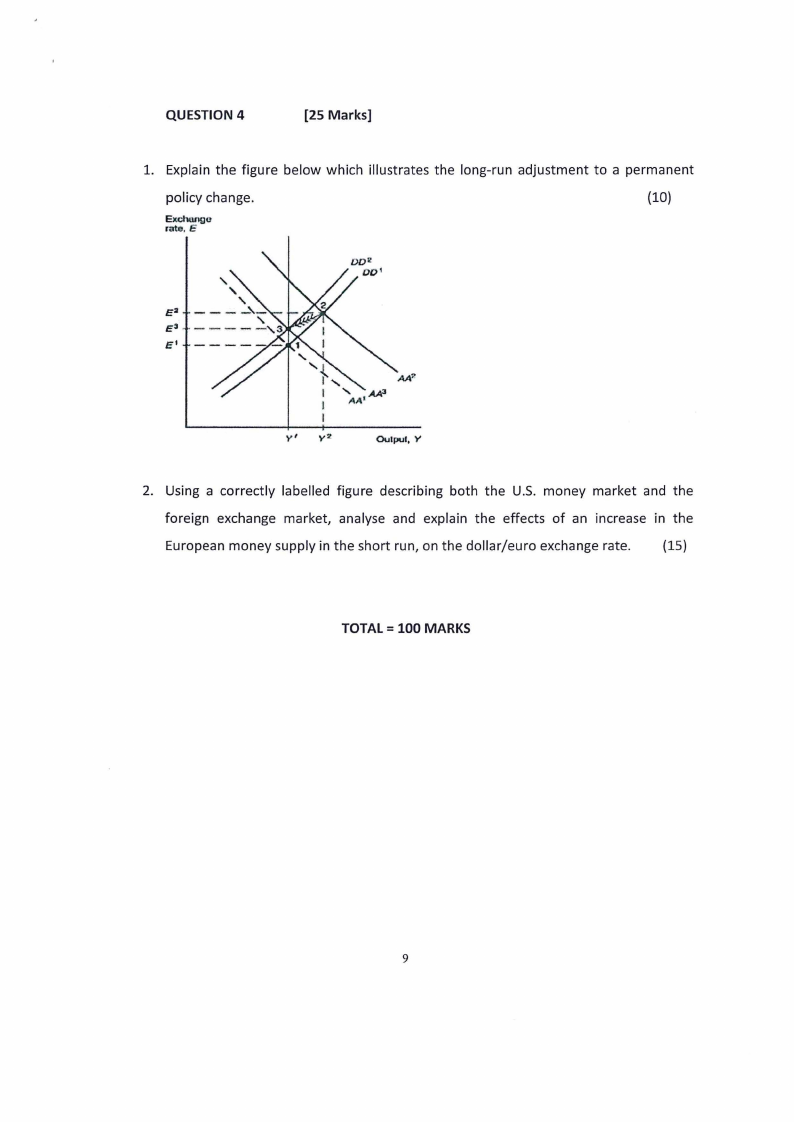
1. Explain the figure below which illustrates the long-run adjustment to a permanent
policy change.
Exchungo
rate, E
(10)
2. Using a correctly labelled figure describing both the U.S. money market and the
foreign exchange market, analyse and explain the effects of an increase in the
European money supply in the short run, on the dollar/euro exchange rate. (15)
TOTAL = 100 MARKS
9