


 |
GCO621S - GENDER COMMUNICATION - 1ST OPP - NOVEMBER 2025 |
|
|
1 Page 1 |
▲back to top |
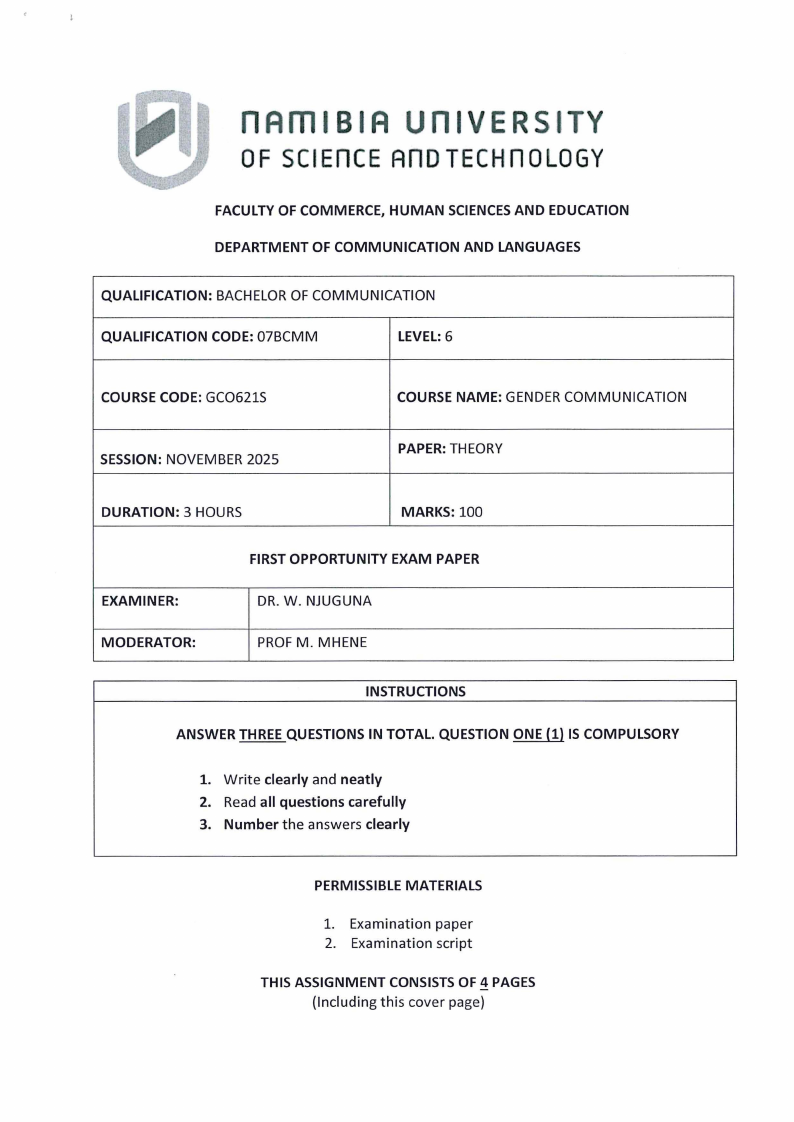
n Am I BI A u n IVERs I.TY
OF SCIEnCE AnDTECHnOLOGY
FACULTY OF COMMERCE, HUMAN SCIENCES AND EDUCATION
DEPARTMENT OF COMMUNICATION AND LANGUAGES
QUALIFICATION: BACHELOR OF COMMUNICATION
QUALIFICATION CODE: 07BCMM
LEVEL: 6
COURSE CODE: GCO621S
COURSE NAME: GENDER COMMUNICATION
SESSION: NOVEMBER 2025
PAPER: THEORY
DURATION: 3 HOURS
MARKS: 100
EXAMINER:
MODERATOR:
FIRST OPPORTUNITY EXAM PAPER
DR. W. NJUGUNA
PROF M. MHENE
INSTRUCTIONS
ANSWER THREE QUESTIONS IN TOTAL. QUESTION ONE (1) IS COMPULSORY
1. Write clearly and neatly
2. Read all questions carefully
3. Number the answers clearly
PERMISSIBLE MATERIALS
1. Examination paper
2. Examination script
THIS ASSIGNMENT CONSISTS OF 4 PAGES
(Including this cover page)
|
|
2 Page 2 |
▲back to top |
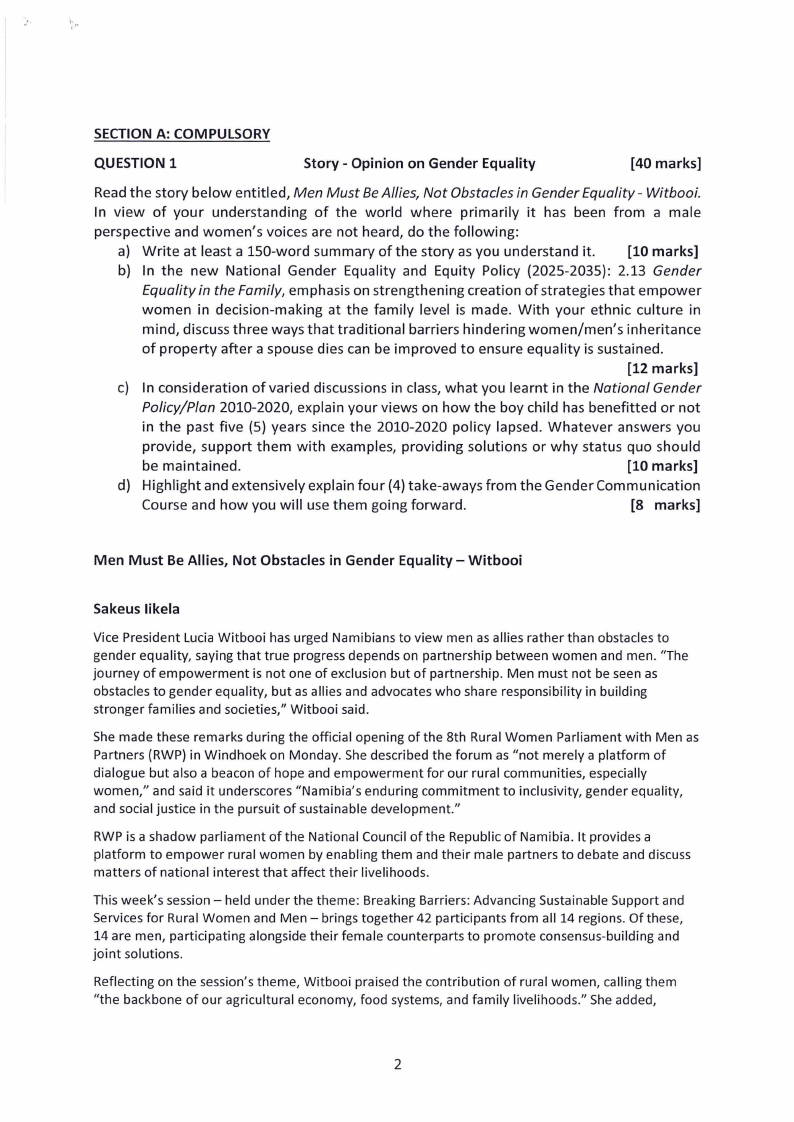
SECTION A: COMPULSORY
QUESTION 1
Story - Opinion on Gender Equality
[40 marks]
Read the story below entitled, Men Must Be Allies, Not Obstacles in Gender Equality- Witbooi.
In view of your understanding of the world where primarily it has been from a male
perspective and women's voices are not heard, do the following:
a) Write at least a 150-word summary of the story as you understand it. [10 marks]
b) In the new National Gender Equality and Equity Policy (2025-2035): 2.13 Gender
Equality in the Family, emphasis on strengthening creation of strategies that empower
women in decision-making at the family level is made. With your ethnic culture in
mind, discuss three ways that traditional barriers hindering women/men's inheritance
of property after a spouse dies can be improved to ensure equality is sustained.
[12 marks]
c) In consideration of varied discussions in class, what you learnt in the National Gender
Policy/Plan 2010-2020, explain your views on how the boy child has benefitted or not
in the past five (5) years since the 2010-2020 policy lapsed. Whatever answers you
provide, support them with examples, providing solutions or why status quo should
be maintained.
[10 marks]
d) Highlight and extensively explain four (4) take-aways from the Gender Communication
Course and how you will use them going forward.
[8 marks]
Men Must Be Allies, Not Obstacles in Gender Equality - Witbooi
Sakeus likela
Vice President Lucia Witbooi has urged Namibians to view men as allies rather than obstacles to
gender equality, saying that true progress depends on partnership between women and men. "The
journey of empowerment is not one of exclusion but of partnership. Men must not be seen as
obstacles to gender equality, but as allies and advocates who share responsibility in building
stronger families and societies," Witbooi said.
She made these remarks during the official opening of the 8th Rural Women Parliament with Men as
Partners (RWP) in Windhoek on Monday. She described the forum as "not merely a platform of
dialogue but also a beacon of hope and empowerment for our rural communities, especially
women," and said it underscores "Namibia's enduring commitment to inclusivity, gender equality,
and social justice in the pursuit of sustainable development."
RWP is a shadow parliament of the National Council of the Republic of Namibia. It provides a
platform to empower rural women by enabling them and their male partners to debate and discuss
matters of national interest that affect their livelihoods.
This week's session - held under the theme: Breaking Barriers: Advancing Sustainable Support and
Services for Rural Women and Men - brings together 42 participants from all 14 regions. Of these,
14 are men, participating alongside their female counterparts to promote consensus-building and
joint solutions.
Reflecting on the session's theme, Witbooi praised the contribution of rural women, calling them
"the backbone of our agricultural economy, food systems, and family livelihoods." She added,
2
|
|
3 Page 3 |
▲back to top |
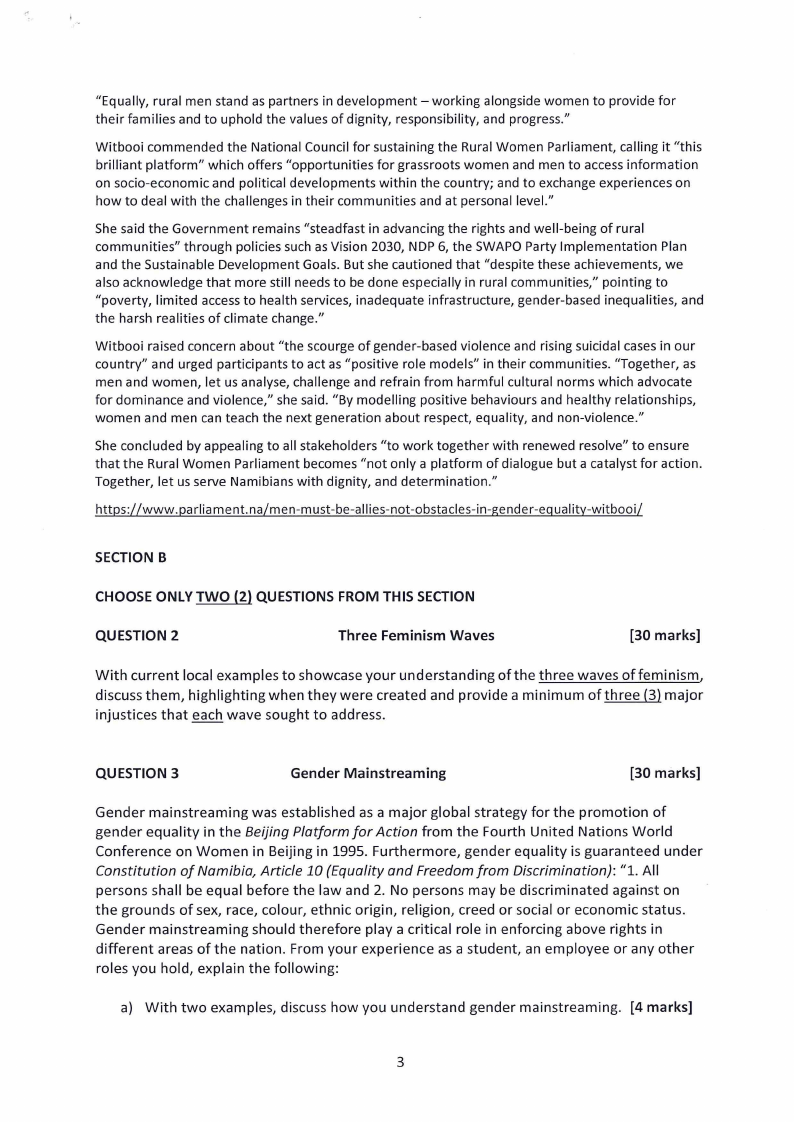
"Equally, rural men stand as partners in development -working alongside women to provide for
their families and to uphold the values of dignity, responsibility, and progress."
Witbooi commended the National Council for sustaining the Rural Women Parliament, calling it "this
brilliant platform" which offers "opportunities for grassroots women and men to access information
on socio-economic and political developments within the country; and to exchange experiences on
how to deal with the challenges in their communities and at personal level."
She said the Government remains "steadfast in advancing the rights and well-being of rural
communities" through policies such as Vision 2030, NOP 6, the SWAPO Party Implementation Plan
and the Sustainable Development Goals. But she cautioned that "despite these achievements, we
also acknowledge that more still needs to be done especially in rural communities," pointing to
"poverty, limited access to health services, inadequate infrastructure, gender-based inequalities, and
the harsh realities of climate change."
Witbooi raised concern about "the scourge of gender-based violence and rising suicidal cases in our
country" and urged participants to act as "positive role models" in their communities. "Together, as
men and women, let us analyse, challenge and refrain from harmful cultural norms which advocate
for dominance and violence," she said. "By modelling positive behaviours and healthy relationships,
women and men can teach the next generation about respect, equality, and non-violence."
She concluded by appealing to all stakeholders "to work together with renewed resolve" to ensure
that the Rural Women Parliament becomes "not only a platform of dialogue but a catalyst for action .
Together, let us serve Namibians with dignity, and determination."
https://www. parliament. na/men-must-be-al lies-not-obstacles-in-gender-eq uality-witbooi/
SECTION B
CHOOSE ONLY TWO (2) QUESTIONS FROM THIS SECTION
QUESTION 2
Three Feminism Waves
[30 marks]
With current local examples to showcase your understanding of the three waves of feminism,
discuss them, highlighting when they were created and provide a minimum of three (3) major
injustices that each wave sought to address.
QUESTION 3
Gender Mainstreaming
[30 marks]
Gender mainstreaming was established as a major global strategy for the promotion of
gender equality in the Beijing Platform for Action from the Fourth United Nations World
Conference on Women in Beijing in 1995. Furthermore, gender equality is guaranteed under
Constitution of Namibia, Article 10 {Equality and Freedom from Discrimination): "1. All
persons shall be equal before the law and 2. No persons may be discriminated against on
the grounds of sex, race, colour, ethnic origin, religion, creed or social or economic status.
Gender mainstreaming should therefore play a critical role in enforcing above rights in
different areas of the nation. From your experience as a student, an employee or any other
roles you hold, explain the following:
a) With two examples, discuss how you understand gender mainstreaming. [4 marks]
3
|
|
4 Page 4 |
▲back to top |
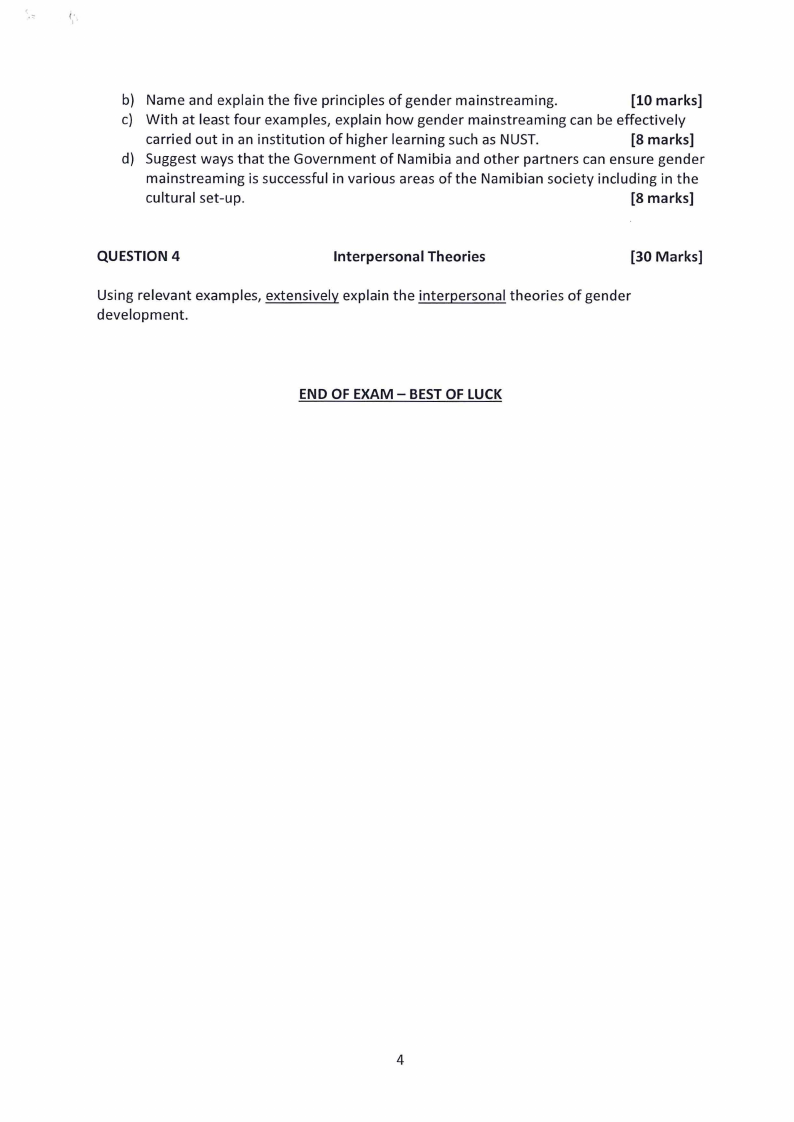
b) Name and explain the five principles of gender mainstreaming.
[10 marks]
c) With at least four examples, explain how gender mainstreaming can be effectively
carried out in an institution of higher learning such as NUST.
[8 marks]
d) Suggest ways that the Government of Namibia and other partners can ensure gender
mainstreaming is successful in various areas of the Namibian society including in the
cultural set-up.
[8 marks]
QUESTION 4
Interpersonal Theories
[30 Marks]
Using relevant examples, extensively explain the interpersonal theories of gender
development.
END OF EXAM - BEST OF LUCK
4