


 |
EVP510S - ENVIRONMENTAL PLANNING - 1ST OPP - JUNE 2025 |
|
|
1 Page 1 |
▲back to top |
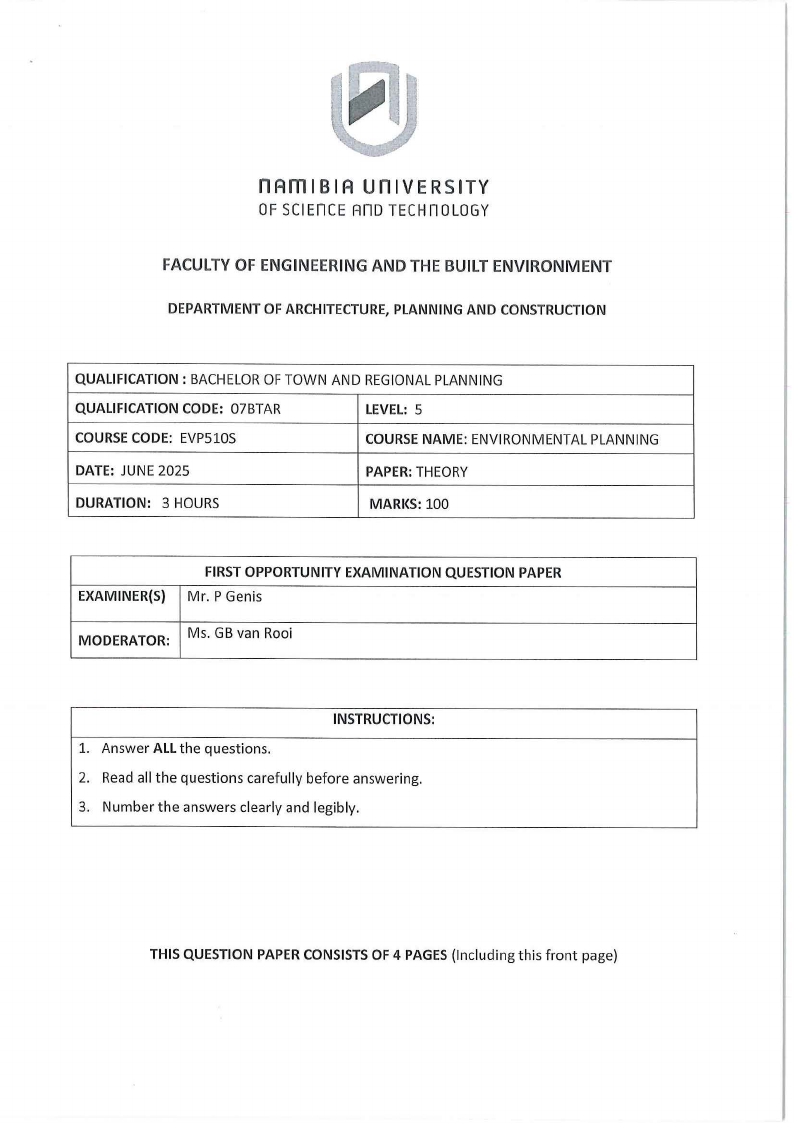
nAmlBIA UnlVERSITY
OF SCIEnCE Ano TECHnOLOGY
FACULTYOF ENGINEERINGAND THE BUILTENVIRONMENT
DEPARTMENTOF ARCHITECTUREP, LANNINGAND CONSTRUCTION
QUALIFICATION: BACHELOROF TOWN AND REGIONALPLANNING
QUALIFICATIONCODE: 07BTAR
COURSECODE: EVP510S
LEVEL:5
COURSENAME: ENVIRONMENTALPLANNING
DATE: JUNE 2025
PAPER:THEORY
DURATION: 3 HOURS
MARKS: 100
FIRSTOPPORTUNITYEXAMINATION QUESTION PAPER
EXAMINER(S} Mr. P Genis
MODERATOR: Ms. GB van Rooi
INSTRUCTIONS:
1. Answer ALLthe questions.
2. Read all the questions carefully before answering.
3. Number the answers clearly and legibly.
THIS QUESTION PAPERCONSISTSOF 4 PAGES(Including this front page)
|
|
2 Page 2 |
▲back to top |
EnvironmentalPlanning
Question 1
EVP510S
a) A critical aspect of solutions to environmental challenges is to follow an environmental decision-
making process. Indicate the important steps in this process.
(7)
b) Pollution is anything in the environment that is harmful to the health, survival or activities of
humans or other organisms. Elaborate on pollutant sources.
(4)
c) Answer each question below by writing True or False next to each respective number.
(4)
i)
Chattanooga city encouraged recycling to address toxic waste in the river.
ii)
Ecological footprint is the highest rate of resource use without reducing available supply.
iii) Economic development is the increase in output of the gross domestic product (GDP).
iv) Common resource rights are available to anyone.
[15]
Question2
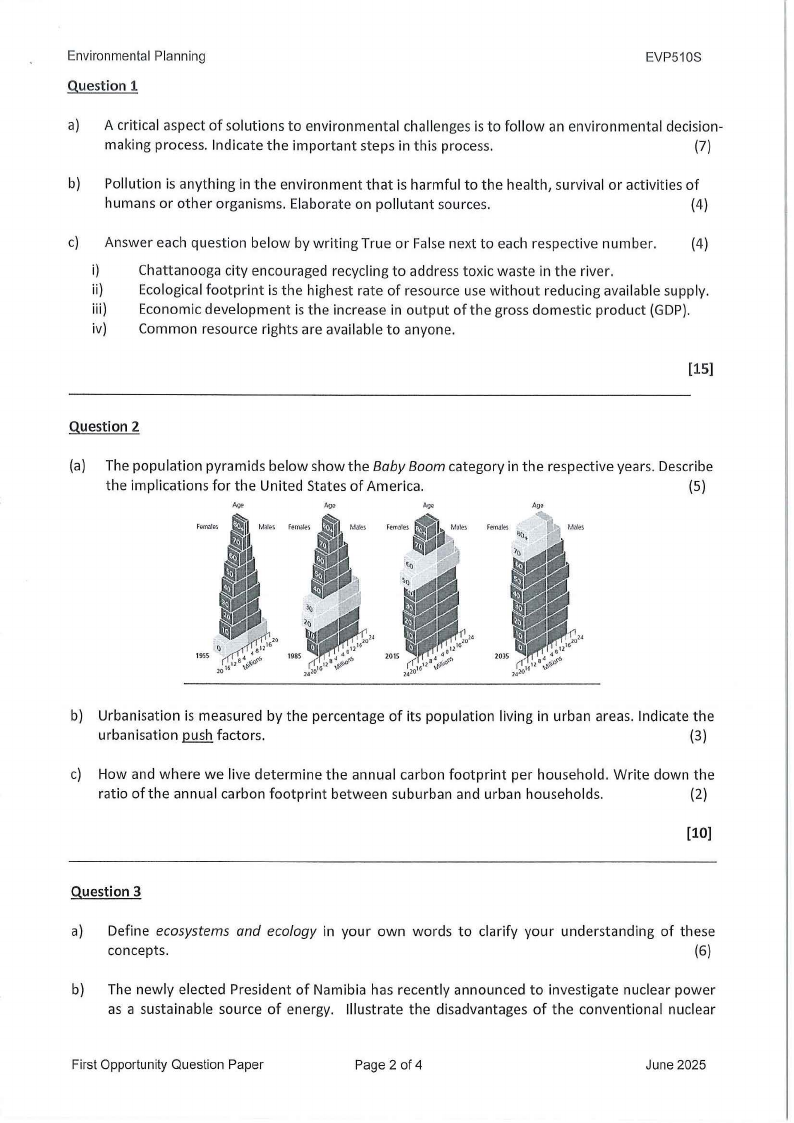
(a) The population pyramids below show the Baby Boom category in the respective years. Describe
the implications for the United States of America.
(5)
Age
Age
Age
Age
females
Femilles
"<l,
)o
So
2~
I 1
l4
I
"
I
1985
2.42016 \\,);
2015
(116 ,t~·
2420
l'.1.:iles
•
.
b) Urbanisation is measured by the percentage of its population living in urban areas. Indicate the
urbanisation push factors.
(3)
c) How and where we live determine the annual carbon footprint per household. Write down the
ratio of the annual carbon footprint between suburban and urban households.
(2)
[10]
Question 3
a) Define ecosystems and ecology in your own words to clarify your understanding of these
concepts.
(6)
b) The newly elected President of Namibia has recently announced to investigate nuclear power
as a sustainable source of energy. Illustrate the disadvantages of the conventional nuclear
First OpportunityQuestion Paper
Page 2 of 4
June 2025
|
|
3 Page 3 |
▲back to top |
Environmental Planning
energy cycle.
EVP510S
(6)
c) Answer each question below by writing True or False next to each respective number.
i) Energy conservation is how much work we can get from each unit of energy used.
ii) A benefit of solar energy is high net energy yield.
iii) The transition to a sustainable energy future includes research and development.
{3)
[15]
Question 4
(a) A major health hazard is the concentration of highly toxic methylmercury in the chemical
pathways found in food chains and aquatic systems. Briefly describe how we can prevent
mercury pollution.
(4)
(b) Prevention approaches to waste reduction include reusing, recycling or composting
of waste. Elaborate on the recycling of~
as discussed in the case study.
(3)
(c) Identify the factors that influence the levels of toxicants.
{3)
(d) How can we prevent motor vehicle air pollution?
{3)
(e) Climate change is often described as the biggest challenge of this century. Why do you think
climate change is very complex?
(2)
[15]
Question 5
a) Identify strategies to reduce poverty.
(3)
b) Gunter Pauli's Blue Economy aims to shift society from scarcity to abundance with what is locally
available and tackling issues that cause environmental and related problems in new ways.
Explain (what & how) four innovative principles as solutions for a blue economy type. (4)
c) Politics is concerned with the process of actions and policies of government and is critical to
environmental sustainability. List the stages of the policy life cycle.
(4)
d) Explain the role of government to serve environmental and other public interests.
(4)
[15]
Question 6
(a) Wheeler, in his book: Planningfor Sustainability, identified unsustainable development
trends. Discussthese issues under the category of mobility & transportation.
(5)
First Opportunity Question Paper
Page 3 of4
June 2025
|
|
4 Page 4 |
▲back to top |
Environmental Planning
EVP510S
(b) Urban sprawl is characterised by low-density growth on urban edges, eliminating surrounding
agricultural/wild lands and loosely connected land uses. Identify the undesirable impacts of
urban sprawl in respect of land & biodiversity.
(4)
(c) Sustainable urban development approaches include New Urbanism and Smart Growth.
Recommend the elements and benefits of Smart Growth.
(6)
[15]
Question 7
a) A key function of the Minister under the Environmental Management Act, 2007 {EMA), is to
make policies for the use, protection and management of the environment. Summarise the
functions of the Sustainable Development Advisory Council, appointed by the Minister under
the EMA.
(5)
b) Indicate the key stages for environmental impact assessment.
(5)
c) Briefly explain the sustainability indicators of economy by Van Biljon, 2014.
(5)
[15]
TOTAL: [100]
First Opportunity Question Paper
Page 4 of 4
June 2025