


 |
ATE711S - ADVANCED TRANSPORT ECONOMICS - 1ST OPP - JUNE 2025 |
|
|
1 Page 1 |
▲back to top |
nAmlBIA UnlVERSITY
OF SCIEnCE Ano
FACULTY OF COMMERCE, HUMAN SCIENCESAND EDUCATION
DEPARTMENTOF MARKETING,LOGISTICSAND SPORTMANAGEMENT
QUALIFICATION:BACHELOROF TRANSPORTMANAGEMENT
QUALIFICATIONCODE: 07BTRA
COURSECODE: ATE711S
LEVEL: 7
COURSENAME: ADVANCEDTRANSPORTECONOMICS
SESSION:JUNE 2025
DURATION: 3 HOURS
PAPER:THEORY
MARKS: 100
EXAMINER
FIRST OPPORTUNITY EXAMINATION QUESTION PAPER
Ms. Hilma Nuuyandja (FM, EF}
Ms Elina Lumbu (PM}
Mr Betuel Nangombe (DI}
MODERATOR Ms Tunomukumo Thikusho
INSTRUCTIONS
1. Answer ALL the questions.
2. Write clearly and neatly.
3. Number the answers clearly.
THIS QUESTION PAPERCONSISTSOF§. PAGES(Including this front page)
|
|
2 Page 2 |
▲back to top |
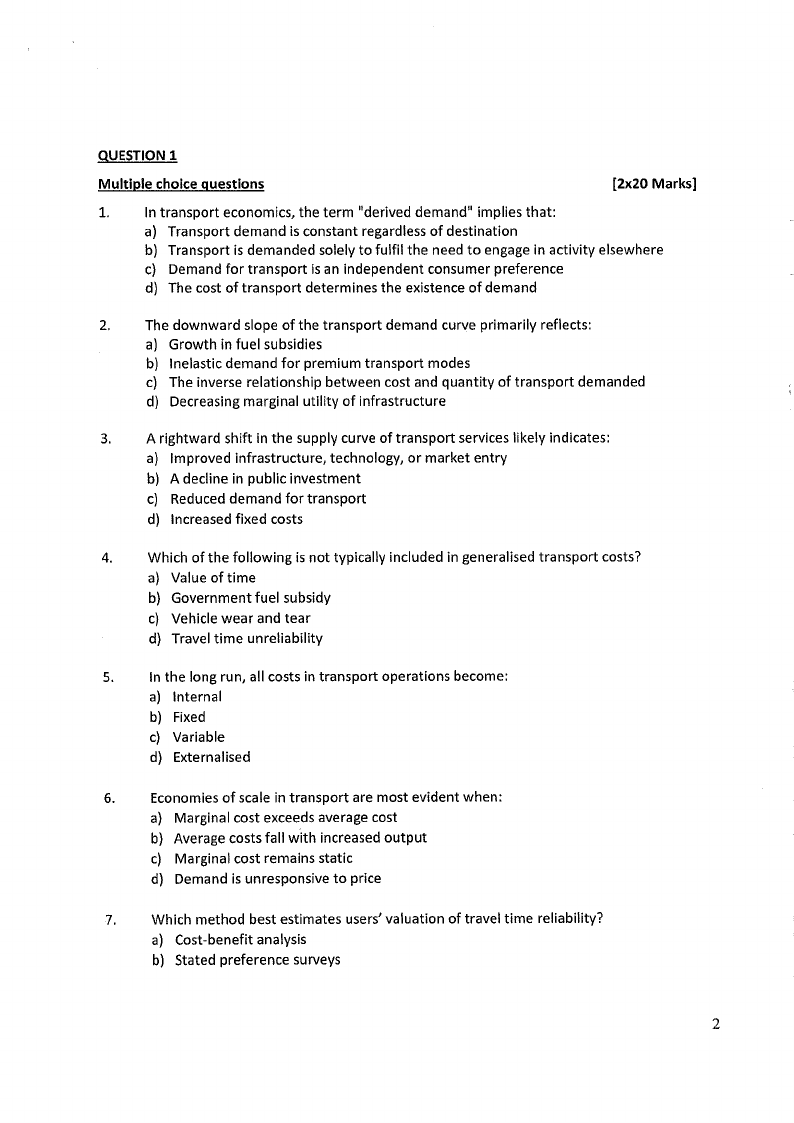
QUESTION 1
Multiple choice questions
[2x20 Marks]
1.
In transport economics, the term "derived demand" implies that:
a) Transport demand is constant regardless of destination
b) Transport is demanded solely to fulfil the need to engage in activity elsewhere
c) Demand for transport is an independent consumer preference
d) The cost of transport determines the existence of demand
2. The downward slope of the transport demand curve primarily reflects:
a) Growth in fuel subsidies
b) Inelastic demand for premium transport modes
c) The inverse relationship between cost and quantity of transport demanded
d) Decreasing marginal utility of infrastructure
3.
A rightward shift in the supply curve of transport services likely indicates:
a) Improved infrastructure, technology, or market entry
b) A decline in public investment
c) Reduced demand for transport
d) Increased fixed costs
4.
Which of the following is not typically included in generalised transport costs?
a) Value of time
b) Government fuel subsidy
c) Vehicle wear and tear
d) Travel time unreliability
5.
In the long run, all costs in transport operations become:
a) Internal
b) Fixed
c) Variable
d) Externalised
6.
Economies of scale in transport are most evident when:
a) Marginal cost exceeds average cost
b) Average costs fall with increased output
c) Marginal cost remains static
d) Demand is unresponsive to price
7.
Which method best estimates users' valuation of travel time reliability?
a) Cost-benefit analysis
b) Stated preference surveys
2
|
|
3 Page 3 |
▲back to top |
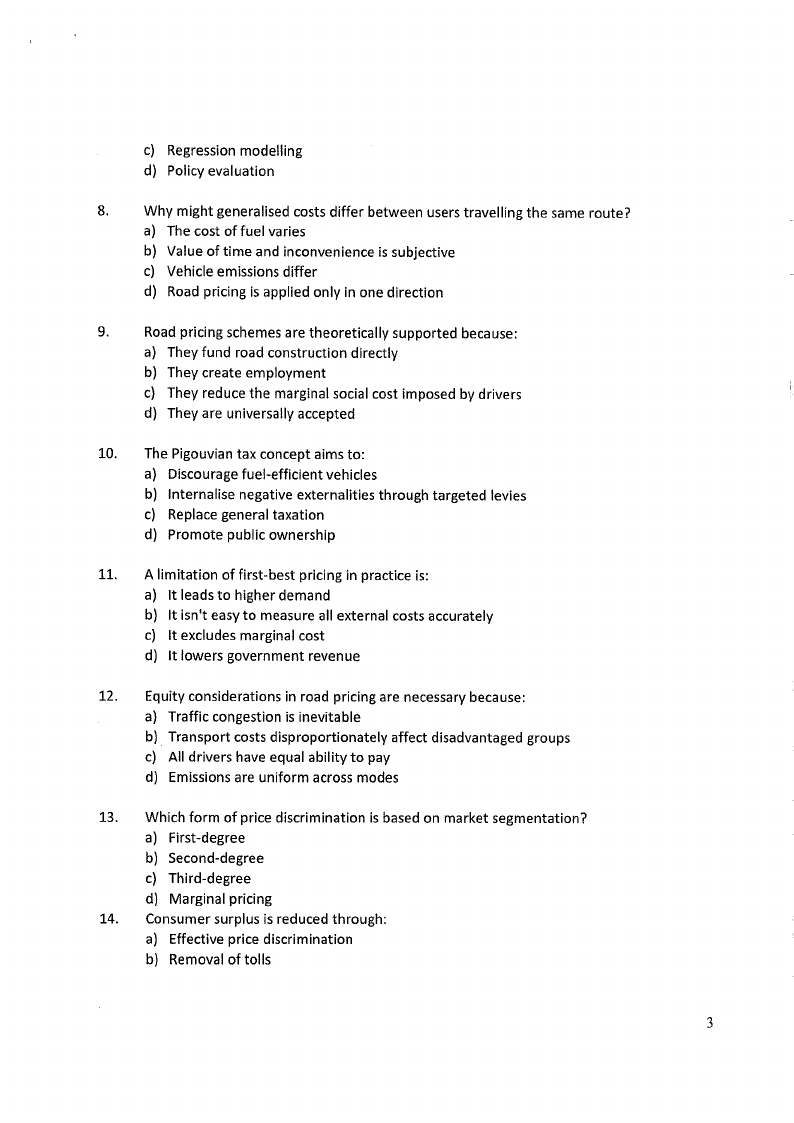
c) Regression modelling
d) Policy evaluation
8. Why might generalised costs differ between users travelling the same route?
a) The cost of fuel varies
b) Value of time and inconvenience is subjective
c) Vehicle emissions differ
d) Road pricing is applied only in one direction
9.
Road pricing schemes are theoretically supported because:
a) They fund road construction directly
b) They create employment
c) They reduce the marginal social cost imposed by drivers
d) They are universally accepted
10. The Pigouvian tax concept aims to:
a) Discourage fuel-efficient vehicles
b) Internalise negative externalities through targeted levies
c) Replace general taxation
d) Promote public ownership
11. A limitation of first-best pricing in practice is:
a) It leads to higher demand
b) It isn't easy to measure all external costs accurately
c) It excludes marginal cost
d) It lowers government revenue
12. Equity considerations in road pricing are necessary because:
a) Traffic congestion is inevitable
b) Transport costs disproportionately affect disadvantaged groups
c) All drivers have equal ability to pay
d) Emissions are uniform across modes
13. Which form of price discrimination is based on market segmentation?
a) First-degree
b) Second-degree
c) Third-degree
d) Marginal pricing
14. Consumer surplus is reduced through:
a) Effective price discrimination
b) Removal of tolls
3
|
|
4 Page 4 |
▲back to top |
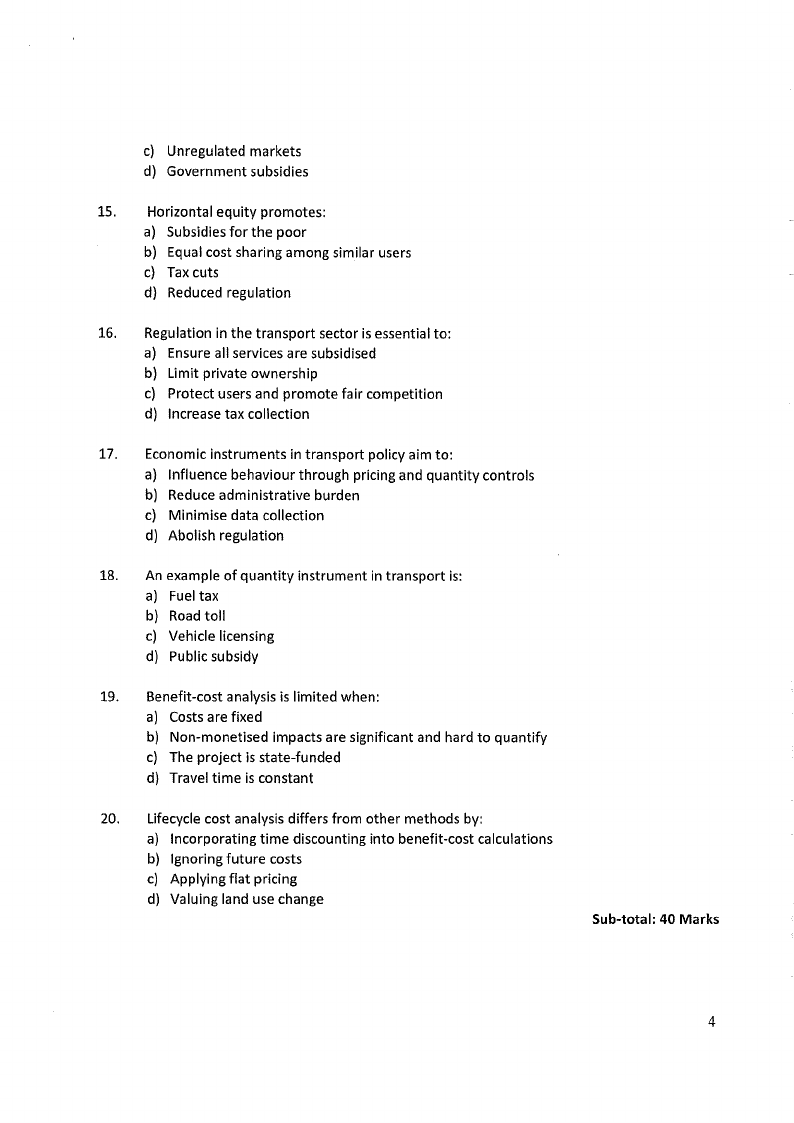
c) Unregulated markets
d) Government subsidies
15. Horizontal equity promotes:
a) Subsidies for the poor
b) Equal cost sharing among similar users
c) Tax cuts
d) Reduced regulation
16. Regulation in the transport sector is essential to:
a) Ensure all services are subsidised
b) Limit private ownership
c) Protect users and promote fair competition
d) Increase tax collection
17. Economic instruments in transport policy aim to:
a) Influence behaviour through pricing and quantity controls
b) Reduce administrative burden
c) Minimise data collection
d) Abolish regulation
18. An example of quantity instrument in transport is:
a) Fuel tax
b) Road toll
c) Vehicle licensing
d) Public subsidy
19. Benefit-cost analysis is limited when:
a) Costs are fixed
b) Non-monetised impacts are significant and hard to quantify
c) The project is state-funded
d) Travel time is constant
20. Lifecycle cost analysis differs from other methods by:
a) Incorporating time discounting into benefit-cost calculations
b) Ignoring future costs
c) Applying flat pricing
d) Valuing land use change
Sub-total: 40 Marks
4
|
|
5 Page 5 |
▲back to top |
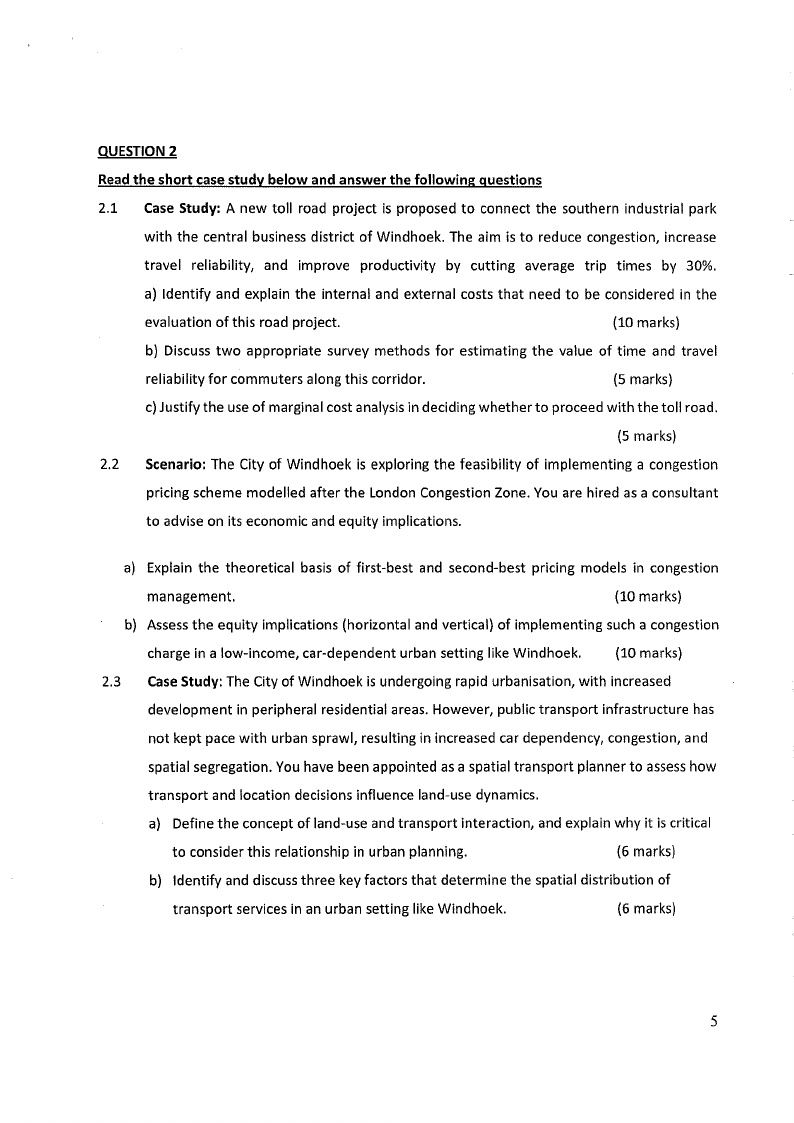
QUESTION 2
Read the short case study below and answer the following questions
2.1 Case Study: A new toll road project is proposed to connect the southern industrial park
with the central business district of Windhoek. The aim is to reduce congestion, increase
travel reliability, and improve productivity by cutting average trip times by 30%.
a) Identify and explain the internal and external costs that need to be considered in the
evaluation of this road project.
(10 marks)
b) Discuss two appropriate survey methods for estimating the value of time and travel
reliability for commuters along this corridor.
(5 marks)
c) Justify the use of marginal cost analysis in deciding whether to proceed with the toll road.
(5 marks)
2.2 Scenario: The City of Windhoek is exploring the feasibility of implementing a congestion
pricing scheme modelled after the London Congestion Zone. You are hired as a consultant
to advise on its economic and equity implications.
a) Explain the theoretical basis of first-best and second-best pricing models in congestion
management.
(10 marks)
b) Assessthe equity implications (horizontal and vertical) of implementing such a congestion
charge in a low-income, car-dependent urban setting like Windhoek.
(10 marks)
2.3 Case Study: The City of Windhoek is undergoing rapid urbanisation, with increased
development in peripheral residential areas. However, public transport infrastructure has
not kept pace with urban sprawl, resulting in increased car dependency, congestion, and
spatial segregation. You have been appointed as a spatial transport planner to assesshow
transport and location decisions influence land-use dynamics.
a) Define the concept of land-use and transport interaction, and explain why it is critical
to consider this relationship in urban planning.
(6 marks)
b) Identify and discuss three key factors that determine the spatial distribution of
transport services in an urban setting like Windhoek.
(6 marks)
5
|
|
6 Page 6 |
▲back to top |
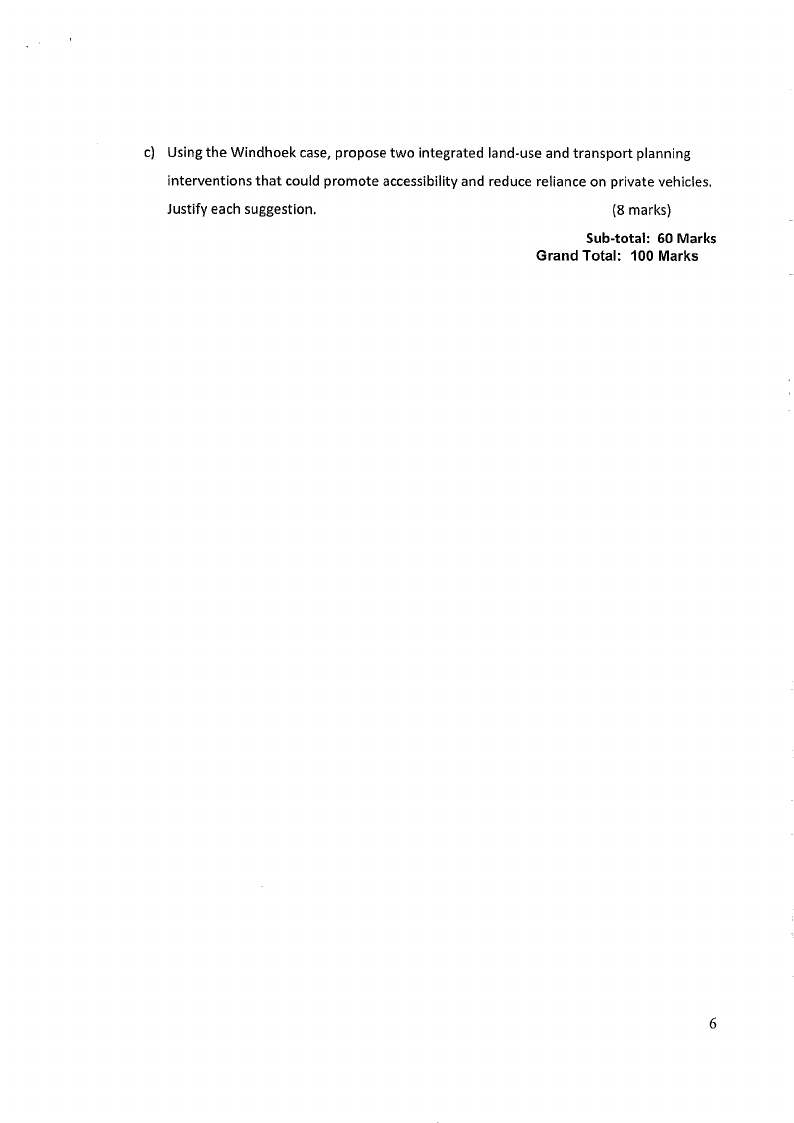
c) Using the Windhoek case, propose two integrated land-use and transport planning
interventions that could promote accessibility and reduce reliance on private vehicles.
Justify each suggestion.
(8 marks)
Sub-total: 60 Marks
Grand Total: 100 Marks
6