


 |
ATE711S - ADVANCED TRANSPORT ECONOMICS - 2ND OPP - JULY 2025 |
|
|
1 Page 1 |
▲back to top |
n Am I BIA u n IVE Rs ITY
OF SCIEnCE Ano TECHnOLOGY
FACULTYOF COMMERCE,HUMAN SCIENCESAND EDUCATION
DEPARTMENTOF MARKETING,LOGISTICSAND SPORT MANAGEMENT
QUALIFICATION:BACHELOROF TRANSPORTMANAGEMENT
QUALIFICATIONCODE: 07BTRA
LEVEL: 7
COURSECODE: ATE711S
COURSENAME: ADVANCED TRANSPORTECONOMICS
SESSION:JULY 2025
DURATION: 3 HOURS
PAPER:THEORY
MARKS: 100
SUPPLEMENTARY/ SECOND OPPORTUNITY EXAMINATION QUESTION PAPER
EXAMINER
Ms. Hilma Nuuyandja (FM, EF)
Ms Elina Lumbu (PM)
Mr Betuel Nangombe (DI)
MODERATOR Ms Tunomukumo Thikusho
INSTRUCTIONS
1. Answer ALL the questions.
2. Write clearly and neatly.
3. Number the answers clearly.
THIS QUESTION PAPERCONSISTSOF 6 PAGES(Including this front page)
|
|
2 Page 2 |
▲back to top |
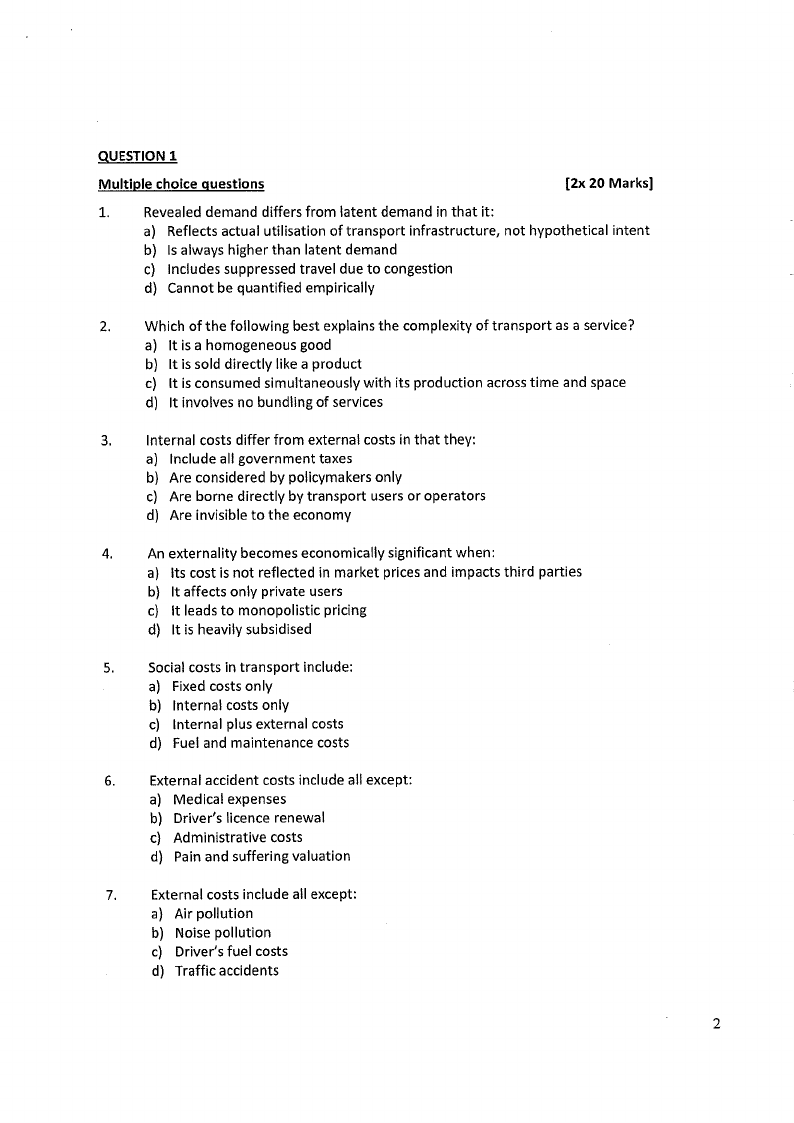
QUESTION 1
Multiple choice questions
[2x 20 Marks]
1. Revealed demand differs from latent demand in that it:
a) Reflects actual utilisation of transport infrastructure, not hypothetical intent
b) Is always higher than latent demand
c) Includes suppressed travel due to congestion
d) Cannot be quantified empirically
2. Which of the following best explains the complexity of transport as a service?
a) It is a homogeneous good
b) It is sold directly like a product
c) It is consumed simultaneously with its production across time and space
d) It involves no bundling of services
3. Internal costs differ from external costs in that they:
a) Include all government taxes
b) Are considered by policymakers only
c) Are borne directly by transport users or operators
d) Are invisible to the economy
4. An externality becomes economically significant when:
a) Its cost is not reflected in market prices and impacts third parties
b) It affects only private users
c) It leads to monopolistic pricing
d) It is heavily subsidised
5. Social costs in transport include:
a) Fixed costs only
b) Internal costs only
c) Internal plus external costs
d) Fuel and maintenance costs
6. External accident costs include all except:
a) Medical expenses
b) Driver's licence renewal
c) Administrative costs
d) Pain and suffering valuation
7. External costs include all except:
a) Air pollution
b) Noise pollution
c) Driver's fuel costs
d) Traffic accidents
2
|
|
3 Page 3 |
▲back to top |
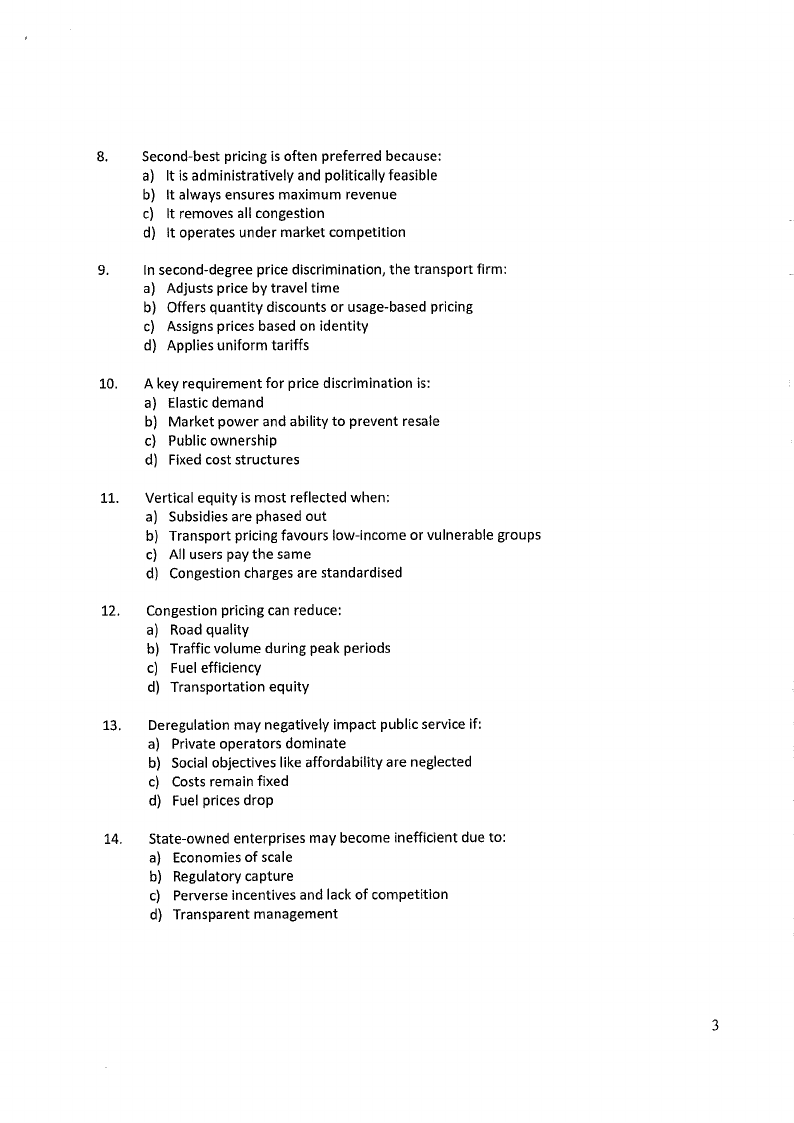
8. Second-best pricing is often preferred because:
a) It is administratively and politically feasible
b) It always ensures maximum revenue
c) It removes all congestion
d) It operates under market competition
9. In second-degree price discrimination, the transport firm:
a) Adjusts price by travel time
b) Offers quantity discounts or usage-based pricing
c) Assigns prices based on identity
d) Applies uniform tariffs
10. A key requirement for price discrimination is:
a) Elastic demand
b) Market power and ability to prevent resale
c) Public ownership
d) Fixed cost structures
11. Vertical equity is most reflected when:
a) Subsidies are phased out
b) Transport pricing favours low-income or vulnerable groups
c) All users pay the same
d) Congestion charges are standardised
12. Congestion pricing can reduce:
a) Road quality
b) Traffic volume during peak periods
c) Fuel efficiency
d) Transportation equity
13. Deregulation may negatively impact public service if:
a) Private operators dominate
b) Social objectives like affordability are neglected
c) Costs remain fixed
d) Fuel prices drop
14. State-owned enterprises may become inefficient due to:
a) Economies of scale
b) Regulatory capture
c) Perverse incentives and lack of competition
d) Transparent management
3
|
|
4 Page 4 |
▲back to top |
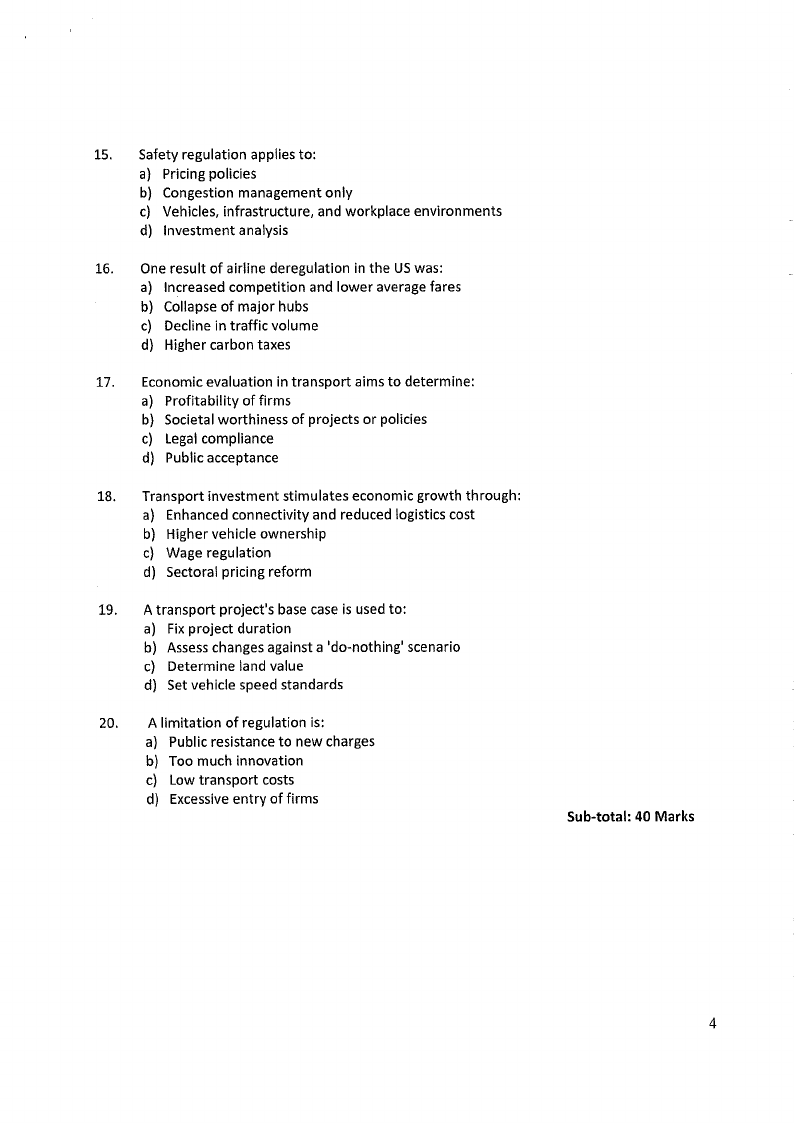
15. Safety regulation applies to:
a) Pricing policies
b) Congestion management only
c) Vehicles, infrastructure, and workplace environments
d) Investment analysis
16. One result of airline deregulation in the USwas:
a) Increased competition and lower average fares
b) Collapse of major hubs
c) Decline in traffic volume
d) Higher carbon taxes
17. Economic evaluation in transport aims to determine:
a) Profitability of firms
b) Societal worthiness of projects or policies
c) Legal compliance
d) Public acceptance
18. Transport investment stimulates economic growth through:
a) Enhanced connectivity and reduced logistics cost
b) Higher vehicle ownership
c) Wage regulation
d) Sectoral pricing reform
19. A transport project's base case is used to:
a) Fix project duration
b) Assesschanges against a 'do-nothing' scenario
c) Determine land value
d) Set vehicle speed standards
20. A limitation of regulation is:
a) Public resistance to new charges
b) Too much innovation
c) Low transport costs
d) Excessiveentry of firms
Sub-total: 40 Marks
4
|
|
5 Page 5 |
▲back to top |
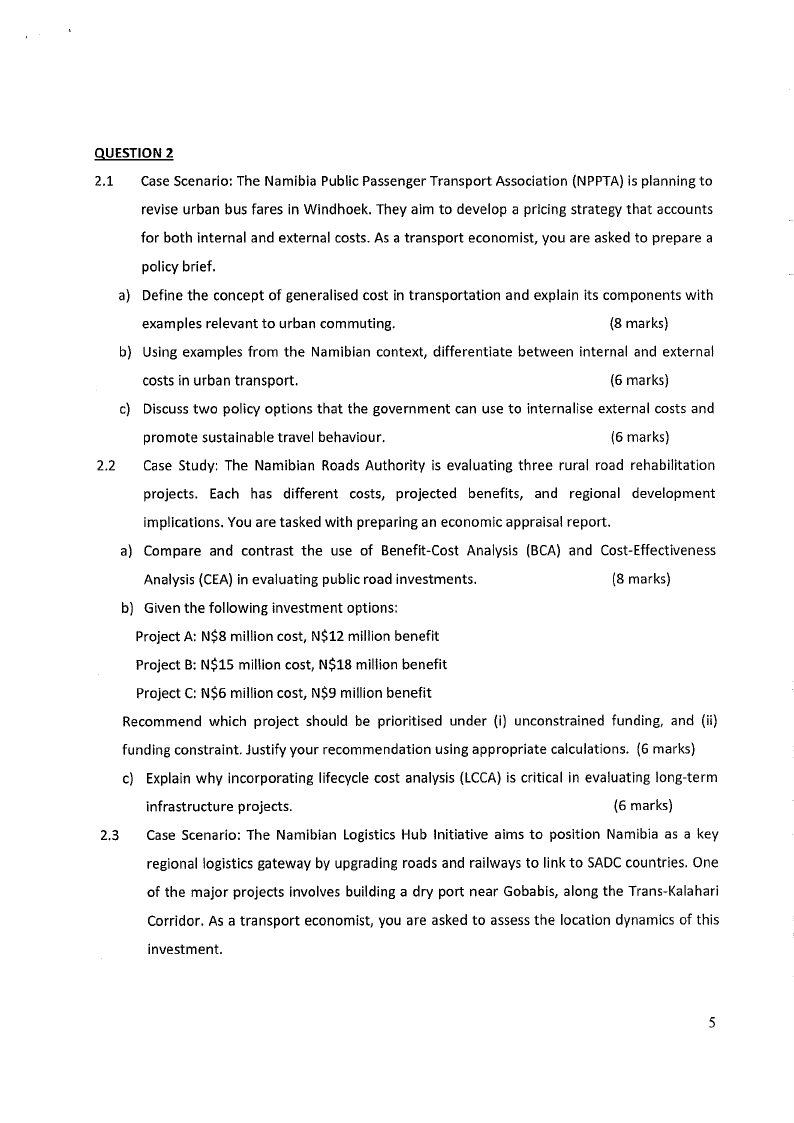
QUESTION 2
2.1 CaseScenario: The Namibia Public PassengerTransport Association (NPPTA)is planning to
revise urban bus fares in Windhoek. They aim to develop a pricing strategy that accounts
for both internal and external costs. As a transport economist, you are asked to prepare a
policy brief.
a) Define the concept of generalised cost in transportation and explain its components with
examples relevant to urban commuting.
(8 marks)
b) Using examples from the Namibian context, differentiate between internal and external
costs in urban transport.
(6 marks)
c) Discusstwo policy options that the government can use to internalise external costs and
promote sustainable travel behaviour.
(6 marks)
2.2 Case Study: The Namibian Roads Authority is evaluating three rural road rehabilitation
projects. Each has different costs, projected benefits, and regional development
implications. You are tasked with preparing an economic appraisal report.
a) Compare and contrast the use of Benefit-Cost Analysis (BCA) and Cost-Effectiveness
Analysis (CEA)in evaluating public road investments.
(8 marks)
b) Given the following investment options:
Project A: N$8 million cost, N$12 million benefit
Project B: N$15 million cost, N$18 million benefit
Project C: N$6 million cost, N$9 million benefit
Recommend which project should be prioritised under (i) unconstrained funding, and (ii)
funding constraint. Justify your recommendation using appropriate calculations. (6 marks)
c) Explain why incorporating lifecycle cost analysis (LCCA)is critical in evaluating long-term
infrastructure projects.
(6 marks)
2.3 Case Scenario: The Namibian Logistics Hub Initiative aims to position Namibia as a key
regional logistics gateway by upgrading roads and railways to link to SADCcountries. One
of the major projects involves building a dry port near Gobabis, along the Trans-Kalahari
Corridor. As a transport economist, you are asked to assessthe location dynamics of this
investment.
5
|
|
6 Page 6 |
▲back to top |
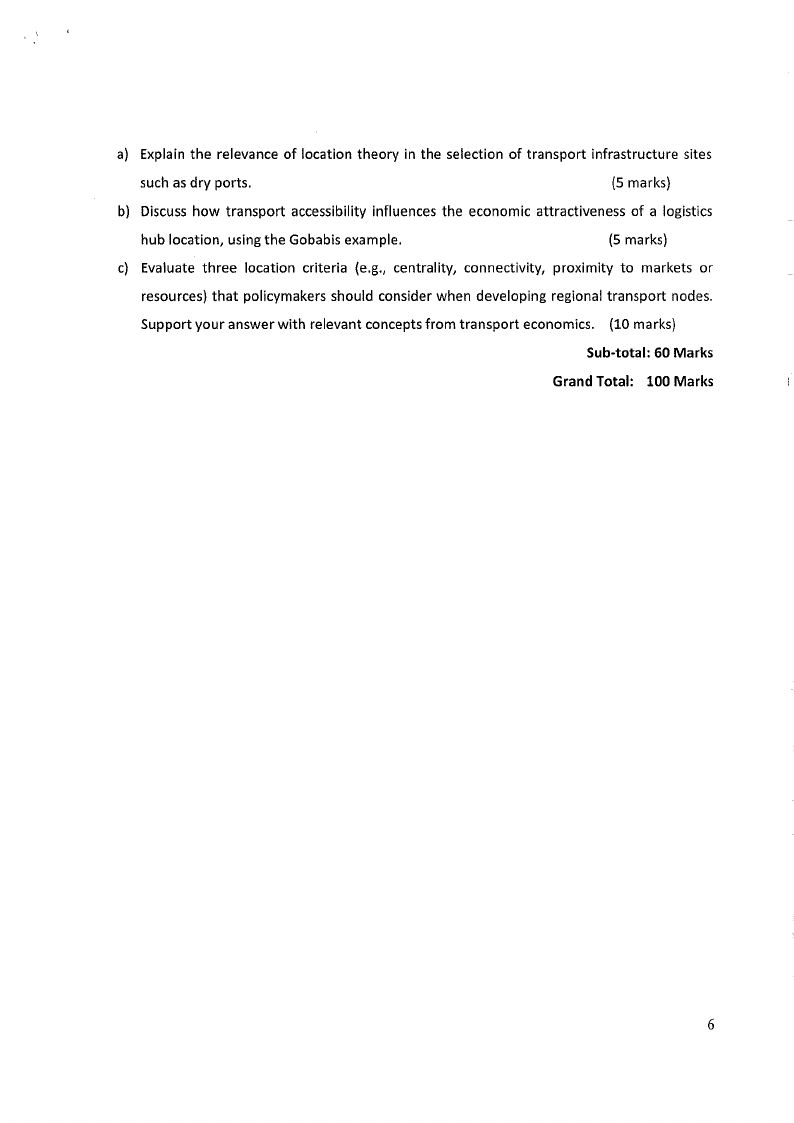
a) Explain the relevance of location theory in the selection of transport infrastructure sites
such as dry ports.
(5 marks)
b) Discuss how transport accessibility influences the economic attractiveness of a logistics
hub location, using the Gobabis example.
(5 marks)
c) Evaluate three location criteria (e.g., centrality, connectivity, proximity to markets or
resources) that policymakers should consider when developing regional transport nodes.
Support your answer with relevant concepts from transport economics. (10 marks)
Sub-total: 60 Marks
Grand Total: 100 Marks
6