


 |
FOC411S - FUNDAMENTALS OF CROP PRODUCTION - 1ST OPP - JUNE 2025 |
|
|
1 Page 1 |
▲back to top |
nAmlBIA UnlVERSITY
0 F SCIEn CE Ano TECHn OLOGY
FACULTY OF COMMERCE, HUMAN SCIENCESAND EDUCATION
DEPARTMENT OF TECHNICAL AND VOCATIONAL EDUCATION AND TRAINING
QUALIFICATION: NUST BRIDGING PROGRAMME -TVET AGRICULTURE SPECIALISATION
QUALIFICATION CODE: 04NBTA
LEVEL: 4
COURSE CODE: FOC411S
COURSE NAME: FUNDAMENTALS OF CROP
PRODUCTION
SESSION: JUNE 2025
DURATION: 3 HOURS
PAPER:1
MARKS: 100
EXAMINER(S)
FIRST OPPORTUNITY EXAMINATION QUESTION PAPER
Ms. E MATALI
MODERATOR: Mr.A MERORO
INSTRUCTIONS
1. The paper has 3 SECTIONS (A, Band C}.
2. Write clearly and neatly using a black or blue ink pen.
3. Each section must start on a new page.
4. All written work MUST be done in blue or black ink.
THIS QUESTION PAPER CONSISTS OF _5_ PAGES (Including this front page)
1
|
|
2 Page 2 |
▲back to top |
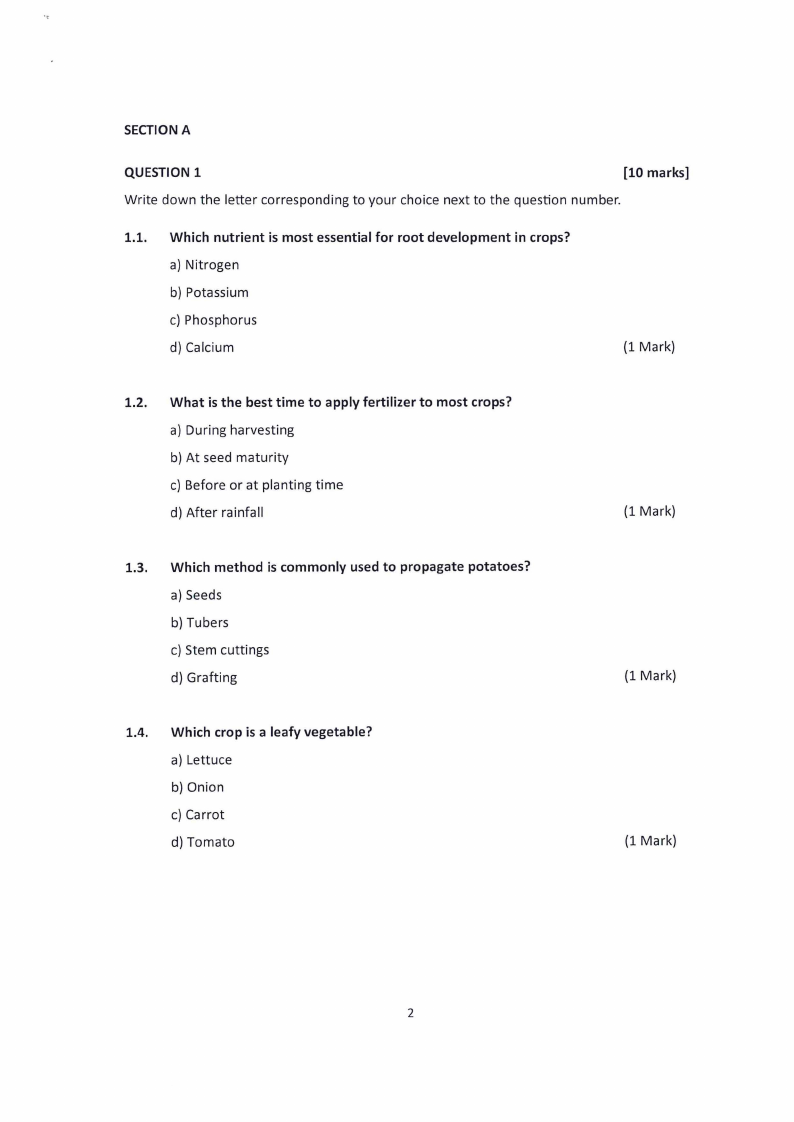
SECTION A
QUESTION 1
[10 marks]
Write down the letter corresponding to your choice next to the question number.
1.1. Which nutrient is most essential for root development in crops?
a) Nitrogen
b) Potassium
c) Phosphorus
d) Calcium
(1 Mark)
1.2. What is the best time to apply fertilizer to most crops?
a) During harvesting
b) At seed maturity
c) Before or at planting time
d) After rainfall
(1 Mark)
1.3. Which method is commonly used to propagate potatoes?
a)Seeds
b) Tubers
c) Stem cuttings
d) Grafting
(1 Mark)
1.4. Which crop is a leafy vegetable?
a) Lettuce
b) Onion
c) Carrot
d) Tomato
(1 Mark)
2
|
|
3 Page 3 |
▲back to top |
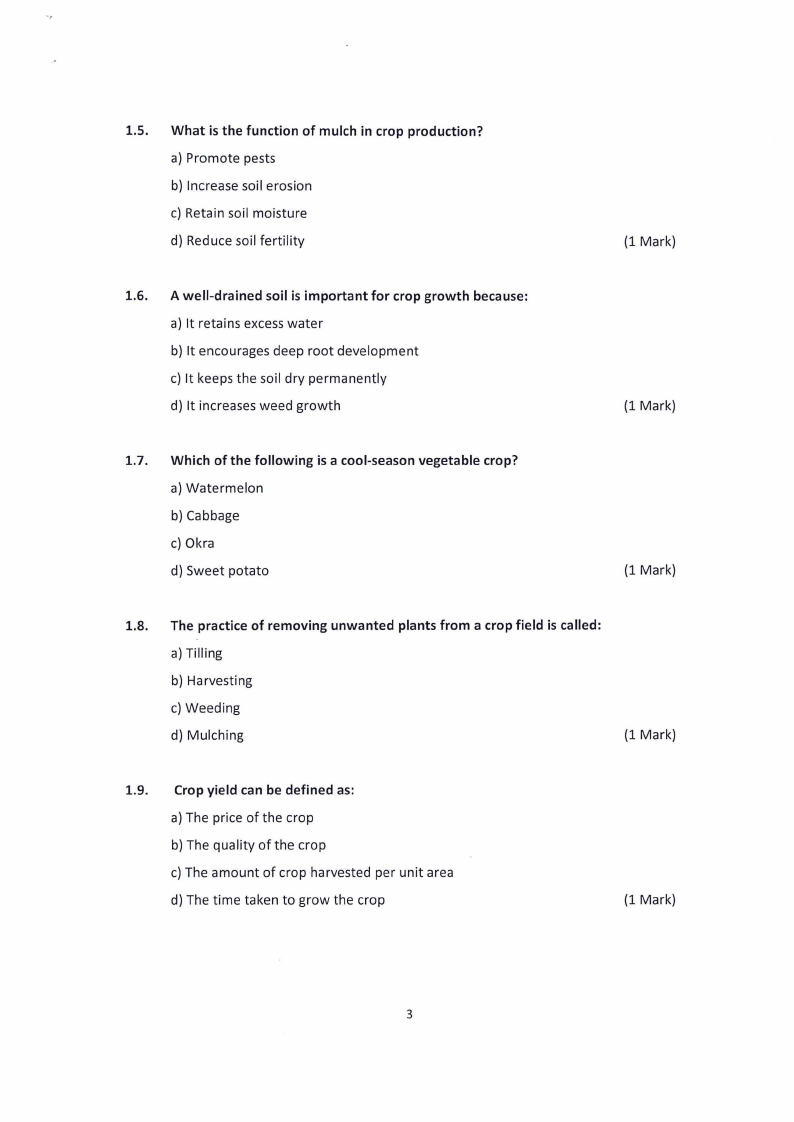
1.5. What is the function of mulch in crop production?
a) Promote pests
b) Increase soil erosion
c) Retain soil moisture
d) Reduce soil fertility
(1 Mark)
1.6. A well-drained soil is important for crop growth because:
a) It retains excess water
b) It encourages deep root development
c) It keeps the soil dry permanently
d) It increases weed growth
(1 Mark)
1.7. Which of the following is a cool-season vegetable crop?
a) Watermelon
b)Cabbage
c) Okra
d) Sweet potato
(1 Mark)
1.8. The practice of removing unwanted plants from a crop field is called:
a) Tilling
b) Harvesting
c) Weeding
d) Mulching
(1 Mark)
1.9. Crop yield can be defined as:
a) The price of the crop
b) The quality of the crop
c) The amount of crop harvested per unit area
d) The time taken to grow the crop
(1 Mark)
3
|
|
4 Page 4 |
▲back to top |
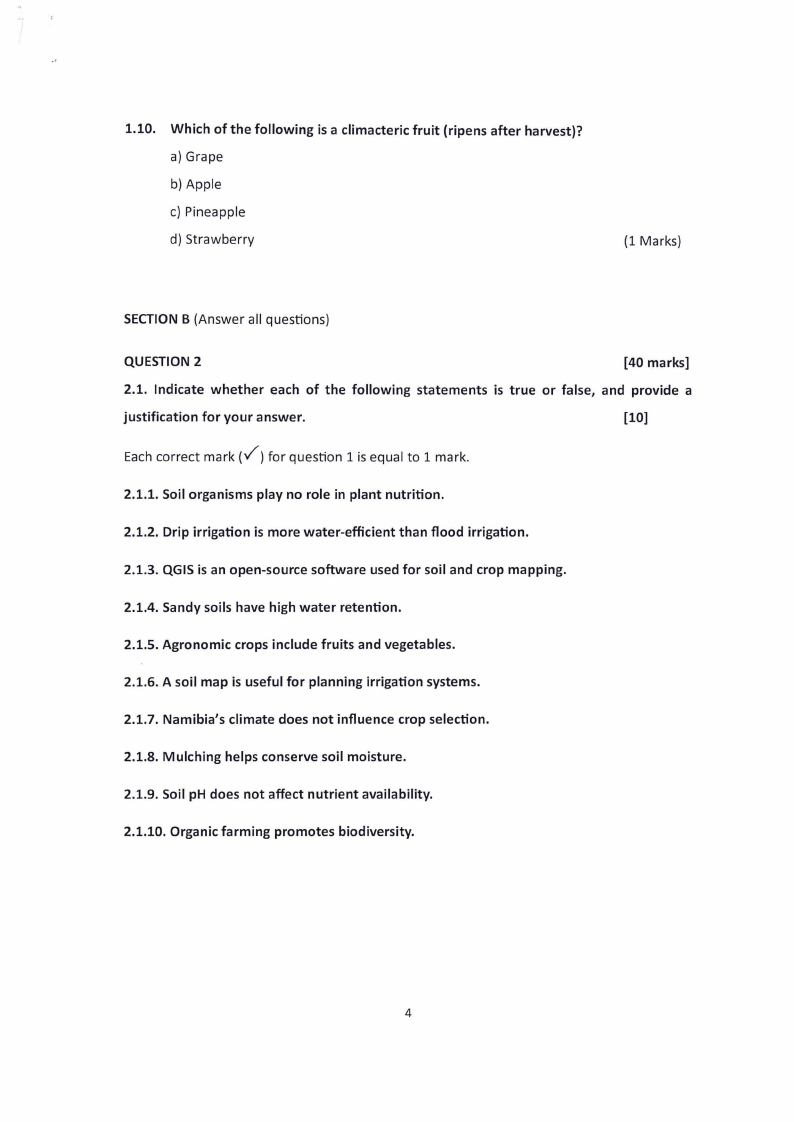
1.10. Which of the following is a climacteric fruit (ripens after harvest)?
a) Grape
b) Apple
c) Pineapple
d) Strawberry
(1 Marks)
SECTIONB (Answer all questions)
QUESTION 2
[40 marks]
2.1. Indicate whether each of the following statements is true or false, and provide a
justification for your answer.
[10]
Each correct
for question 1 is equal to 1 mark.
2.1.1. Soil organisms play no role in plant nutrition.
2.1.2. Drip irrigation is more water-efficient than flood irrigation.
2.1.3. QGIS is an open-source software used for soil and crop mapping.
2.1.4. Sandy soils have high water retention.
2.1.5. Agronomic crops include fruits and vegetables.
2.1.6. A soil map is useful for planning irrigation systems.
2.1.7. Namibia's climate does not influence crop selection.
2.1.8. Mulching helps conserve soil moisture.
2.1.9. Soil pH does not affect nutrient availability.
2.1.10. Organic farming promotes biodiversity.
4
|
|
5 Page 5 |
▲back to top |
rn
2.2. Define soil analysis and explain why it is important for farmers.
2.3. Explain two major climatic challenges that affect farming in Namibia.
2 4. Discuss how plant nutrition influences crop yield.
2.5. Describe the process of sustainable weed control in large-scale farming.
2.6. What is the role of GIStechnology in agriculture?
(6 marks)
(6 marks)
(6 marks)
(6 marks)
(6 marks)
SECTIONC
QUESTION 3
[SO marks]
3.1. Explain the importance of soil mapping and how it helps in crop production planning.
(25 Marks)
3.2. Discuss the major irrigation systems used in agriculture and evaluate their advantages
and disadvantages.
(25 Marks)
END OF PAPER[100]
5