


 |
BEC610S - BUSINESS ETHICS - 2ND OPP - JULY 2025 |
|
|
1 Page 1 |
▲back to top |
nAm I BI A UnlVE RSITY
OF SCIEnCE TECHnOLOGY
FACULTYOF COMMERCE, HUMAN SCIENCEAND EDUCATION
DEPARTMENT OF TECHNICAL, VOCATIONAL EDUCATION AND TRAINING
QUALIFICATION : DIPLOMA IN TECHNICAL AND VOCATIONAL EDUCATION AND TRAINING :
MANAGEMENT
QUALIFICATION CODE: 0GDTVM
LEVEL: 6
COURSE CODE: BEC610S
COURSE NAME: BUSINESS ETHICS
SESSION: JULY 2025
PAPER: 2
DURATION: 3 HOURS
MARKS: 100
SECOND OPPORTUNITY EXAMINATION QUESTION PAPER
EXAMINER(S)
DR. O.A. ALOOVI
MODERATOR: DR. G. TUBAUNDULE
INSTRUCTIONS
1. This paper consists of two sections (section A and B).
2. Answer ALL the sections.
3. Read all the questions carefully before answering.
4. Number your answers clearly.
THIS QUESTION PAPERCONSISTSOF 7 PAGES(Including this front page)
1
|
|
2 Page 2 |
▲back to top |
SECTIONA
[10 marks]
This section consists of 10 multiple choice questions. For each question there are four possible
answers A, B, C and D. Choose the one you consider correct. Just write the question number and the
letter of your choice. E.g., 1. D.
1.1 ______
and ____
in simple words mean principles or codes of conduct that governs
transactions, in this case business transaction.
(1)
A. Values and morals
B. Values and ethics
C. Standards and ethics
D. Morals and ethics
1.2 Being fair, honest and ethical is one of the basic human needs. Every employee's desire is to be
such himself and to work for an organisation that is fair and ethical in its practices. This relates to:
(1)
A. Uniting People and Leadership
B. Creating Credibility
C. Satisfying Basic Human Needs
D. Improving Decision Making
1.3 When we trace the origin of business ethics, we start with a period where
________
was seen as the only purpose of existence for a business.
(1)
A. Ethics
B. Morals
C. Standards
D. Profit maximisation
2
|
|
3 Page 3 |
▲back to top |
1.4 ________
the respective field.
is a wider term that includes many other sub ethics that are relevant to
(1)
A. Business ethics
B. Standard ethics
C. King report on standards ethics
D. Policies ethics
1.5 ________
business operations.
are meant to analyse problems that come up in the day-to-day course of
(1)
A. Morals
B. Standards
C. Ethics
D. Procedure
1.6 An organisation that is believed to be driven by moral values is respected in society even by those
who may have no information about work and the businessesor an organisation. This relates to: (1)
A. Satisfying Basic Human Needs
B. Creating Credibility
C. Uniting People and Leadership
D. Improving Decision Making
1.7 Identify the option that says individual's moral judgements are about right and wrong.
(1)
A. Rules
B. Mores
C. Morals
D. Ethics
3
|
|
4 Page 4 |
▲back to top |

1.8 Refraining from using confidential information for unethical or illegal advantage. This relates
to _____
_
(1)
A. Accountability
B. Confidentiality
C. Disclosure
D. Auditing
1.9 _____________
is the overall estimation in which an organisation is held by
its internal and external stakeholders based on its past actions and probability of its future
behaviour.
{1)
A. Corporate ethics
B. Corporate standards
C. Corporate reputation
D. Corporate regulations
1.10 __________
is directed and controlled.
is the system of rules, practices, and processesby which a company
(1)
A. Ethics
B. Constitution
C. Corporate governance
D. King report
4
|
|
5 Page 5 |
▲back to top |
SECTION B
This section consists of seven (7) structured questions. Answer ALLthe questions.
QUESTION 2
[18]
Readthe case study below carefully and answer the questions that follow.
On the morning of a consultation meeting, the Head of Department requested John, a trainer, to
supervise the cleaning of the automotive workshop by trainees throughout the day. John initially
responded by stating, "I already have plans to play tennis with my colleagues this afternoon." However,
around noon, John and two of his colleagues made arrangements that required them to borrow the
institution's car the following day. Consequently, John decided to cancel playing tennis and proceeded
to supervise the trainees as they cleaned the automotive workshop.
2.1 At what stage of moral development do you think John's decision was made? Justify your answer.
(2)
2.2 Explain any five stagesof moral development you have learned in this course.
(10)
2.3 What are the distinctions between traditional utilitarianism and rule utilitarianism, and why did
theorists create utilitarianism rule?
(6)
QUESTION 3
[18]
3.1 Distinguish between ethics and business ethics.
(4)
3.2. In your opinion, why is the practice of business ethics essential for any business or company? (5)
3.3 Explain three business ethical principles you have learned in this course. For each principle, state
why it is important in business.
(9)
QUESTION 4
[6]
Normative ethics involves supplying and justifying moral systems. Even though business ethics covers
a variety of topics, there are three basic types of issues it focuses on. Explain the three basic types of
issues as outlined by Velasquez.
5
|
|
6 Page 6 |
▲back to top |
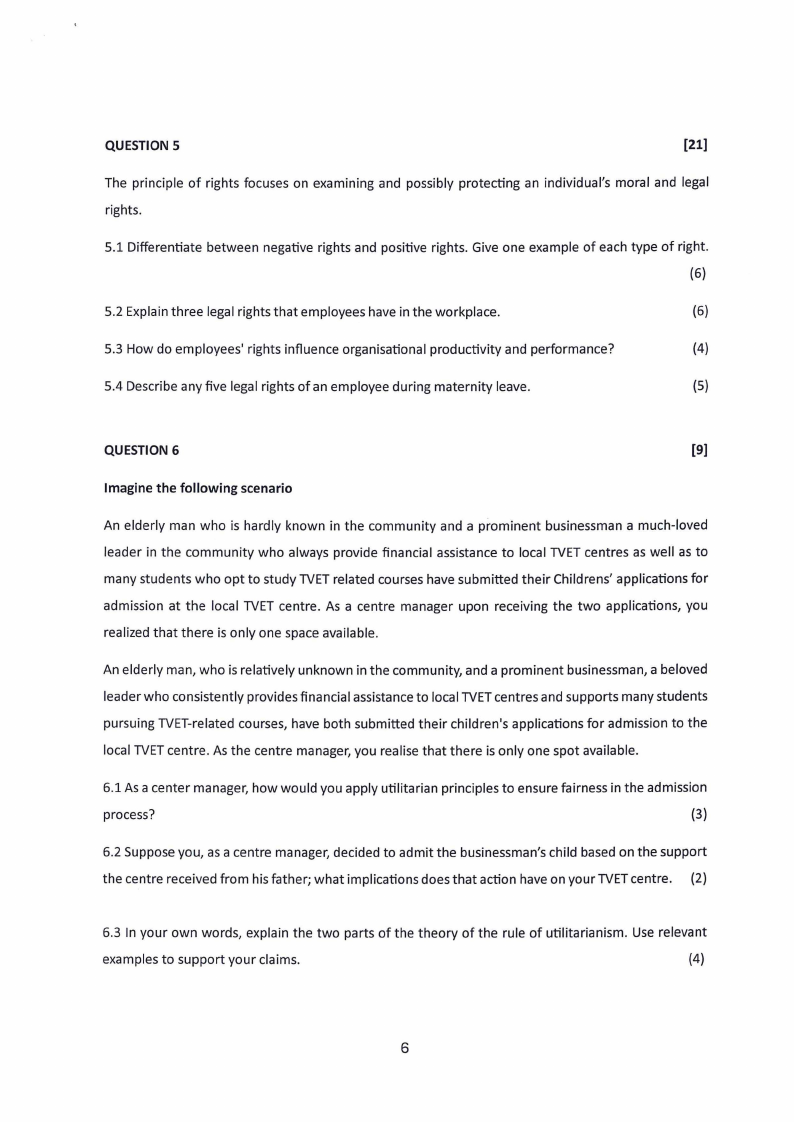
QUESTION 5
[21]
The principle of rights focuses on examining and possibly protecting an individual's moral and legal
rights.
5.1 Differentiate between negative rights and positive rights. Give one example of each type of right.
(6)
5.2 Explain three legal rights that employees have in the workplace.
(6)
5.3 How do employees' rights influence organisational productivity and performance?
(4)
5.4 Describe any five legal rights of an employee during maternity leave.
(5)
QUESTION 6
[9]
Imagine the following scenario
An elderly man who is hardly known in the community and a prominent businessman a much-loved
leader in the community who always provide financial assistance to local TVET centres as well as to
many students who opt to study TVET related courses have submitted their Childrens' applications for
admission at the local TVET centre. As a centre manager upon receiving the two applications, you
realized that there is only one space available.
An elderly man, who is relatively unknown in the community, and a prominent businessman, a beloved
leader who consistently provides financial assistance to local TVET centres and supports many students
pursuing TVET-related courses, have both submitted their children's applications for admission to the
local TVET centre. As the centre manager, you realise that there is only one spot available.
6.1 As a center manager, how would you apply utilitarian principles to ensure fairness in the admission
process?
(3)
6.2 Suppose you, as a centre manager, decided to admit the businessman's child based on the support
the centre received from his father; what implications does that action have on your TVETcentre. (2)
6.3 In your own words, explain the two parts of the theory of the rule of utilitarianism. Use relevant
examples to support your claims.
(4)
6
|
|
7 Page 7 |
▲back to top |

QUESTION 7
[18]
Global C.C is a Company committed to provide a safe environment for all its employees free from
harassment at work including sexual harassment. Global C.Ccompany is operating on a zero-tolerance
policy for any form of sexual harassment in the workplace. Any employee found to have sexually
harassed another employee will face disciplinary action, up to and including dismissal from
employment. All complaints of sexual harassment are being taken seriously and treated with respect
and in confidence. No one is being victimised for making such complaints.
Discuss the steps that managers must take to effectively address and handle cases of sexual
harassment in the workplace. Provide examples to support your answer.
TOTAL MARKS:
100
END OF EXAMINATION PAPER
7