


 |
PPM712S - PRODUCT PRICING MANAGEMENT - 1ST OPP - JUNE 2025 |
|
|
1 Page 1 |
▲back to top |
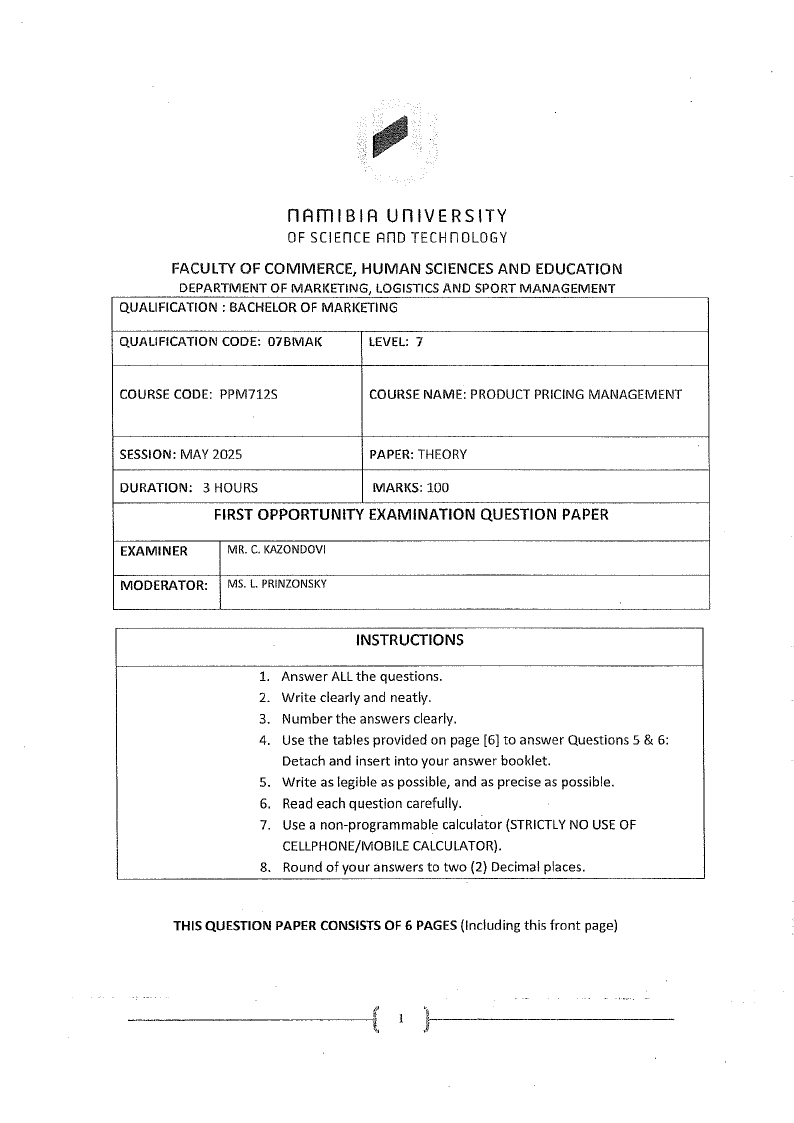
nAmlBIA UnlVERSITY
OF SCIEnCE Ano TECHnOLOGY
FACULTYOF COMMERCE, HUMAN SCIENCESAND EDUCATION
DEPARTMENT OF MARKETING, LOGISTICSAND SPORTMANAGEMENT
QUALIFICATION : BACHELOR OF MARKETING
QUALIFICATION CODE: 07BMAK
LEVEL: 7
COURSE CODE: PPM7125
COURSE NAME: PRODUCTPRICINGMANAGEMENT
SESSION: MAY 2025
PAPER: THEORY
DURATION: 3 HOURS
MARKS: 100
FIRST OPPORTUNITY EXAMINATION QUESTION PAPER
EXAMINER
MR. C. KAZONDOVI
MODERATOR: MS.L. PRINZONSl<Y
INSTRUCTIONS
1. Answer ALL the questions.
2. Write clearly and neatly.
3. Number the answers clearly.
4. Use the tables provided on page [6) to answer Questions 5 & 6:
Detach and insert into your answer booklet.
5. Write as legible as possible, and as precise as possible.
6. Read each question carefully.
7. Use a non-programmable calculator (STRICTLYNO USEOF
CELLPHONE/MOBILE CALCULATOR).
8. Round of your answers to two (2) Decimal places.
THIS QUESTION PAPER CONSISTS OF 6 PAGES (Including this front page)
.l 1~-----------
|
|
2 Page 2 |
▲back to top |
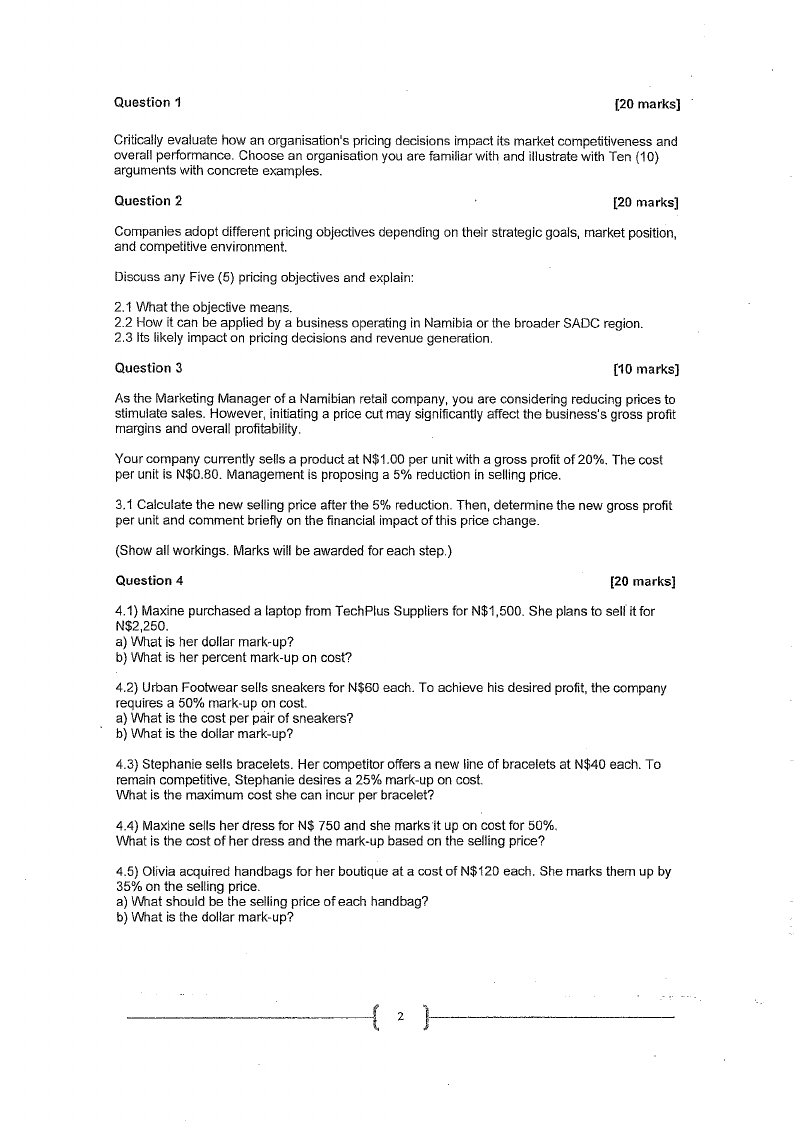
Question 1
[20 marks]
Critically evaluate how an organisation's pricing decisions impact its market competitiveness and
overall performance. Choose an organisation you are familiar with and illustrate with Ten (10)
arguments with concrete examples.
Question 2
[20 marks]
Companies adopt different pricing objectives depending on their strategic goals, market position,
and competitive environment.
Discuss any Five (5) pricing objectives and explain:
2.1 What the objective means.
2.2 How it can be applied by a business operating in Namibia or the broader SADC region.
2.3 Its likely impact on pricing decisions and revenue generation.
Question 3
[10 marks)
As the Marketing Manager of a Namibian retail company, you are considering reducing prices to
stimulate sales. However, initiating a price cut may significantly affect the business's gross profit
margins and overall profitability.
Your company currently sells a product at N$1.00 per unit with a gross profit of 20%. The cost
per unit is N$0.80. Management is proposing a 5% reduction in selling price.
3.1 Calculate the new selling price after the 5% reduction. Then, determine the new gross profit
per unit and comment briefly on the financial impact of this price change.
(Show all workings. Marks will be awarded for each step.)
Question 4
[20 marks]
4.1) Maxine purchased a laptop from TechPlus Suppliers for N$1,500. She plans to sell it for
N$2,250.
a) What is her dollar mark-up?
b) What is her percent mark-up on cost?
4.2) Urban Footwear sells sneakers for N$60 each. To achieve his desired profit, the company
requires a 50% mark-up on cost.
a) What is the cost per pair of sneakers?
b) What is the dollar mark-up?
4.3) Stephanie sells bracelets. Her competitor offers a new line of bracelets at N$40 each. To
remain competitive, Stephanie desires a 25% mark-up on cost.
What is the maximum cost she can incur per bracelet?
4.4) Maxine sells her dress for N$ 750 and she marks it up on cost for 50%.
What is the cost of her dress and the mark-up based on the selling price?
4.5) Olivia acquired handbags for her boutique at a cost of N$120 each. She marks them up by
35% on the selling price.
a) What should be the selling price of each handbag?
b) What is the dollar mark-up?
t2
j)
|
|
3 Page 3 |
▲back to top |
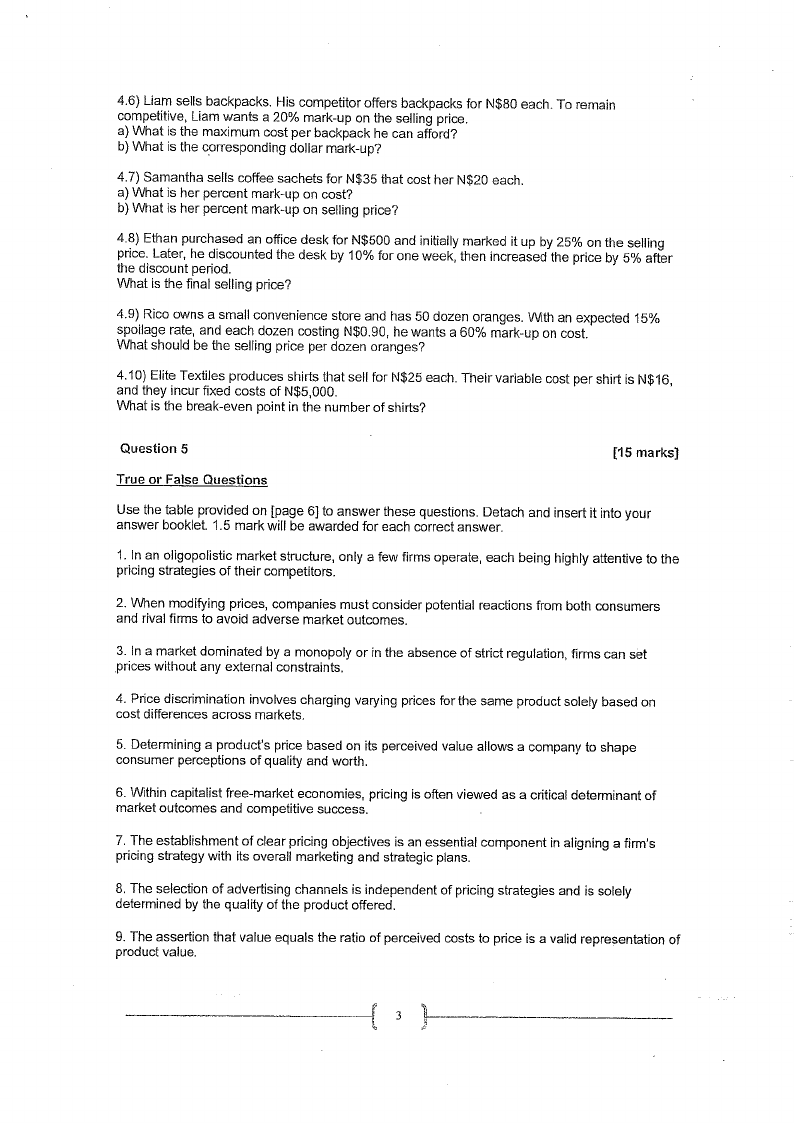
4.6) Liam sells backpacks. His competitor offers backpacks for N$80 each. To remain
competitive, Liam wants a 20% mark-up on the selling price.
a) What is the maximum cost per backpack he can afford?
b) What is the c_orrespondingdollar mark-up?
4.7) Samantha sells coffee sachets for N$35 that cost her N$20 each.
a) What is her percent mark-up on cost?
b) What is her percent mark-up on selling price?
4.8) Ethan purchased an office desk for N$500 and initially marked it up by 25% on the selling
price. Later, he discounted the desk by 10% for one week, then increased the price by 5% after
the discount period.
What is the final selling price?
4.9) Rico owns a small convenience store and has 50 dozen oranges. With an expected 15%
spoilage rate, and each dozen costing N$0.90, he wants a 60% mark-up on cost.
What should be the selling price per dozen oranges?
4.10) Elite Textiles produces shirts that sell for N$25 each. Their variable cost per shirt is N$16,
and they incur fixed costs of N$5,000.
What is the break-even point in the number of shirts?
Question 5
True or False Questions
[15 marks]
Use the table provided on [page 6] to answer these questions. Detach and insert it into your
answer booklet. 1.5 mark will be awarded for each correct answer.
1. In an oligopolistic market structure, only a few firms operate, each being highly attentive to the
pricing strategies of their competitors.
2. When modifying prices, companies must consider potential reactions from both consumers
and rival firms to avoid adverse market outcomes.
3. In a market dominated by a monopoly or in the absence of strict regulation, firms can set
prices without any external constraints.
4. Price discrimination involves charging varying prices for the same product solely based on
cost differences across markets.
5. Determining a product's price based on its perceived value allows a company to shape
consumer perceptions of quality and worth.
6. Within capitalist free-market economies, pricing is often viewed as a critical determinant of
market outcomes and competitive success.
7. The establishment of clear pricing objectives is an essential component in aligning a firm's
pricing strategy with its overall marketing and strategic plans.
8. The selection of advertising channels is independent of pricing strategies and is solely
determined by the quality of the product offered.
9. The assertion that value equals the ratio of perceived costs to price is a valid representation of
product value.
3
|
|
4 Page 4 |
▲back to top |
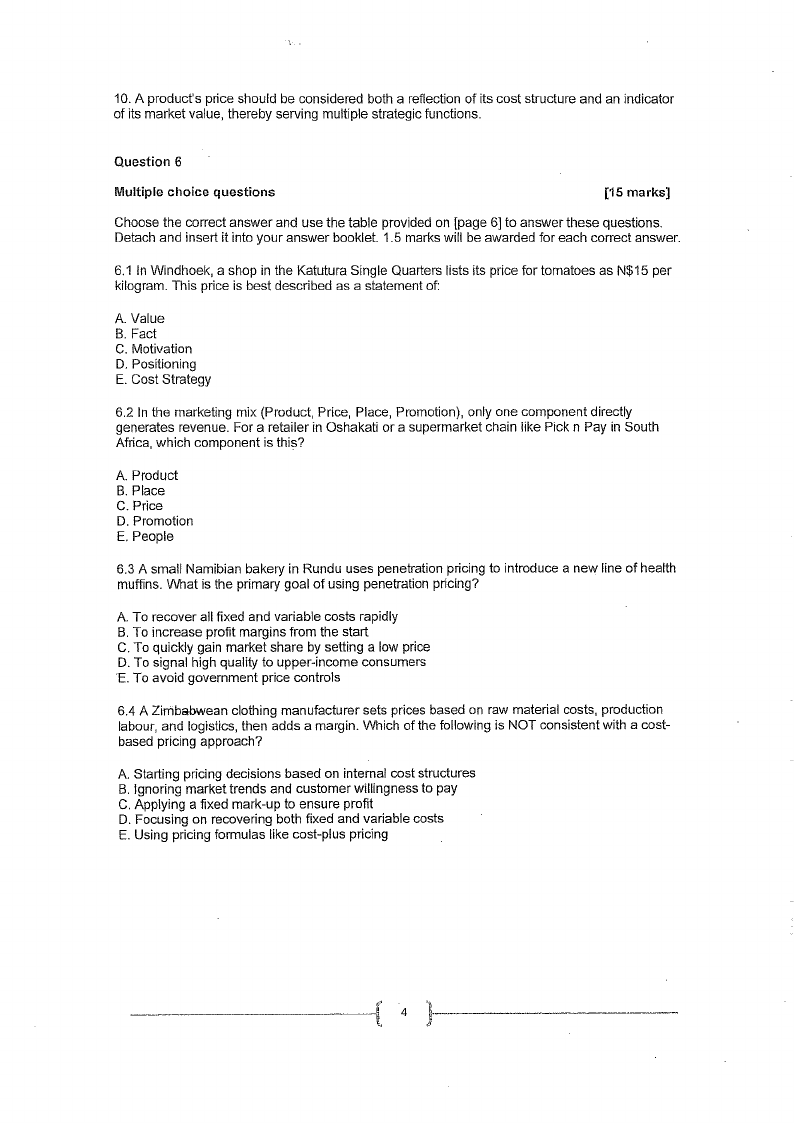
10. A product's price should be considered both a reflection of its cost structure and an indicator
of its market value, thereby serving multiple strategic functions.
Question 6
Multiple choice questions
[15 marks]
Choose the correct answer and use the table provided on [page 6] to answer these questions.
Detach and insert it into your answer booklet. 1.5 marks will be awarded for each correct answer.
6.1 In Windhoek, a shop in the Katutura Single Quarters lists its price for tomatoes as N$15 per
kilogram. This price is best described as a statement of:
A. Value
B. Fact
C. Motivation
D. Positioning
E. Cost Strategy
6.2 In the marketing mix (Product, Price, Place, Promotion), only one component directly
generates revenue. For a retailer in Oshakati or a supermarket chain like Pick n Pay in South
Africa, which component is this?
A. Product
B. Place
C. Price
D. Promotion
E. People
6.3 A small Namibian bakery in Rundu uses penetration pricing to introduce a new line of health
muffins. What is the primary goal of using penetration pricing?
A. To recover all fixed and variable costs rapidly
B. To increase profit margins from the start
C. To quickly gain market share by setting a low price
D. To signal high quality to upper-income consumers
E To avoid government price controls
6.4 A Zimbabwean clothing manufacturer sets prices based on raw material costs, production
labour, and logistics, then adds a margin. Which of the following is NOT consistent with a cost-
based pricing approach?
A. Starting pricing decisions based on internal cost structures
B. Ignoring market trends and customer willingness to pay
C. Applying a fixed mark-up to ensure profit
D. Focusing on recovering both fixed and variable costs
E. Using pricing formulas like cost-plus pricing
4
|
|
5 Page 5 |
▲back to top |
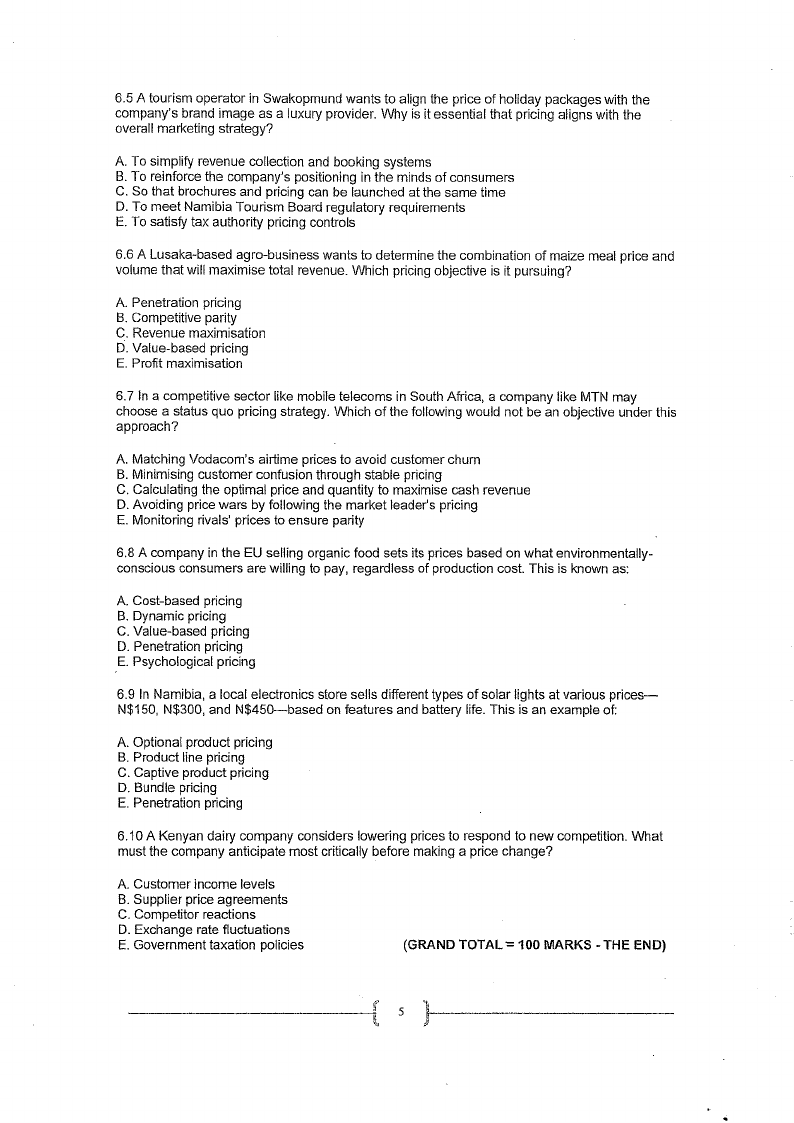
6.5 A tourism operator in Swakopmund wants to align the price of holiday packages with the
company's brand image as a luxury provider. Why is it essential that pricing aligns with the
overall marketing strategy?
A To simplify revenue collection and booking systems
B. To reinforce the company's positioning in the minds of consumers
C. So that brochures and pricing can be launched at the same time
D. To meet Namibia Tourism Board regulatory requirements
E. To satisfy tax authority pricing controls
6.6 A Lusaka-based agro-business wants to determine the combination of maize meal price and
volume that will maximise total revenue. Which pricing objective is it pursuing?
A Penetration pricing
B. Competitive parity
C. Revenue maximisation
D. Value-based pricing
E. Profit maximisation
6.7 In a competitive sector like mobile telecoms in South Africa, a company like MTN may
choose a status quo pricing strategy. Which of the following would not be an objective under this
approach?
A Matching Vodacom's airtime prices to avoid customer churn
B. Minimising customer confusion through stable pricing
C. Calculating the optimal price and quantity to maximise cash revenue
D. Avoiding price wars by following the market leader's pricing
E. Monitoring rivals' prices to ensure parity
6.8 A company in the EU selling organic food sets its prices based on what environmentally-
conscious consumers are willing to pay, regardless of production cost This is known as:
A Cost-based pricing
B. Dynamic pricing
C. Value-based pricing
D. Penetration pricing
E. Psychological pricing
6.9 In Namibia, a local electronics store sells different types of solar lights at various prices-
N$150, N$300, and N$450-based on features and battery life. This is an example of:
A Optional product pricing
B. Product line pricing
C. Captive product pricing
D. Bundle pricing
E. Penetration pricing
6.10 A Kenyan dairy company considers lowering prices to respond to new competition. What
must the company anticipate most critically before making a price change?
A Customer income levels
B. Supplier price agreements
C. Competitor reactions
D. Exchange rate fluctuations
E. Government taxation policies
(GRAND TOTAL-= 100 MARKS - THE END)
5
|
|
6 Page 6 |
▲back to top |
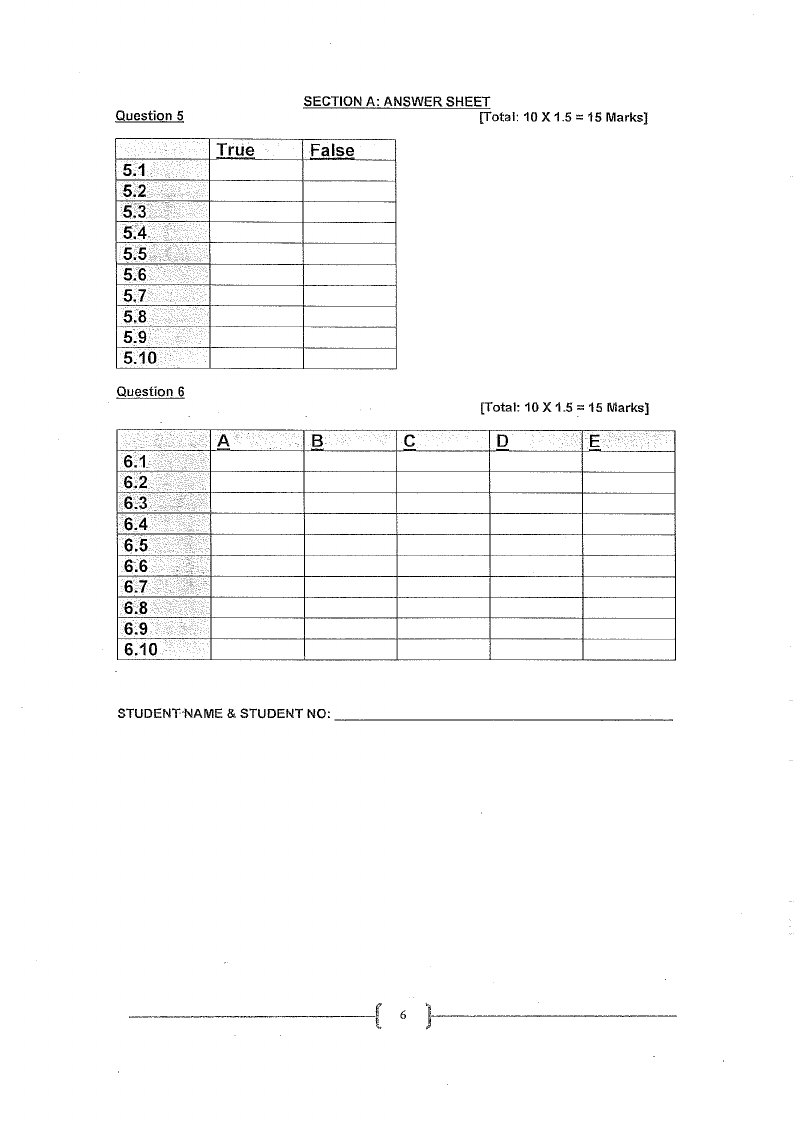
Question 5
.
.
True
5.1 . .
5s.2:3..·...
SA ·.:'·:_
''
_.,
s:s ; ·'
",_
·.
5.6 .
5.7
5.8 ...
s:g .
5.10.
.
Question 6
.
. .
.
6.1
A ·.... ·
.
6;2
6,3•. ·.·
6.4.
. ·..•····.·.
.
,·..
. 6.5.····•··,.,•
6.6 ' ;
6.7
. <-
.· -
.
6.8
6.9 .. ·.•·. ··•
6.10
..
SECTION A: ANSWER SHEET
[Total: 10 X 1.5 = 15 Marks]
False
B . ·.·
[Total: 10 X 1.5 = 15 Marks]
C
D
E .. . ..
·.
STUDENT·NAME & STUDENT NO: _________________
_
6