


 |
PSM611S - PURCHASING AND SUPPLY MANAGEMENT - 2ND OPP - JUNE 2025 |
|
|
1 Page 1 |
▲back to top |
n Am I BI A u n IVER s I TY
OF SCIEnCE Ano TECHnOLOGY
FACULTYOF COMMERCE,HUMAN SCIENCESAND EDUCATION
DEPARTMENTOF GOVERNANCEAND MANAGEMENTSCIENCES
QUALIFICATION: BACHELOR OF MANAGEMENT
QUALIFICATION CODE: 07BBMA
LEVEL: 7
COURSE CODE: PSM611S
COURSE NAME: PURCHASINGAND SUPPLYMANAGEMENT
SESSION: JUNE 2024
DURATION: 3 HOURS
PAPER: 1
MARKS: 100
EXAMINER(S)
SECOND OPPORTUNITY EXAMINATION QUESTION PAPER
Ms. 0.N Kangandjo
MODERATOR:
Mr. M B Simasiku
THIS QUESTION PAPER CONSISTS OF 7 PAGES (Including this front page)
INSTRUCTIONS
1.
Answer all questions.
2.
Read all the questions carefully before answering.
3.
Marks for each question are indicated at the end of each question.
4.
Please ensure that your writing is legible, neat and presentable and start each Section on a
new page.
PERMISSIBLEMATERIALS
1. Examination question paper
2. Examination answer sheet
1
|
|
2 Page 2 |
▲back to top |
nAmlBIA un1VERSITY
OF SCIEnCE Ano TECHnOLOGY
FACULTYOF COMMERCE,HUMAN SCIENCESAND EDUCATION
DEPARTMENTOF GOVERNANCEAND MANAGEMENTSCIENCES
QUALIFICATION: BACHELOR OF MANAGEMENT
QUALIFICATION CODE: 07BBMA
LEVEL: 7
COURSE CODE: PSM611S
COURSE NAME: PURCHASINGAND SUPPLYMANAGEMENT
SESSION: JUNE 2024
DURATION: 3 HOURS
PAPER: 1
MARKS: 100
EXAMINER(S)
SECOND OPPORTUNITY EXAMINATION QUESTION PAPER
Ms. 0.N Kangandjo
MODERATOR:
Mr. M B Simasiku
THIS QUESTION PAPER CONSISTS OF 7 PAGES {Including this front page)
INSTRUCTIONS
1.
Answer all questions.
2.
Read all the questions carefully before answering.
3.
Marks for each question are indicated at the end of each question.
4.
Please ensure that your writing is legible, neat and presentable and start each Section on a
new page.
PERMISSIBLEMATERIALS
1. Examination question paper
2. Examination answer sheet
1
|
|
3 Page 3 |
▲back to top |
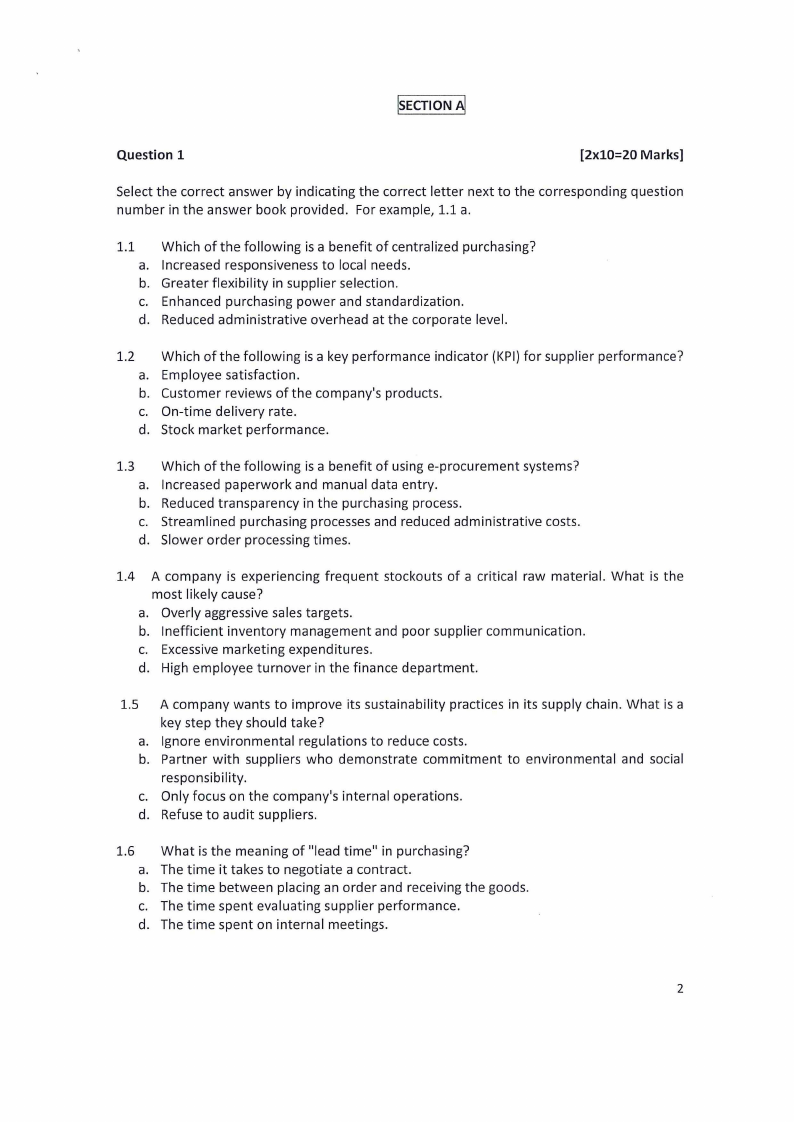
!SECTION~
Question 1
[2x10=20 Marks]
Select the correct answer by indicating the correct letter next to the corresponding question
number in the answer book provided. For example, 1.1 a.
1.1
a.
b.
C.
d.
Which of the following is a benefit of centralized purchasing?
Increased responsiveness to local needs.
Greater flexibility in supplier selection.
Enhanced purchasing power and standardization.
Reduced administrative overhead at the corporate level.
1.2 Which of the following is a key performance indicator (KPI) for supplier performance?
a. Employee satisfaction.
b. Customer reviews of the company's products.
C. On-time delivery rate.
d. Stock market performance.
1.3 Which of the following is a benefit of using e-procurement systems?
a. Increased paperwork and manual data entry.
b. Reduced transparency in the purchasing process.
C. Streamlined purchasing processes and reduced administrative costs.
d. Slower order processing times.
1.4 A company is experiencing frequent stockouts of a critical raw material. What is the
most likely cause?
a. Overly aggressive sales targets.
b. Inefficient inventory management and poor supplier communication.
C. Excessive marketing expenditures.
d. High employee turnover in the finance department.
1.5 A company wants to improve its sustainability practices in its supply chain. What is a
key step they should take?
a. Ignore environmental regulations to reduce costs.
b. Partner with suppliers who demonstrate commitment to environmental and social
responsibility.
C. Only focus on the company's internal operations.
d. Refuse to audit suppliers.
1.6 What is the meaning of "lead time" in purchasing?
a. The time it takes to negotiate a contract.
b. The time between placing an order and receiving the goods.
C. The time spent evaluating supplier performance.
d. The time spent on internal meetings.
2
|
|
4 Page 4 |
▲back to top |
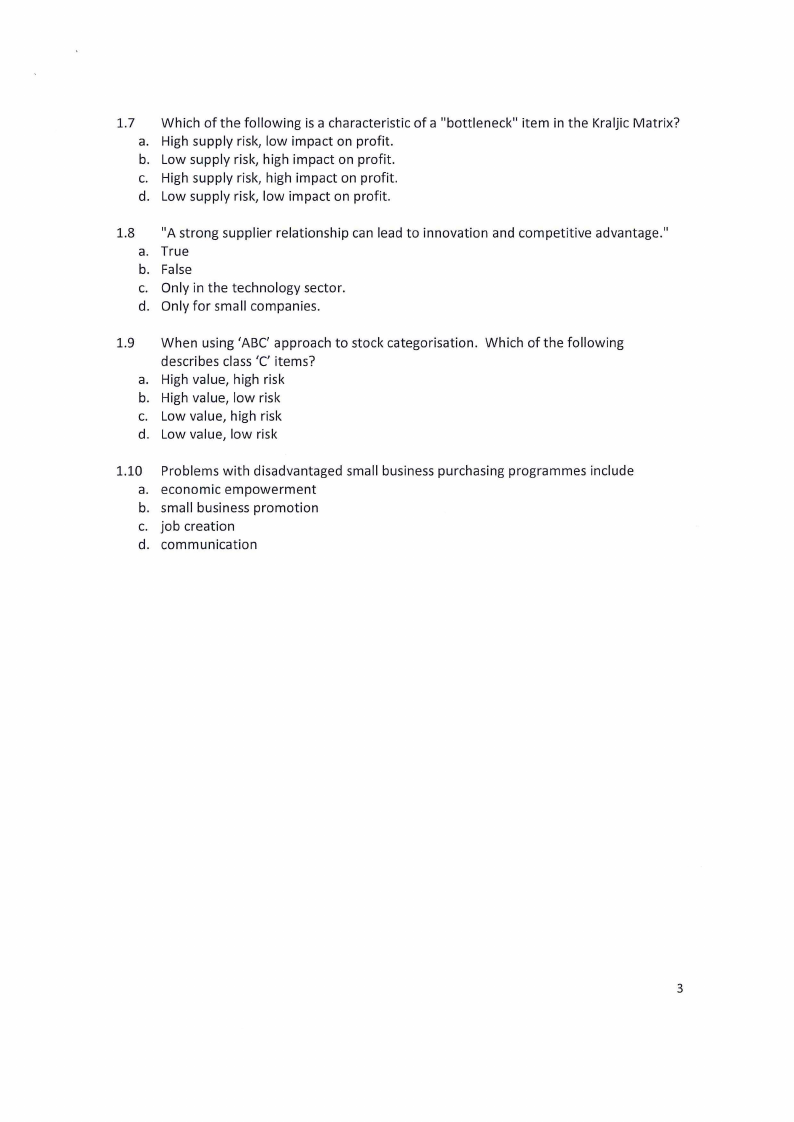
1.7
a.
b.
c.
d.
Which of the following is a characteristic of a "bottleneck"
High supply risk, low impact on profit.
Low supply risk, high impact on profit.
High supply risk, high impact on profit.
Low supply risk, low impact on profit.
item in the Kraljic Matrix?
1.8 "A strong supplier relationship can lead to innovation and competitive advantage."
a. True
b. False
c. Only in the technology sector.
d. Only for small companies.
1.9
a.
b.
c.
d.
When using 'ABC' approach to stock categorisation.
describes class 'C' items?
High value, high risk
High value, low risk
Low value, high risk
Low value, low risk
Which of the following
1.10 Problems with disadvantaged small business purchasing programmes include
a. economic empowerment
b. small business promotion
c. job creation
d. communication
3
|
|
5 Page 5 |
▲back to top |
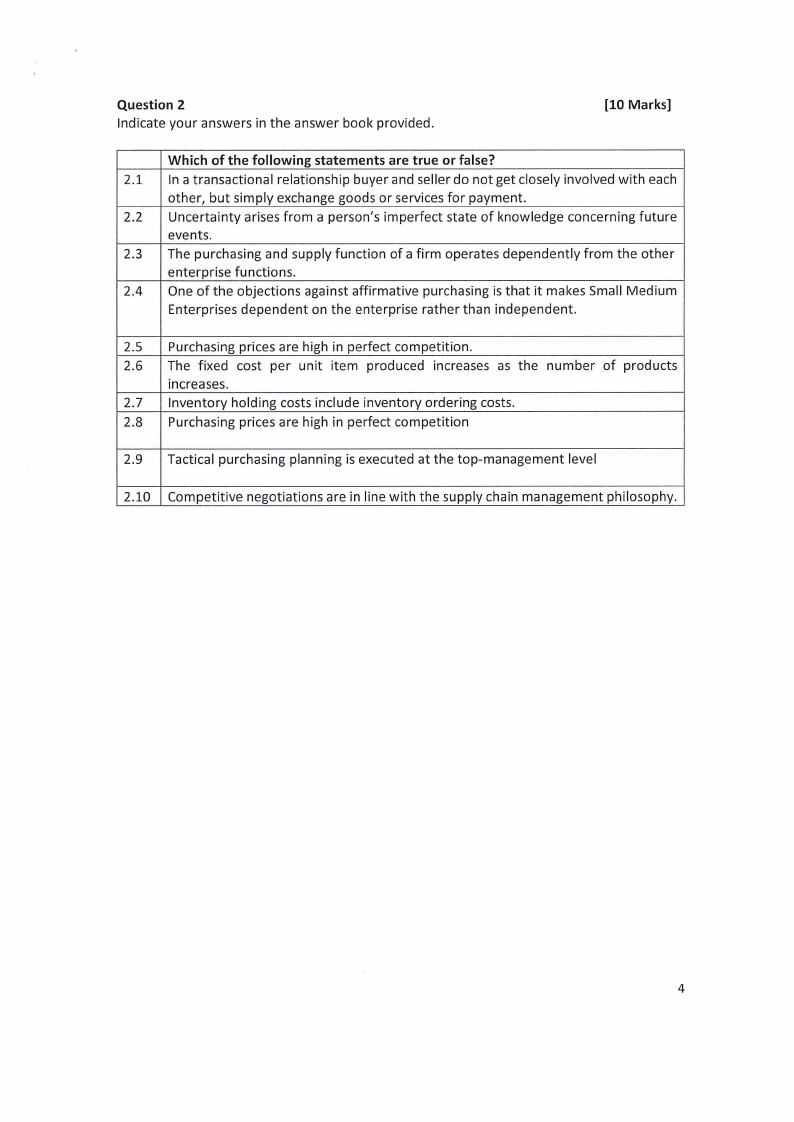
Question 2
Indicate your answers in the answer book provided.
[10 Marks]
Which of the following statements are true or false?
2.1 In a transactional relationship buyer and seller do not get closely involved with each
other, but simply exchange goods or services for payment.
2.2 Uncertainty arises from a person's imperfect state of knowledge concerning future
events.
2.3 The purchasing and supply function of a firm operates dependently from the other
enterprise functions.
2.4 One of the objections against affirmative purchasing is that it makes Small Medium
Enterprises dependent on the enterprise rather than independent.
2.5 Purchasing prices are high in perfect competition.
2.6 The fixed cost per unit item produced increases as the number of products
increases.
2.7 Inventory holding costs include inventory ordering costs.
2.8 Purchasing prices are high in perfect competition
2.9 Tactical purchasing planning is executed at the top-management level
2.10 Competitive negotiations are in line with the supply chain management philosophy.
4
|
|
6 Page 6 |
▲back to top |
!SECTIONBl
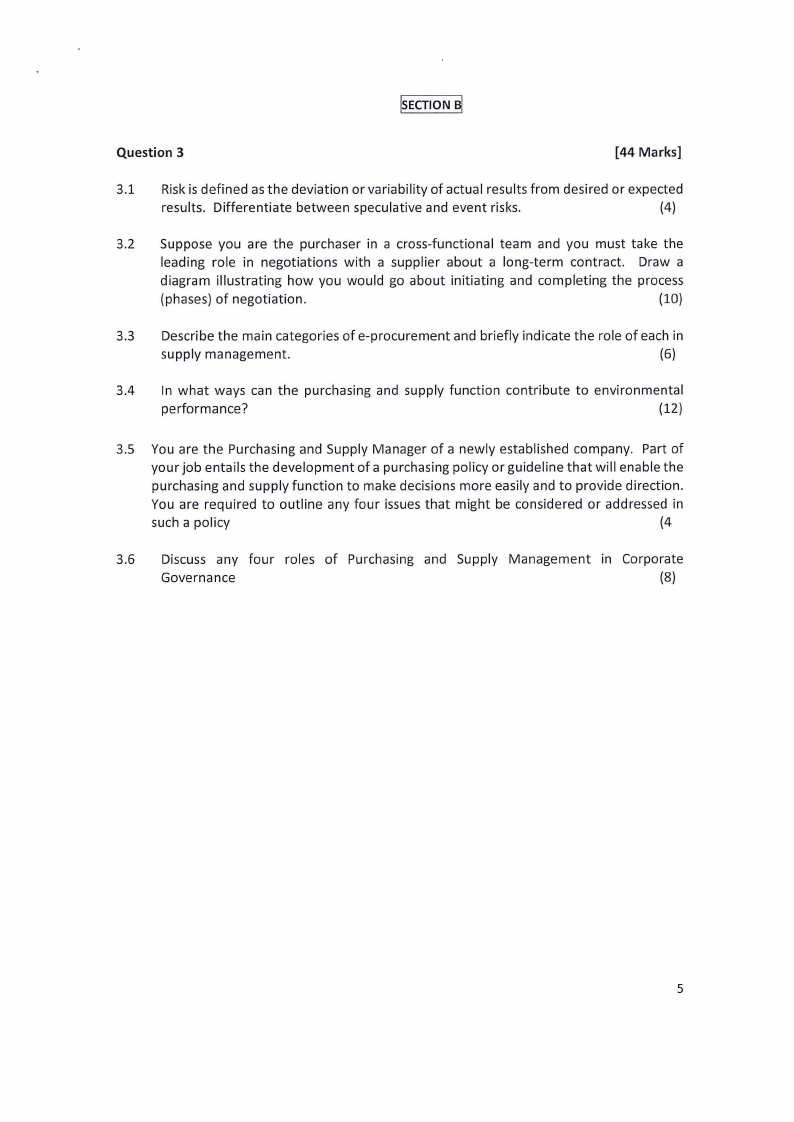
Question 3
[44 Marks]
3.1 Risk is defined as the deviation or variability of actual results from desired or expected
results. Differentiate between speculative and event risks.
(4)
3.2 Suppose you are the purchaser in a cross-functional team and you must take the
leading role in negotiations with a supplier about a long-term contract. Draw a
diagram illustrating how you would go about initiating and completing the process
(phases) of negotiation.
(10)
3.3 Describe the main categories of e-procurement and briefly indicate the role of each in
supply management.
(6)
3.4 In what ways can the purchasing and supply function contribute to environmental
performance?
(12)
3.5 You are the Purchasing and Supply Manager of a newly established company. Part of
your job entails the development of a purchasing policy or guideline that will enable the
purchasing and supply function to make decisions more easily and to provide direction.
You are required to outline any four issues that might be considered or addressed in
such a policy
(4
3.6 Discuss any four roles of Purchasing and Supply Management in Corporate
Governance
{8)
5
|
|
7 Page 7 |
▲back to top |
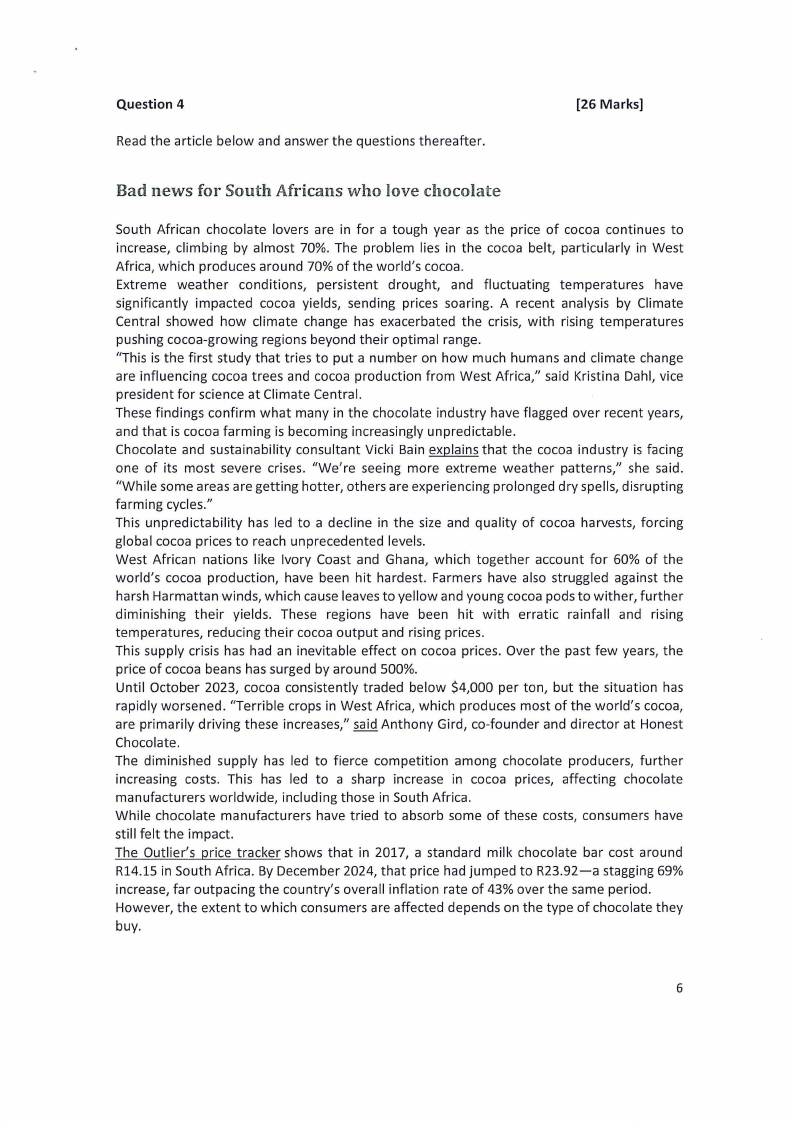
Question 4
Read the article below and answer the questions thereafter.
[26 Marks]
Bad news for South Africans who love chocolate
South African chocolate lovers are in for a tough year as the price of cocoa continues to
increase, climbing by almost 70%. The problem lies in the cocoa belt, particularly in West
Africa, which produces around 70% of the world's cocoa.
Extreme weather conditions, persistent drought, and fluctuating temperatures have
significantly impacted cocoa yields, sending prices soaring. A recent analysis by Climate
Central showed how climate change has exacerbated the crisis, with rising temperatures
pushing cocoa-growing regions beyond their optimal range.
"This is the first study that tries to put a number on how much humans and climate change
are influencing cocoa trees and cocoa production from West Africa," said Kristina Dahl, vice
president for science at Climate Central.
These findings confirm what many in the chocolate industry have flagged over recent years,
and that is cocoa farming is becoming increasingly unpredictable.
Chocolate and sustainability consultant Vicki Bain explains that the cocoa industry is facing
one of its most severe crises. "We're seeing more extreme weather patterns," she said.
"While some areas are getting hotter, others are experiencing prolonged dry spells, disrupting
farming cycles."
This unpredictability has led to a decline in the size and quality of cocoa harvests, forcing
global cocoa prices to reach unprecedented levels.
West African nations like Ivory Coast and Ghana, which together account for 60% of the
world's cocoa production, have been hit hardest. Farmers have also struggled against the
harsh Harmattan winds, which cause leaves to yellow and young cocoa pods to wither, further
diminishing their yields. These regions have been hit with erratic rainfall and rising
temperatures, reducing their cocoa output and rising prices.
This supply crisis has had an inevitable effect on cocoa prices. Over the past few years, the
price of cocoa beans has surged by around 500%.
Until October 2023, cocoa consistently traded below $4,000 per ton, but the situation has
rapidly worsened. "Terrible crops in West Africa, which produces most of the world's cocoa,
are primarily driving these increases," said Anthony Gird, co-founder and director at Honest
Chocolate.
The diminished supply has led to fierce competition among chocolate producers, further
increasing costs. This has led to a sharp increase in cocoa prices, affecting chocolate
manufacturers worldwide, including those in South Africa.
While chocolate manufacturers have tried to absorb some of these costs, consumers have
still felt the impact.
The Outlier's price tracker shows that in 2017, a standard milk chocolate bar cost around
R14.15 in South Africa. By December 2024, that price had jumped to R23.92-a stagging 69%
increase, far outpacing the country's overall inflation rate of 43% over the same period.
However, the extent to which consumers are affected depends on the type of chocolate they
buy.
6
|
|
8 Page 8 |
▲back to top |
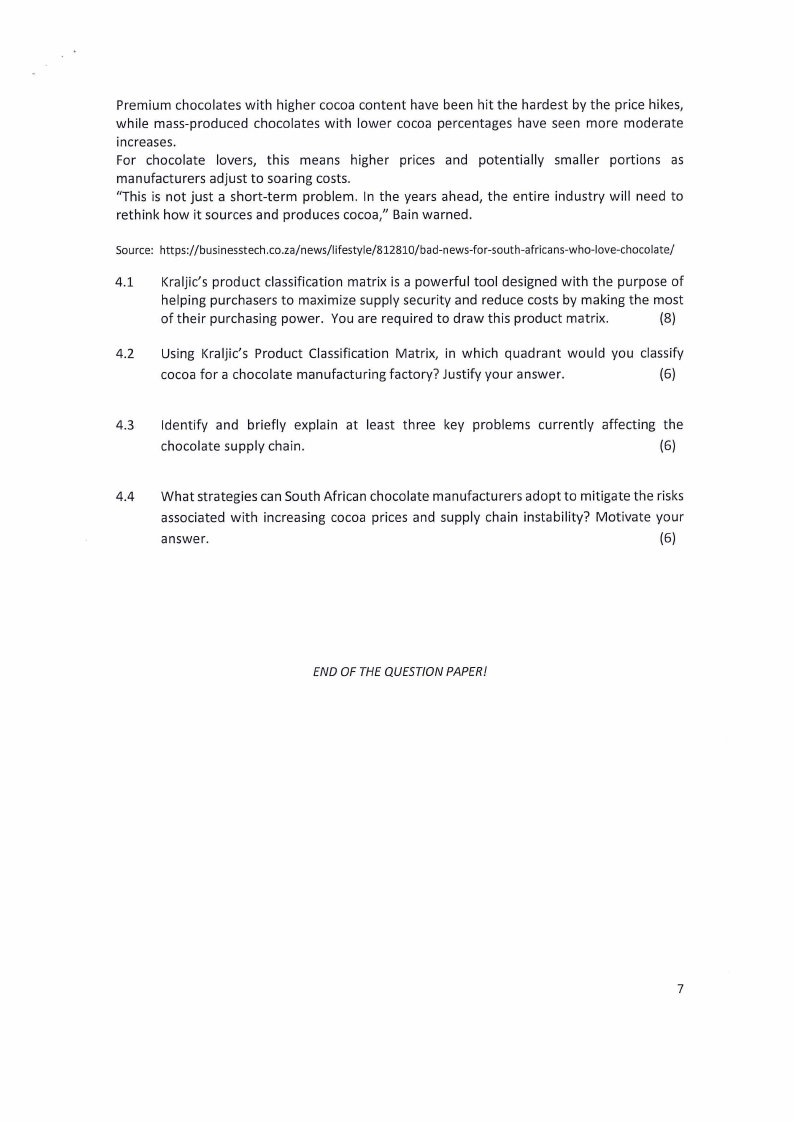
Premium chocolates with higher cocoa content have been hit the hardest by the price hikes,
while mass-produced chocolates with lower cocoa percentages have seen more moderate
increases.
For chocolate lovers, this means higher prices and potentially smaller portions as
manufacturers adjust to soaring costs.
"This is not just a short-term problem. In the years ahead, the entire industry will need to
rethink how it sources and produces cocoa," Bain warned.
Source: https ://bus inesst ech.co.za/ news/1ifestyle/812810 /bad-n ews-for-south-africa ns-who-1ove-choco late/
4.1 Kraljic's product classification matrix is a powerful tool designed with the purpose of
helping purchasers to maximize supply security and reduce costs by making the most
of their purchasing power. You are required to draw this product matrix.
(8)
4.2 Using Kraljic's Product Classification Matrix, in which quadrant would you classify
cocoa for a chocolate manufacturing factory? Justify your answer.
(6)
4.3 Identify and briefly explain at least three key problems currently affecting the
chocolate supply chain.
(6)
4.4 What strategies can South African chocolate manufacturers adopt to mitigate the risks
associated with increasing cocoa prices and supply chain instability? Motivate your
answer.
(6)
END OF THEQUESTIONPAPER!
7