


 |
GAU711S-AUDITING 310-1ST OPP- JUNE 2025 |
|
|
1 Page 1 |
▲back to top |
nAmlBIA unlVERSITY
OF SCIEnCE Ano TECHn OLOGY
FACULTY OF COMMERCE, HUMAN SCIENCESAND EDUCATION
DEPARTMENT OF ECONOMICS, ACCOUNTING AND FINANCE
QUALIFICATION: BACHELOR OF ACCOUNTING
QUALIFICATION CODE: 07 BOAC
LEVEL: 7
COURSE CODE: GAU 7115
COURSE NAME: AUDITING 310
SESSION: MAY/JUNE 2025
DURATION: 180 MINUTES
PAPER: THEORY
MARKS: 100
FIRST OPPORTUNITY EXAMINATION QUESTION PAPER
EXAMINER(S) P. ERKIE,K. TJONDU AND Y.TJEJAMBA
MODERATOR: A. NANGOLO
INSTRUCTIONS
1. This test paper is made up of four (4) questions.
2. Answer ALL Questions in blue or black ink.
3. Start each question on a new page in your answer sheet.
4. The names of people and businesses used throughout this assessment do not
reflect the reality and may be purely coincidental.
5. Questions relating to this paper may be raised in the initial 30 minutes after the
start of the paper. Thereafter, candidates must use their initiative to deal with any
perceived error or ambiguities & any assumption made by the candidate should
be clearly stated.
THIS QUESTION PAPER CONSISTS OF 7 PAGES (including this cover page)
|
|
2 Page 2 |
▲back to top |
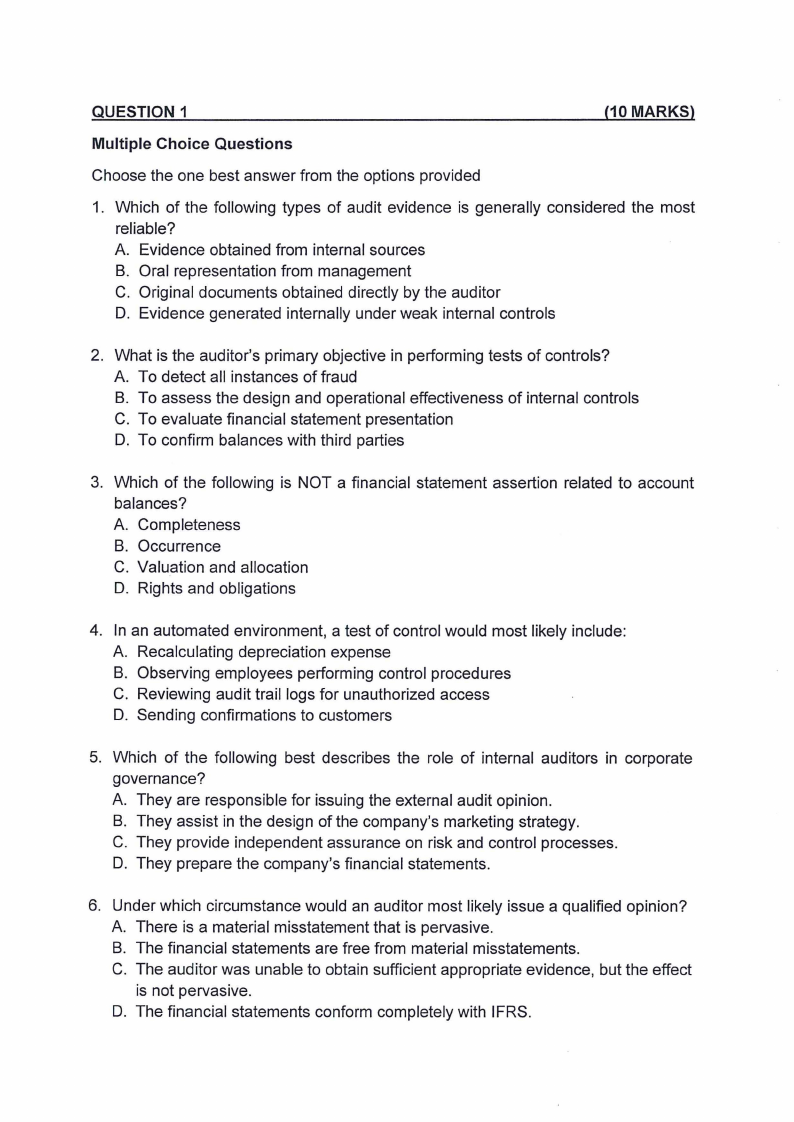
QUESTION 1
(10 MARKS)
Multiple Choice Questions
Choose the one best answer from the options provided
1. Which of the following types of audit evidence is generally considered the most
reliable?
A. Evidence obtained from internal sources
B. Oral representation from management
C. Original documents obtained directly by the auditor
D. Evidence generated internally under weak internal controls
2. What is the auditor's primary objective in performing tests of controls?
A. To detect all instances of fraud
B. To assess the design and operational effectiveness of internal controls
C. To evaluate financial statement presentation
D. To confirm balances with third parties
3. Which of the following is NOT a financial statement assertion related to account
balances?
A. Completeness
B. Occurrence
C. Valuation and allocation
D. Rights and obligations
4. In an automated environment, a test of control would most likely include:
A. Recalculating depreciation expense
B. Observing employees performing control procedures
C. Reviewing audit trail logs for unauthorized access
D. Sending confirmations to customers
5. Which of the following best describes the role of internal auditors in corporate
governance?
A. They are responsible for issuing the external audit opinion.
B. They assist in the design of the company's marketing strategy.
C. They provide independent assurance on risk and control processes.
D. They prepare the company's financial statements.
6. Under which circumstance would an auditor most likely issue a qualified opinion?
A. There is a material misstatement that is pervasive.
B. The financial statements are free from material misstatements.
C. The auditor was unable to obtain sufficient appropriate evidence, but the effect
is not pervasive.
D. The financial statements conform completely with IFRS.
|
|
3 Page 3 |
▲back to top |
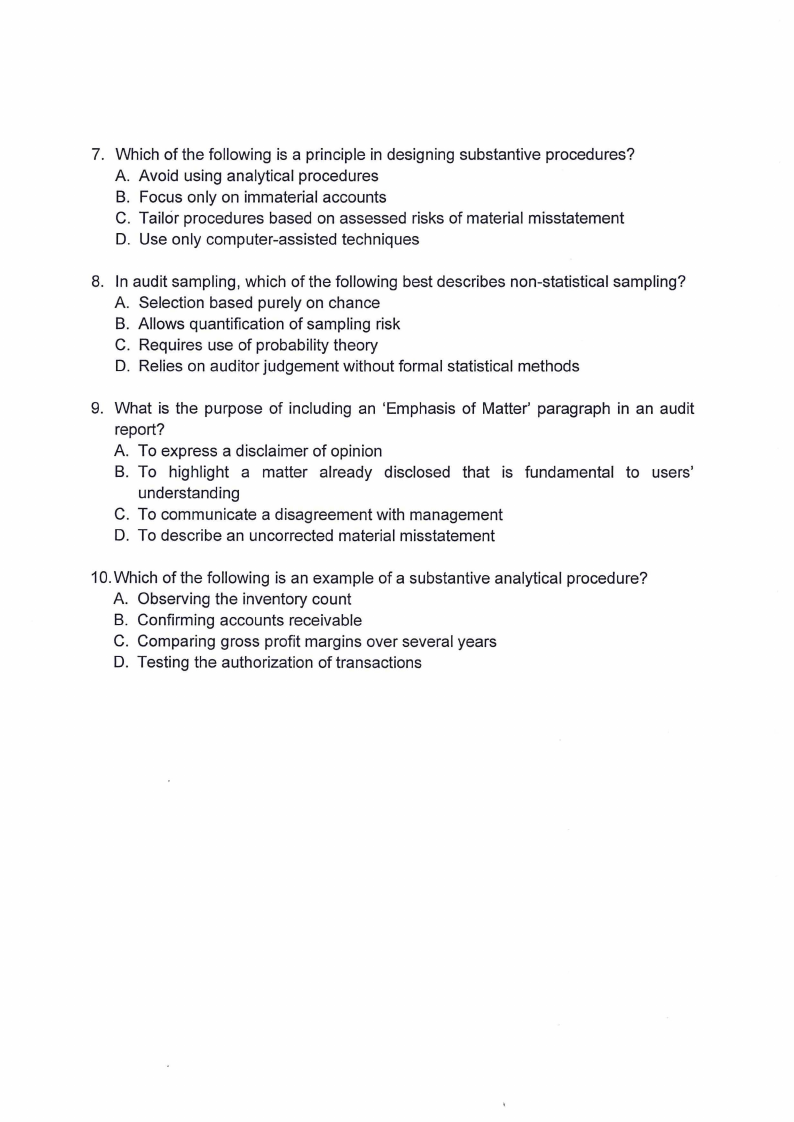
7. Which of the following is a principle in designing substantive procedures?
A. Avoid using analytical procedures
B. Focus only on immaterial accounts
C. Tailor procedures based on assessed risks of material misstatement
D. Use only computer-assisted techniques
8. In audit sampling, which of the following best describes non-statistical sampling?
A. Selection based purely on chance
B. Allows quantification of sampling risk
C. Requires use of probability theory
D. Relies on auditor judgement without formal statistical methods
9. What is the purpose of including an 'Emphasis of Matter' paragraph in an audit
report?
A. To express a disclaimer of opinion
B. To highlight a matter already disclosed that is fundamental to users'
understanding
C. To communicate a disagreement with management
D. To describe an uncorrected material misstatement
10. Which of the following is an example of a substantive analytical procedure?
A. Observing the inventory count
B. Confirming accounts receivable
C. Comparing gross profit margins over several years
D. Testing the authorization of transactions
|
|
4 Page 4 |
▲back to top |
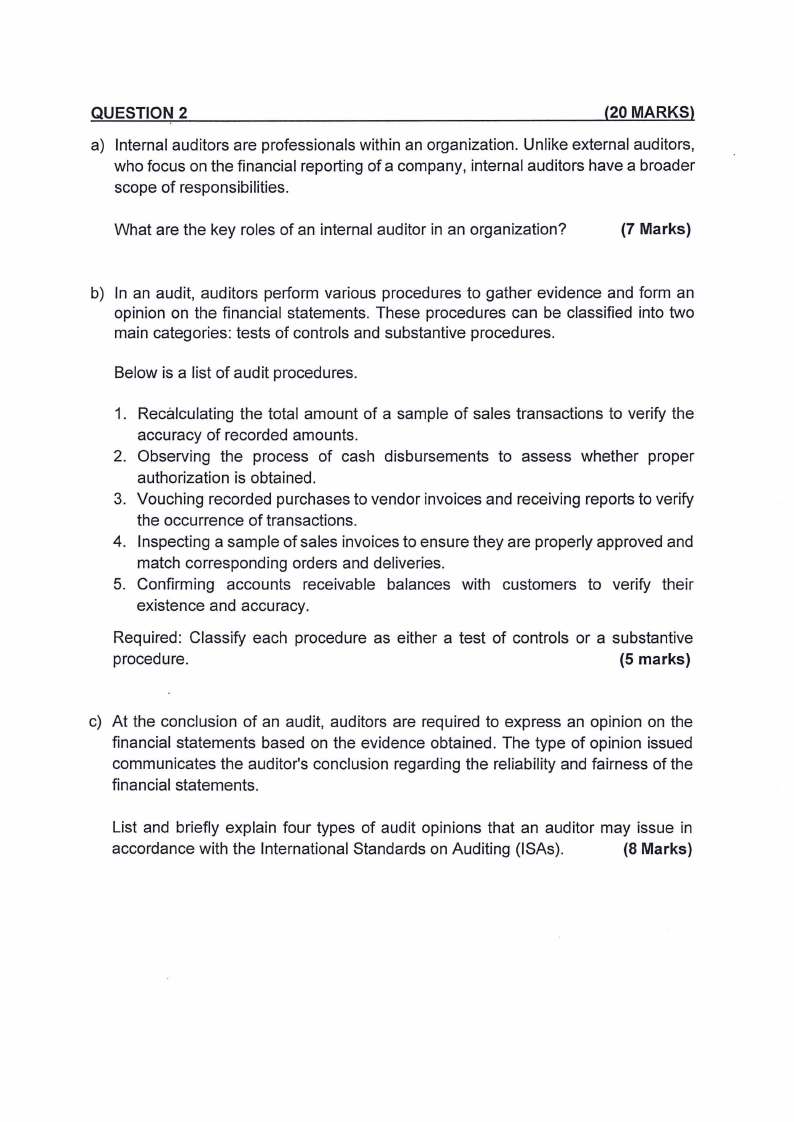
QUESTION 2
(20 MARKS)
a) Internal auditors are professionals within an organization. Unlike external auditors,
who focus on the financial reporting of a company, internal auditors have a broader
scope of responsibilities.
What are the key roles of an internal auditor in an organization?
(7 Marks)
b) In an audit, auditors perform various procedures to gather evidence and form an
opinion on the financial statements. These procedures can be classified into two
main categories: tests of controls and substantive procedures.
Below is a list of audit procedures.
1. Recalculating the total amount of a sample of sales transactions to verify the
accuracy of recorded amounts.
2. Observing the process of cash disbursements to assess whether proper
authorization is obtained.
3. Vouching recorded purchases to vendor invoices and receiving reports to verify
the occurrence of transactions.
4. Inspecting a sample of sales invoices to ensure they are properly approved and
match corresponding orders and deliveries.
5. Confirming accounts receivable balances with customers to verify their
existence and accuracy.
Required: Classify each procedure as either a test of controls or a substantive
procedure.
(5 marks)
c) At the conclusion of an audit, auditors are required to express an opinion on the
financial statements based on the evidence obtained. The type of opinion issued
communicates the auditor's conclusion regarding the reliability and fairness of the
financial statements.
List and briefly explain four types of audit opinions that an auditor may issue in
accordance with the International Standards on Auditing (ISAs).
(8 Marks)
|
|
5 Page 5 |
▲back to top |
QUESTION 3
(45 MARKS)
PART A
SCENARIO
Background Information
Savanna Tech Industries (Pty) Ltd is a regional electronics manufacturing and
distribution company operating across Namibia. You have been appointed as the
Senior Auditor for Savanna Tech Industries' financial audit for the year ended 31
December 2024.
During the audit, you are required to evaluate the company's revenue cycle to assess
the effectiveness of internal controls, the accuracy of revenue recognition, and the
completeness of reported sales.
Revenue Cycle
Savanna Tech processes hundreds of sales orders per month, both locally and for
export. The company has an integrated sales and accounting system that manages
sales orders, inventory, invoicing, and revenue recording.
The Revenue Cycle Process and Controls in Place Are as Follows:
1. Customer orders are received by the Sales Department either via email or through
the company's online portal. A sales order is created in the system and must be
reviewed and approved by a Sales Manager before being processed.
2. Once approved, the Inventory Control Department verifies stock availability. If the
item is in stock, a delivery note is generated, and the goods are packed and
dispatched by the warehouse team.
3. Dispatch personnel confirm the shipment by updating the system and attaching
proof of delivery. No sales invoice can be generated until this confirmation is
logged.
4. After dispatch confirmation, the Finance Department generates a sales invoice
using the system. Invoices are automatically matched to the approved sales orders
and delivery confirmations.
5. The Accounts Receivable (AR) Clerk monitors customer accounts and records
payments once they are received. Payments are typically made via EFT or bank
deposit. The system automatically flags overdue accounts.
6. On a monthly basis, the AR Clerk prepares an aged debtors report, which is
reviewed by the Credit Controller and escalated to management for any accounts
overdue by more than 60 days.
|
|
6 Page 6 |
▲back to top |
7. The company applies the accrual basis of accounting. Revenue is recognized
when goods are delivered and control has transferred to the customer, not when
payment is received.
8. The system maintains a complete audit trail of all sales transactions, including
order approval, dispatch, invoicing, and payment.
9. Management performs monthly reconciliations between the sales ledger and the
general ledger. Any discrepancies are investigated and resolved.
10. Credit limits are assigned to customers and reviewed periodically. Orders that
exceed a customer's credit limit are automatically blocked by the system and must
be manually approved by a senior manager.
Required:
a) With reference to the REVENUE CYCLE, as a Senior Auditor auditing Savanna
Tech Industries (Pty) Ltd, what tests of controls will you perform to ensure the
effectiveness of internal controls?
(20 Marks)
PARTB
As part of the audit for Savanna tech and are tasked with auditing the company's
property, plant, and equipment (PPE). As part of your audit procedures, you need to
perform substantive procedures to verify the PPE balance reported on the Statement
of Financial position.
Required:
b) Name and explain the key assertions you will test.
(10 Marks)
c) Explain the substantive procedures you would perform to audit machinery as part
of PPE. For each procedure, provide a brief explanation of why it is important and
how it helps in verifying the machinery balance.
(15 Marks)
|
|
7 Page 7 |
▲back to top |
QUESTION 4
(25 MARKS)
SCENARIO
GreenFields Organics (Pty) Ltd is a mid-sized company based in Mariental,
specializing in the production and distribution of organic dairy products. For over a
decade, it held a solid market presence, supplying national supermarket chains and
boutique health stores across Namibia.
However, over the past 18 months, GreenFields has been facing severe operational
and financial stress. The company has experienced the loss of a major retailer
contract, which previously accounted for 40% of its revenue. This loss was a direct
result of GreenFields' failure to meet revised food safety compliance requirements,
and the retailer has since shifted to a new competitor offering lower prices and faster
delivery.
In the most recent financial year, the company recorded a significant net loss, with
negative operating cash flows. The balance sheet shows a net liability position, and
the current ratio has dropped below 0.9. The company is struggling to meet its
obligations and has arrears in supplier payments, with some creditors threatening legal
action for unpaid invoices.
GreenFields had relied heavily on short-term financing, which has now reached its
limit. Several loan agreements are in breach of terms, particularly interest coverage
ratios, and the bank has issued a warning that further breaches could trigger loan
recall. Attempts to secure additional funding have been unsuccessful due to the
company's poor financial standing.
Adding to the concern, a key executive (Chief Operational Officer) recently resigned
and has not been replaced, and the HR department has reported growing
dissatisfaction among staff, with threats of industrial action over delayed salaries.
Meanwhile, a change in Namibian government agricultural subsidy policies has
removed critical financial support that GreenFields r~lied on to sustain its organic
certification program. The company's failure to adapt has led to negative public
perception around the authenticity of its organic products.
To manage its liquidity crisis, GreenFields has moved from credit-based supply
arrangements to cash-on-delivery terms, further straining cash reserves. The board
has recently held a meeting where management expressed uncertainty about
continuing operations beyond the next financial quarter if a strategic investor is not
secured.
Required: Based on the scenario above, assess whether GreenFields Organics (Pty)
Ltd, is a going concern by identifying the relevant indicators and explaining your
reasoning.
(25 marks)
..................... THE END .................. .