


 |
CNH710S - CULTURAL AND NATURAL HERITAGE MANAGEMENT - 1ST OPP - JUNE 2025 |
|
|
1 Page 1 |
▲back to top |
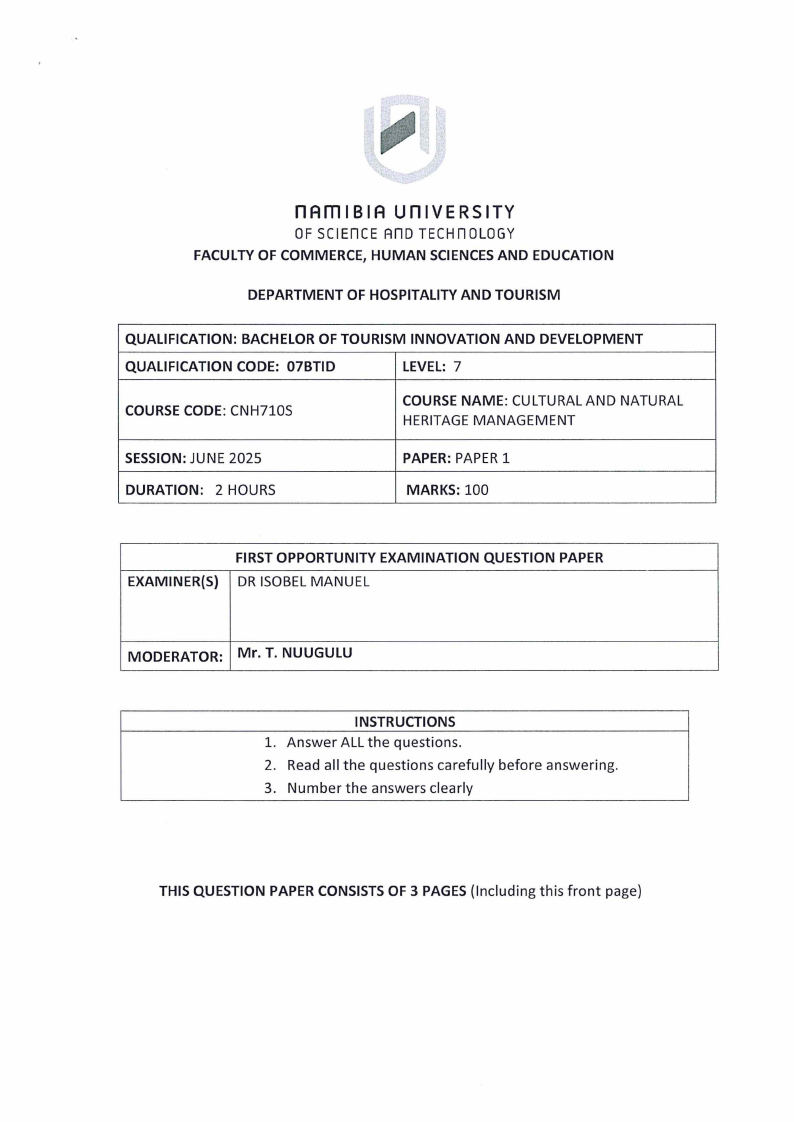
nAmlBIA UnlVERSITY
OF SCIEn CE Ano TECHn OLOGY
FACULTY OF COMMERCE, HUMAN SCIENCESAND EDUCATION
DEPARTMENT OF HOSPITALITY AND TOURISM
QUALIFICATION: BACHELOR OF TOURISM INNOVATION AND DEVELOPMENT
QUALIFICATION CODE: 07BTID
LEVEL: 7
COURSE CODE: CNH710S
COURSE NAME: CULTURAL AND NATURAL
HERITAGE MANAGEMENT
SESSION: JUNE 2025
DURATION: 2 HOURS
PAPER: PAPER 1
MARKS: 100
EXAMINER(S)
FIRST OPPORTUNITY EXAMINATION QUESTION PAPER
DR ISOBEL MANUEL
MODERATOR: Mr. T. NUUGULU
INSTRUCTIONS
1. Answer ALL the questions.
2. Read all the questions carefully before answering.
3. Number the answers clearly
THIS QUESTION PAPER CONSISTS OF 3 PAGES (Including this front page)
|
|
2 Page 2 |
▲back to top |
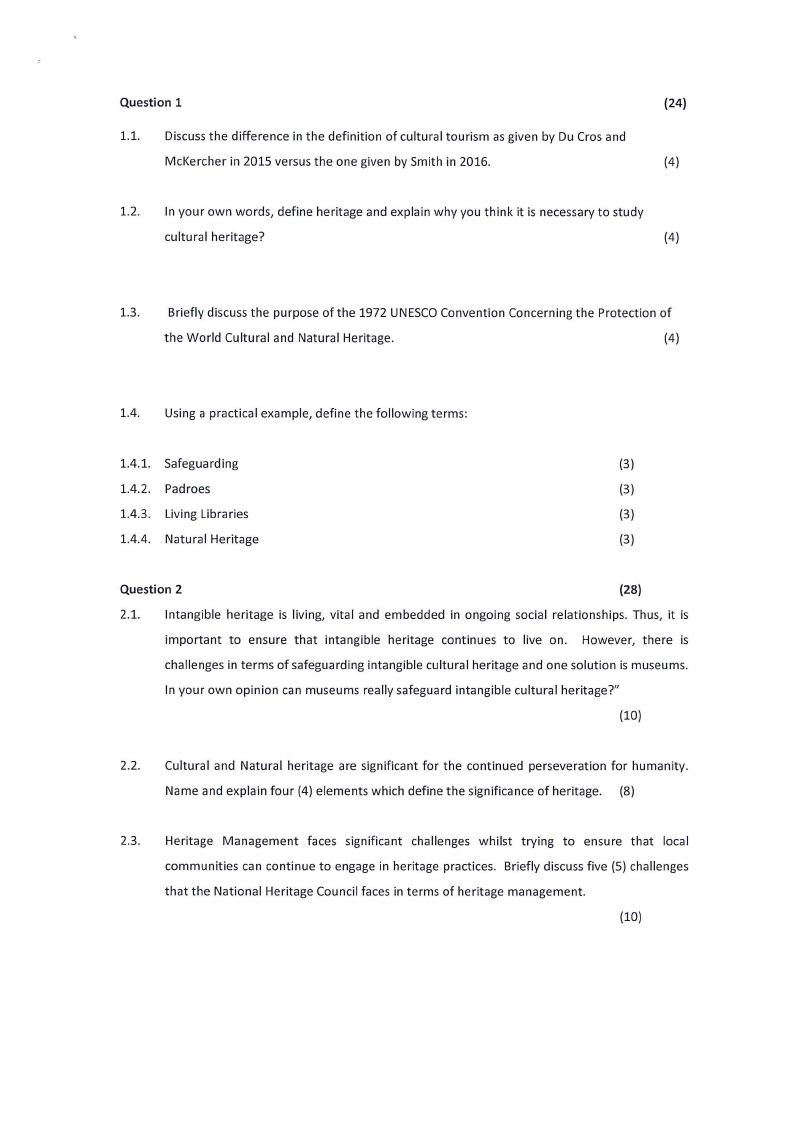
Question 1
(24)
1.1. Discuss the difference in the definition of cultural tourism as given by Du Cros and
McKercher in 2015 versus the one given by Smith in 2016.
(4)
1.2. In your own words, define heritage and explain why you think it is necessary to study
cultural heritage?
(4)
1.3. Briefly discuss the purpose of the 1972 UNESCOConvention Concerning the Protection of
the World Cultural and Natural Heritage.
(4)
1.4. Using a practical example, define the following terms:
1.4.1. Safeguarding
(3)
1.4.2. Padroes
(3)
1.4.3. Living Libraries
(3)
1.4.4. Natural Heritage
(3)
Question 2
(28)
2.1. Intangible heritage is living, vital and embedded in ongoing social relationships. Thus, it is
important to ensure that intangible heritage continues to live on. However, there is
challenges in terms of safeguarding intangible cultural heritage and one solution is museums.
In your own opinion can museums really safeguard intangible cultural heritage?"
(10)
2.2. Cultural and Natural heritage are significant for the continued perseveration for humanity.
Name and explain four (4) elements which define the significance of heritage. (8)
2.3. Heritage Management faces significant challenges whilst trying to ensure that local
communities can continue to engage in heritage practices. Briefly discuss five (5) challenges
that the National Heritage Council faces in terms of heritage management.
(10)
|
|
3 Page 3 |
▲back to top |
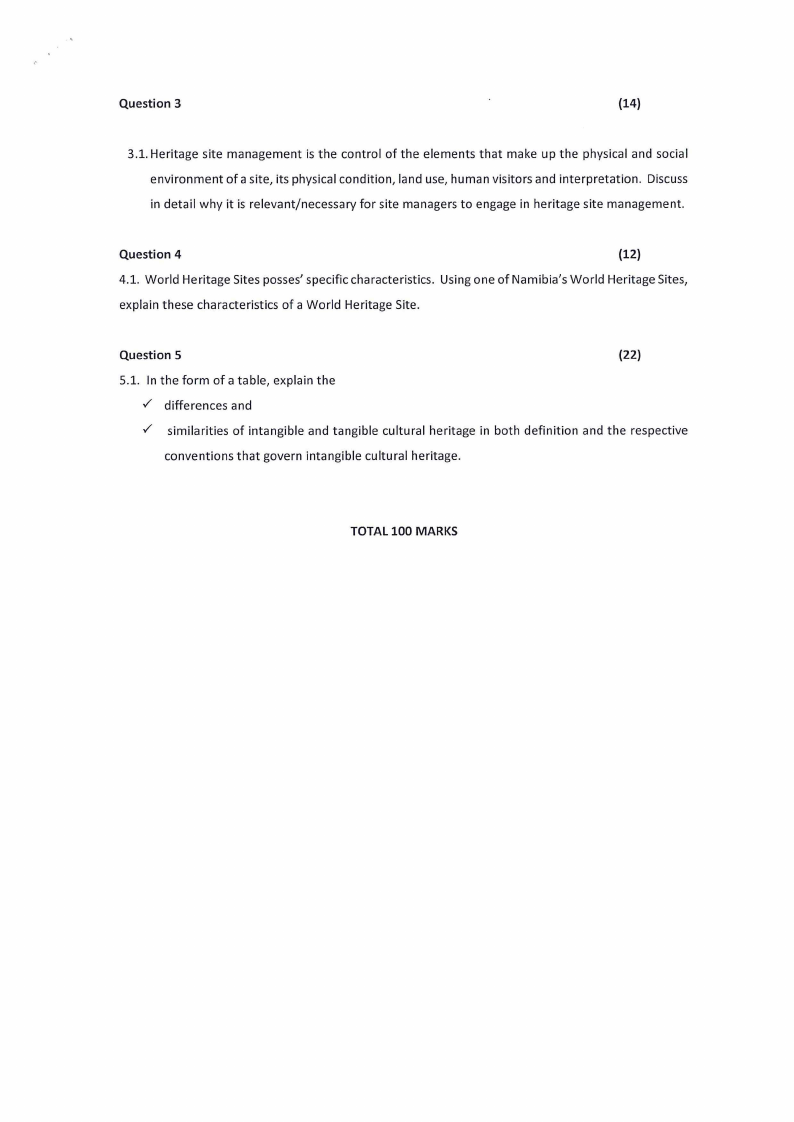
Question 3
(14)
3.1. Heritage site management is the control of the elements that make up the physical and social
environment of a site, its physical condition, land use, human visitors and interpretation. Discuss
in detail why it is relevant/necessary for site managers to engage in heritage site management.
Question 4
(12)
4.1. World Heritage Sites posses' specific characteristics. Using one of Namibia's World Heritage Sites,
explain these characteristics of a World Heritage Site.
Question 5
(22)
5.1. In the form of a table, explain the
differences and
similarities of intangible and tangible cultural heritage in both definition and the respective
conventions that govern intangible cultural heritage.
TOT AL 100 MARKS