


 |
CNH710S - CULTURAL AND NATURAL HERITAGE MANAGEMENT - 2ND OPP - JULY 2025 |
|
|
1 Page 1 |
▲back to top |
nAmlBIA UnlVERSITY
0 F SCIEn CE Ano TECHn OLOGY
FACULTY OF COMMERCE, HUMAN SCIENCES AND EDUCATION
DEPARTMENT OF HOSPITALITY AND TOURISM
QUALIFICATION: BACHELOR OF TOURISM INNOVATION AND DEVELOPMENT
QUALIFICATION CODE: 07BTID
LEVEL: 7
COURSE CODE: CNH710S
COURSE NAME: CULTURAL AND NATURAL
HERITAGE MANAGEMENT
SESSION: JULY 2025
DURATION: 2 HOURS
PAPER: PAPER 1
MARKS: 100
SECOND OPPORTUNITY EXAMINATION QUESTION PAPER
EXAMINER(S) DR ISOBEL MANUEL
MODERATOR: Mr. T. NUUGULU
INSTRUCTIONS
1. Answer ALL the questions.
2. Read all the questions carefully before answering.
3. Number the answers clearly
THIS QUESTION PAPER CONSISTS OF 2 PAGES (Including this front page)
|
|
2 Page 2 |
▲back to top |
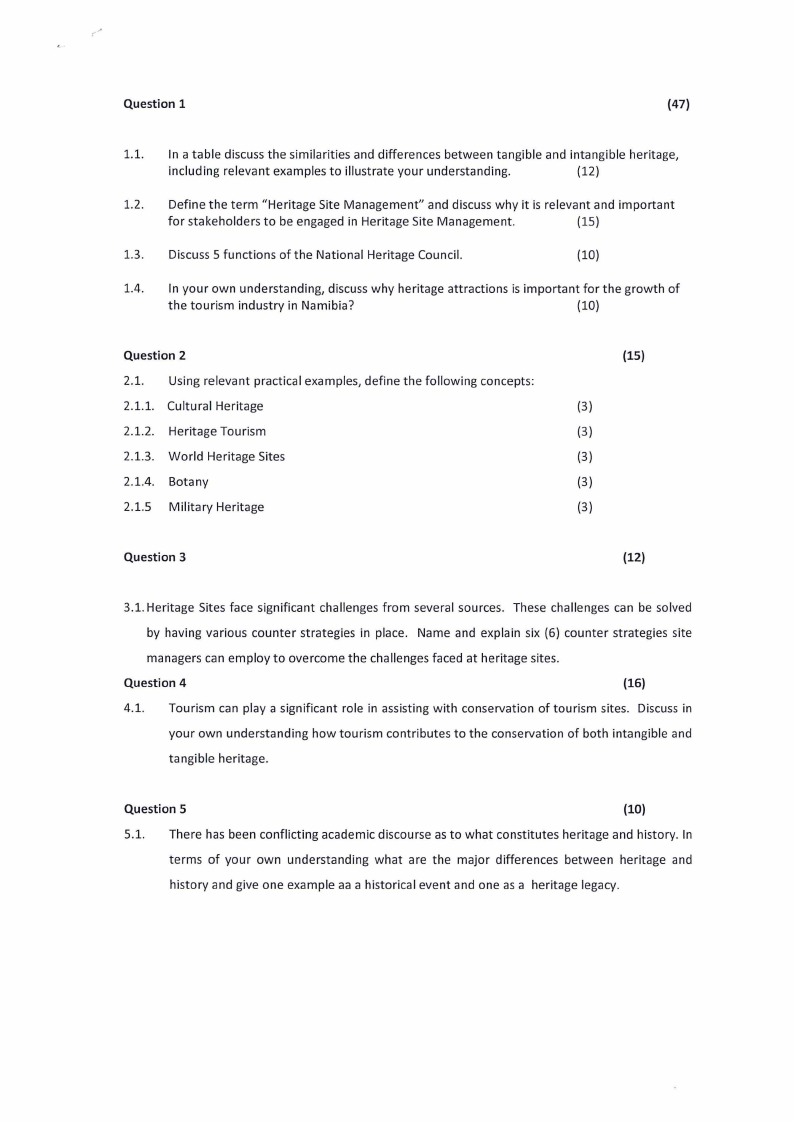
Question 1
(47)
1.1. In a table discuss the similarities and differences between tangible and intangible heritage,
including relevant examples to illustrate your understanding.
(12)
1.2. Define the term "Heritage Site Management" and discuss why it is relevant and important
for stakeholders to be engaged in Heritage Site Management.
(15)
1.3. Discuss 5 functions of the National Heritage Council.
(10)
1.4. In your own understanding, discuss why heritage attractions is important for the growth of
the tourism industry in Namibia?
(10)
Question 2
2.1. Using relevant practical examples, define the following concepts:
2.1.1. Cultural Heritage
2.1.2. Heritage Tourism
2.1.3. World Heritage Sites
2.1.4. Botany
2.1.5 Military Heritage
(15)
(3)
(3)
(3)
(3)
(3)
Question 3
(12)
3.1. Heritage Sites face significant challenges from several sources. These challenges can be solved
by having various counter strategies in place. Name and explain six (6) counter strategies site
managers can employ to overcome the challenges faced at heritage sites.
Question 4
(16)
4.1. Tourism can play a significant role in assisting with conservation of tourism sites. Discuss in
your own understanding how tourism contributes to the conservation of both intangible and
tangible heritage.
Question 5
(10)
5.1. There has been conflicting academic discourse as to what constitutes heritage and history. In
terms of your own understanding what are the major differences between heritage and
history and give one example aa a historical event and one as a heritage legacy.