TOC621s - Transport Operations And Costing - 1st Opp - Nov 2025


TOC621s - Transport Operations And Costing - 1st Opp - Nov 2025


1 Page 1

▲back to top


n Am I B I A u n IVE Rs I TY
OF SCIEnCE Ano TECHnOLOGY
FACULTY OF COMMERCE, HUMAN SCIENCES AND EDUCATION
DEPARTMENT OF MARKETING, LOGISTICS AND SPORT MANAGEMENT
QUALIFICATION : BACHELOR OF TRANSPORT MANAGEMENT
QUALIFICATION CODE: 07BTRA
COURSE CODE: TOC621S
SESSION: NOVEMBER 2025
DURATION: 3 HOURS
LEVEL: 6
COURSE NAME: TRANSPORT OPERATIONS AND
COSTING
PAPER: THEORY
MARKS: 100
FIRST OPPORTUNITY EXAMINATION QUESTION PAPER
EXAMINER(S) MR. VETIRAIJE TJIPOMBO (FT & PT)
MR. AUGUSTUS ANTONIO (EN)
MR. BETHUEL NANGOMBE (DI)
MODERATOR: Ms. ESTER JESAYA
INSTRUCTIONS
1. Answer ALL the questions
2. Read all the questions carefully before answering.
3. Number the answers clearly
THIS EXAMINATION PAPER CONSISTS OF _9_ PAGES (Including this front pages)

2 Page 2

▲back to top


SECTION A: SHORT ANSWER QUESTIONS
QUESTION 1: MULTIPLE CHOICE
Indicate the correct answer by for example: 1.1. A, 1.2. B or 1.3. C
(30 MARKS)
1. Why is addressing environmental sustainability a significant challenge for airlines, and how can
it be tackled effectively?
A.
Due to the high cost of aircraft maintenance.
B.
It's primarily related to airport congestion.
C.
Exploring alternative fuel sources and fleet renewal.
D.
Through improved baggage handling processes.
2. How do air traffic controllers play a critical role in ensuring the safety and efficiency of air
travel?
A.
By conducting routine aircraft maintenance.
B.
By managing air traffic using advanced radar systems.
C.
By handling baggage and cargo.
D.
By inspecting airport facilities.
3. A Who is responsible for the safety of the aircraft, passengers, and crew members during a
flight?
A.
Co-pilot
B.
Flight engineer
C.
Pilot-In-Command (Pie) or captain
D.
Flight attendant
4. Which route structure is characterized by flights that operate independently, allowing for high
utilization of aircraft and personnel?
A.
Point-to-Point system
B.
Linear Route System
C.
Hub-and-Spoke (H&S) Route System
D.
Hybrid Route System
5. In the hub-and-spoke route system, passengers departing from one spoke city to another spoke
city usually:
A.
Take a non-stop flight
B.
Make one connecting stop at the hub city
C.
Fly directly to their destination
D.
Change aircraft at the spoke city
6. What is a major disadvantage of the linear route system?
A.
High unit cost due to long distances between stops
B.
Complexity in scheduling and operational control
C.
. Limited passenger demand for connecting flights
2

3 Page 3

▲back to top


D.
Inefficient use of aircraft and personnel
7. Elaborating on the coordination and management role of port authorities, how can their
effectiveness influence a seaport's ability to thrive and engage stakeholders in a dynamic
industry?
A.
By promoting inefficiencies and stakeholder conflicts
B.
By having minimal impact on stakeholder engagement
C.
By enhancing stakeholder engagement, operational efficiency, and adaptability
D.
By focusing exclusively on cargo equipment suppliers
8. You are a consultant advising a seaport on enhancing its competitive advantages. Which of the
following is NOT considered a competitive advantage for a seaport's success?
A.
The size of the port's cargo handling equipment
B.
Geographical location
C.
Legal and regulatory framework
D.
Economy
9. You are a port manager dealing with Off-Port-Limits (OPL) Operations. What is the primary
purpose of OPL operations at your port?
A.
Handling cargo loading and unloading
B.
Providing logistics services
C.
Managing passenger embarkation
D.
Coordinating cargo distribution within the supply chain
10. A charterer is considering different charter party types. Which charter party type provides
charterers with the most control over a ship's functions?
A. Voyage Charter Party
B. Time Charter Party
C. Contract of Affreightment (COA)
D. Bareboat Charter Party
11. You're working as a logistics coordinator for a major retail company. To optimize your supply
chain, you need to understand the structural components of the transport system. Which
element among the following is NOT a part of this system?
a.
Demand
b.
Nodes
c.
Networks
d.
Demand elasticity
12. As a transportation analyst, you're assessing modal competition for a shipping company. In
which situation do different transportation modes tend to complement each other, and how
does this benefit the overall logistics?
a.
When they serve similar geographical markets
3

4 Page 4

▲back to top


b.
When they operate in different transport markets
c.
When they offer varying levels of service
d.
None of the above
13. A city planner is developing a comprehensive transportation strategy. They want to consider
various aspects to ensure efficiency. Which dimension among the following, as defined in
transportation geography, primarily deals with managing information and data related to
transport?
a.
Economics
b.
Engineering
c.
Mathematics and Computer Science
d.
Planning and Policy
14. You are an urban planner tasked with improving transportation systems in a growing city.
Explain how planning and policy dimension plays a pivotal role in achieving effective
transportation networks and what strategies can be employed.
a.
Discuss the historical factors influencing transportation planning
b.
Evaluate the social costs associated with modal and spatial choices
c.
Analyze the political interventions that can shape transportation systems
d.
Examine technological advancements that impact transportation efficiency.
15. You are a logistics manager for a multinational corporation. When deciding which transport
mode to use for distributing products across continents, that key factors should you
consider? Provide examples of situations where geographical constraints may limit the
choice of transport mode.
a.
Consider the physical attributes of the shipment and its distribution requirements.
b.
Evaluate the weather conditions along the transportation route.
c.
Assess the availability of skilled personnel for each mode.
d.
Analyze the historical performance of each mode.
16. You're a pricing strategist for a transportation company. How do operational costs impact
your pricing objectives, and what strategies can you implement to maintain competitiveness
while dealing with a higher operational cost?
a.
Operational costs have no direct impact on pricing
b.
Higher operational costs necessitate higher pricing to cover expenses
c.
Lower operational costs allow for more competitive pricing strategies.
d.
Pricing objectives are solely based on market demand
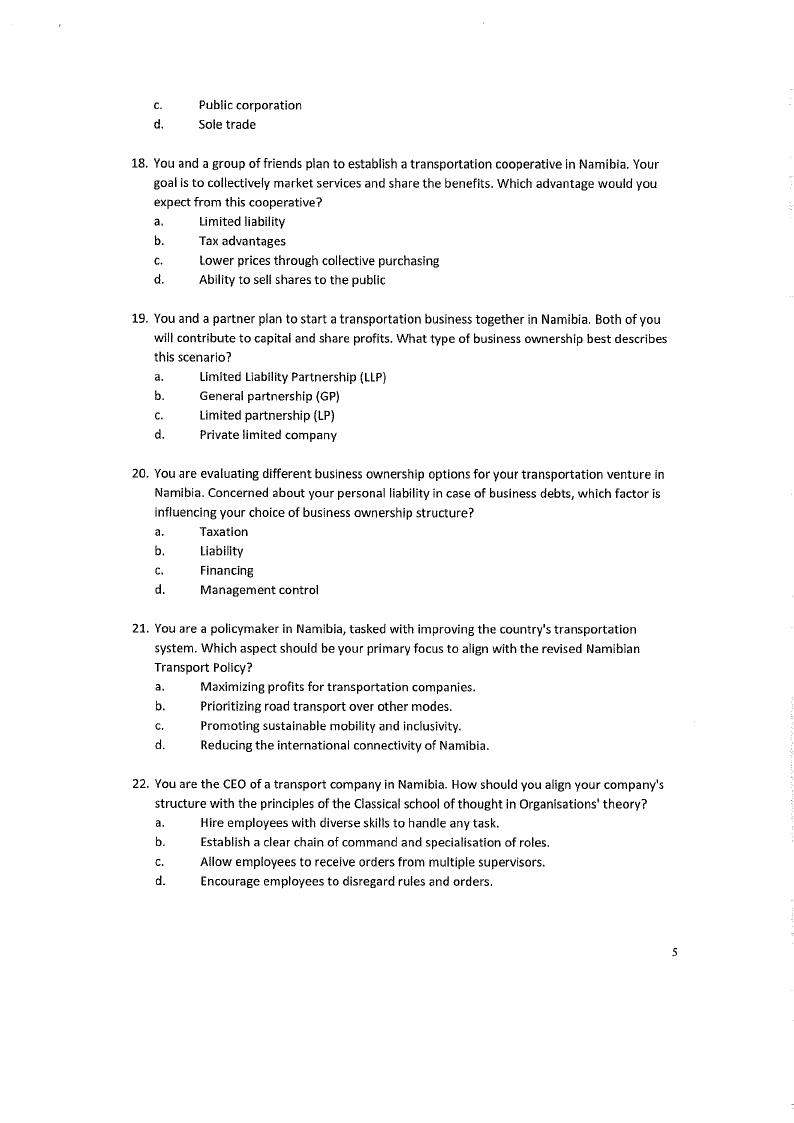
17. You are considering staring a transportation business in Namibia. You want to operate
independently, making all decisions and being solely responsible for profits and liabilities.
What type of business ownership would suit your scenario?
a.
limited company
b.
Partnership
4

5 Page 5

▲back to top


c.
Public corporation
d.
Sole trade
18. You and a group of friends plan to establish a transportation cooperative in Namibia. Your
goal is to collectively market services and share the benefits. Which advantage would you
expect from this cooperative?
a.
Limited liability
b.
Tax advantages
c.
Lower prices through collective purchasing
d.
Ability to sell shares to the public
19. You and a partner plan to start a transportation business together in Namibia. Both of you
will contribute to capital and share profits. What type of business ownership best describes
this scenario?
a.
Limited Liability Partnership (LLP)
b.
General partnership (GP)
c.
Limited partnership (LP)
d.
Private limited company
20. You are evaluating different business ownership options for your transportation venture in
Namibia. Concerned about your personal liability in case of business debts, which factor is
influencing your choice of business ownership structure?
a.
Taxation
b.
Liability
c.
Financing
d.
Management control
21. You are a policymaker in Namibia, tasked with improving the country's transportation
system. Which aspect should be your primary focus to align with the revised Namibian
Transport Policy?
a.
Maximizing profits for transportation companies.
b.
Prioritizing road transport over other modes.
c.
Promoting sustainable mobility and inclusivity.
d.
Reducing the international connectivity of Namibia.
22. You are the CEO of a transport company in Namibia. How should you align your company's
structure with the principles of the Classical school of thought in Organisations' theory?
a.
Hire employees with diverse skills to handle any task.
b.
Establish a clear chain of command and specialisation of roles.
c.
Allow employees to receive orders from multiple supervisors.
d.
Encourage employees to disregard rules and orders.
5

6 Page 6

▲back to top


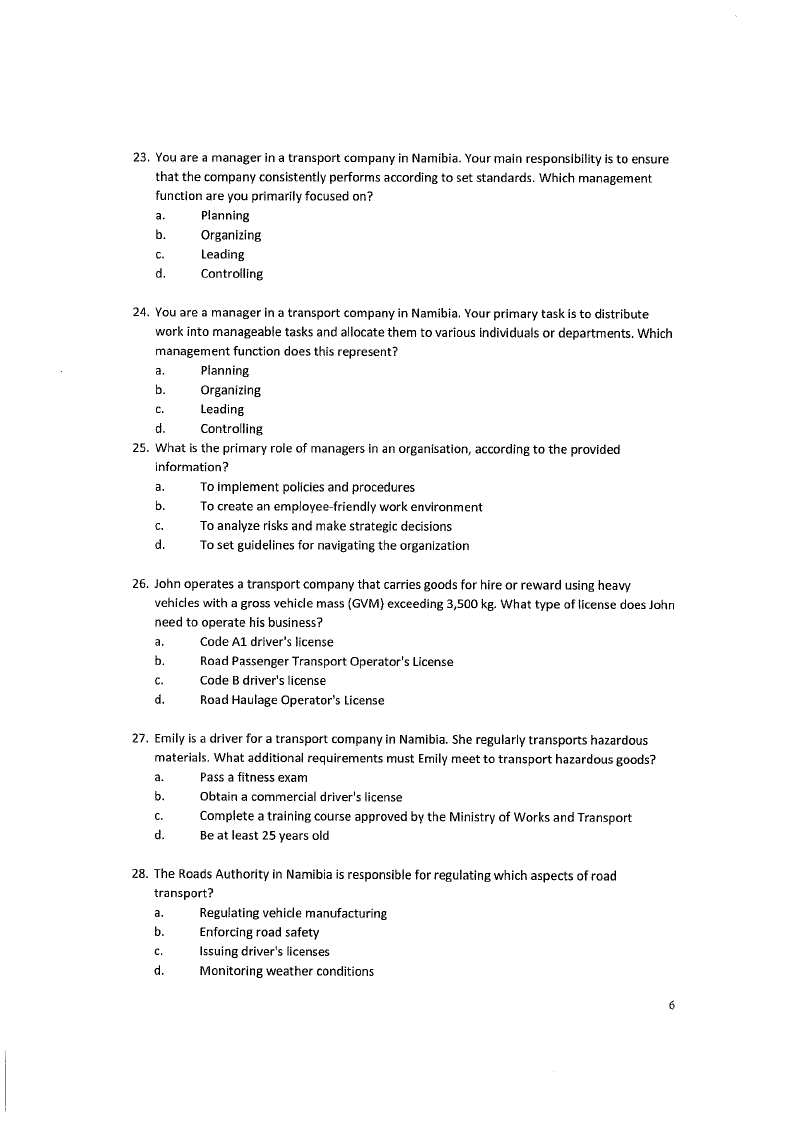
23. You are a manager in a transport company in Namibia. Your main responsibility is to ensure
that the company consistently performs according to set standards. Which management
function are you primarily focused on?
a.
Planning
b.
Organizing
c.
Leading
d.
Controlling
24. You are a manager in a transport company in Namibia. Your primary task is to distribute
work into manageable tasks and allocate them to various individuals or departments. Which
management function does this represent?
a.
Planning
b.
Organizing
c.
Leading
d.
Controlling
25. What is the primary role of managers in an organisation, according to the provided
information?
a.
To implement policies and procedures
b.
To create an employee-friendly work environment
c.
To analyze risks and make strategic decisions
d.
To set guidelines for navigating the organization
26. John operates a transport company that carries goods for hire or reward using heavy
vehicles with a gross vehicle mass (GVM) exceeding 3,500 kg. What type of license does John
need to operate his business?
a.
Code Al driver's license
b.
Road Passenger Transport Operator's License
c.
Code B driver's license
d,
Road Haulage Operator's License
27. Emily is a driver for a transport company in Namibia. She regularly transports hazardous
materials. What additional requirements must Emily meet to transport hazardous goods?
a.
Pass a fitness exam
b.
Obtain a commercial driver's license
c.
Complete a training course approved by the Ministry of Works and Transport
d.
Be at least 25 years old
28. The Roads Authority in Namibia is responsible for regulating which aspects of road
transport?
a.
Regulating vehicle manufacturing
b.
Enforcing road safety
c.
Issuing driver1s licenses
d.
Monitoring weather conditions
6

7 Page 7

▲back to top


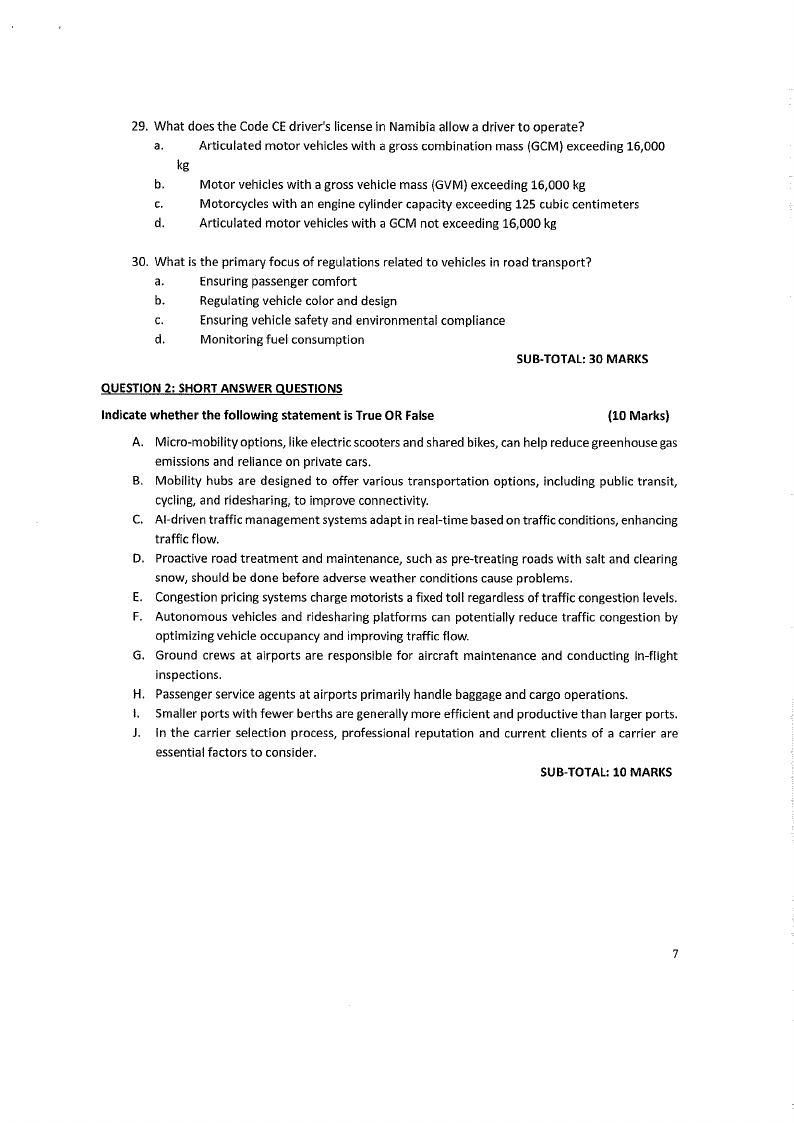
29. What does the Code CE driver's license in Namibia allow a driver to operate?
a.
Articulated motor vehicles with a gross combination mass (GCM) exceeding 16,000
kg
b.
Motor vehicles with a gross vehicle mass (GVM) exceeding 16,000 kg
c.
Motorcycles with an engine cylinder capacity exceeding 125 cubic centimeters
d.
Articulated motor vehicles with a GCM not exceeding 16,000 kg
30. What is the primary focus of regulations related to vehicles in road transport?
a.
Ensuring passenger comfort
b.
Regulating vehicle color and design
c.
Ensuring vehicle safety and environmental compliance
d.
Monitoring fuel consumption
SUB-TOTAL: 30 MARKS
QUESTION 2: SHORT ANSWER QUESTIONS
Indicate whether the following statement is True OR False
(10 Marks)
A. Micro-mobility options, like electric scooters and shared bikes, can help reduce greenhouse gas
emissions and reliance on private cars.
B. Mobility hubs are designed to offer various transportation options, including public transit,
cycling, and ridesharing, to improve connectivity.
C. Al-driven traffic management systems adapt in real-time based on traffic conditions, enhancing
traffic flow.
D. Proactive road treatment and maintenance, such as pre-treating roads with salt and clearing
snow, should be done before adverse weather conditions cause problems.
E. Congestion pricing systems charge motorists a fixed toll regardless of traffic congestion levels.
F. Autonomous vehicles and ridesharing platforms can potentially reduce traffic congestion by
optimizing vehicle occupancy and improving traffic flow.
G. Ground crews at airports are responsible for aircraft maintenance and conducting in-flight
inspections.
H. Passenger service agents at airports primarily handle baggage and cargo operations.
I. Smaller ports with fewer berths are generally more efficient and productive than larger ports.
J. In the carrier selection process, professional reputation and current clients of a carrier are
essential factors to consider.
SUB-TOTAL: 10 MARKS
7

8 Page 8

▲back to top


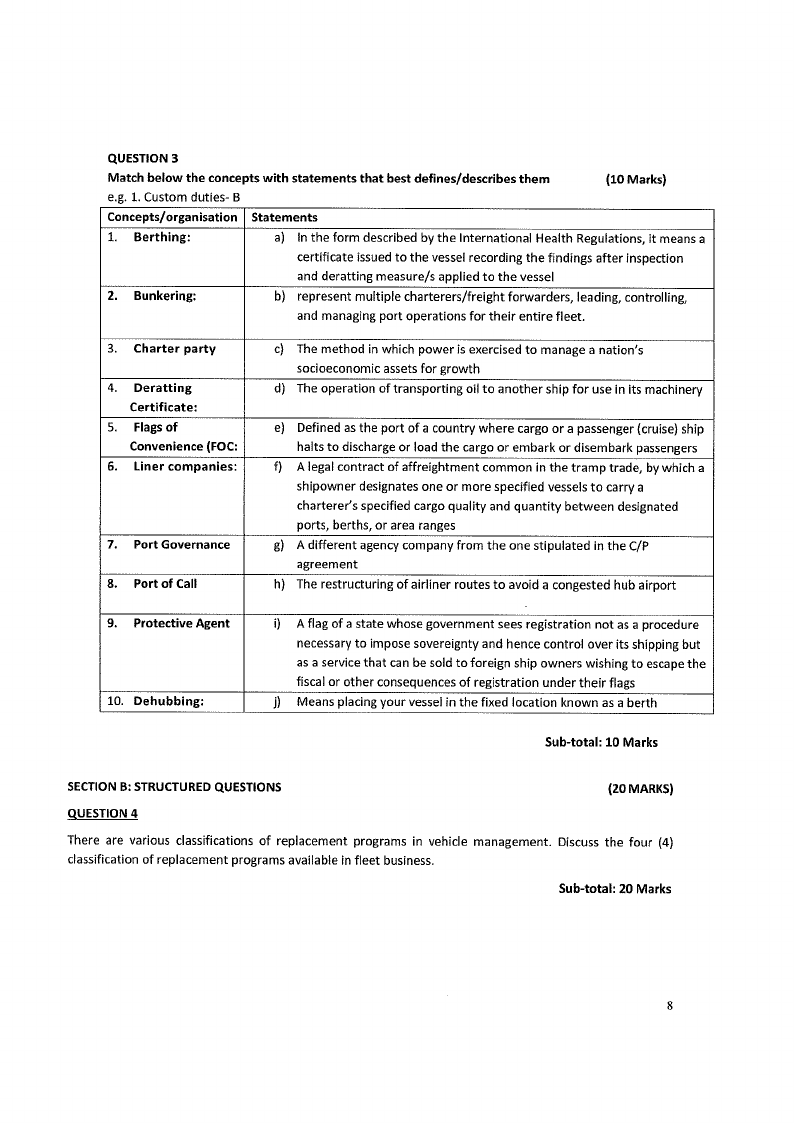
QUESTION 3
Match below the concepts with statements that best defines/describes them
e.g. 1. Custom duties- B
(10 Marks)
Concepts/organisation Statements
1. Berthing:
a) In the form described by the International Health Regulations, it means a
certificate issued to the vessel recording the findings after inspection
and deratting measure/s applied to the vessel
2. Bunkering:
b) represent multiple charterers/freight forwarders, leading, controlling,
and managing port operations for their entire fleet.
3. Charter party
4. Deratting
Certificate:
5. Flags of
Convenience (FOC:
6. Liner companies:
7. Port Governance
8. Port of Call
c) The method in which power is exercised to manage a nation's
socioeconomic assets for growth
d) The operation of transporting oil to another ship for use in its machinery
e) Defined as the port of a country where cargo or a passenger (cruise) ship
halts to discharge or load the cargo or embark or disembark passengers
f) A legal contract of affreightment common in the tramp trade, by which a
shipowner designates one or more specified vessels to carry a
charterer's specified cargo quality and quantity between designated
ports, berths, or area ranges
g) A different agency company from the one stipulated in the C/P
agreement
h) The restructuring of airliner routes to avoid a congested hub airport
9. Protective Agent
10. Dehubbing:
i) A flag of a state whose government sees registration not as a procedure
necessary to impose sovereignty and hence control over its shipping but
as a service that can be sold to foreign ship owners wishing to escape the
fiscal or other consequences of registration under their flags
j) Means placing your vessel in the fixed location known as a berth
Sub-total: 10 Marks
SECTION B: STRUCTURED QUESTIONS
QUESTION4
(20MARKS)
There are various classifications of replacement programs in vehicle management. Discuss the four (4)
classification of replacement programs available in fleet business.
Sub-total: 20 Marks
8

9 Page 9

▲back to top


QUESTION 5
(20 MARKS)
You are a maritime consultant, and a port authority has approached you to improve its port operations. Discuss
any five (5) key competitive advantages a port should leverage for success, considering factors such as
geographical location, legal framework, and technological innovation.
Sub-total: 20 Marks
QUESTION6
(10 MARKS)
Imagine you are a senior aviation consultant advising a national airline considering expanding its international
routes. Discuss the key factors the airline should consider when evaluating the safety and security aspects of
operating in foreign airspace. Provide specific examples and recommendations.
Sub-total: 10 Marks
END OF EXAMINATION PAPER
Grand Total: 100 Marks
9

10 Page 10

▲back to top