


 |
TOC621S - Transport Operations And Costing - 2nd Opp - Nov 2025 |
|
|
1 Page 1 |
▲back to top |
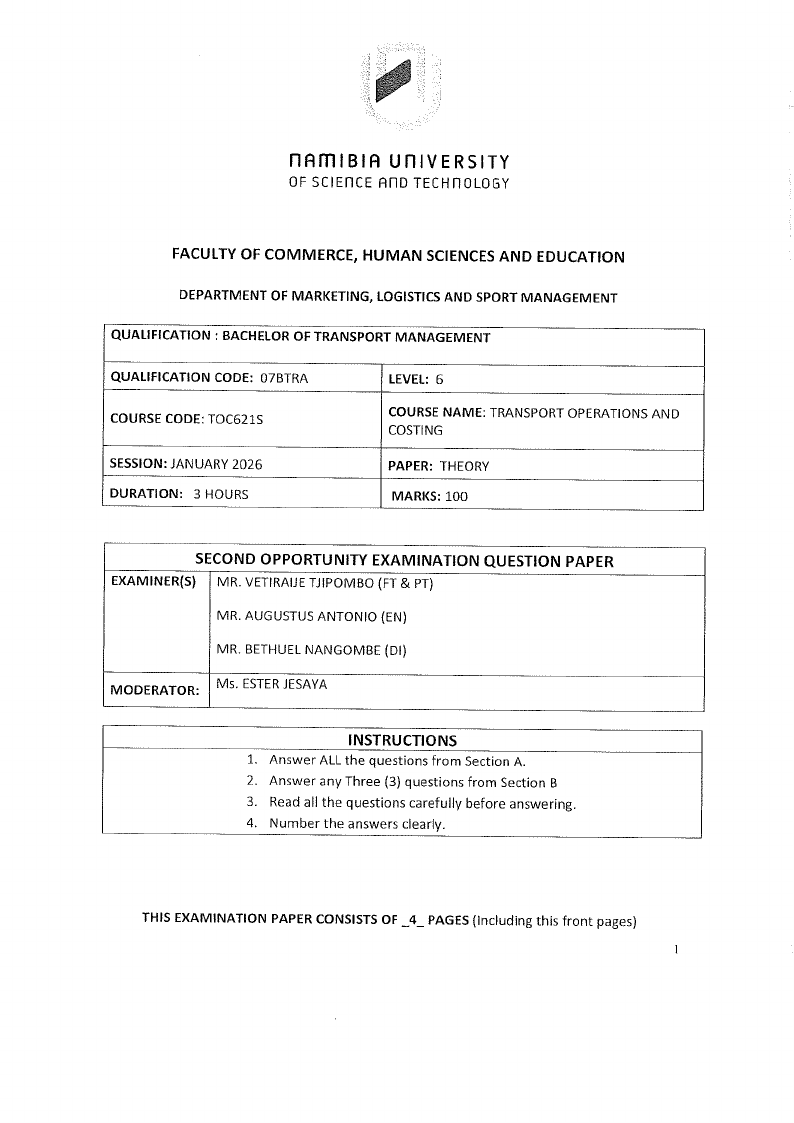
nAmlBIA untVERSITY
OF SCIEnCE Ano TECHnOLOGY
FACULTY OF COMMERCE, HUMAN SCIENCES AND EDUCATION
DEPARTMENT OF MARKETING, LOGISTICS AND SPORT MANAGEMENT
QUALIFICATION: BACHELOR OF TRANSPORT MANAGEMENT
QUALIFICATION CODE: 07BTRA
COURSE CODE: TOC621S
SESSION: JANUARY 2026
DURATION: 3 HOURS
LEVEL: 6
COURSE NAME: TRANSPORT OPERATIONS AND
COSTING
PAPER: THEORY
MARKS: 100
SECOND OPPORTUNITY EXAMINATION QUESTION PAPER
EXAMINER($) MR. VETIRAIJE TJIPOMBO (FT & PT)
MR. AUGUSTUS ANTONIO (EN)
MR. BETHUEL NANGOMBE (DI)
MODERATOR: Ms. ESTER JESAYA
INSTRUCTIONS
1. Answer ALL the questions from Section A.
2. Answer any Three (3) questions from Section B
3. Read all the questions carefully before answering.
4. Number the answers clearly.
THIS EXAMINATION PAPER CONSISTS OF_4_ PAGES (Including this front pages)
|
|
2 Page 2 |
▲back to top |
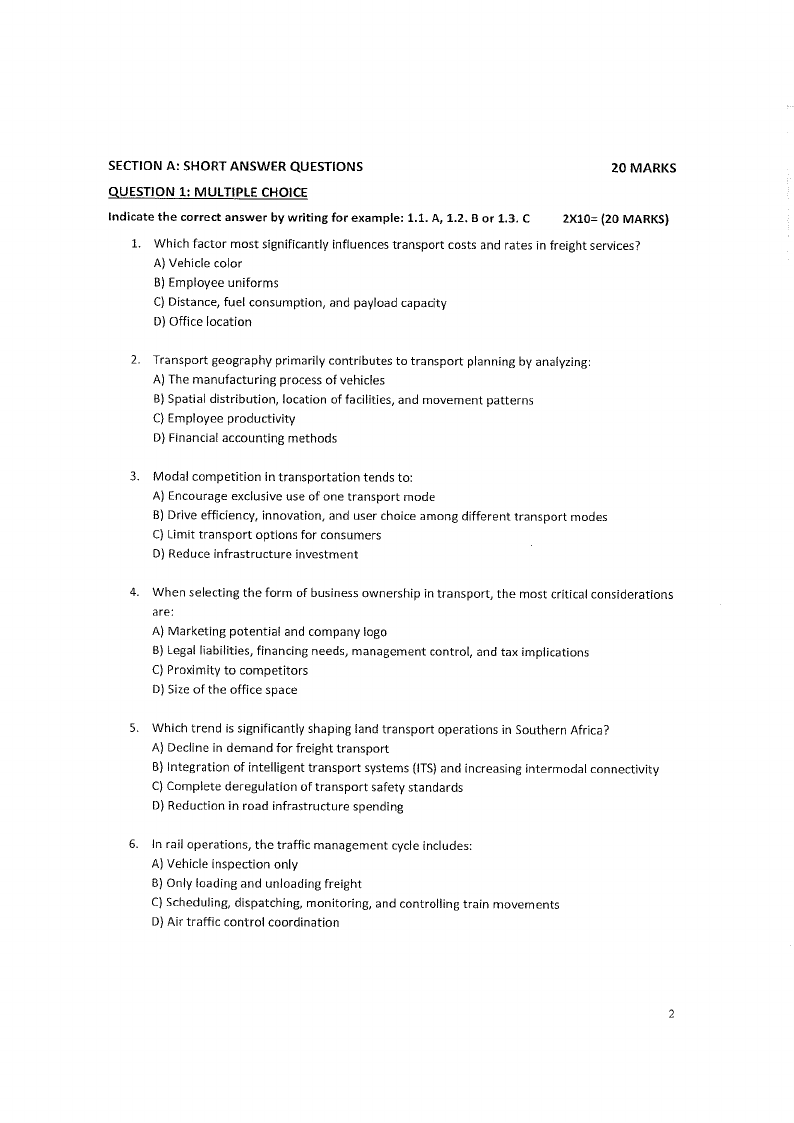
SECTION A: SHORT ANSWER QUESTIONS
20MARKS
QUESTION 1: MULTIPLE CHOICE
Indicate the correct answer by writing for example: 1.1. A, 1.2. B or 1.3. C
2X10= (20 MARKS)
1. Which factor most significantly influences transport costs and rates in freight services?
A) Vehicle color
B) Employee uniforms
C) Distance, fuel consumption, and payload capacity
D) Office location
2. Transport geography primarily contributes to transport planning by analyzing:
A) The manufacturing process of vehicles
8) Spatial distribution, location of facilities, and movement patterns
C) Employee productivity
D) Financial accounting methods
3. Modal competition in transportation tends to:
A) Encourage exclusive use of one transport mode
B) Drive efficiency, innovation, and user choice among different transport modes
C) Limit transport options for consumers
D) Reduce infrastructure investment
4. When selecting the form of business ownership in transport, the most critical considerations
are:
A) Marketing potential and company logo
B) Legal liabilities, financing needs, management control, and tax implications
C) Proximity to competitors
D) Size of the office space
5. Which trend is significantly shaping land transport operations in Southern Africa?
A) Decline in demand for freight transport
B) Integration of intelligent transport systems (ITS) and increasing intermodal connectivity
C) Complete deregulation of transport safety standards
D) Reduction in road infrastructure spending
6. In rail operations, the traffic management cycle includes:
A) Vehicle inspection only
B) Only loading and unloading freight
C) Scheduling, dispatching, monitoring, and controlling train movements
D) Air traffic control coordination
2
|
|
3 Page 3 |
▲back to top |
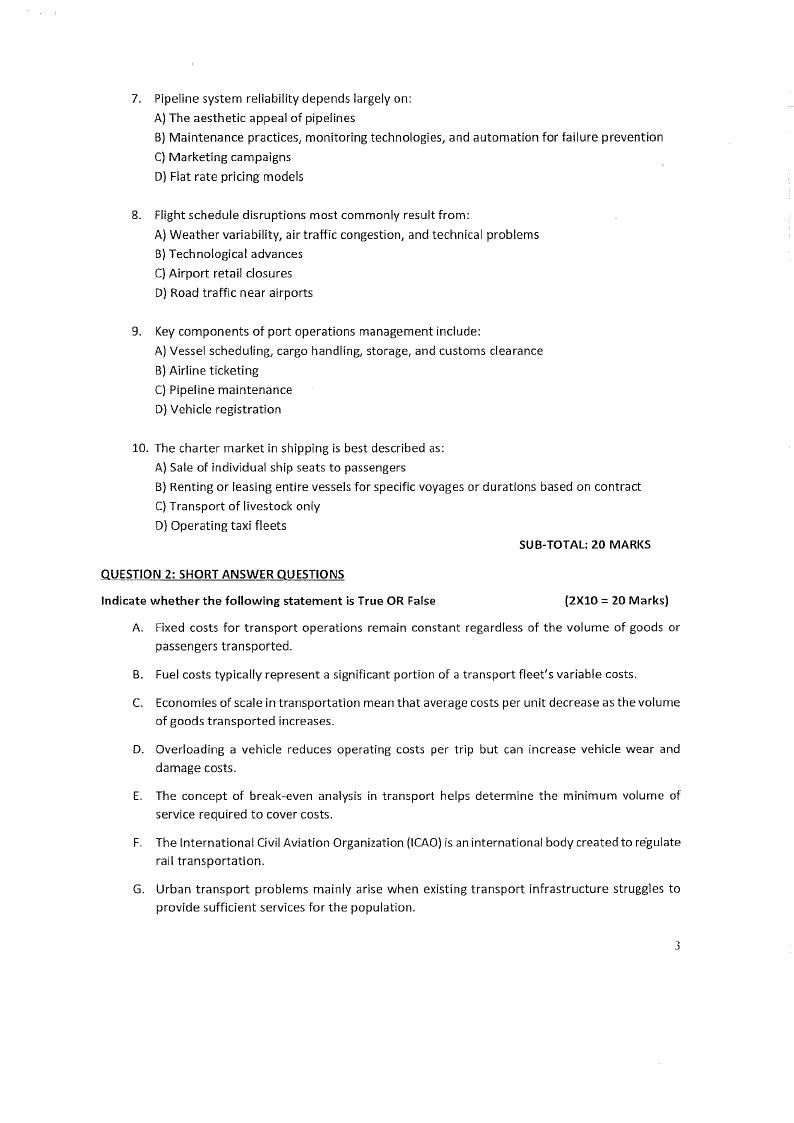
7. Pipeline system reliability depends largely on:
A) The aesthetic appeal of pipelines
B) Maintenance practices, monitoring technologies, and automation for failure prevention
C) Marketing campaigns
D) Flat rate pricing models
8. Flight schedule disruptions most commonly result from:
A) Weather variability, air traffic congestion, and technical problems
B) Technological advances
C) Airport retail closures
D) Road traffic near airports
9. Key components of port operations management include:
A) Vessel scheduling, cargo handling, storage, and customs clearance
B) Airline ticketing
C) Pipeline maintenance
D) Vehicle registration
10. The charter market in shipping is best described as:
A) Sale of individual ship seats to passengers
B} Renting or leasing entire vessels for specific voyages or durations based on contract
C) Transport of livestock only
D) Operating taxi fleets
SUB-TOTAL: 20 MARKS
QUESTION 2: SHORT ANSWER QUESTIONS
Indicate whether the following statement is True OR False
{2X10 = 20 Marks)
A. Fixed costs for transport operations remain constant regardless of the volume of goods or
passengers transported.
8. Fuel costs typically represent a significant portion of a transport fleet's variable costs.
C. Economies of scale in transportation mean that average costs per unit decrease as the volume
of goods transported increases.
D. Overloading a vehicle reduces operating costs per trip but can increase vehicle wear and
damage costs.
E. The concept of break-even analysis in transport helps determine the minimum volume of
service required to cover costs.
F. The International Civil Aviation Organization (!CAO) is an international body created to re·gulate
rail transportation.
G. Urban transport problems mainly arise when existing transport infrastructure struggles to
provide sufficient services for the population.
3
|
|
4 Page 4 |
▲back to top |
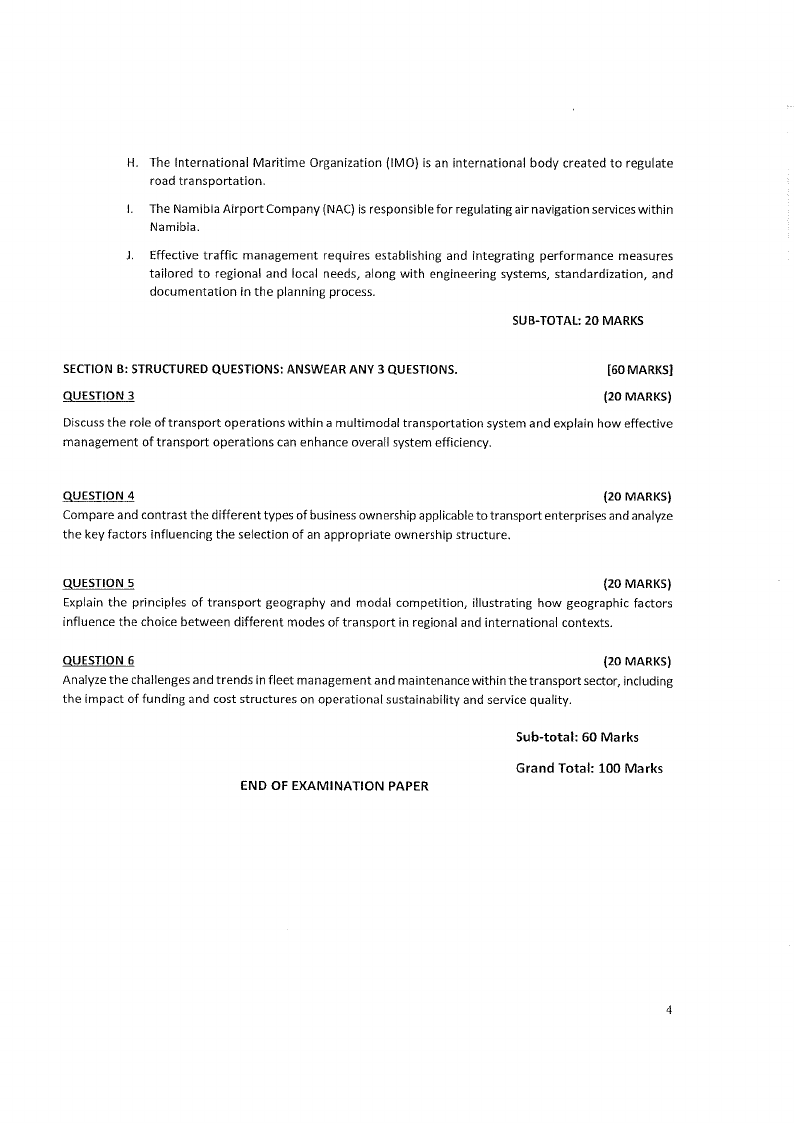
H. The International Maritime Organization (IMO) is an international body created to regulate
road transportation.
L The Namibia Airport Company (NAC) is responsible for regulating air navigation services within
Namibia.
J. Effective traffic management requires establishing and integrating performance measures
tailored to regional and local needs, along with engineering systems, standardization, and
documentation in the planning process.
SUB-TOTAL: 20 MARKS
SECTION B: STRUCTURED QUESTIONS: ANSWEAR ANY 3 QUESTIONS.
[60MARKS]
QUESTION 3
(20 MARKS)
Discuss the role of transport operations within a multi modal transportation system and explain how effective
management of transport operations can enhance overall system efficiency.
QUESTION 4
(20 MARKS)
Compare and contrast the different types of business ownership applicable to transport enterprises and analyze
the key factors influencing the selection of an appropriate ownership structure.
QUESTION 5
(20 MARKS)
Explain the principles of transport geography and modal competition, illustrating how geographic factors
influence the choice between different modes of transport in regional and international contexts.
QUESTION 6
(20 MARKS)
Analyze the challenges and trends in fleet management and maintenance within the transport sector, including
the impact of funding and cost structures on operational sustainability and service quality.
END OF EXAMINATION PAPER
Sub-total: 60 Marks
Grand Total: 100 Marks
4