


 |
NRS711S - NATURAL RESOURCES MANAGEMENT AND SUSTAINABLE DEVELOPMENT - 1ST OPP - JUNE 2025 |
|
|
1 Page 1 |
▲back to top |
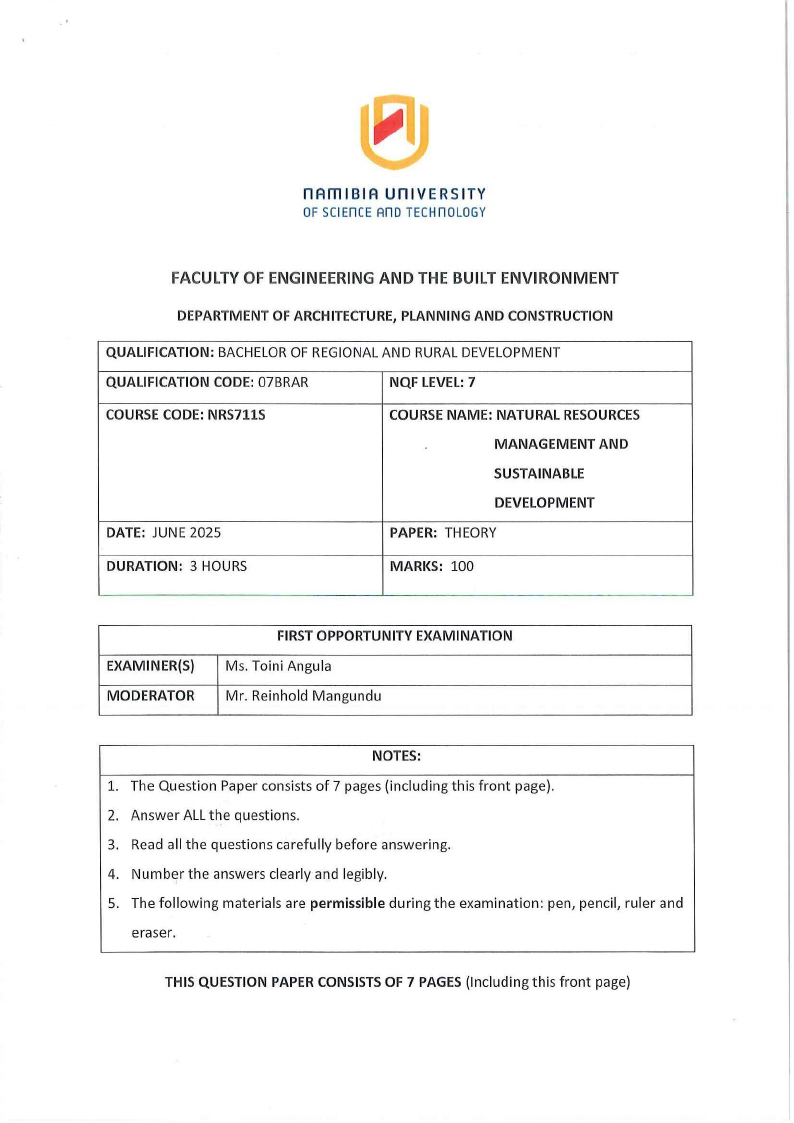
nAmlBIA UnlVERSITY
OF SCIEnCE Ano TECHnOLOGY
FACULTYOF ENGINEERINGAND THE BUILTENVIRONMENT
DEPARTMENTOF ARCHITECTUREP, LANNINGAND CONSTRUCTION
QUALIFICATION:BACHELOROF REGIONALAND RURAL DEVELOPMENT
QUALIFICATIONCODE:07BRAR
NQF LEVEL:7
COURSECODE:NRS711S
DATE: JUNE 2025
COURSENAME: NATURALRESOURCES
MANAGEMENT AND
SUSTAINABLE
DEVELOPMENT
PAPER: THEORY
DURATION: 3 HOURS
MARKS: 100
EXAMINER(S}
MODERATOR
FIRSTOPPORTUNITYEXAMINATION
Ms. Toini Angula
Mr. Reinhold Mangundu
NOTES:
1. The Question Paper consists of 7 pages (including this front page).
2. Answer ALL the questions.
3. Read all the questions carefully before answering.
4. Number the answers clearly and legibly.
5. The following materials are permissible during the examination: pen, pencil, ruler and
eraser.
THIS QUESTIONPAPERCONSISTSOF 7 PAGES(Including this front page)
|
|
2 Page 2 |
▲back to top |
Natural Resource Management and Sustainable Development
NRS711S
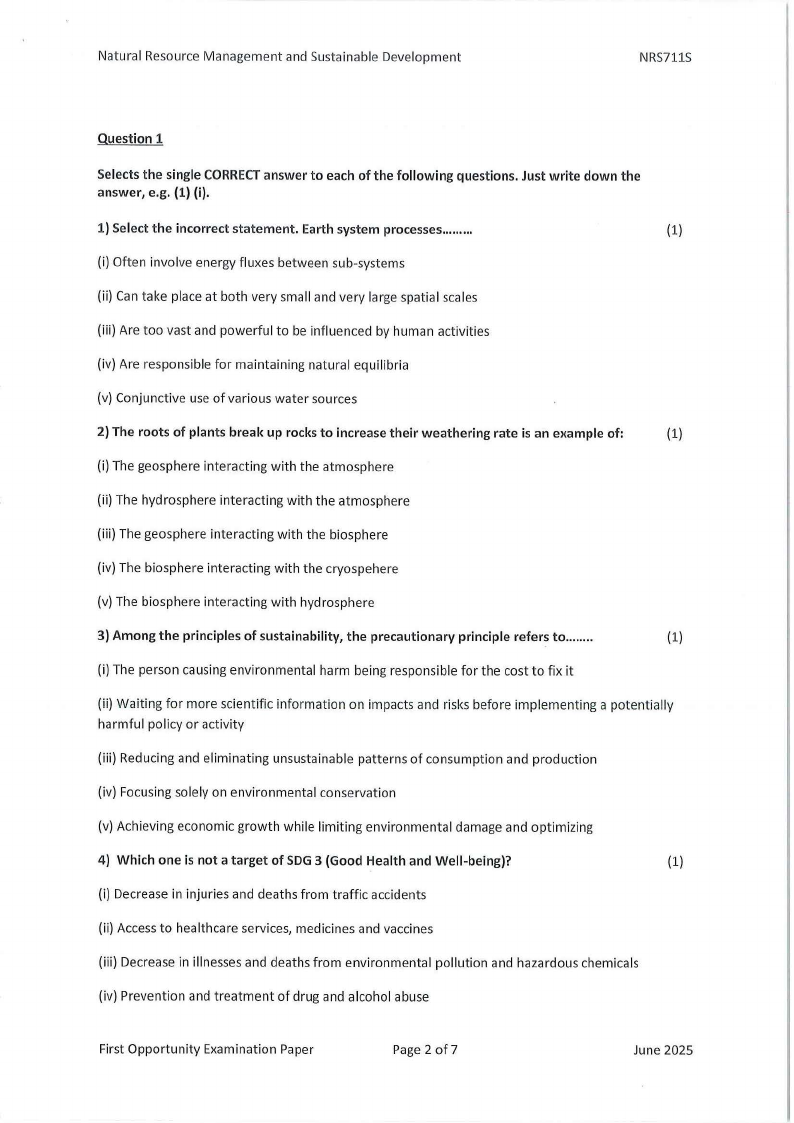
Question 1
Selects the single CORRECTanswer to each of the following questions. Just write down the
answer, e.g. (1) (i).
1) Select the incorrect statement. Earth system processes.........
(1)
(i) Often involve energy fluxes between sub-systems
(ii) Can take place at both very small and very large spatial scales
(iii) Are too vast and powerful to be influenced by human activities
(iv) Are responsible for maintaining natural equilibria
(v) Conjunctive use of various water sources
2) The roots of plants break up rocks to increase their weathering rate is an example of:
(1)
(i) The geosphere interacting with the atmosphere
(ii) The hydrosphere interacting with the atmosphere
(iii) The geosphere interacting with the biosphere
(iv) The biosphere interacting with the cryospehere
(v) The biosphere interacting with hydrosphere
3) Among the principles of sustainability, the precautionary principle refers to ........
(1)
(i) The person causing environmental harm being responsible for the cost to fix it
(ii) Waiting for more scientific information on impacts and risks before implementing a potentially
harmful policy or activity
(iii) Reducing and eliminating unsustainable patterns of consumption and production
(iv) Focusing solely on environmental conservation
(v) Achieving economic growth while limiting environmental damage and optimizing
4) Which one is not a target of SDG 3 (Good Health and Well-being)?
(1)
(i) Decrease in injuries and deaths from traffic accidents
(ii) Access to healthcare services, medicines and vaccines
(iii) Decrease in illnesses and deaths from environmental pollution and hazardous chemicals
(iv) Prevention and treatment of drug and alcohol abuse
First Opportunity Examination Paper
Page 2 of 7
June 2025
|
|
3 Page 3 |
▲back to top |
Natural Resource Management and Sustainable Development
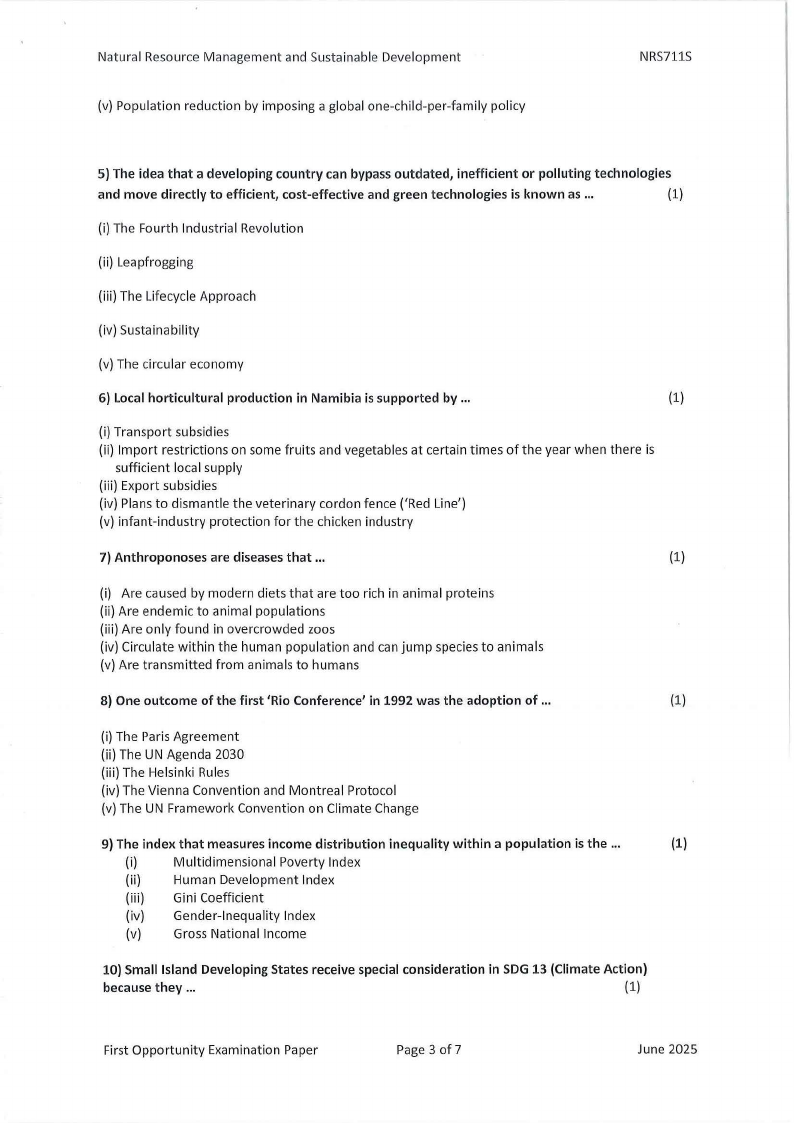
(v) Population reduction by imposing a global one-child-per-family policy
NRS711S
5) The idea that a developing country can bypass outdated, inefficient or polluting technologies
and move directly to efficient, cost-effective and green technologies is known as...
(1)
(i) The Fourth Industrial Revolution
(ii) Leapfrogging
(iii) The Lifecycle Approach
(iv) Sustainability
(v) The circular economy
6) Local horticultural production in Namibia is supported by ...
(1)
(i) Transport subsidies
(ii) Import restrictions on some fruits and vegetables at certain times of the year when there is
sufficient local supply
(iii) Export subsidies
(iv) Plans to dismantle the veterinary cordon fence ('Red Line')
(v) infant-industry protection for the chicken industry
7) Anthroponoses are diseases that ...
(1)
(i) Are caused by modern diets that are too rich in animal proteins
(ii) Are endemic to animal populations
(iii) Are only found in overcrowded zoos
(iv) Circulate within the human population and can jump species to animals
(v) Are transmitted from animals to humans
8) One outcome of the first 'Rio Conference' in 1992 was the adoption of ...
(1)
(i) The Paris Agreement
(ii) The UN Agenda 2030
(iii) The Helsinki Rules
(iv) The Vienna Convention and Montreal Protocol
(v) The UN Framework Convention on Climate Change
9) The index that measures income distribution inequality within a population is the ...
(1)
(i)
Multidimensional Poverty Index
(ii)
Human Development Index
(iii) Gini Coefficient
(iv) Gender-Inequality Index
(v)
Gross National Income
10) Small Island Developing States receive special consideration in SDG 13 (Climate Action)
because they...
(1)
First Opportunity Examination Paper
Page 3 of7
June 2025
|
|
4 Page 4 |
▲back to top |
Natural Resource Management and Sustainable Development
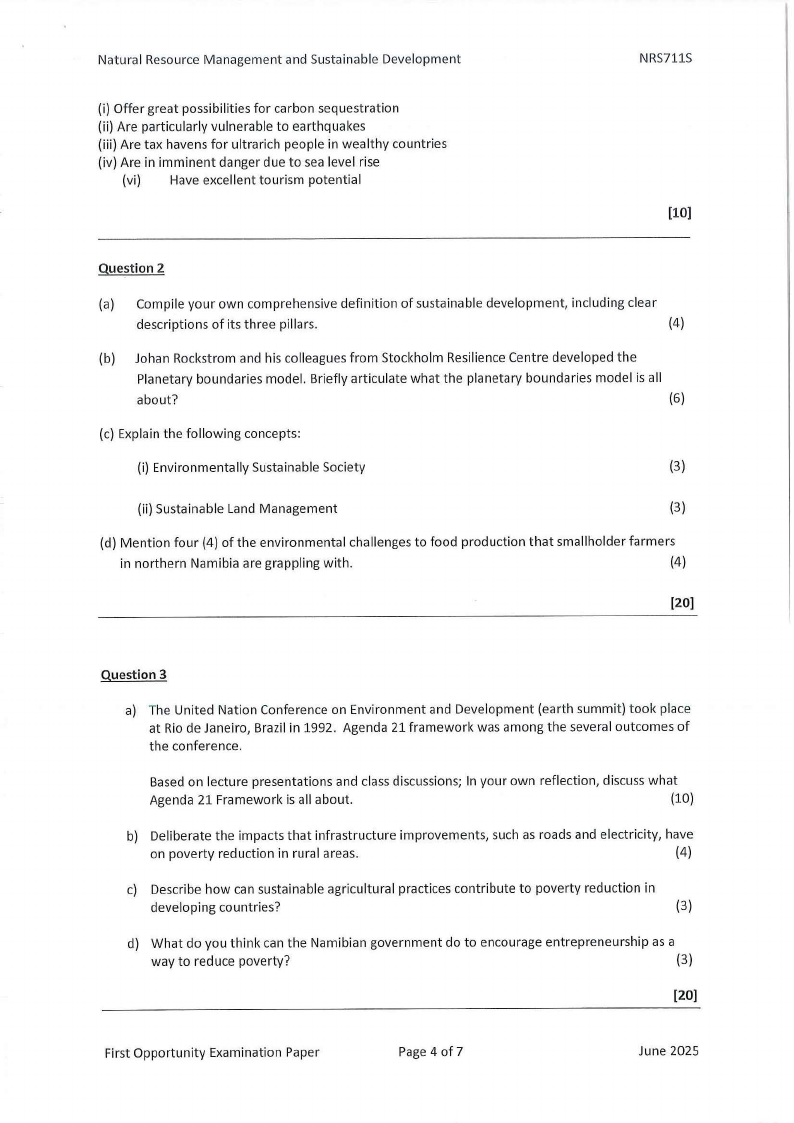
(i) Offer great possibilities for carbon sequestration
(ii) Are particularly vulnerable to earthquakes
(iii) Are tax havens for ultra rich people in wealthy countries
(iv) Are in imminent danger due to sea level rise
(vi) Have excellent tourism potential
NRS711S
[10]
Question 2
(a) Compile your own comprehensive definition of sustainable development, including clear
descriptions of its three pillars.
(4)
(b) Johan Rockstrom and his colleagues from Stockholm Resilience Centre developed the
Planetary boundaries model. Briefly articulate what the planetary boundaries model is all
about?
(6)
(c) Explain the following concepts:
(i) Environmentally Sustainable Society
(3)
(ii) Sustainable Land Management
(3)
(d) Mention four (4) of the environmental challenges to food production that smallholder farmers
in northern Namibia are grappling with.
(4)
[20]
Question 3
a) The United Nation Conference on Environment and Development (earth summit) took place
at Rio de Janeiro, Brazil in 1992. Agenda 21 framework was among the several outcomes of
the conference.
Basedon lecture presentations and class discussions; In your own reflection, discuss what
Agenda 21 Framework is all about.
(10)
b) Deliberate the impacts that infrastructure improvements, such as roads and electricity, have
on poverty reduction in rural areas.
(4)
c) Describe how can sustainable agricultural practices contribute to poverty reduction in
developing countries?
(3)
d) What do you think can the Namibian government do to encourage entrepreneurship as a
way to reduce poverty?
(3)
[20]
First Opportunity Examination Paper
Page4 of 7
June 2025
|
|
5 Page 5 |
▲back to top |
Natural Resource Management and Sustainable Development
NRS711S
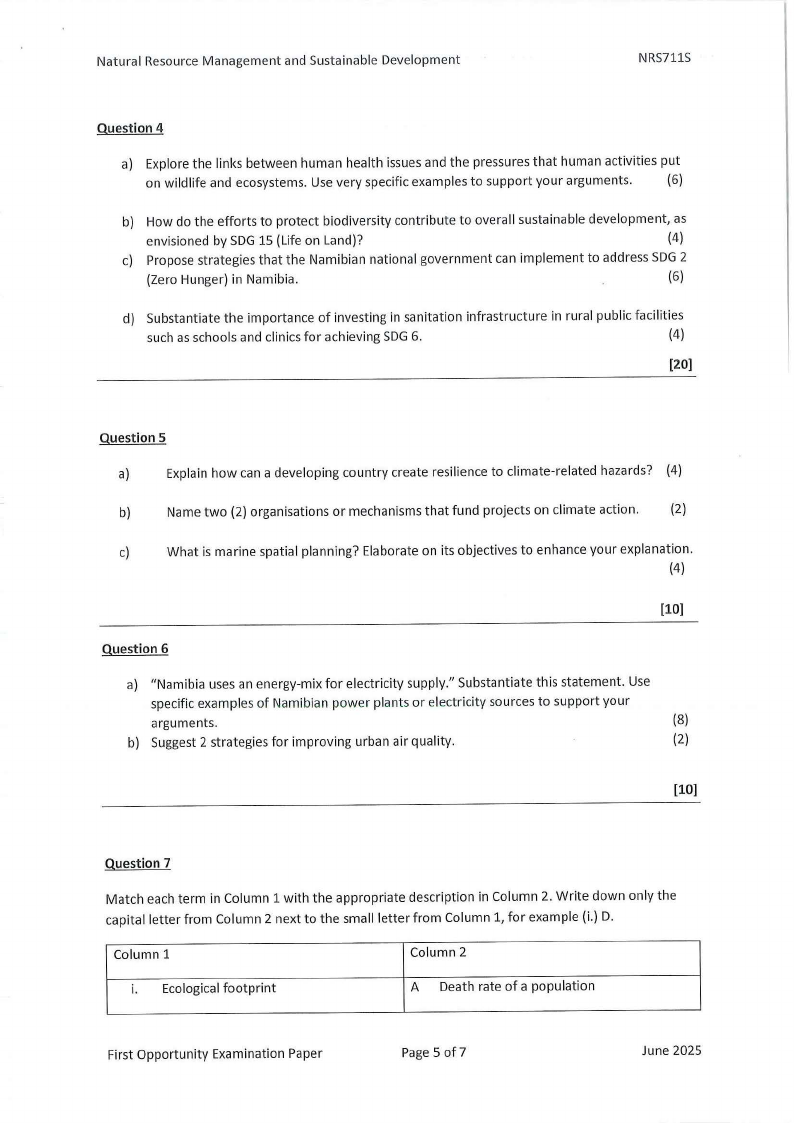
Question 4
a) Explore the links between human health issuesand the pressures that human activities put
on wildlife and ecosystems. Use very specific examples to support your arguments.
(6)
b) How do the efforts to protect biodiversity contribute to overall sustainable development, as
envisioned by SDG15 (Life on Land)?
(4)
c) Propose strategies that the Namibian national government can implement to address SDG2
(Zero Hunger) in Namibia.
(6)
d) Substantiate the importance of investing in sanitation infrastructure in rural public facilities
such as schools and clinics for achieving SDG6.
(4)
[20]
Question 5
a)
Explain how can a developing country create resilience to climate-related hazards? (4)
b)
Name two (2) organisations or mechanisms that fund projects on climate action.
(2)
c)
What is marine spatial planning? Elaborate on its objectives to enhance your explanation.
(4)
[10]
Question 6
a) "Namibia uses an energy-mix for electricity supply." Substantiate this statement. Use
specific examples of Namibian power plants or electricity sources to support your
arguments.
(8)
b) Suggest 2 strategies for improving urban air quality.
(2)
[10]
Question 7
Match each term in Column 1 with the appropriate description in Column 2. Write down only the
capital letter from Column 2 next to the small letter from Column 1, for example (i.) D.
Column 1
Column 2
i. Ecological footprint
A Death rate of a population
First Opportunity Examination Paper
Page 5 of 7
June 2025
|
|
6 Page 6 |
▲back to top |
Natural Resource Management and Sustainable Development
NRS711S
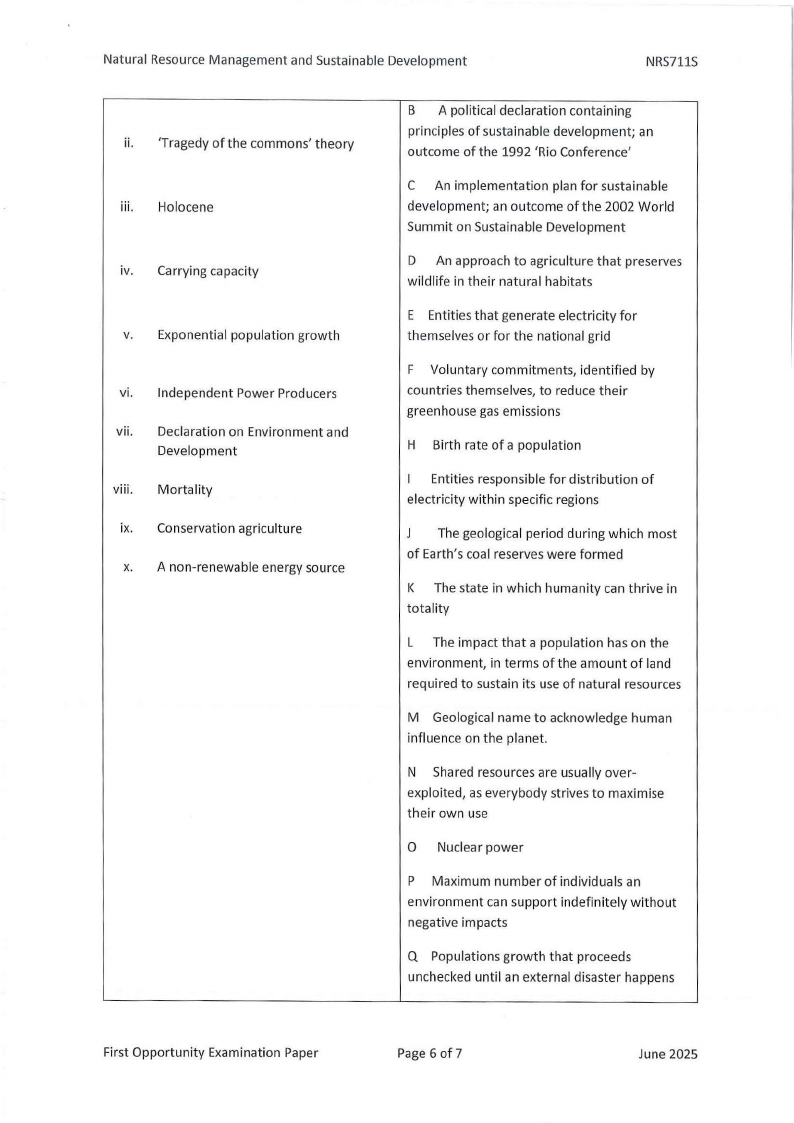
ii. 'Tragedy of the commons' theory
iii. Holocene
iv. Carrying capacity
V. Exponential population growth
vi. Independent Power Producers
vii. Declaration on Environment and
Development
viii. Mortality
ix. Conservation agriculture
x. A non-renewable energy source
B A political declaration containing
principles of sustainable development; an
outcome of the 1992 'Rio Conference'
C An implementation plan for sustainable
development; an outcome of the 2002 World
Summit on Sustainable Development
D An approach to agriculture that preserves
wildlife in their natural habitats
E Entities that generate electricity for
themselves or for the national grid
F Voluntary commitments, identified by
countries themselves, to reduce their
greenhouse gas emissions
H Birth rate of a population
Entities responsible for distribution of
electricity within specific regions
The geological period during which most
of Earth's coal reserves were formed
K The state in which humanity can thrive in
totality
L The impact that a population has on the
environment, in terms of the amount of land
required to sustain its use of natural resources
M Geological name to acknowledge human
influence on the planet.
N Shared resources are usually over-
exploited, as everybody strives to maximise
their own use
0 Nuclear power
P Maximum number of individuals an
environment can support indefinitely without
negative impacts
Q Populations growth that proceeds
unchecked until an external disaster happens
First Opportunity Examination Paper
Page 6 of 7
June 2025
|
|
7 Page 7 |
▲back to top |
Natural Resource Management and Sustainable Development
NRS711S
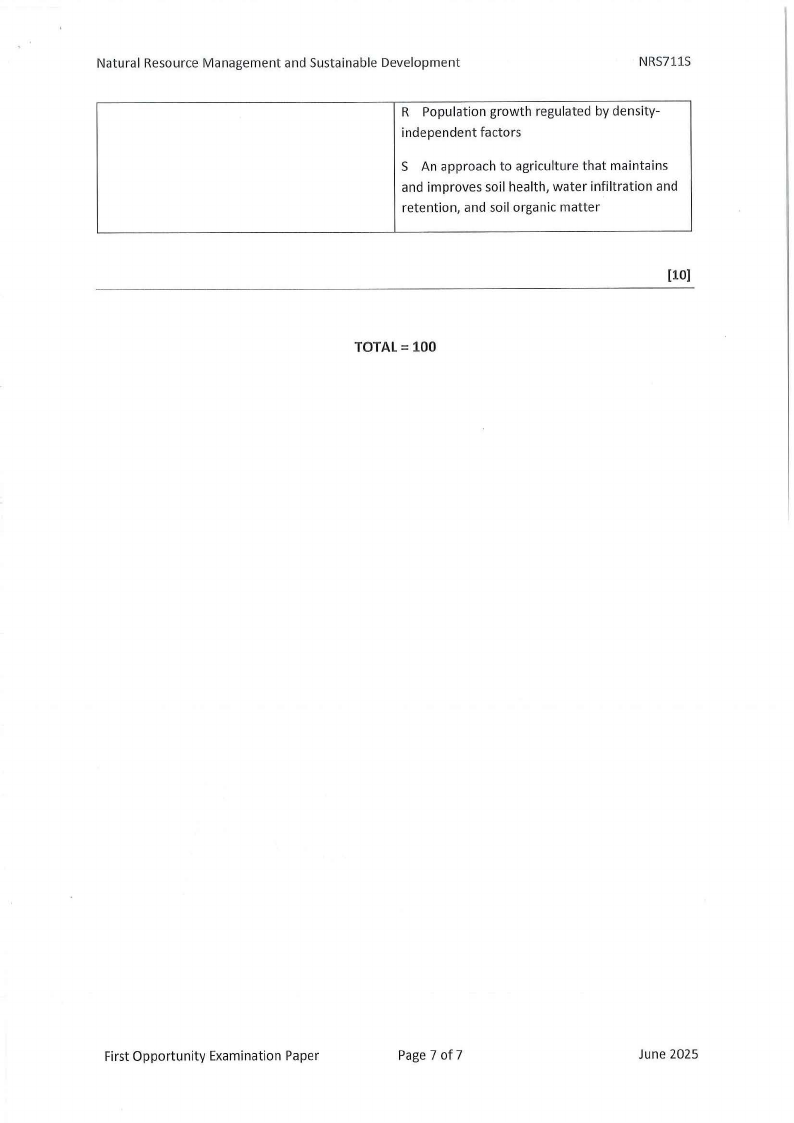
R Population growth regulated by density-
independent factors
S An approach to agriculture that maintains
and improves soil health, water infiltration and
retention, and soil organic matter
[10)
TOTAL= 100
First Opportunity Examination Paper
Page 7 of7
June 2025