


 |
DEC712S-DEVELOPMENT ECONOMICS-2ND OPP-DEC 2025 |
|
|
1 Page 1 |
▲back to top |
nAmlBIA UnlVERS I TY
OF SCIEnCE Ano TECH n □ LOGY
FACULTY OF COMMERCE, HUMAN SCIENCES AND EDUCATION
DEPARTMENT OF ECONOMICS, ACCOUNTING AND FINANCE
QUALIFICATION: BACHELOR OF ECONOMICS
QUALIFICATION CODE: 07BECO
LEVEL: 7
COURSE CODE: DEC712S
COURSE NAME: DEVELOPMENT ECONOMICS
SESSION: DECEMBER 2025
DURATION: 3 HOURS
PAPER: THEORY
MARKS: 100
SECOND OPPORTUNITY EXAMINATION PAPER
EXAMINER(S) MR. MALLY LIKUKELA
MODERATOR: DR RUTH EEGUNJOBI
INSTRUCTIONS
1. This paper consist of 4 sections
2. Answer ALL questions
3. Number your answers in accordance with the question paper.
4. Start each section answer on a new page
5. Write clearly and legibly
PERMISSIBLE MATERIALS
1. Pen
2. Ruler
3. Calculator
THIS PAPER CONSISTS OF 5 PAGES {Including this front page)
|
|
2 Page 2 |
▲back to top |
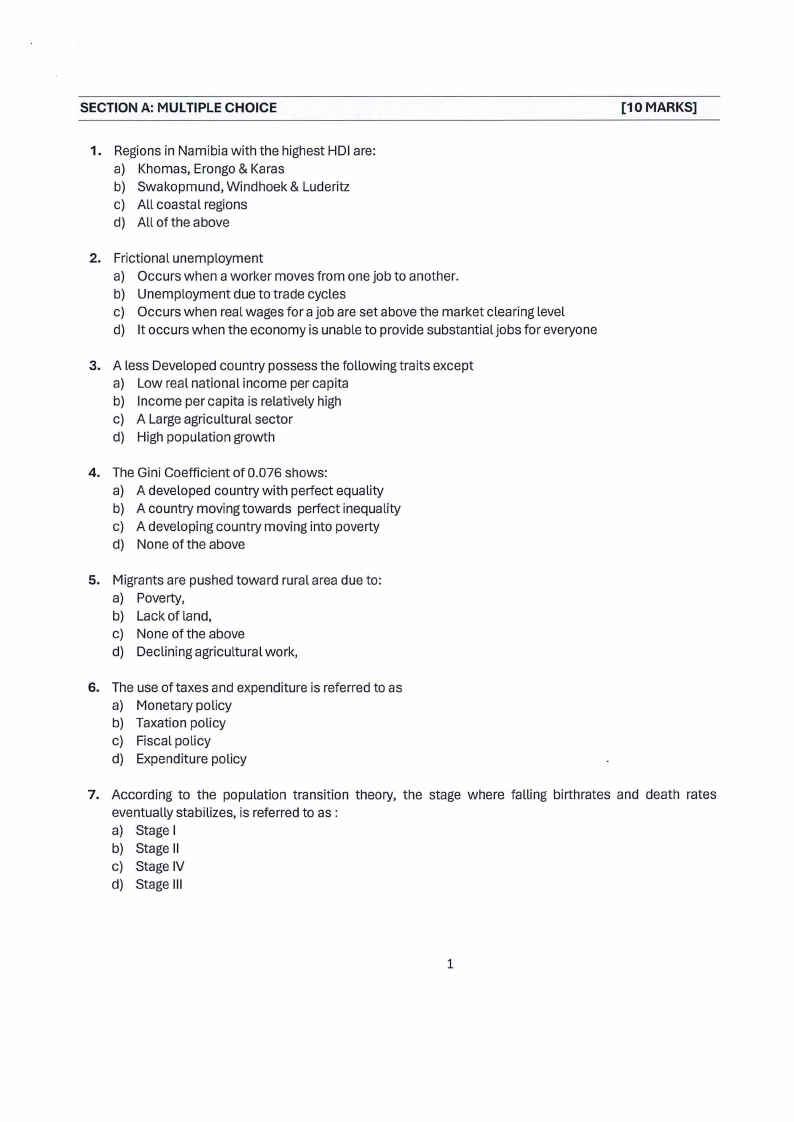
SECTION A: MULTIPLE CHOICE
[10 MARKS]
1. Regions in Namibia with the highest HDI are:
a) Khomas, Erongo & Karas
b) Swakopmund, Windhoek & Luderitz
c) All coastal regions
d) All of the above
2. Frictional unemployment
a) Occurs when a worker moves from one job to another.
b) Unemployment due to trade cycles
c) Occurs when real wages for a job are set above the market clearing level
d) It occurs when the economy is unable to provide substantial jobs for everyone
3. A less Developed country possess the following traits except
a) Low real national income per capita
b) Income per capita is relatively high
c) A Large agricultural sector
d) High population growth
4. The Gini Coefficient of 0.076 shows:
a) A developed country with perfect equality
b) A country moving towards perfect inequality
c) A developing country moving into poverty
d) None of the above
5. Migrants are pushed toward rural area due to:
a) Poverty,
b) Lack of land,
c) None of the above
d) Declining agricultural work,
6. The use of taxes and expenditure is referred to as
a) Monetary policy
b) Taxation policy
c) Fiscal policy
d) Expenditure policy
7. According to the population transition theory, the stage where falling birthrates and death rates
eventually stabilizes, is referred to as:
a) Stage I
b) Stage II
c) Stage IV
d) Stage Ill
1
|
|
3 Page 3 |
▲back to top |
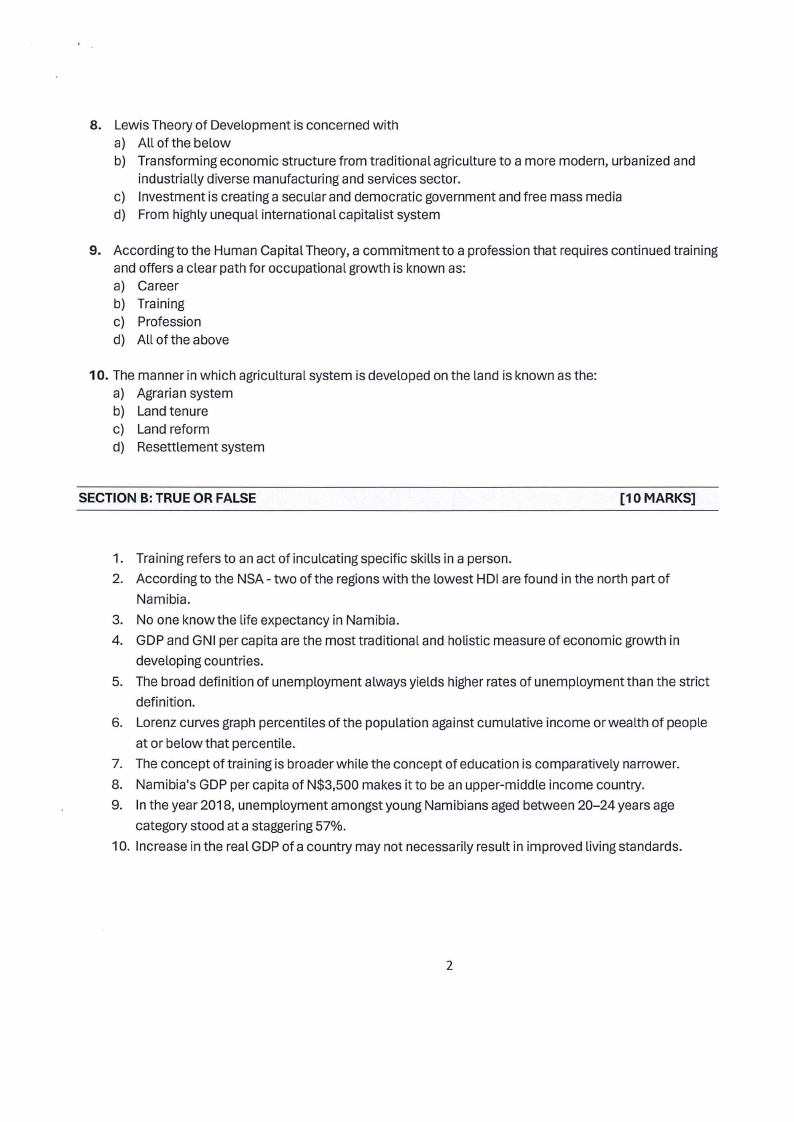
8. Lewis Theory of Development is concerned with
a) All of the below
b) Transforming economic structure from traditional agriculture to a more modern, urbanized and
industrially diverse manufacturing and services sector.
c) Investment is creating a secular and democratic government and free mass media
d) From highly unequal international capitalist system
9. According to the Human Capital Theory, a commitment to a profession that requires continued training
and offers a clear path for occupational growth is known as:
a) Career
b) Training
c) Profession
d) All of the above
1O. The manner in which agricultural system is developed on the land is known as the:
a) Agrarian system
b) Land tenure
c) Land reform
d) Resettlement system
SECTION B: TRUE OR FALSE
[10 MARKS]
1. Training refers to an act of inculcating specific skills in a person.
2. According to the NSA - two of the regions with the lowest HDI are found in the north part of
Namibia.
3. No one know the life expectancy in Namibia.
4. GDP and GNI per capita are the most traditional and holistic measure of economic growth in
developing countries.
5. The broad definition of unemployment always yields higher rates of unemployment than the strict
definition.
6. Lorenz curves graph percentiles of the population against cumulative income or wealth of people
at or below that percentile.
7. The concept of training is broader while the concept of education is comparatively narrower.
8. Namibia's GDP per capita of N$3,500 makes it to be an upper-middle income country.
9. In the year 2018, unemployment amongst young Namibians aged between 20-24 years age
category stood at a staggering 57%.
10. Increase in the real GDP of a country may not necessarily result in improved living standards.
2
|
|
4 Page 4 |
▲back to top |
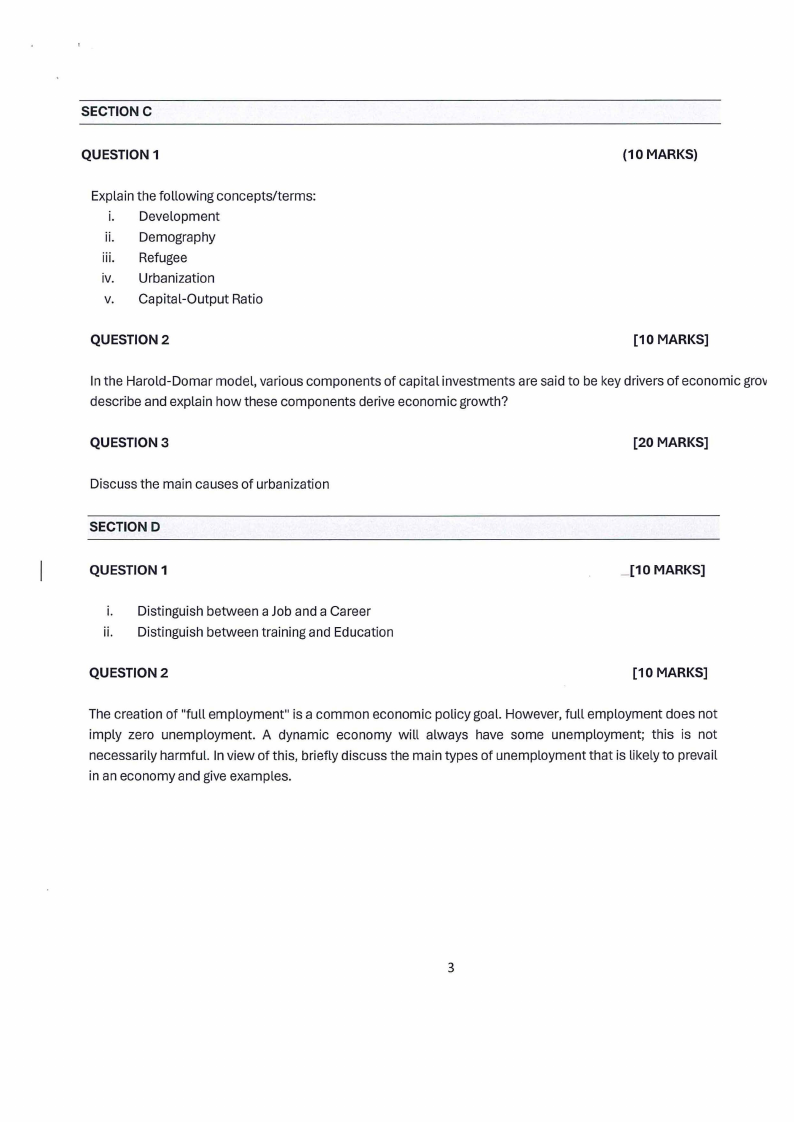
SECTIONC
QUESTION 1
(10 MARKS)
Explain the following concepts/terms:
i. Development
ii. Demography
iii. Refugee
iv. Urbanization
v. Capital-Output Ratio
QUESTION2
[10 MARKS]
In the Harold-Damar model, various components of capital investments are said to be key drivers of economic gro\\i
describe and explain how these components derive economic growth?
QUESTION3
[20 MARKS]
Discuss the main causes of urbanization
SECTION D
QUESTION 1
_ [10 MARKS]
i. Distinguish between a Job and a Career
ii. Distinguish between training and Education
QUESTION2
[10 MARKS]
The creation of "full employment" is a common economic policy goal. However, full employment does not
imply zero unemployment. A dynamic economy will always have some unemployment; this is not
necessarily harmful. In view of this, briefly discuss the main types of unemployment that is likely to prevail
in an economy and give examples.
3
|
|
5 Page 5 |
▲back to top |
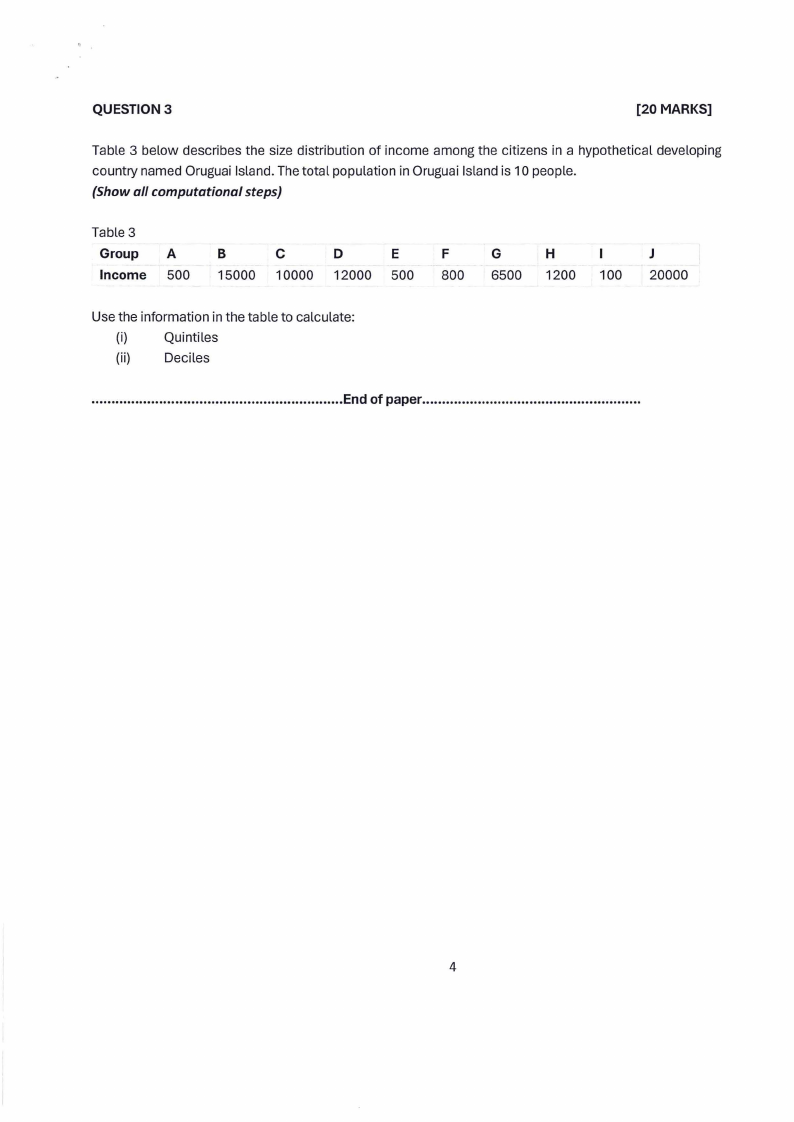
QUESTION 3
[20 MARKS]
Table 3 below describes the size distribution of income among the citizens in a hypothetical developing
country named Oruguai Island. The total population in Oruguai Island is 1Opeople.
(Show all computational steps)
Table 3
Group A
B
C
D
E
F
G
H
J
Income 500 15000 10000 12000 500 800 6500 1200 100 20000
Use the information in the table to calculate:
(i)
Quintiles
(ii)
Deciles
...............................................................End of paper.......................................................
4