


 |
DEC712S-DEVELOPMENT ECONOMICS-1ST OPP-NOV 2025 |
|
|
1 Page 1 |
▲back to top |
nAmlBIA UnlVERSITY
OF SCIEnCE A n □ TECH nOLOG Y
FACULTY OF COMMERCE, HUMAN SCIENCES AND EDUCATION
DEPARTMENT OF ECONOMICS, ACCOUNTING AND FINANCE
QUALIFICATION: BACHELOR OF ECONOMICS
QUALIFICATION CODE: 07BECO
LEVEL: 7
COURSE CODE: DEC712S
COURSE NAME: DEVELOPMENT ECONOMICS
SESSION: NOVEMBER 2025
DURATION: 3 HOURS
PAPER: THEORY
MARKS: 100
EXAMINER(S)
FIRST OPPORTUNITY EXAMINATION PAPER
MR. MALLY LIKUKELA
MODERATOR: DR RUTH EEGUNJOBI
INSTRUCTIONS
1. This paper consist of 4 sections
2. Answer ALL questions
3. Number your answers in accordance with the question paper.
4. Start each section answer on a new page
5. Write clearly and legibly
PERMISSIBLE MATERIALS
1. Pen
2. Ruler
3. Calculator
THIS PAPER CONSISTS OF 5. PAGES (Including this front page)
|
|
2 Page 2 |
▲back to top |
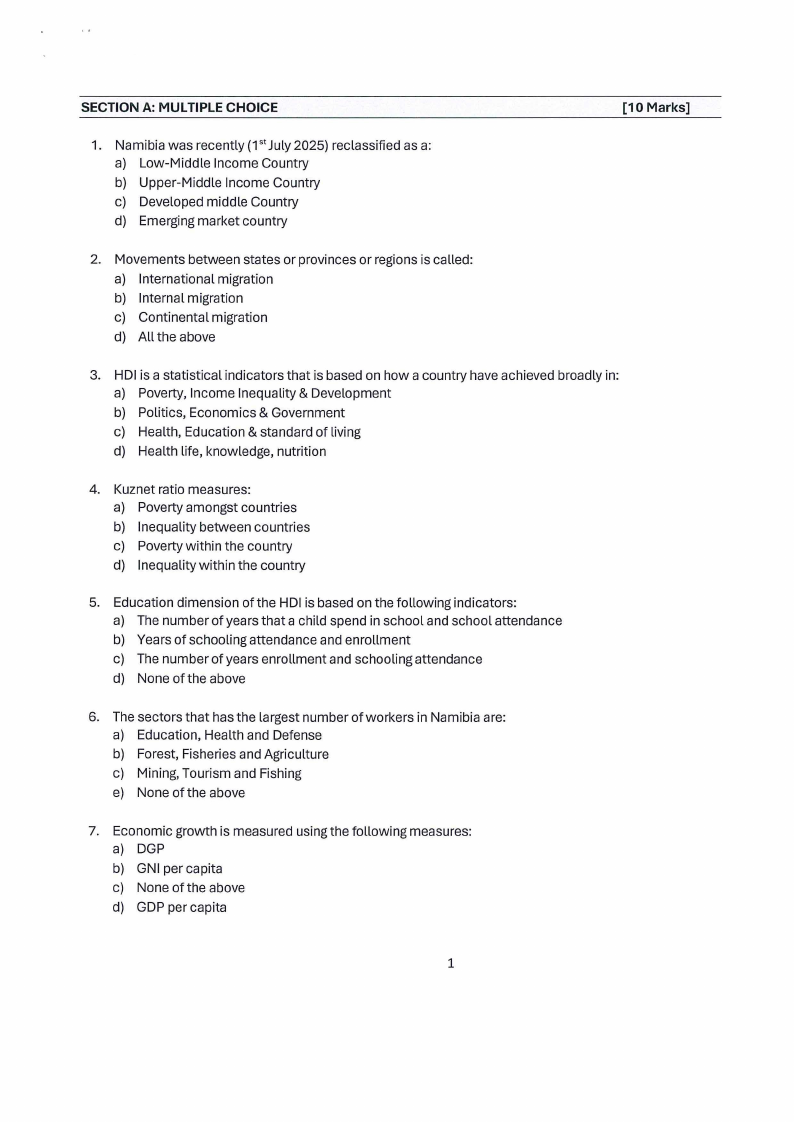
SECTION A: MULTIPLE CHOICE
[10 Marks]
1. Namibia was recently (1 st July 2025) reclassified as a:
a) Low-Middle Income Country
b) Upper-Middle Income Country
c) Developed middle Country
d) Emerging market country
2. Movements between states or provinces or regions is called:
a) International migration
b) Internal migration
c) Continental migration
d) All the above
3. HDI is a statistical indicators that is based on how a country have achieved broadly in:
a) Poverty, Income Inequality & Development
b) Politics, Economics & Government
c) Health, Education & standard of living
d) Health life, knowledge, nutrition
4. Kuznet ratio measures:
a) Poverty amongst countries
b) Inequality between countries
c) Poverty within the country
d) Inequality within the country
5. Education dimension of the HDI is based on the following indicators:
a) The number of years that a child spend in school and school attendance
b) Years of schooling attendance and enrollment
c) The number of years enrollment and schooling attendance
d) None of the above
6. The sectors that has the largest number of workers in Namibia are:
a) Education, Health and Defense
b) Forest, Fisheries and Agriculture
c) Mining, Tourism and Fishing
e) None of the above
7. Economic growth is measured using the following measures:
a) DGP
b) GNI per capita
c) None of the above
d) GDP per capita
1
|
|
3 Page 3 |
▲back to top |
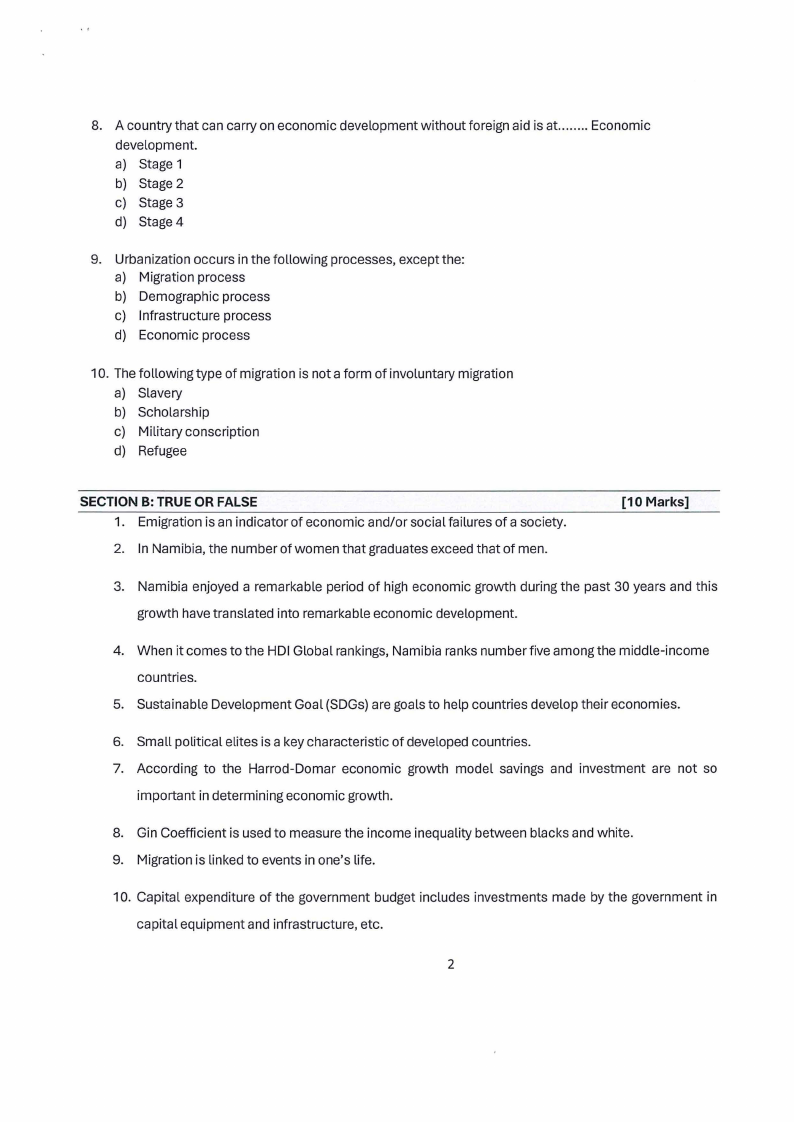
8. A country that can carry on economic development without foreign aid is at.. ... ... Economic
development.
a) Stage 1
b) Stage 2
c) Stage 3
d) Stage 4
9. Urbanization occurs in the following processes, except the:
a) Migration process
b) Demographic process
c) Infrastructure process
d) Economic process
10. The following type of migration is not a form of involuntary migration
a) Slavery
b) Scholarship
c) Military conscription
d) Refugee
SECTION B: TRUE OR FALSE
1. Emigration is an indicator of economic and/or social failures of a society.
2. In Namibia , the number of women that graduates exceed that of men.
[10 Marks]
3. Namibia enjoyed a remarkable period of high economic growth during the past 30 years and this
growth have translated into remarkable economic development.
4. When it comes to the HDI Global rankings, Namibia ranks number five among the middle-income
countries.
5. Sustainable Development Goal (SDGs) are goals to help countries develop their economies.
6. Small political elites is a key characteristic of developed countries.
7. According to the Harrod-Damar economic growth model savings and investment are not so
important in determining economic growth.
8. Gin Coefficient is used to measure the income inequality between blacks and white.
9. Migration is linked to events in one's life.
10. Capital expenditure of the government budget includes investments made by the government in
capital equipment and infrastructure, etc.
2
|
|
4 Page 4 |
▲back to top |
SECTIONC:
QUESTION 1
Explain the following technical terms:
(i)
Kuznets hypothesis
(ii)
Stabilization policy
(iii) Malthusian Theory of Population
(iv) Gini coefficient
(v) The cost of borrowing
[10 MARKS]
QUESTION 2
[20 MARKS]
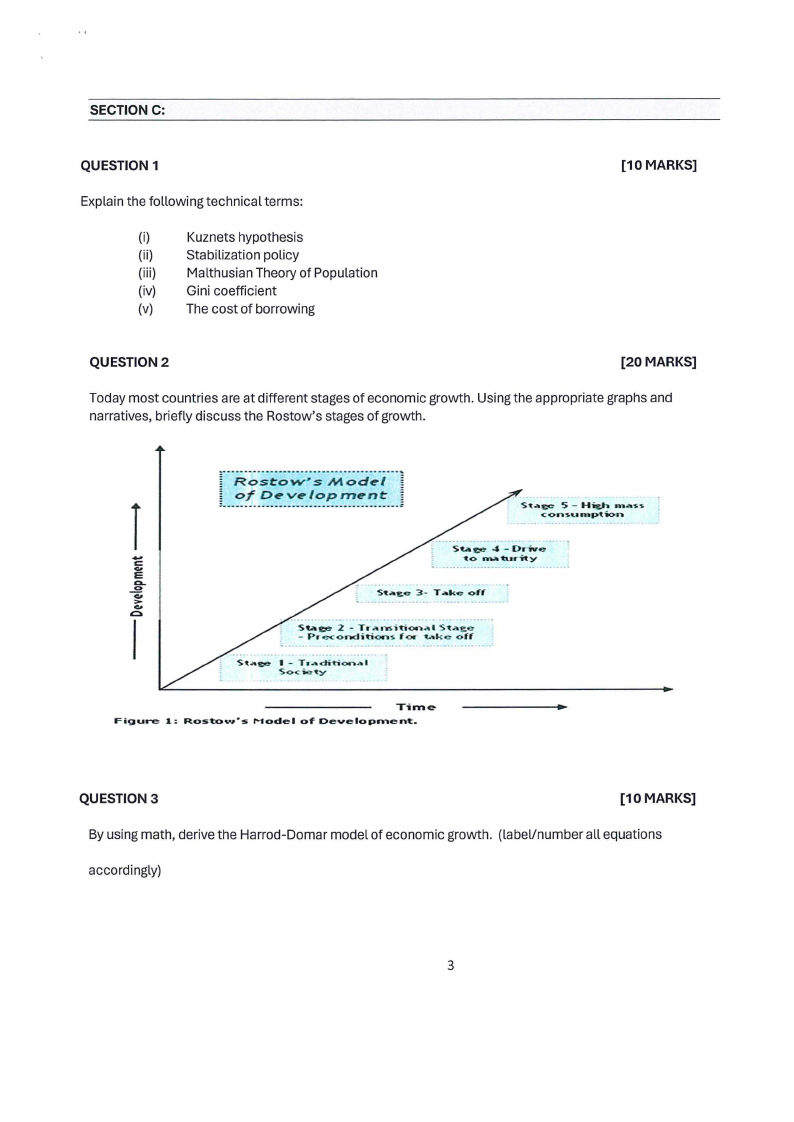
Today most countries are at different stages of economic growth. Using the appropriate graphs and
narratives, briefly discuss the Rostow's stages of growth.
----- --- --·------------ -- --- --- -- --- --- -....
~ RosrollV, S Modf!!'I ~
~ of Develop menr ~
i-.C..:
: ---- --------- -- ........... --- -- -------- ... -- -- -:
s,ace 5 - H~h m,.ss
consun,p1.ion
..
5'-"ee 4 - Drive
,o n'°'b.>.-Tty
E
a..
...cC:>;
>
s,a~e 3 - T Ake off
.;,, . ··-- . . -- ..
Clo
I
S'-"ee 2 - T, an,sitio.-. al S ,ag.e-
- Pr c< ondition s f o■ v.ke- o ff
I - T,,.dition,.I
Sociefy
Time
Figure 1: Rosto,v•s l'-todel of Deve.lopment.
QUESTION3
[10 MARKS]
By using math, derive the Harrod-Damar model of economic growth. (label/number all equations
accordingly)
3
|
|
5 Page 5 |
▲back to top |
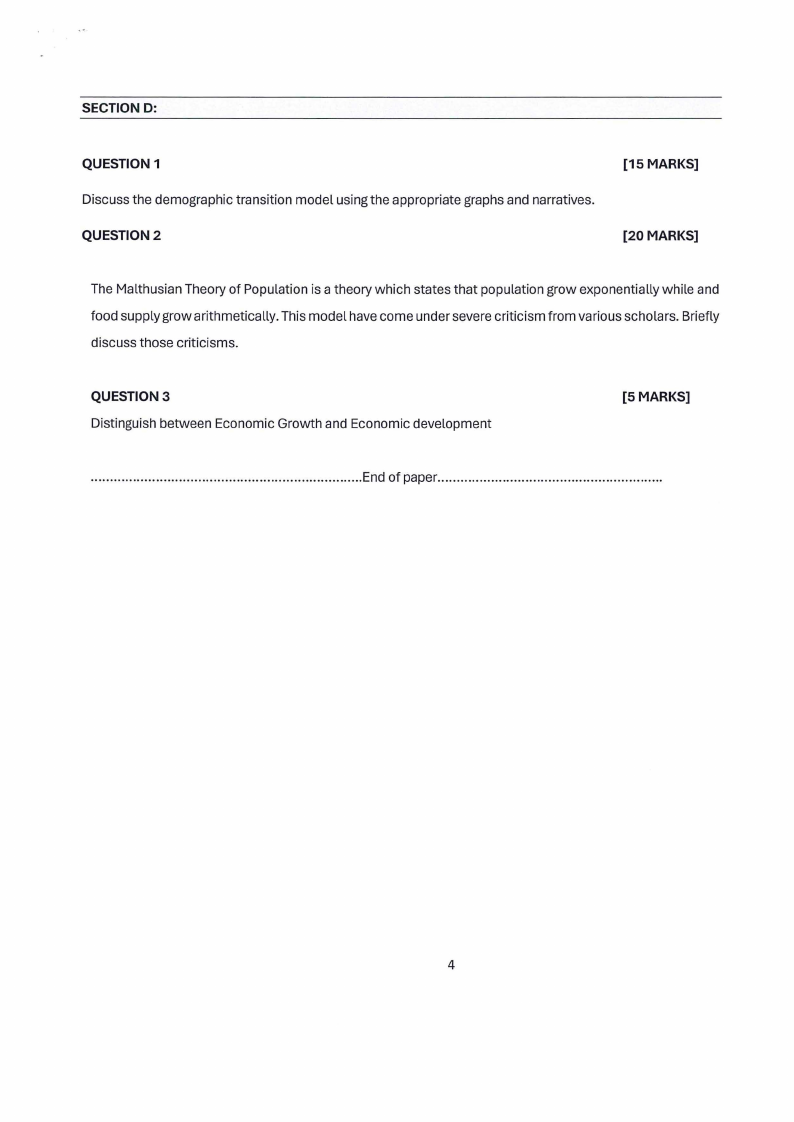
SECTION D:
QUESTION 1
[15 MARKS]
Discuss the demographic transition model using the appropriate graphs and narratives.
QUESTION2
[20 MARKS]
The Malthusian Theory of Population is a theory which states that population grow exponentially while and
food supply grow arithmetically. This model have come under severe criticism from various scholars. Briefly
discuss those criticisms.
QUESTION 3
Distinguish between Economic Growth and Economic development
[5 MARKS]
..... ...... ... ............... .. ................ ........ ................End of paper............................ ....... .. .... ..... ....... ... ...
4