


 |
GDG621S - GEODEMOGRAPHICS - 1ST OPP - JUNE 2025 |
|
|
1 Page 1 |
▲back to top |
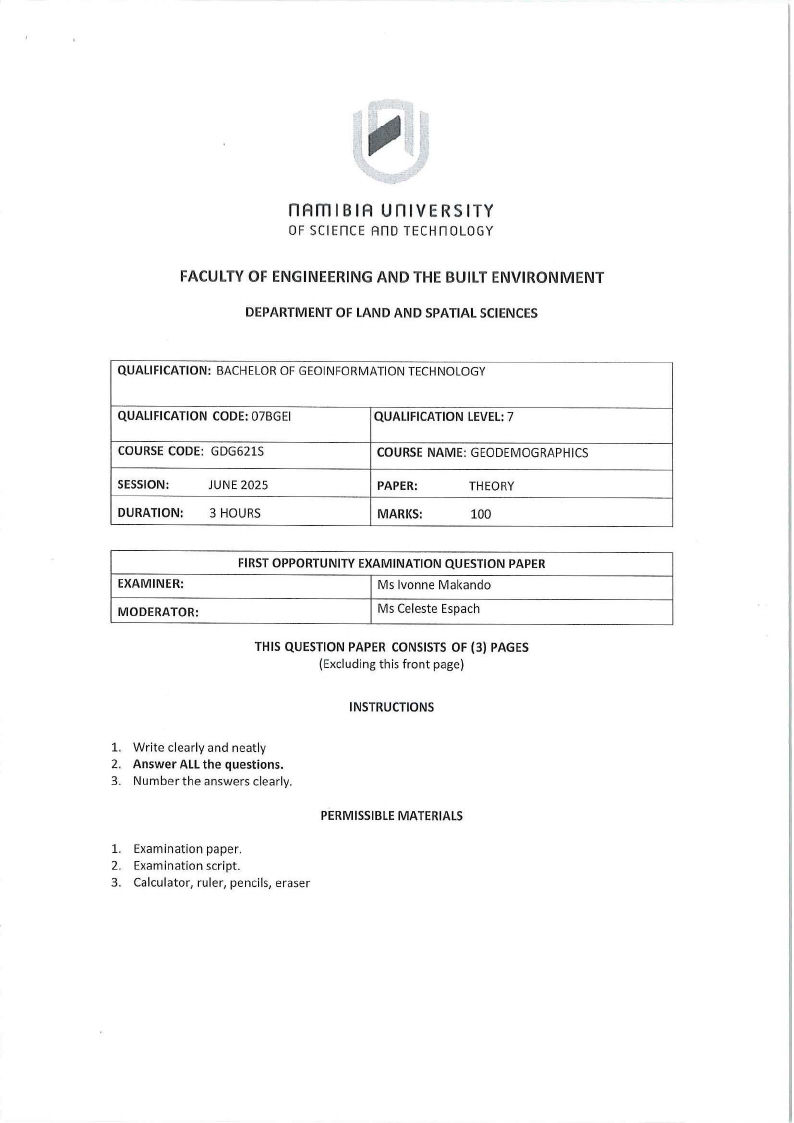
n Am I BI A u n IVER s I TY
OF SCIEnCE Ano TECHnOLOGY
FACULTYOF ENGINEERINGAND THE BUILTENVIRONMENT
DEPARTMENTOF LANDAND SPATIALSCIENCES
QUALIFICATION: BACHELOROF GEOINFORMATIONTECHNOLOGY
QUALIFICATION CODE:07BGEI
COURSECODE: GDG621S
SESSION:
DURATION:
JUNE 2025
3 HOURS
QUALIFICATIONLEVEL:7
COURSENAME: GEODEMOGRAPHICS
PAPER:
MARKS:
THEORY
100
EXAMINER:
MODERATOR:
FIRSTOPPORTUNITYEXAMINATION QUESTION PAPER
Ms Ivonne Makando
Ms Celeste Espach
THIS QUESTION PAPER CONSISTSOF (3) PAGES
(Excluding this front page)
INSTRUCTIONS
1. Write clearly and neatly
2. Answer ALLthe questions.
3. Number the answers clearly.
PERMISSIBLEMATERIALS
1. Examination paper.
2. Examination script.
3. Calculator, ruler, pencils, eraser
|
|
2 Page 2 |
▲back to top |
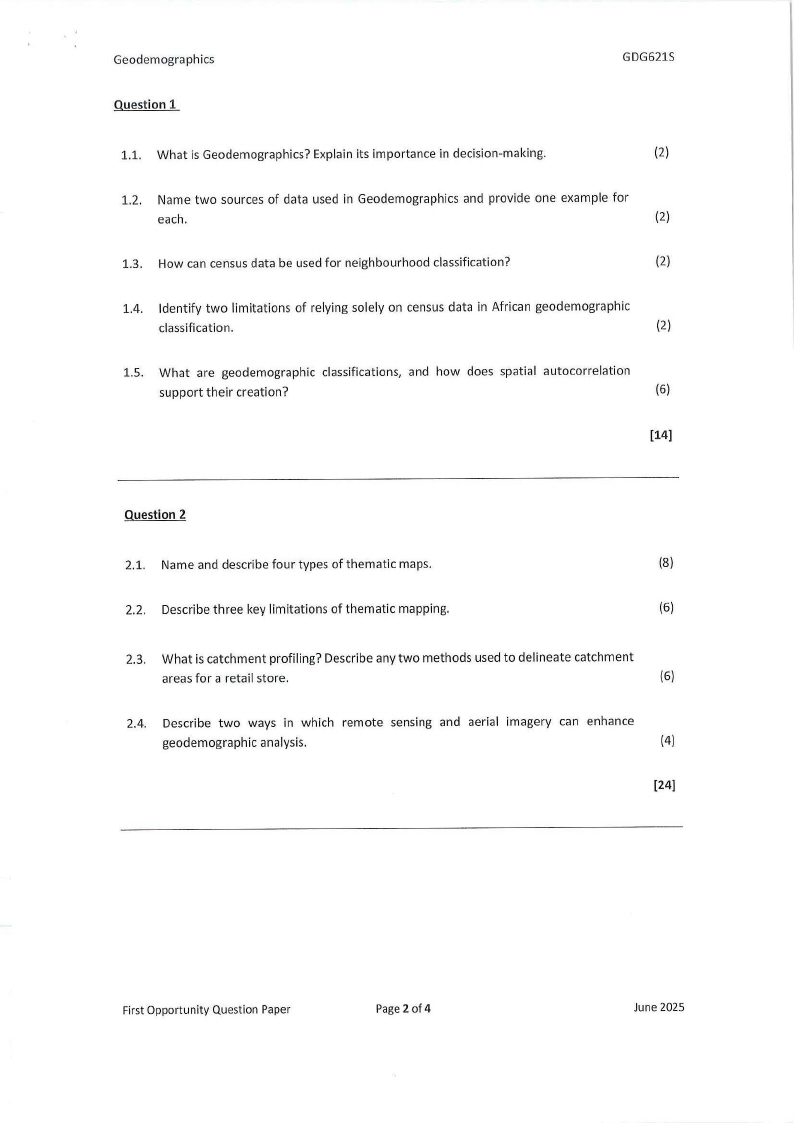
Geodemographics
GDG621S
Question 1
1.1. What is Geodemographics? Explain its importance in decision-making.
(2)
1.2. Name two sources of data used in Geodemographics and provide one example for
each.
(2)
1.3. How can census data be used for neighbourhood classification?
(2)
1.4. Identify two limitations of relying solely on census data in African geodemographic
classification.
(2)
1.5. What are geodemographic classifications, and how does spatial autocorrelation
support their creation?
(6)
[14]
Question2
2.1. Name and describe four types of thematic maps.
(8)
2.2. Describe three key limitations of thematic mapping.
(6)
2.3. What is catchment profiling? Describe any two methods used to delineate catchment
areas for a retail store.
(6)
2.4. Describe two ways in which remote sensing and aerial imagery can enhance
geodemographic analysis.
(4)
[24]
First Opportunity Question Paper
Page 2 of 4
June 2025
|
|
3 Page 3 |
▲back to top |
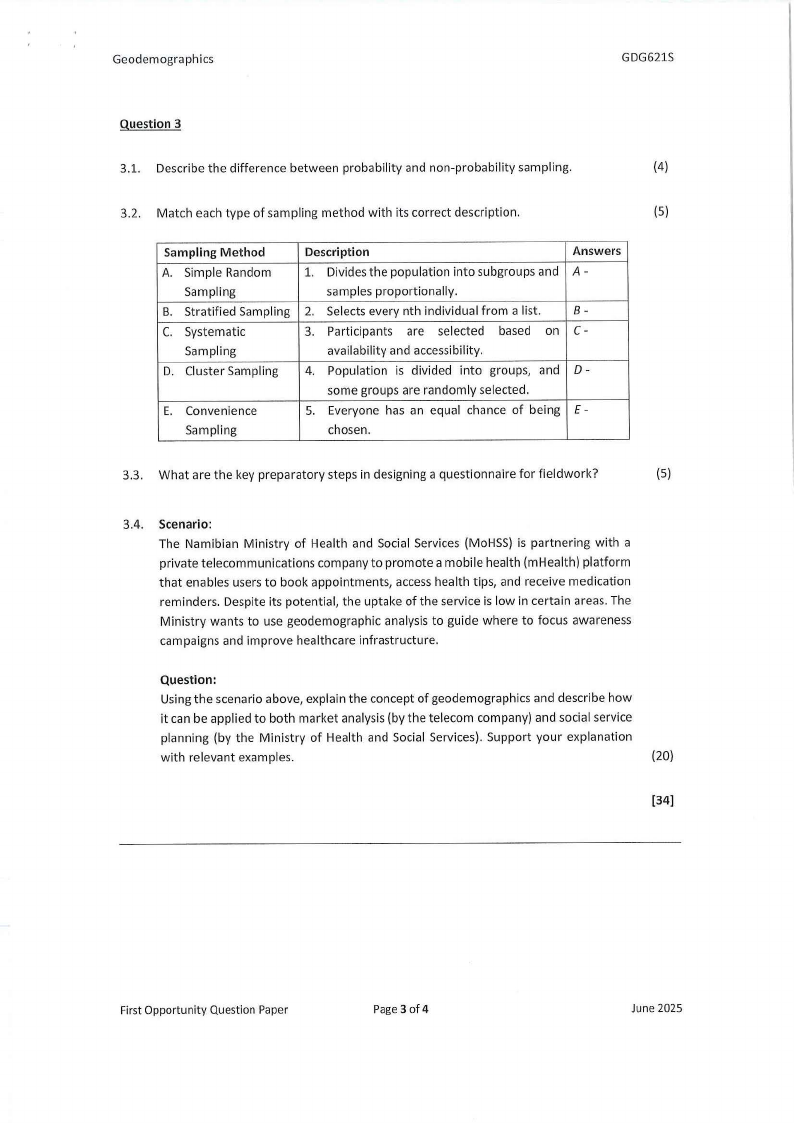
Geodemographics
GDG621S
Question 3
3.1. Describe the difference between probability and non-probability sampling.
(4)
3.2. Match each type of sampling method with its correct description.
(5)
Sampling Method
A. Simple Random
Sampling
B. Stratified Sampling
C. Systematic
Sampling
D. Cluster Sampling
E. Convenience
Sampling
Description
1. Divides the population into subgroups and
samples proportionally.
2. Selects every nth individual from a list.
3. Participants are selected based on
availability and accessibility.
4. Population is divided into groups, and
some groups are randomly selected.
5. Everyone has an equal chance of being
chosen.
Answers
A-
8-
C-
D-
E-
3.3. What are the key preparatory steps in designing a questionnaire for fieldwork?
(5)
3.4. Scenario:
The Namibian Ministry of Health and Social Services (MoHSS) is partnering with a
private telecommunications company to promote a mobile health (mHealth) platform
that enables users to book appointments, access health tips, and receive medication
reminders. Despite its potential, the uptake of the service is low in certain areas. The
Ministry wants to use geodemographic analysis to guide where to focus awareness
campaigns and improve healthcare infrastructure.
Question:
Using the scenario above, explain the concept of geodemographics and describe how
it can be applied to both market analysis (by the telecom company) and social service
planning (by the Ministry of Health and Social Services). Support your explanation
with relevant examples.
(20)
[34)
First Opportunity Question Paper
Page 3 of 4
June 2025
|
|
4 Page 4 |
▲back to top |
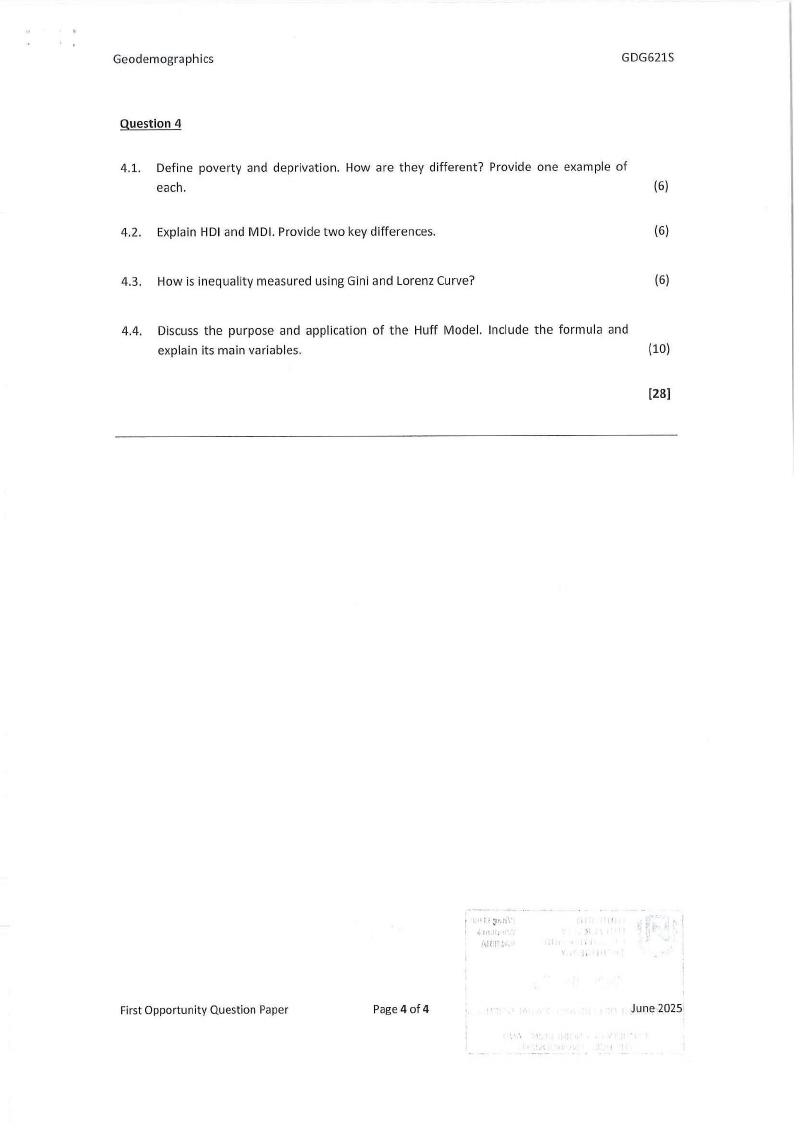
Geodemographics
GDG621S
Question 4
4.1. Define poverty and deprivation. How are they different? Provide one example of
each.
(6)
4.2. Explain HDI and MDI. Provide two key differences.
(6)
4.3. How is inequality measured using Gini and Lorenz Curve?
(6)
4.4. Discuss the purpose and application of the Huff Model. Include the formula and
explain its main variables.
(10)
[28]
First Opportunity Question Paper
Page4 of 4
<:
June 2025